

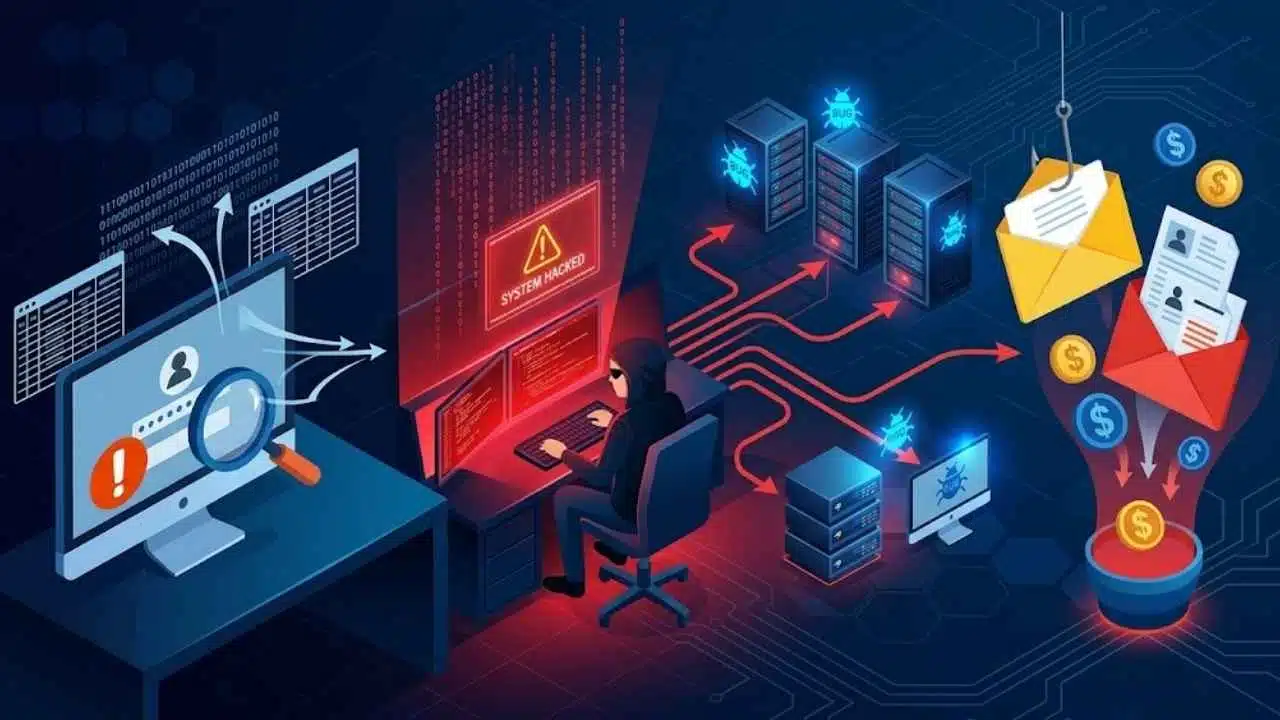
How data breaches happen starts with dismantling a common myth: attackers rarely breach networks overnight with dramatic single-event hacks. Instead, modern cyberattacks are multi-stage operations that begin quietly—often using a stolen credential, an unpatched perimeter system, or an overly permissive vendor account.
Initial access is merely step one. A minor foothold transforms into a costly breach when attackers establish persistence, escalate privileges, move laterally across internal networks, and stage sensitive files for exfiltration.
By analyzing the full cyber kill chain—from early reconnaissance to final data theft—security leaders can identify structural weaknesses, enforce Zero Trust controls, and stop intrusions long before critical business data leaves the environment.
A Security Incident Is Not Automatically a Data Breach
The terms are often used as if they mean the same thing. They do not. A blocked phishing attempt or malware stopped before execution can be a security event without confirmed data exposure. A breach generally involves unauthorized access to, acquisition of or disclosure of protected information, although legal definitions vary.
The distinction matters. Malware on one laptop does not prove that customer data was stolen. The absence of ransomware proves little either; an attacker may quietly access files and leave without disrupting a system.
Accidental disclosure also counts under many data-protection rules. Exposed cloud storage or sensitive records sent to the wrong recipient can create a personal data breach without a malicious intruder. Response plans need to cover both.
How Data Breaches Happen, Stage by Stage
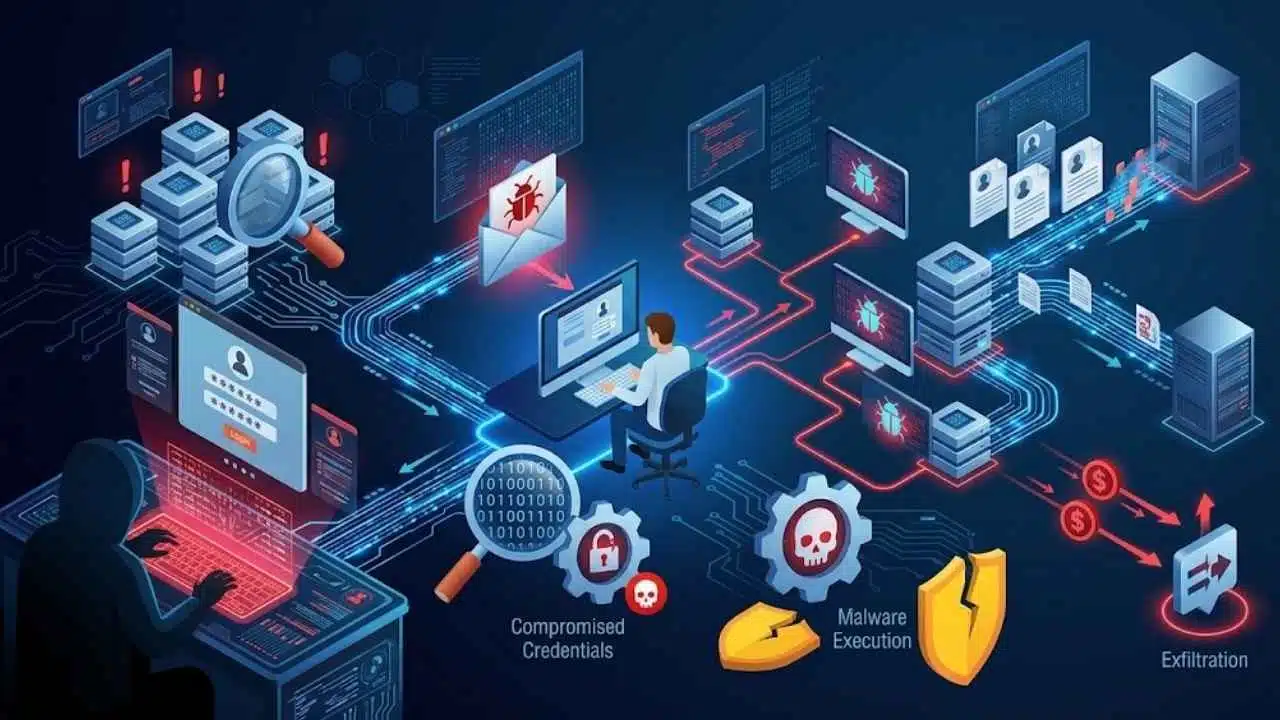
MITRE ATT&CK separates enterprise adversary behavior into tactical goals including reconnaissance, initial access, persistence, credential access, discovery, lateral movement, collection, exfiltration and impact. The seven stages below group those behaviors into a practical sequence that business and technical teams can follow.
1. Reconnaissance Finds the Easiest Door
Attackers begin with what the organization exposes. Employee profiles, leaked credentials and supplier relationships provide context, while internet scanning finds VPN gateways and remote-management interfaces.
This phase is not always targeted. Criminal groups can scan for a known vulnerability and investigate the organizations that respond. An obscure appliance may offer privileged access while receiving less attention than a public website.
Forgotten development systems, acquired subsidiaries and vendor-managed devices may sit outside the normal patching process. Attackers do not care whether an asset appears on the official diagram.
2. Initial Access Turns Exposure Into a Foothold
The working route may be stolen credentials, social engineering, a malicious attachment, an exposed application or trusted third-party access.
Software flaws deserve particular attention. Verizon’s 2026 Data Breach Investigations Report found vulnerability exploitation at the start of 31% of the breaches in its dataset, overtaking stolen credentials as the leading entry point for the first time in the report’s history. That percentage describes Verizon’s studied incidents, not every breach worldwide, but it reinforces the risk around exposed gateways and appliances.
Valid credentials and an approved VPN client create fewer warning signs than noisy malware. Teams need to recognize unusual devices, locations, times and access patterns in authentication logs.
3. Persistence Keeps the Door Open
One stolen session is fragile, so attackers try to preserve access before a password reset or patch closes the original route. Persistence can involve a new account, authentication method, web shell, cloud role or remote-management tool. Some methods abuse legitimate administration features.
Resetting one password may close the first route while leaving an attacker-controlled account, token, API key or application consent in place. Responders need to identify every access mechanism connected to the compromised identity or system.
4. Credential Theft and Privilege Escalation Expand Control
The first account may reach only one mailbox or workstation. To access valuable data, the attacker looks for passwords, tokens, service-account secrets and higher permissions.
Administrative rights are especially dangerous in routine work. A compromised endpoint becomes far more valuable when its user can manage servers or cloud services. Shared accounts and long-lived credentials create similar problems.
Multifactor authentication reduces account-takeover risk, but codes and push approvals can still be phished. A stolen session may not request the second factor again. CISA recommends phishing-resistant methods such as FIDO/WebAuthn for privileged and remote access.
5. Discovery and Lateral Movement Reveal the Real Target
Directory services, network shares, cloud consoles and internal documentation provide the map: users, devices, databases and security controls. Lateral movement may lead from a laptop to a file server, a contractor account to a cloud application, or a subsidiary into a shared environment.
Segmentation alone is not enough. If one privileged identity crosses every boundary, the walls exist mostly on a diagram. Distinct administrative accounts and limited trust relationships matter just as much.
A marketing account querying directory groups or a workstation connecting to many servers should look unusual even when each action uses a legitimate feature.
6. Collection and Exfiltration Deepen the Breach
Unauthorized access may already constitute a breach even if no files leave. Collection and exfiltration increase the scope and likely harm. Selected files may be gathered in a staging location, compressed and moved outside the organization; copying everything at once attracts attention.
Targets include customer records, health data, intellectual property and employee files. Exfiltration can pass through encrypted web traffic or approved cloud services. CISA identifies Rclone, Rsync and web storage among the methods used to move data.
Blocking every transfer utility may interrupt legitimate work, while unrestricted outbound movement leaves a path for theft. Useful controls focus on unusual volume, new destinations, bulk downloads and staging archives.
Encryption at rest helps when storage media or snapshots are exposed, but it does not automatically protect data from an attacker using an authorized application or compromised account that can decrypt it.
7. Impact, Extortion and Cleanup Increase the Damage
Data theft may be the objective or a step before disruption. Ransomware operators can combine exfiltration with encryption, preserving the threat of disclosure even when backups work. Others delete systems, manipulate records or use stolen information for fraud.
Before creating visible damage, attackers may disable security tools, delete logs and compromise backups. A backup controlled through the same identities as production can disappear with production.
Recovery requires a trusted environment, removed persistence, rotated credentials and evidence that the attacker cannot return. CISA recommends protected backups and restoration testing. Successful backup jobs do not prove that critical services can recover under pressure.
A Plausible Breach Sequence
Consider a hypothetical company with an exposed file-transfer appliance whose patching owner is unclear. An attacker exploits a known flaw, installs a web shell and captures a service credential. Internal documentation reveals cloud project names and an administrative process. The attacker compromises a more privileged account, stages selected customer files and transfers the archive to external storage.
Ransomware deployed afterward becomes the first visible alert, but the data breach occurred earlier. Restoring servers will not show which files left, which credentials remain exposed or whether notification duties have begun.
This is illustrative, not a report of one company. Its value is the control chain: asset ownership, patching, credential storage, access boundaries, logging and recovery all influence the impact.
Why Attackers Get Further Than the Initial Compromise
Security programs often spend heavily on preventing entry and less on limiting what happens afterward. One missed patch or successful login then carries too much consequence.
Several ordinary conditions turn a foothold into a breach:
- Privileged access granted broadly or left active after roles change
- Internet-facing assets without clear owners
- Service credentials that are old, shared or stored insecurely
- Security logs collected without alerts or enough retention for investigation
- Suppliers connected to sensitive systems without strong authentication or periodic access review
- Backups that have never been restored at the scale the business would actually need
Verizon’s 2026 DBIR found third-party involvement in 48% of the breaches it examined. An annual questionnaire is not enough; vendor access needs an owner, a business reason, periodic review and proportionate monitoring.
The Regulatory Clock May Start Before the Investigation Ends
Technical teams want complete evidence. Regulatory timelines may begin while facts remain incomplete. Under the EU GDPR, a controller must notify the relevant supervisory authority without undue delay and, where feasible, within 72 hours after becoming aware of a reportable personal data breach. Notification is not required when a breach is unlikely to risk people’s rights and freedoms. Current UK ICO guidance also uses 72 hours for notifiable breaches and permits information to be supplied in phases when the investigation is incomplete.
For companies subject to SEC Form 8-K reporting, Item 1.05 requires a filing within four business days after the registrant determines that a cybersecurity incident is material—not four days after discovery. The materiality decision must be made without unreasonable delay after the incident is discovered.
The triggers and exceptions differ. Legal, privacy, communications and technical decision-makers need to start the assessment before forensic certainty arrives.
What to Fix Before the Next Alert
Start with controls that break several stages of the attack chain:
- Identify internet-facing assets and assign owners. Include cloud services, acquired companies and vendor-managed appliances. Use CISA’s Known Exploited Vulnerabilities Catalog when prioritizing remediation.
- Harden privileged and remote access. Move toward phishing-resistant MFA, separate administrative identities from everyday accounts and remove access that no longer has a business purpose.
- Limit movement. Segment sensitive systems, restrict service accounts and review trust relationships between cloud environments, subsidiaries and suppliers.
- Keep evidence that can answer breach questions. Centralize identity, endpoint, network and cloud logs, protect them from alteration and retain enough history to reconstruct an attack.
- Watch data leaving, not only malware arriving. Alert on abnormal downloads, staging archives, new transfer destinations and activity inconsistent with the user or workload.
- Test recovery as a business process. Restore identity services, applications and data in order, involving people who approve downtime and customer communications.
- Exercise the incident plan. Decide who can isolate systems, engage outside responders, assess notification duties and brief leadership before a real incident forces those decisions.
NIST places detection, response and recovery inside wider governance, identification and protection work. Incident response does not begin only when an alert appears.
Final Thoughts
Understanding how data breaches happen shows why blaming one employee, one malicious file or one missed patch is rarely useful. The entry point matters, but the breach grows through excessive access, weak separation, missing evidence and recovery plans that were never tested.
Trace one critical service—such as payroll, online sales or customer support—from its public entry points to its data stores, administrators, suppliers and backups. Then ask how far a stolen account could travel and which log would prove what it did. That exercise will expose more useful work than another generic security checklist.





















