

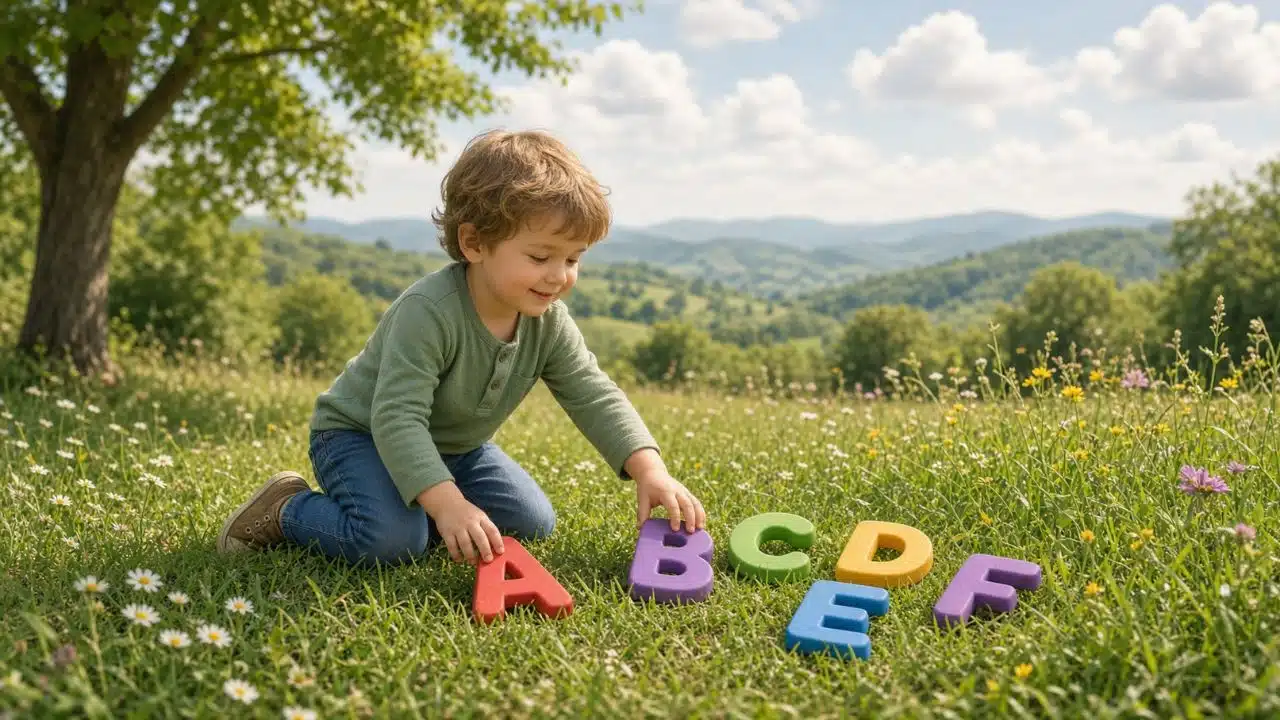
Most parents ask this question right after a comparison. A cousin’s three-year-old names every letter on a cereal box. A classmate writes her own name. Meanwhile, your child sings the ABC song beautifully and then points at a W and says, “That’s a mountain.” So, how long does it take a child to learn the alphabet?
For most children, the whole thing takes somewhere between eighteen months and three years from the first letter they recognize to the last one they can write. That is a wide range, and it is wide for a good reason: “learning the alphabet” is not one skill. It is five, and children pick them up at different speeds.
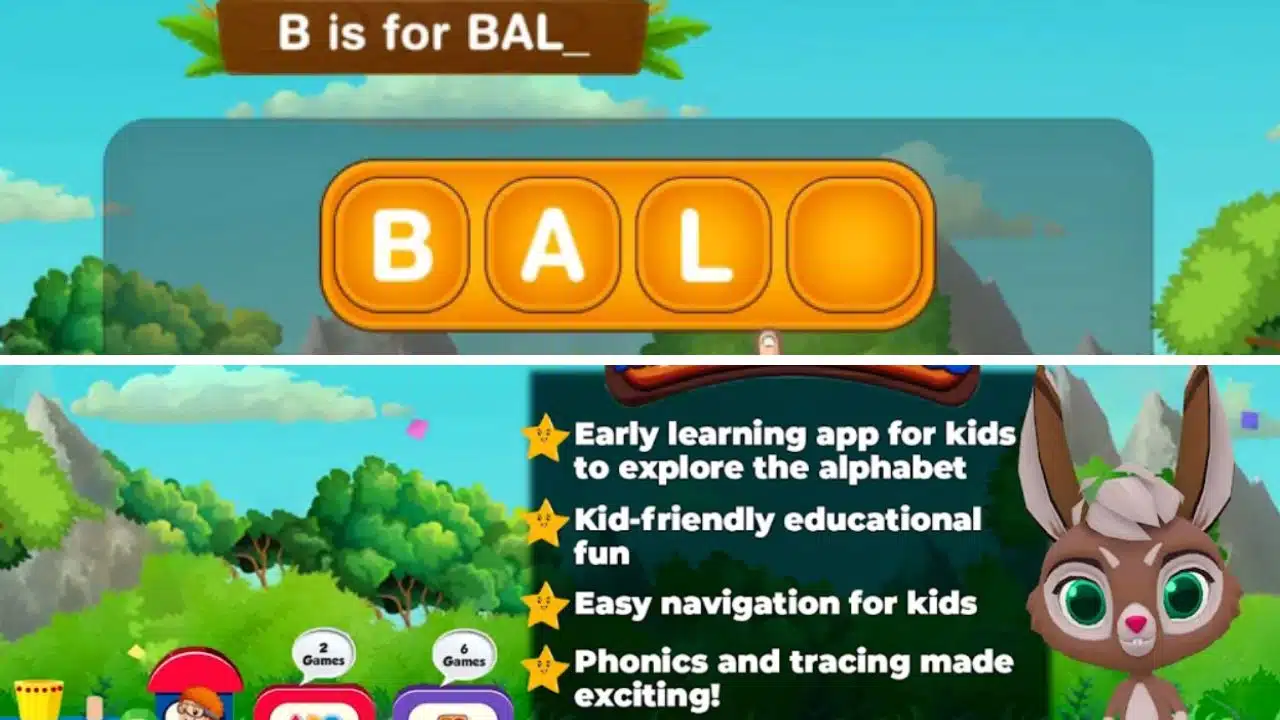
We build early learning games for a living. Our alphabet app, Alphabet Magic Trace & Phonics, has eight small games in it, and building each one taught us something about where children slow down and where they surprise you. A lot of what we assumed at the design stage turned out to be wrong.
The Short Answer By Age
Here is the rough shape of it, based on the research on letter-name knowledge and on what we see from parents using our app:
| Age | What most children can usually do |
|---|---|
| 2–3 years | Sing or hum the ABC song. Recognize a few letters, usually the first letter of their name. |
| 3–4 years | Name somewhere between five and fifteen uppercase letters. Lowercase is mostly still a blur. |
| 4–5 years | Name most uppercase letters. Know a handful of lowercase ones. Starting to link letters to sounds. |
| 5–6 years | Recognise all 26 in both cases. Write most of them, messily. Sound out short words. |
Two things are worth pulling out of that table. First, uppercase comes well before lowercase for almost every child—that gap is normal and it can last a year. Second, the finish line most schools use is the end of kindergarten, not the start of it. A five-year-old who does not know all 26 lowercase letters is not behind.
Why the Answers Online Vary So Much
Ask five people and you get five timelines. That is because they are answering five different questions. When a parent says their child “knows the alphabet,” they could mean any of these:
- Singing it. Reciting ABCDEFG as one long word. This is memorized sound, not letter knowledge.
- Recognizing uppercase. Pointing to R when you say “R.”
- Recognizing lowercase. Same skill, much harder, because b, d, p and q are the same shape rotated.
- Knowing letter sounds. Knowing that S says sss. This is the one that actually leads to reading.
- Writing letters. A motor skill that depends on hand strength, not brainpower.
A child can be excellent at the first and hopeless at the fifth. That is not a problem. When we mapped our own app, we split these into separate games on purpose rather than one big “learn ABC” screen, because bundling them hides where a child is actually stuck.
The ABC song deserves a special warning. Nearly every child we hear about sings it early, and nearly every parent reads that as progress. It is not. Plenty of kids sing all 26 letters and cannot identify a single one on paper. The song is a rhythm they have learned, like a nursery rhyme. Useful, but it proves less than it sounds.
How Long Does It Take a Child to Learn the Alphabet With Daily Practice?
This is the version of the question most parents actually want answered. If you sit down with your child every day, how fast does it go?
From what we see, a four-year-old doing five to ten focused minutes a day will usually recognize all 26 uppercase letters within three to six months. Lowercase takes another three to six on top of that. Sounds run alongside. Writing lags everything else by six months or more.
For a three-year-old, stretch all of that out. Their attention span is shorter and their fine motor control is not there yet. Six to twelve months for uppercase is a fair expectation, and there is nothing wrong with slower.
The single biggest variable is not the method. It is whether the practice is short and frequent or long and occasional. Twenty minutes on Sunday does far less than four minutes on six days. Repetition spaced out is what makes letters stick. This is also why apps do reasonably well here — not because a screen teaches better than a parent, but because a screen makes it easy to do a small amount often.
What Building the App Changed Our Minds About
We designed the first version of Alphabet Magic the way most people would: start at A and go to Z, one letter at a time, tracing first. That was wrong on nearly every count.
Children do not learn letters in alphabetical order
They learn the letters that mean something to them. The first letter of their name comes first, almost always. Then letters from family names, favorite characters, and shop signs. Research on letter-name knowledge backs this up — the first letter of a child’s own name is reliably among the earliest they learn. We ended up building the Cosmic Letter Discovery game to let children wander through letters freely rather than march through them in order.
Recognition and tracing are on completely different clocks
We assumed a child who could recognize M could trace M. Not close. Tracing needs a pinch grip, wrist control and enough patience to follow a path. We watched children confidently name a letter and then produce something that looked nothing like it. That is why the uppercase and lowercase tracing games are separate from the matching and tapping games — a child can be two levels ahead in one and still working through the other.
Some letters are just harder, and it is predictable
More on this below, but it changed how we ordered content.
Session length matters more than session quality
Our early builds had long levels. Children quit halfway. The shorter games—Twinkle Tap and Star Match—held attention far better and got more repetition per week, which is what actually moves the needle. We rebuilt around that.
One more thing, and this comes from parent feedback rather than design: several parents told us the app worked best when they sat next to their child rather than handing over the phone. One review put it plainly—the games are good for practice, but a parent still needs to guide. We agree, and we would rather say so than pretend otherwise. Anything a child does on a screen sticks better when someone names the letter out loud with them and points it out on a cereal box an hour later.
The Letters that Slow Children Down
Not all 26 letters are equal, and knowing which ones drag helps you stop worrying about the wrong things.
Letters whose names contain their own sound tend to get learned earlier. Say B, P, T, F, and M out loud and you can hear the sound sitting inside the name. Now say W, H, Y, Q, G, C. The name gives the child no clue about the sound at all. Research on the order children learn letters has found this pattern repeatedly, and those six are consistently among the last to land.
The other group is visual. Lowercase b, d, p and q are one shape in four orientations. Young children are used to a world where a cup is a cup whether you turn it around or not, so treating b and d as different things is genuinely a new idea. Mixing them up at four or five is normal, and it often persists into early reading. We deliberately avoid putting b and d next to each other in the same matching round for this reason.
Then there is the middle of the alphabet. Because the ABC song front-loads exposure, letters near the start get heard more often. The letters around J through R tend to lag, not because they are hard but because children simply meet them less.
A Weekly Rhythm that Works
Skip the rigid curriculum. This is closer to what actually happens in homes where it goes well:
Work on three or four letters at a time, not one, and not all 26. One letter a week is too slow to feel like progress; the whole alphabet at once is noise. Three or four gives enough contrast for a child to tell them apart.
Start with the letters in their name. Always. It is the one word they are already emotionally invested in.
Review old letters in every session. New letters are exciting and old ones fall out of memory fast. A session that is two-thirds review and one-third new looks unimpressive and works better than the reverse.
Stop before they want to stop. This is the hardest one for parents. Ending a session while a child is still enjoying it is what makes them willing to come back tomorrow. Pushing for “just three more” is how alphabet practice becomes a thing they resist.
Keep uppercase and lowercase separate at the start. Teaching A and a together seems efficient and mostly just confusing. Get uppercase solid, then bring lowercase in.
Mistakes that Stretch the Timeline
A few things reliably slow children down, and most of them come from good intentions.
Drilling in alphabetical order is the most common. It feels organized, but it means a child spends weeks on letters that mean nothing to them before reaching the ones that do.
Starting pencil work too early is the second. If a child cannot hold a crayon comfortably, tracing becomes a frustration exercise rather than a letter exercise. Finger tracing on a screen, on sand, on a foggy window — all of it builds the same shape memory without the grip problem.
Correcting too much is the third. A backwards S at four is not a warning sign. Naming the letter correctly matters far more than forming it correctly at this stage.
And treating the ABC song as evidence, which we mentioned above, quietly delays the moment a parent realizes their child cannot identify letters on sight.
On Screen Time Honestly
We make an app, so take this with the appropriate pinch of salt.
Current pediatric guidance for children aged two to five has moved away from a hard hourly cap and towards asking better questions: Is the content good? Is someone watching with the child? Is it crowding out sleep, play and conversation? The old one-hour benchmark is still cited as a reasonable anchor for this age group.
For alphabet practice specifically, we would not go past ten or fifteen minutes in a sitting for a preschooler, and we would rather it be five minutes twice than fifteen once. An app is a repetition tool. It is not a substitute for being read to, which remains the single best predictor of how early letters click.
When Slower Progress is Worth a Second Look
Most slow starts are just slow starts. A few are worth mentioning to someone.
If a child is turning five and cannot reliably name more than a handful of letters after regular exposure, it is reasonable to raise it with their teacher or pediatrician—not as an emergency, but as a question. The same goes if letter learning is paired with unclear speech, trouble hearing rhymes, or difficulty following two-step instructions. Those combinations are more informative than letter knowledge alone.
Children learning two languages at once often take a different path, and that is expected rather than concerning.
Final Thoughts
How long does it take a child to learn the alphabet? Realistically, one to three years, with most of the visible progress happening between ages four and five, and full mastery of both uppercase and lowercase usually landing around the end of kindergarten. If your child is three and knows four letters, they are fine. If your child is five and mixes up b and d, they are fine.
What speeds it up is not a better method. It is small amounts of practice, often, starting with letters the child already cares about, with an adult nearby saying the letters out loud.
If you want a structured way to do the daily few minutes, Alphabet Magic trace & phonics splits recognition, matching, tracing and phonics into separate short games so you can see exactly which part your child is stuck on rather than guessing. Sit next to them while they play it. That part matters more than the app does.






















