A Google algorithm update just cost you a third of your organic traffic. Your first instinct is to rebuild everything. Don’t. Recovery is a structured process with a known timeline, and the data says most sites get it wrong the first time. Google has shipped more than 14 confirmed algorithm updates since January 2023, and core updates now roll out roughly every three months instead of the historical twice-a-year cadence.
This guide walks through the seven steps that separate recovered sites from permanently damaged ones: confirm the cause, name the target, audit against Google’s own criteria, sort your pages, build trust signals, fix the technical layer, and track the next window.
Confirm the hit was actually an algorithm update
Before you change anything, verify the cause. A traffic drop can come from a technical error, a server outage, a manual action, or a hosting issue, and none of those respond to an SEO content overhaul. You’d be surprised how many people rewrite their whole site because a plugin broke their robots.txt.
Open Google Search Console and check three things. Whether impressions fell sharply on the same date. Whether pages are still indexed. Whether a Manual Actions notice is waiting in the security section. Then check Google’s Search Status Dashboard to confirm which update was rolling out and when it completed.
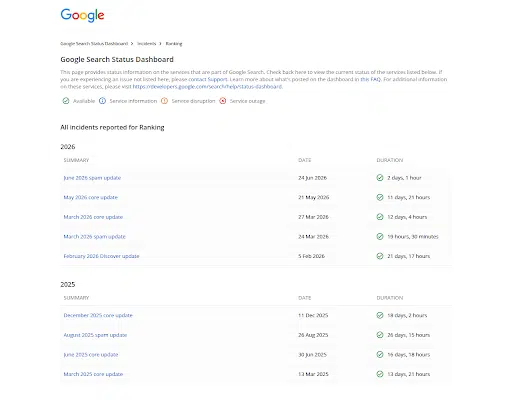
Google Search Status Dashboard showing 2026 ranking incidents
Google’s Search Status Dashboard lists every confirmed ranking incident, including the March, May, and June 2026 updates. Screenshot: status.search.google.com, captured August 2026.
The 2026 dashboard tells a clear story about volatility. The March spam update launched on March 24. The March core update followed on March 27 and ran 12 days and 4 hours. The May core update ran 11 days and 21 hours. The June spam update started June 24 and completed in about two days, per Google Search Status Dashboard. If your traffic fell inside one of those windows, the algorithm is the likely cause. If it fell on a random Tuesday with no update running, keep debugging before you rewrite anything.
Know what the 2026 updates targeted
Each update has a target, and recovery starts by naming yours. Confusing one target with another is the most common recovery mistake. A site hit for scaled content needs a different response than one hit for slow pages. Getting that wrong means six months of fixing the wrong thing.
Here’s the 2026 picture as of August 2026, per Google Search Status Dashboard and DigitalApplied:
| Update | Rollout | What it targeted |
| March 2026 spam update | Mar 24 – Mar 25 | Scaled AI content abuse, expired domain manipulation, site reputation abuse |
| March 2026 core update | Mar 27 – Apr 8 | Holistic Core Web Vitals scoring; comparative content value |
| May 2026 core update | May 21 – Jun 2 | Content quality and relevance recalibration |
| June 2026 spam update | Jun 24 – Jun 26 | Spam signals, global rollout |
The March 2026 core update introduced the most significant ranking signal change since the Helpful Content Update: holistic Core Web Vitals scoring. LCP, INP, and CLS are now aggregated into a composite performance score instead of being evaluated individually, per DigitalApplied. That single change rewired how technical performance affects rankings. Most site owners didn’t notice until the traffic dropped.
Audit your content against Google’s own questions
Google publishes the exact criteria its systems reward. Use the official self-assessment, not a third-party interpretation of it, per Google Search Central. Yes, the document is dry. That’s fine. It’s also the closest thing to a direct answer from Google about what it wants.
The content and quality questions cover whether your content provides original information, reporting, research, or analysis; whether it provides a substantial, complete description of the topic; whether it goes beyond the obvious; whether it avoids simply copying or rewriting other sources; whether the heading honestly summarizes the page; and whether it is the sort of page you would bookmark, share with a friend, or expect to see in a printed magazine or encyclopedia.
Run every affected page through these questions. Score honestly. A page that fails five of the twelve questions is a rewrite candidate. A page that fails nine is a removal candidate. It’s brutal, but it’s faster than guessing.
The most useful question for recovery is the “Why” question. Content created primarily to help people aligns with what core ranking systems reward, per Google Search Central. Content created primarily to rank in search does not. Be honest about which bucket each page falls into, because that classification will decide most of your rewrite budget.
Sort pages into prune, consolidate, or rewrite
Not every page deserves the same treatment. A practical way to sort the affected pages is by search intent. Group them into three buckets.
Pages that answer a question no one is asking anymore can go. Pages that compete for the same keyword should be merged into one strong page with a redirect. Pages that rank but underperform on expertise should be rewritten with real evidence and named sources. Apply the bookmark test Google suggests. Pages that fail are candidates for removal, not resuscitation.
The March 2024 core update showed how aggressive Google has become. The company said it would reduce low-quality, unoriginal content in search results by 40 percent, a target reportedly achieved within six months of rollout, per Cloudswitched. Keeping weak pages around after a hit is the most common reason recovery stalls. You’re not doing them a favor by leaving them up.
For pages you keep, the rewrite needs a standard. Original data beats rewritten summaries. Named sources beat vague authority. First-hand testing beats generic recommendations. A page that says “we tested this for six weeks” outranks a page that says “experts recommend” with no names attached.
Build the E-E-A-T signals
Recovery rewards demonstrated expertise. Google evaluates experience, expertise, authoritativeness, and trustworthiness as part of its core ranking systems, and those signals are evaluated per page, not just per domain.
The practical checklist:
- Add author bylines with real credentials on every article. A named, qualified author is the fastest E-E-A-T win.
- Publish original research, surveys, or proprietary data. Originality is one of Google’s explicit quality questions.
- Cite authoritative sources with context. A citation that explains what the source said and why it matters is worth ten bare links.
- Make the about page explain who is behind the content and why they are qualified.
- Add real-world experience to the content itself. Dates of testing, locations, and specific numbers are hard for competitors to fake.
Most sites already have authors, a bio page, and a footer full of promises. The difference is whether the evidence actually shows up inside the articles. That’s where the signals live.
Fix the technical layer
The March 2026 core update made Core Web Vitals a composite score, which raises the bar for the technical layer. Google’s “good” thresholds, per developers.google.com and DigitalApplied:
| Metric | What it measures | Good | Needs improvement | Poor |
| LCP | Loading performance | ≤ 2.5s | 2.5s – 4.0s | > 4.0s |
| INP | Responsiveness | ≤ 200ms | 200ms – 500ms | > 500ms |
| CLS | Visual stability | ≤ 0.1 | 0.1 – 0.25 | > 0.25 |
The pass rates show how much room most sites have. About 32 percent of origins exceed the 2.5-second LCP threshold, and about 22 percent exceed the 0.1 CLS threshold, per DigitalApplied. A single slow interaction can now pull down an otherwise fast page under composite scoring. That’s not a theory. It’s how the math works now.
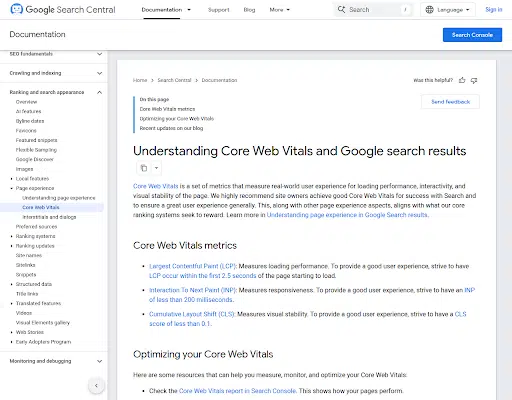
Google Core Web Vitals documentation showing LCP, INP, and CLS thresholds
Google’s official Core Web Vitals documentation defines the good thresholds for LCP, INP, and CLS. Screenshot: developers.google.com, captured August 2026.
Run a full technical audit. Page speed on real devices. Mobile usability. Crawl errors. Broken redirects. Structured data. The helpful content system has been integrated into Google’s core ranking algorithm since March 2024, which means technical health and content quality are evaluated together. Fixing one while ignoring the other leaves you half-recovered.
Understand the recovery timeline
Recovery is measured in months, not days. Google’s own documentation says improvements may take effect in a few days, but it could take several months, per Google Search Central. Plan for the slow version and you won’t be disappointed.
Sites affected by core updates may not see recovery until a subsequent core update re-evaluates the changes. That means the recovery window is tied to Google’s release cadence, not your publishing schedule. The industry data:
| Recovery path | Average timeline |
| Professional-led recovery | 2 – 4 months |
| DIY recovery | 6 – 12 months |
| Sites that made no real changes | No recovery until the next core update, if ever |
Those ranges come from Cloudswitched’s analysis of major updates from the March 2024 core update onward. Some sites wait a full year. Expecting a two-week recovery is how sites make panic decisions that extend the damage.
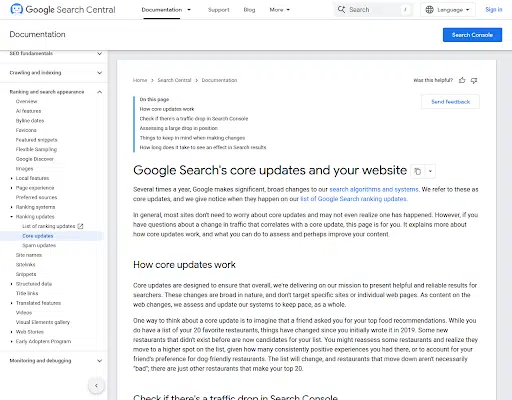
Google Core Updates documentation
Google’s official guidance on core updates explains why improvements take time to show up in search results. Screenshot: developers.google.com, captured August 2026.
Track the next update window
Because recovery is re-evaluated at the next core update, you need a tracking system.
Keep a recovery log. Note what you changed, on which pages, and when. Set a reminder for the next expected core update window, roughly every three months based on the 2026 cadence. When the update starts rolling out, stop making changes and let it complete. Then compare your Search Console data before and after the rollout.
The sites that recover are the ones that made real changes and then gave the systems time to notice. Daily checking produces anxiety, not rankings. A quarterly review produces decisions.
What not to do after a hit
- Don’t rebuild everything at once. You cannot know what failed until the audit is done.
- Don’t chase every ranking theory. One trusted source of truth beats ten conflicting guides.
- Don’t delete and start over. Existing authority is an asset, even when rankings dropped.
- Don’t ignore the timeline. Recovery is a months-long process, not a weekend project.
Final thought
Algorithm recovery rewards discipline. The sites that bounce back audit first, change deliberately, and give the systems time to re-evaluate. The sites that do not recover usually skip the audit and guess.
If your organic traffic took a hit, start with a full technical and content audit before touching a single URL. That audit is the difference between a three-month recovery and a twelve-month one.
FAQ: Frequently asked questions about recovering from Google algorithm updates
1. How long does it take to recover from a Google algorithm update?
Google says improvements may take effect in a few days, but it can take several months. Industry data puts professional-led recovery at two to four months on average, and DIY recovery at six to twelve months. Sites affected by core updates may not see recovery until a subsequent core update re-evaluates the changes.
2. Should I change anything when a core update is rolling out?
No. Wait for the rollout to complete before making significant changes. Making changes during a rollout makes it impossible to tell whether the update or your changes caused the movement.
3. Is AI-generated content the reason my site was hit?
Not by itself. Google does not penalize content simply because it was created with AI. It penalizes thin, unoriginal, or manipulative content regardless of how it was produced. The March 2026 spam update specifically targeted scaled AI content abuse, not all AI content.
4. Do I need to delete my old content?
Only content that fails Google’s own quality questions. Pages that are thin, copied, or written to rank rather than help are removal or consolidation candidates. Pages with real substance should be rewritten, not deleted.
5. Will buying links speed up recovery?
No. Link buying violates Google’s spam policies and can trigger a manual action on top of the algorithm hit. Recovery comes from content quality, technical health, and demonstrated expertise, not purchased links.