Have you ever watched a coworker use ChatGPT to finish a task in ten minutes that used to take an hour? That feeling in your stomach is real, and it is worth paying attention to.
Here is the good news: AI skills are learnable. You do not need a computer science degree to build them.
Think of it this way. Twenty years ago, knowing how to use email became the baseline for almost every job. Today, knowing how to use AI tools like ChatGPT and Claude is heading the same way.
Companies in finance, healthcare, marketing, and tech are hiring people who can work with AI systems right now. They want folks who understand machine learning basics, data analysis, and prompt engineering and who can fold artificial intelligence into everyday workflows.
The gap between people who learn AI skills and people who wait keeps getting wider.
So let’s walk through the seven AI skills you need, one at a time. I’ll show you where to start, which tools actually matter, and why each skill pays off. By the end, you’ll have a clear plan to future-proof your career.
Why AI Skills Are a Necessity in 2026
The job market is shifting fast. Companies are actively hunting for workers who can interact with AI technologies, and the people who build these skills first will have the best career paths ahead.
Your competition is already learning. Organizations want employees who grasp machine learning basics, data analysis, and prompt engineering skills, and who can apply AI tools to solve real problems.
Your paycheck and job security depend on keeping pace with these changes. And the numbers back this up in a big way. According to PwC’s 2026 Global AI Jobs Barometer and data from the Bipartisan Policy Center, U.S. workers with AI skills now earn an average wage premium of 62 percent, and job postings asking for these skills grew 144 percent year over year by spring 2026.
Read that again: a 62 percent pay bump. That is the market telling you, loudly, that AI literacy is worth your time right now.
Schools see it too. Education programs across America are scrambling to add AI training to their courses, because students who graduate without AI fundamentals will struggle to land good jobs.
Here is what employers are really looking for:
- People who understand AI capabilities and their limits
- Workers who can apply AI tools to daily tasks
- Team members with strong critical thinking and collaboration skills
- Professionals who keep learning as AI evolves
The path forward is clear. Those who develop AI skills today will lead tomorrow in healthcare, business strategy, and countless other fields.
AI Skills Everyone Should Learn in 2026
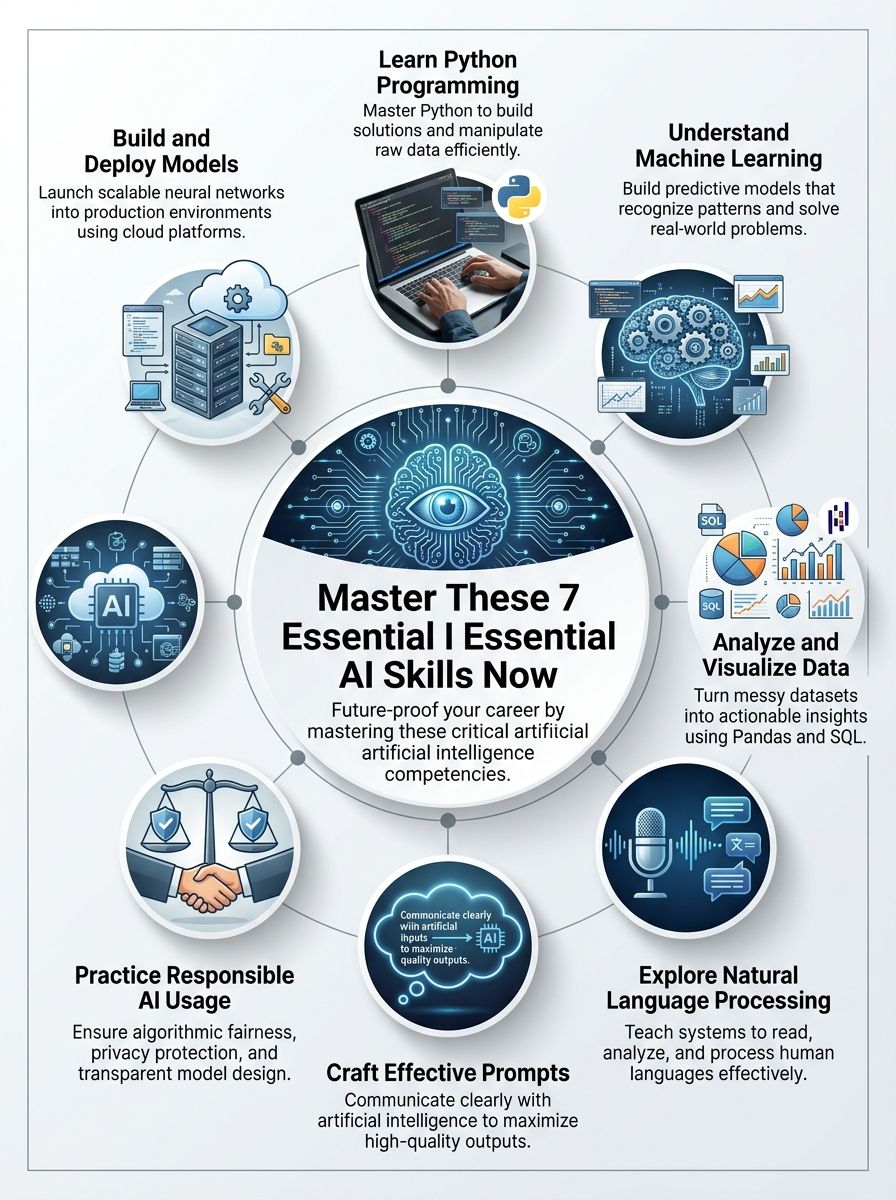
As artificial intelligence becomes part of everyday work, learning how to use it effectively is no longer optional. In 2026, people across nearly every profession will benefit from understanding AI tools, prompt writing, automation, data analysis, and responsible AI use. These skills can improve productivity, strengthen decision-making, and help individuals stay competitive in a rapidly changing job market.
1. Programming Skills for AI
Programming forms the backbone of AI development, and Python stands out as the top choice. It offers simplicity and power in equal measure, which is a rare combination.
And the demand is not just talk. Based on labor market analysis from the Stanford University 2026 AI Index Report, Python appeared in roughly 259,000 U.S. AI-related job postings in 2025, about four times more than a decade ago. If you are going to bet your learning time on one language, Python is the safest bet you can make.
R also serves professionals well, especially for statistical analysis and data visualization. But if you are new to computer programming, start with Python. Its clear syntax makes learning faster.
A solid programming foundation speeds up everything else. It lets you work with popular AI frameworks like TensorFlow and PyTorch, and libraries like Pandas help you clean, sort, and reshape data, which is where most AI projects actually spend their time. These skills open doors to career opportunities in AI development across industries like healthcare and business.
Don’t Skip the Soft Skills
Soft skills matter just as much as technical skills when working with AI. Your collaboration skills shape how well you contribute to teams building AI at scale, and clear communication helps you explain complex concepts to stakeholders without technical backgrounds.
Critical thinking guides your decision-making too, like choosing the right algorithm or validating your test data sets.
Want to grow faster? Try these habits:
- Practice coding daily through small projects and sandbox environments
- Join AI communities where developers share feedback and best practices
- Experiment with AI frameworks on your own terms to build confidence
- Work alongside colleagues who bring different expertise to the table
2. Machine Learning
Machine learning is the foundation for your AI skills. Your computer learns patterns from data without you spelling out every rule.
Think of it like teaching a child to recognize dogs. You do not list every dog trait. You show many dog pictures, and the child spots the patterns. Machines learn the same way.
Python is the go-to language here, paired with Pandas for data handling and Matplotlib for visualization. These tools let you work hands-on with real data sets. Start small: try predicting house prices or customer behavior. You will see how machines learn from training and test data sets, then make predictions on new information.
Frameworks like TensorFlow and PyTorch turn your learning into real applications, letting you build neural networks and deep learning models without starting from scratch. And employers agree on which tools matter. According to 2026 market analysis from Second Talent, PyTorch appears in 37.7 percent of U.S. AI job postings and TensorFlow in 32.9 percent, making them the two most requested machine learning frameworks in the market.
Focus on those two, and you cover most of what employers ask for.

This hands-on approach sticks with you far better than theory alone. Machine learning skills open doors across industries, from healthcare to Amazon’s recommendation systems.
Companies need people who can turn raw data into actionable insights. Start now, because the gap between AI learners and non-learners grows wider every day.
3. Advanced Techniques in Data Analysis and Visualization
Data analysis skills separate the winners from the rest. You need to master tools like Excel and SQL to handle real data sets effectively.
SQL deserves special attention here. According to 2026 data market trends published by EWSolutions and industry analysts, SQL shows up in roughly 52 percent of all data job postings, and organizations with strong data foundations report a 30 percent improvement in decision-making speed. In plain terms: SQL gets you hired, and the skill makes your company faster.
Python’s Pandas library takes you even further. It lets you clean, transform, and explore data at scale, spotting patterns that others miss.
Here is how these tools stack up:
| Tool | Best For | Skill Level |
|---|---|---|
| Excel | Simple tasks and quick charts | Beginner |
| SQL | Deeper queries on large databases | Beginner to intermediate |
| Pandas | Cleaning and exploring data at scale | Intermediate |
Visualization matters just as much as analysis. Dashboards and charts transform raw numbers into stories people actually understand, and companies hire people who can turn messy data into actionable insights.
Healthcare organizations use these techniques to track patient outcomes. Amazon and other tech giants rely on skilled analysts to guide their strategies. Start with basic charts, then move to interactive dashboards that stakeholders love.
The key to mastering data analysis is practice with real problems. Your career in AI accelerates when you combine technical skills with storytelling ability, because effective AI output depends on quality data analysis happening behind the scenes.
4. Natural Language Processing (NLP)
Natural Language Processing, or NLP, teaches machines how to read and understand human language. It powers chatbots that answer your questions, email filters that catch spam, and translation apps that help you communicate across languages.

The field of AI is growing fast, and companies across healthcare, retail, and finance all need people who understand how machines process words. How fast? According to Gloat’s 2026 U.S. Job Market report, job postings asking for NLP capabilities jumped 155 percent heading into 2026, driven largely by companies adopting large language models for customer service and document analysis.
That is not a slow trend. That is a hiring wave.
The best part? You do not need to be a math genius to start. You need curiosity and some basic Python knowledge. Libraries like NLTK and spaCy handle the complicated code, so you can focus on learning the concepts.
With NLP skills, you will learn how machines:
- Break down sentences into parts they can process
- Find patterns in large amounts of text
- Extract meaning from what humans write or say
- Power chatbots and content analysis tools companies want to deploy
Start small with simple projects, like analyzing customer feedback or sorting messages by topic. As you practice, you will gain confidence working with text data and understanding how neural networks process language.
Your résumé will stand out when employers see you can work with language model technology. The growth of AI means NLP skills are becoming essential for developers, data analysts, and anyone serious about staying relevant in tech.
5. AI Prompts Engineering
Crafting effective AI prompts is the skill that separates successful AI users from casual ones. Your ability to communicate clearly with AI tools directly shapes the quality of results you get back.
I like to think of prompting as a conversation, not a command. Here is how to hold up your end of it.
Set Up the Request
- State your goal upfront and make it specific; vague requests produce vague answers.
- Provide context about your situation, your audience, and any constraints, so the AI sees the full picture.
- Break complex tasks into smaller steps; AI performs better handling one thing at a time.
- Specify the format you want, whether that’s a list, paragraph, code snippet, or dashboard layout.
- Include examples of good output when possible; showing AI what success looks like improves results dramatically.
Refine the Response
- Ask AI to explain its reasoning or show its work, which helps you catch errors and validate the response.
- Adjust your prompts based on what comes back; treat it as a back-and-forth between human and machine intelligence.
- Use clear language without jargon unless the AI needs technical terms.
- Tell AI about your skill level, so it matches the response to what you can actually use.
- Test different phrasings to find what works best; effective prompting improves productivity and innovation.
Does a structured approach really pay off? The evidence says yes. When content writers applied a five-step prompt template covering goal, audience, constraints, example, and format, useful responses jumped from 45 percent to 85 percent of attempts. Revision cycles per task dropped from more than three rounds down to just over one.
Using a short template made prompt outcomes far more predictable and cut rewrite time by two thirds in practice. The lesson: learning repeatable prompt structures beats guessing at what works. Your productivity gains compound when you build reliable workflows for guiding conversational AI tools toward the results you actually need.
6. Ethical AI and Responsible Usage
AI systems shape decisions that affect real people every single day. Bias in algorithms can sneak into hiring tools, loan approvals, and health care recommendations without anyone noticing at first.
Ethical AI and governance is not some distant concern for tech companies alone. It is your responsibility too, and awareness of bias, privacy, and accountability is crucial for responsible AI use.
When you build models or work with generative AI tools like Claude, ask yourself hard questions:
- Does this system treat all groups fairly?
- Could my AI solution harm someone’s privacy?
- Am I transparent about how this tool works?
These questions matter because AI failure modes can damage trust, hurt people, and create legal problems for your company. Stakeholders across industries, from Amazon to health care providers, now expect AI developers to weigh societal impact before launching new systems.
Why Data Hygiene Catches Bias Early
Data quality problems often hide the root causes of fairness failures. One audit of a prototype recommendation system found twelve distinct encoding variants for a single demographic field in the training data. That inconsistency produced a 22 percent disparity in recommendation exposure between encoded groups during validation runs.
The fix was surprisingly simple. Normalizing those categorical fields reduced the disparity to just 4 percent after retraining. Encoding inconsistency was the root cause, and cleaning it up fixed most of the gap.
Checking your input data for inconsistent labels and formats is one of the most practical steps you can take to build fairer AI systems.
Responsible AI use requires ongoing attention, not a one-time check. Learn to spot risks, validate that your models work fairly across different populations, and communicate limitations honestly. Handle sensitive data safely and follow the regulations that protect consumers.
Building dashboards to track model performance helps you spot when something goes wrong. Companies that invest in ethics now avoid costly failures later, and mastering these principles makes you someone who builds AI systems people can actually trust. That is a real competitive advantage in 2026 and beyond.
7. Building and Deploying AI Models
Building and deploying AI models is where all your other skills come together. This is the step that turns your AI ideas into working systems people can actually use.

Here is a strong reason to stick with it. According to 2026 AI salary data from Axial Search and cloud deployment forecasts from Gartner, the median salary for U.S. MLOps engineers hit $184,000 in 2026, and over 80 percent of enterprises now deploy their AI applications on major cloud platforms like AWS. Deployment skills are unglamorous, and they pay accordingly.
Build Your Foundation
- Learn Python programming first, since it powers most AI development and makes building neural networks approachable.
- Master Pandas to clean, organize, and prepare datasets for model training.
- Study neural network fundamentals to grasp how machines learn patterns and make predictions.
- Explore frameworks like TensorFlow or PyTorch, which simplify the complex math behind AI development.
- Practice validation techniques to catch errors before your AI systems reach users.
Move Into Production
- Understand cloud platforms that support AI deployments, since they give your applications room to scale.
- Learn deployment strategies that move models from development into production, where they solve real problems for stakeholders.
- Gain knowledge of Robotic Process Automation through tools like UiPath and Automation Anywhere to automate repetitive workflow tasks.
- Study computer vision with OpenCV to teach machines how to interpret images and videos.
- Get comfortable with dashboard tools to monitor how your AI models perform after deployment.
Feeling overwhelmed? A structured pipeline makes it manageable. One practical seven-step workflow covers the full journey: export your data, write a Pandas cleaning script, create a train/test split notebook, train your model with a small TensorFlow script, capture validation metrics, containerize the model with a minimal runtime, then deploy to a sandbox endpoint.
Learners who follow this sequence typically finish every step in about five and a half hours. One focused day, and you have a working endpoint. That hands-on experience demystifies production deployment and gives you the confidence to launch your own AI solutions into real environments.
Final Words
You now have a clear path forward. These seven AI skills will shape your career and keep you competitive as artificial intelligence transforms every industry. Start with Python. Master data analysis through tools like Pandas, then branch into machine learning and natural language processing.
Your resume will stand out when you add hands-on experience with AI tools and techniques, from prompt engineering to model deployment. The time to act is right now, not next year. The job market rewards those who move fast and learn faster, so pick one skill from this list and start today.