
Founders can explain runway risk, hiring risk, product risk, churn risk, and investor risk with impressive confidence. Then the company starts eating their sleep, patience, relationships, and ability to think clearly, and suddenly the language gets vague. “I’m just tired.” “It’s a hard season.” “We’ll reset after the next milestone.”
That is how founder mental health gets pushed into the background until it starts running the company from underneath. A founder who cannot sleep makes worse decisions. A founder who cannot ask for help becomes harder to work with. A founder who treats panic as discipline may look committed for a while, but the bill comes due.
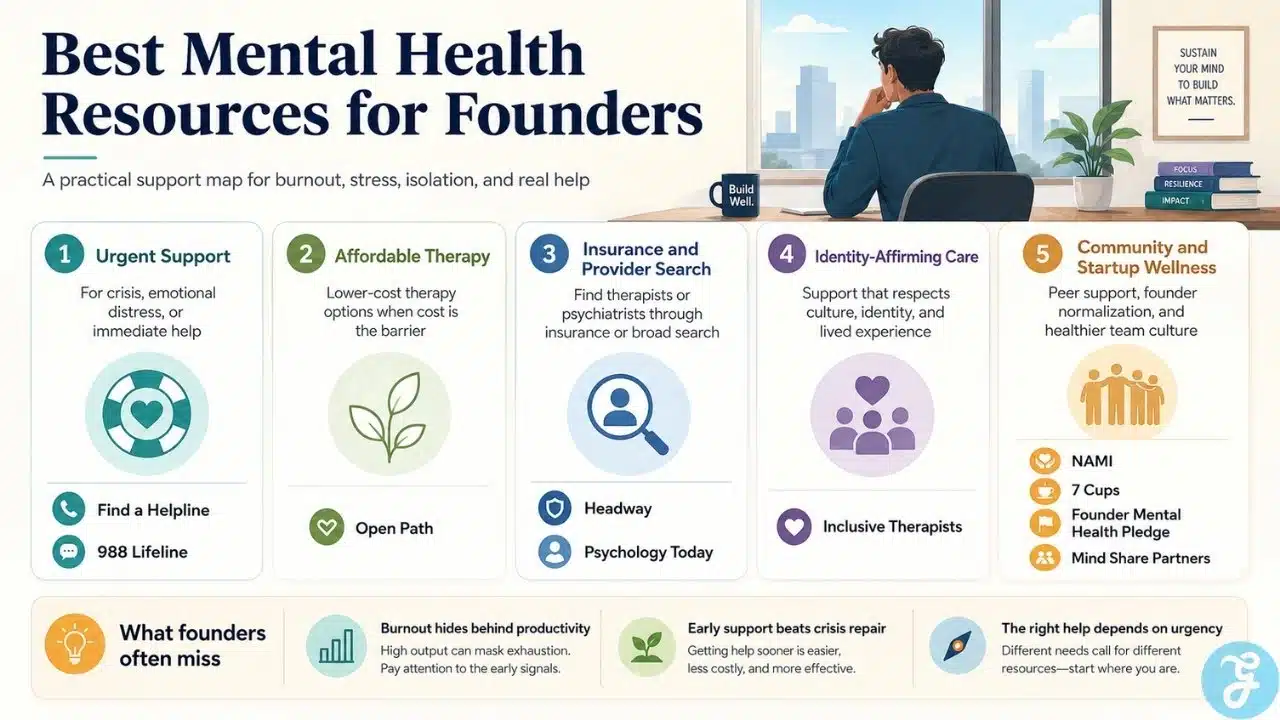
The best mental health resources for founders are not motivational posters or another morning routine. They are practical support systems: crisis lines, therapy directories, affordable care options, peer support, founder-focused initiatives, and startup wellness resources that help founders stop carrying everything alone.
This article is not medical advice and does not replace care from a licensed professional. If someone is in immediate danger, thinking about self-harm, or afraid they may hurt themselves, the first step is emergency support, a crisis line, or local emergency services.
Our Selection Criteria
We looked for resources that founders can actually use when stress moves beyond normal hard work and starts affecting judgment, sleep, relationships, or company leadership.
The strongest resources were not selected because they sound polished. They were selected because they solve a real access problem: urgent help, affordable therapy, identity-aware care, peer support, insurance navigation, workplace systems, or founder-specific normalization.
We used these filters:
- Access: The resource needs a clear way to start, search, call, chat, or book support.
- Credibility: We favored established organizations, verified directories, trained support systems, or resources connected to licensed providers.
- Founder relevance: The resource needs to fit founder mental health, leadership pressure, startup wellness, isolation, burnout, or entrepreneur therapy.
- Affordability path: We prioritized resources with insurance support, lower-cost access, free support, or practical navigation help.
- Use-case clarity: Each resource needs a clear role. Crisis support is not therapy. Peer listening is not psychiatry. Workplace culture tools are not a replacement for care.
- Limitations: We avoided treating any resource like a universal fix.
A founder’s situation determines the right kind of help. Urgent distress needs a different response from long-term burnout. Identity-related stress needs different support from co-founder conflict. A team-wide culture problem needs more than a meditation app.
Who This Founder Mental Health List Is For
This guide is for founders, co-founders, startup operators, solo entrepreneurs, and early leadership teams who know the work is becoming mentally expensive.
It is also useful for investors, accelerators, and startup advisors who want to point founders toward better support without pretending that one resource can solve everything. A founder does not have to be in crisis to use mental health support. Waiting until collapse is not a strategy.
9 Best Mental Health Resources for Founder Mental Health Support
The resources below are organized by practical use, not by hype. Some are for urgent support. Some help founders find entrepreneur therapy. Others help with startup wellness, workplace culture, peer listening, or affordable care.
The goal is not to use all nine. The goal is to choose the resource that fits the actual problem in front of you.
1. Find a Helpline and 988 Lifeline
Find a Helpline and 988 belong at the top because crisis support should never be buried below productivity tools. Find a Helpline helps people search for verified support services by country and topic, which matters for founders outside the United States. In the U.S., 988 is the Suicide & Crisis Lifeline for people facing suicidal thoughts, emotional distress, mental health crisis, or substance-use crisis.
Best Feature/For: immediate crisis support when someone needs help now.
Why We Chose It:
- It helps founders move from silent distress to live support quickly.
- Find a Helpline is useful for global readers because crisis numbers differ by country.
- 988 gives U.S.-based users a simple call, text, or chat route during crisis or emotional distress.
Things to consider:
- These are crisis and emotional support resources, not ongoing therapy.
- If someone is in immediate danger, use local emergency services or urgent local crisis care first.
A founder does not need to wait until the situation is dramatic enough to “deserve” crisis support. If the thoughts are getting darker, panic is taking over, or being alone feels unsafe, the company can wait.
2. Founder Mental Health Pledge
The Founder Mental Health Pledge is useful because it speaks directly to the startup ecosystem. Its position is simple: founders should be supported in treating mental health care, including therapy, coaching, group support, and app-based solutions, as a legitimate business priority. That matters because many founders delay care when they believe it is too personal, too soft, or too embarrassing to discuss around investors.
Best Feature/For: founders and investors who want to normalize mental health care as part of company-building.
Why We Chose It:
- It is specifically built around founder mental health, not generic wellness language.
- It gives investors and startup leaders a way to support care without turning it into a dramatic confession.
- It helps reframe mental health spending as a company-protection decision, not a personal indulgence.
Things to consider:
- It is not a therapy provider.
- It works best when paired with actual care, coaching, peer groups, or workplace support.
This resource is strongest when a founder needs permission to stop treating mental health as a private weakness. A company depends on the founder’s judgment. Protecting that judgment is not a luxury.
3. Open Path Psychotherapy Collective
Open Path helps with one of the most common founder barriers: cost. Early founders may not have stable income, strong insurance, or enough cash confidence to book traditional therapy without hesitation. Open Path connects people with therapists offering lower-cost sessions, which makes it a practical starting point for founders who know they need support but keep delaying because therapy feels financially out of reach.
Best Feature/For: affordable entrepreneur therapy when cost is the main blocker.
Why We Chose It:
- It offers a lower-cost therapy path for people who may not have strong insurance coverage.
- It includes online and in-person options depending on provider availability.
- It helps founders move beyond “therapy is too expensive” without settling for vague wellness advice.
Things to consider:
- Therapist fit still matters, so the first provider may not be the right one.
- Availability, fees, specialties, and licensing vary by location and provider.
Open Path is especially useful for bootstrapped founders, pre-seed founders, solo entrepreneurs, and operators whose companies are not yet stable enough for them to ignore cost.
4. Headway
Headway helps U.S.-based users find therapists and psychiatrists who accept insurance. That sounds simple until you have tried to use an insurance directory with outdated provider listings, unclear availability, and fees that only become obvious after several emails. For founders who already have insurance but keep stalling because the search feels annoying, Headway can reduce some of that friction.
Best Feature/For: U.S. founders looking for therapy or psychiatry through insurance.
Why We Chose It:
- It helps users search for licensed therapists and psychiatrists covered by insurance.
- It can make provider matching, cost estimates, and booking easier than starting from a stale insurance list.
- It works well for founders who need structured care but do not want to pay fully out of pocket.
Things to consider:
- Headway is U.S.-focused.
- Coverage depends on state, provider availability, insurance plan, and clinical fit.
This is not a magic matchmaker. If the first therapist is not a fit, keep searching. Therapy fit is part of the process, not a pass-fail test.
5. Inclusive Therapists
Inclusive Therapists matters because founder stress is not always neutral. A founder may be carrying pressure tied to race, gender, sexuality, disability, neurodivergence, immigration, trauma, religion, family expectations, or being the only person like them in the room. Inclusive Therapists centers culturally responsive, identity-affirming care, which can make the search feel less like handing your most vulnerable thoughts to a stranger who may not understand your life.
Best Feature/For: founders looking for culturally responsive and identity-affirming care.
Why We Chose It:
- It centers BIPOC, LGBTQIA+, neurodivergent, disabled, and marginalized communities.
- It helps founders search with identity, lived experience, and cultural context in mind.
- It can reduce the emotional labor of explaining why certain pressures are not “just startup stress.”
Things to consider:
- Providers operate independently, so founders still need to check licensing, fees, availability, and approach.
- Identity fit helps, but clinical fit still matters.
For some founders, the pressure is not only fundraising, hiring, or survival. It is bias, isolation, code-switching, and the constant need to prove they belong. Care that understands that context can change the conversation.
6. Psychology Today Therapist Directory
Psychology Today is broad, and that is the point. Its directory lets users search for therapists, psychologists, psychiatrists, treatment centers, and support groups by location, specialty, insurance, and other filters. For founders who do not know where to begin, it gives a wide map of available care options.
Best Feature/For: broad therapy and psychiatry search when a founder wants many filters.
Why We Chose It:
- It offers a large directory with filters for specialty, location, insurance, and support type.
- It can help founders compare providers quickly before reaching out.
- It is useful when the need is specific, such as anxiety, burnout, depression, ADHD, trauma, couples therapy, or executive stress.
Things to consider:
- The number of options can feel overwhelming.
- Founders should search with a specific need instead of scrolling endlessly.
A better search starts with a sentence like: “I need help with panic before investor meetings,” or “I need a therapist who understands burnout and relationship strain.” Vague searches create vague results.
7. NAMI
NAMI is useful when a founder needs education, peer support, family guidance, or a way to understand what might be happening before they know the right clinical language. Its HelpLine offers information, resource guidance, and support, while local NAMI organizations may provide education and peer programs. It can also help founders who are trying to support a co-founder, employee, partner, or family member.
Best Feature/For: mental health education, peer support, and navigation help.
Why We Chose It:
- It offers information and support through a known mental health organization.
- It can help founders understand conditions, symptoms, family strain, and support options.
- It is useful for people who are not ready for therapy but need language and direction.
Things to consider:
- NAMI’s HelpLine is not a crisis line.
- It does not replace licensed therapy, emergency care, or psychiatric treatment.
NAMI is often useful before the founder has the perfect vocabulary. Sometimes the first step is not a diagnosis. It is realizing that anxiety, depression, panic, or emotional shutdown is not a character flaw.
8. 7 Cups
7 Cups offers anonymous emotional support through trained volunteer listeners, with paid therapy options available in some contexts. It can be useful for founders who feel isolated, ashamed, or unable to say the honest version of what is happening to a co-founder, employee, investor, or partner. It is lower-friction than therapy, which can make it a bridge toward asking for more structured help.
Best Feature/For: anonymous peer listening when a founder needs to talk but is not ready for therapy.
Why We Chose It:
- It offers free anonymous emotional support through trained volunteer listeners.
- It can help founders break the silence before they seek deeper care.
- It is useful for loneliness, stress, and early help-seeking.
Things to consider:
- Peer listening is not licensed therapy, diagnosis, or crisis care.
- It is not the right choice for immediate danger or complex clinical needs.
This can help the founder who keeps saying “I’m fine” because the real answer feels too heavy. A neutral listener will not fix the company, but they may help the founder stop carrying the truth alone.
Mind Share Partners belongs on this list because founder mental health does not stay inside the founder. It affects culture, pace, communication, layoffs, urgency, transparency, and how the team handles pressure. Their workplace mental health resources and toolkits can help founders think beyond individual self-care and start building healthier operating norms.
Best Feature/For: startup wellness systems and workplace mental health culture.
Why We Chose It:
- It helps founders think about mental health at the company level.
- It offers workplace resources and toolkits that can support managers and leaders.
- It is useful when stress has moved from one founder into the whole team’s operating rhythm.
Things to consider:
- Workplace resources do not replace individual therapy or crisis support.
- Culture change requires leadership behavior, not just a toolkit.
If the team is always in emergency mode, no app will fix the culture. Startup wellness has to show up in workload, communication, manager behavior, recovery time, and what leaders model when pressure rises.
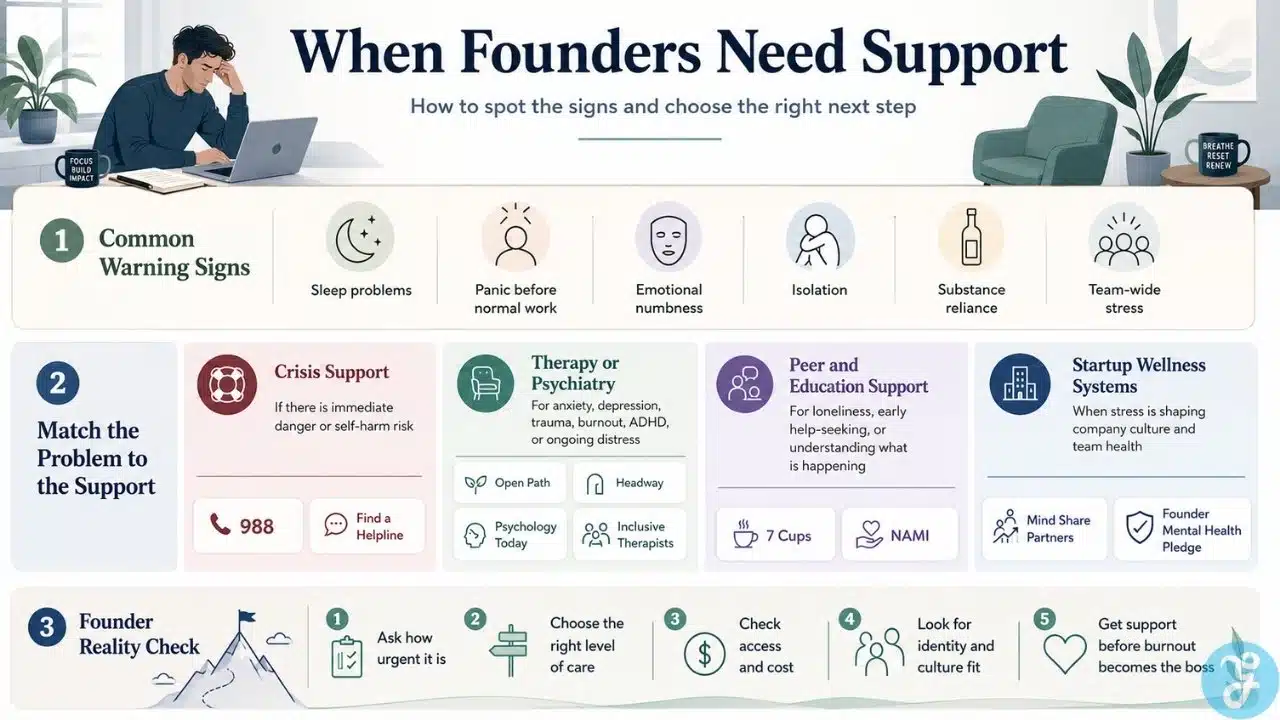
A Quick Overview
Some resources are for immediate help. Others are for ongoing therapy, lower-cost care, peer listening, identity-aware support, or healthier company systems.
Here is a clear comparison to help founders match the resource to the problem instead of choosing whatever looks easiest to click.
| Resource | Best For | Support Type | Best Fit |
|---|---|---|---|
| Find a Helpline and 988 Lifeline | Urgent distress or crisis | Crisis support and helpline directory | Founders who need immediate help |
| Founder Mental Health Pledge | Normalizing founder care | Founder-focused commitment | Founders, investors, accelerators |
| Open Path Psychotherapy Collective | Affordable therapy | Lower-cost therapy directory | Cost-sensitive founders |
| Headway | Insurance-based care | Therapy and psychiatry search | U.S. founders with insurance |
| Inclusive Therapists | Identity-aware care | Affirming therapy directory | Marginalized or underrepresented founders |
| Psychology Today | Broad provider search | Therapy, psychiatry, groups | Founders who want many filters |
| NAMI | Education and peer support | HelpLine and support resources | Founders and families seeking guidance |
| 7 Cups | Low-friction listening | Anonymous peer support | Founders not ready for therapy yet |
| Mind Share Partners | Startup wellness culture | Workplace mental health resources | Founders managing team-wide stress |
Our Top 3 Picks and Why?
Not every founder needs the same kind of help, but three resources stand out because they solve common founder problems: urgent support, affordable therapy, and company-level mental health culture.
Find a Helpline and 988 Lifeline: Best for urgent emotional distress. If there is any concern about safety, this comes before founder productivity, investor calls, or team updates.
Open Path Psychotherapy Collective: Best for affordable therapy access. Cost blocks too many early founders from care, and lower-cost therapy can make support feel possible before the company is financially comfortable.
Mind Share Partners: Best for startup wellness systems. Founder burnout often becomes team burnout, and workplace resources help founders address the operating culture instead of treating stress as one person’s private defect.
How to Choose the Right Mental Health Resource for Founders
Choosing support starts with honesty about the actual problem.
A founder in crisis does not need a long comparison process. They need immediate support. A founder dealing with recurring anxiety, depression, trauma, ADHD, burnout, panic, or emotional shutdown likely needs a licensed therapist or psychiatrist. A founder who feels isolated may need peer support as a first step. A founder whose whole team is operating in survival mode needs workplace mental health systems, not just individual coping tips.
Use this selection framework before choosing.
- Match urgency first: Crisis risk, suicidal thoughts, self-harm risk, or feeling unsafe alone requires emergency support or crisis services before anything else.
- Choose the right care level: Therapy, psychiatry, peer listening, workplace tools, and education solve different problems. Do not ask a peer listener to do a therapist’s job.
- Check access reality: Look at cost, insurance, location, online availability, language, identity fit, and scheduling. The best resource on paper is useless if the founder cannot actually use it.
- Look beyond the founder: If the stress has spread into the team, startup wellness practices and workplace mental health tools need to be part of the answer.
The Final Checklist
Before choosing a resource, use this five-point check.
- Is there any immediate safety risk that requires crisis support or emergency services?
- Does the founder need licensed care, peer support, workplace support, or education?
- Can the founder realistically afford and access the resource?
- Does the provider or organization fit the founder’s identity, culture, language, and lived experience needs?
- Will this resource help with the real issue, or is it just the easiest thing to click?
The Hard Truth About Founder Burnout
The best mental health resources are not there to make founders softer. They are there because pretending to be fine can become a business risk.
The uncomfortable truth is that startups often reward the early signs of burnout. Constant availability looks like commitment. Emotional numbness looks like focus. Ignoring physical symptoms looks like toughness. Saying yes to every investor, customer, and team demand looks like leadership until the founder starts making decisions from exhaustion instead of judgment.
Founder mental health will become a more serious startup conversation because the old model is too expensive. Companies cannot keep treating the founder like an endlessly rechargeable battery. Investors cannot say they care about risk while ignoring the person making the riskiest decisions. Teams cannot build healthy cultures when the person at the top is quietly falling apart.
The future of startup wellness should be less performative and more operational. Founders need care access, healthier norms, peer spaces where honesty is allowed, and company systems that do not turn urgency into a permanent operating model.
A startup can survive a founder taking mental health seriously. It may not survive a founder pretending nothing is wrong until the company is being led by panic, shame, and sleep debt.
Frequently Asked Questions (FAQs) About Best Mental Health Resources
What are the best mental health resources for founders in crisis?
If a founder is in immediate danger, thinking about self-harm, or afraid to be alone, crisis support comes first. In the U.S., 988 is the Suicide & Crisis Lifeline. Outside the U.S., Find a Helpline can help locate local crisis and emotional support services.
Is peer support enough for founder mental health?
Peer support can help with loneliness, stress, and saying the truth out loud for the first time. It is not a replacement for licensed therapy, diagnosis, psychiatry, or crisis care. Use it as a bridge, not the whole plan.
How can founders find affordable entrepreneur therapy?
Open Path can help founders search for lower-cost therapy, while Headway may help U.S.-based founders use insurance for therapy or psychiatry. Founders can also use broader directories like Psychology Today and filter by insurance, sliding scale, specialty, and online availability.
Why does startup wellness matter beyond the founder?
A founder’s stress affects communication, hiring, decision-making, team pace, conflict, and culture. If the company runs in constant emergency mode, the whole team absorbs it. Workplace resources like Mind Share Partners can help founders address the system, not just individual coping.
When should a founder seek professional mental health help?
A founder should consider professional help when anxiety, depression, panic, poor sleep, substance use, trauma, emotional numbness, or burnout starts affecting daily life or decision-making. They do not need to wait until things collapse. Earlier support is usually easier than crisis repair.