
Term sheet negotiation is the point where a funding round stops being a headline and turns into rights, controls, preferences, and long-term consequences.
Founders naturally focus on valuation. It is simple, visible, and easy to compare. It is also the number most likely to distract you from the terms that decide how the company operates after the money arrives.
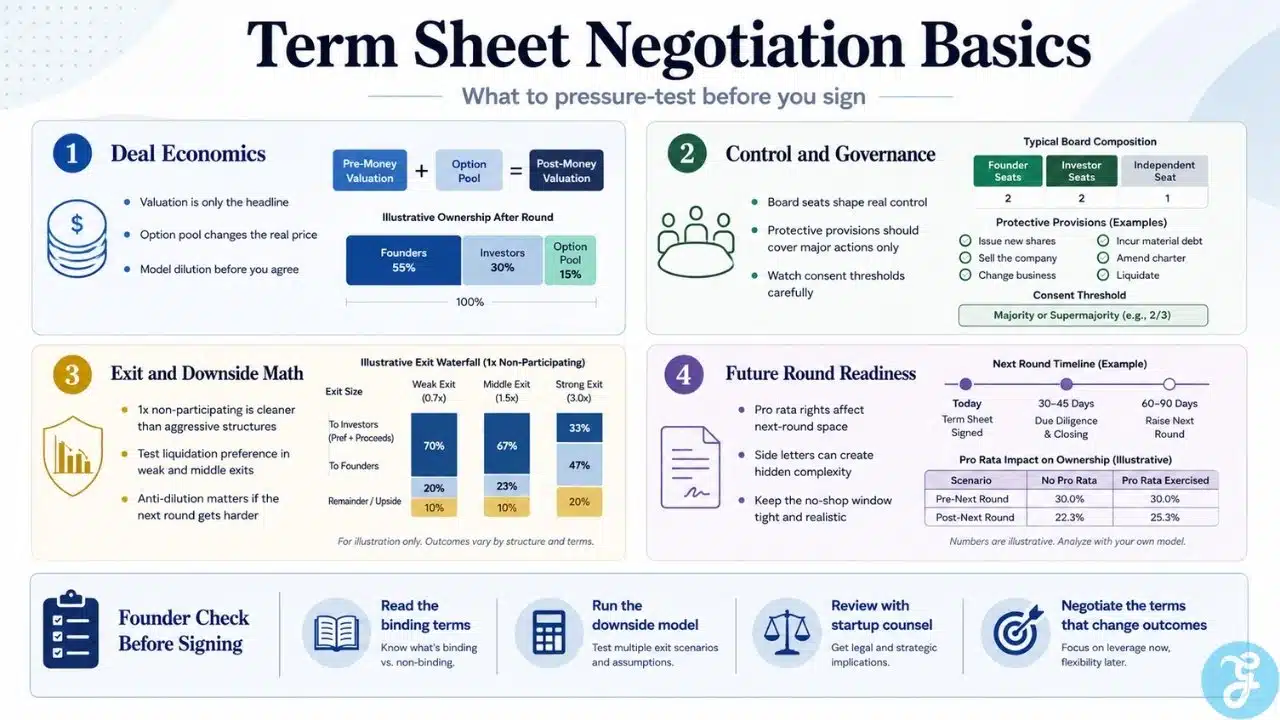
A higher valuation can still leave you with a weaker deal if the option pool is pushed into the pre-money valuation, the liquidation preference takes too much of a modest exit, the board structure shifts control too early, or investor consent rights make normal company decisions harder than they need to be.
A lower valuation with cleaner terms can leave the company easier to run, easier to finance later, and better aligned with employees and future investors.
VC term sheets are not just legal paperwork. They are the first version of the working relationship between the founder, the investor, and the company. A clean term sheet gives the startup capital, gives the investor fair protection, and keeps the company fundable. A messy one may still close, but it can create problems that show up in the next round, the next board meeting, or the first difficult exit discussion.
This term sheet guide focuses on the clauses founders need to understand before negotiating funding terms, especially the terms that look harmless until the company misses plan or the market changes.
The Mirage of Headline Valuation
A term sheet is not the finish line. It is a proposed deal framework.
By the time an investor sends one, they likely want to move toward closing. That does not mean the round is done. Legal diligence, customer calls, investment committee approval, market changes, unresolved cap table issues, or one difficult clause can still slow the process.
The founder’s mistake is treating the term sheet like a trophy. The emotional response is understandable. Fundraising takes time, and getting a written offer feels like validation. But this is the moment to slow down and read the deal, not the moment to relax.
Valuation matters because it tells you how much of the company you are selling. It does not tell you what the deal really costs.
Consider two offers.
Offer A gives the company a $12 million pre-money valuation, but requires a large option pool refresh before the investment, includes participating preferred stock, and gives the investor broad veto rights over budgets and financing decisions.
Offer B gives the company a $10 million pre-money valuation, but includes a clean 1x non-participating liquidation preference, a right-sized option pool, and standard governance terms.
Offer A looks better in a funding announcement. Offer B may be healthier for the company.
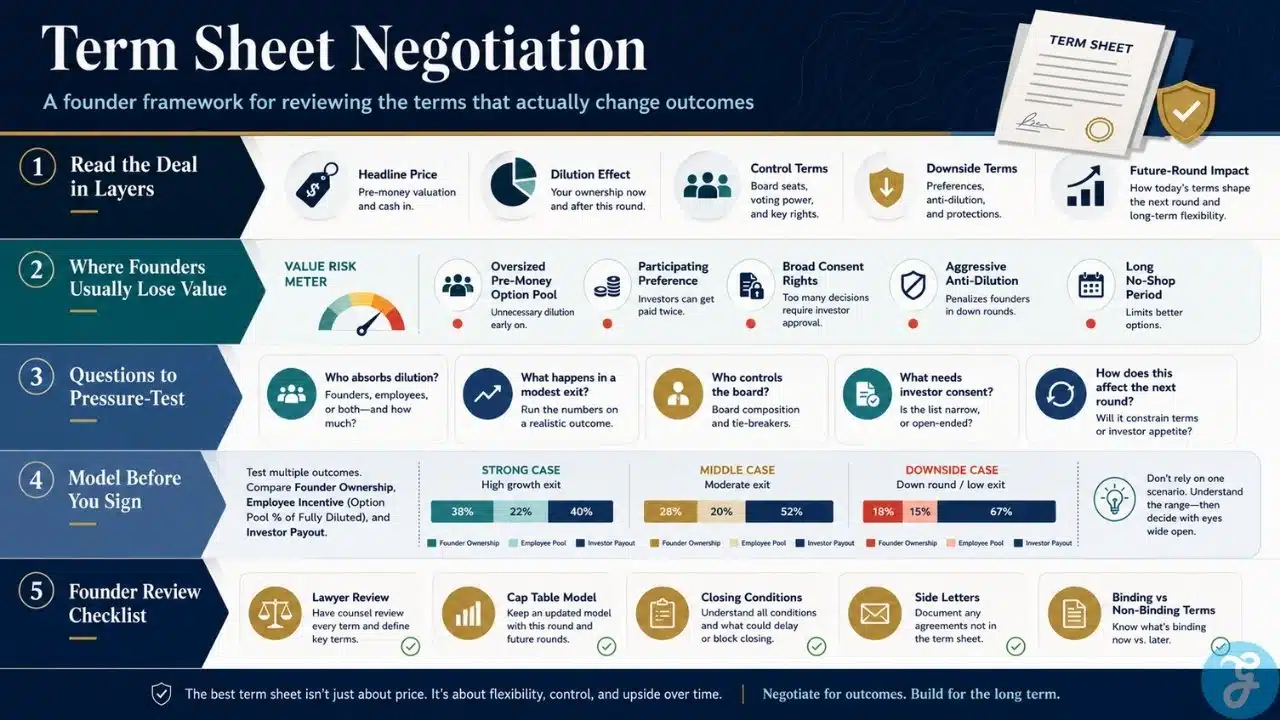
The practical question is not, “Which valuation sounds bigger?” It is, “What do founders and employees own after the round, who controls major decisions, and what happens if the next financing or exit is not perfect?”
The Option Pool Is Part of the Price
The employee option pool is one of the easiest ways for a term sheet to look founder-friendly on the surface while quietly lowering the real economics.
Investors often ask the company to create or expand an option pool before the financing closes. The logic is fair. Startups need equity to hire engineers, sales leaders, product talent, executives, and other key employees.
The negotiation is about who absorbs the dilution.
If the option pool increase happens before the investment, the dilution lands on existing shareholders. That usually means founders, early employees, and earlier investors. If the option pool increase happens after the investment, the new investor shares in that dilution too.
That difference changes the effective valuation.
Say a company raises $2 million at a $10 million pre-money valuation. The headline post-money valuation is $12 million, and the investor expects roughly 16.67% ownership. If the investor also requires a 10% option pool to be created before the investment, the founders absorb that dilution before the new money comes in. The company still advertises a $10 million pre-money valuation, but the founder’s effective price is lower.
This is why the option pool should be negotiated as part of valuation, not treated as a recruiting footnote.
Ask what roles the pool is meant to cover. A planned VP of Sales, two senior engineers, a product lead, and a few customer success hires create a real hiring case. A vague request for “more room” deserves pushback.
The company needs enough equity to recruit. It does not need an oversized unused pool that only protects the investor from future dilution.
Liquidation Preference Decides the Exit Waterfall
Liquidation preference decides who gets paid first when the company sells, merges, or liquidates.
In many standard VC term sheets, investors receive a 1x non-participating liquidation preference. If an investor puts in $5 million, they have the right to get $5 million back before common shareholders receive proceeds. If the company sells for a large enough amount, the investor usually converts into common stock and takes their ownership percentage instead.
That structure is common because it protects the investor in a modest outcome without taking too much away from founders and employees in a strong outcome.
The terms get more painful when participation or multiples appear.
Participating Preferred
Participating preferred lets the investor get their money back first and then also participate in the remaining proceeds based on ownership.
Imagine an investor puts in $5 million for 25% of the company. Later, the company sells for $15 million.
With 1x non-participating preferred, the investor chooses the better result: take the $5 million preference or convert into common and take 25% of $15 million, which is $3.75 million. The investor takes the $5 million preference, and the remaining $10 million goes to common shareholders.
With participating preferred, the investor first takes the $5 million preference. Then the investor also receives 25% of the remaining $10 million, which adds another $2.5 million. The investor receives $7.5 million total from a $15 million exit while owning 25% of the company.
That difference matters most in middle outcomes. The company sells, but not for enough to make everyone comfortable.
Multiple Liquidation Preferences
A 2x liquidation preference on a $5 million investment means the investor gets $10 million before common shareholders receive anything.
If the company sells for $9 million, common shareholders receive nothing. That may be rare in clean early-stage rounds, but it can appear in distressed financings, down rounds, or investor-favorable markets.
Do not negotiate liquidation preference from the best-case exit. Model weak, moderate, and strong exits. If founders and employees receive little or nothing in every realistic middle-case outcome, the deal may keep the company alive while weakening the team’s incentive to keep building.
Board Control Changes How the Company Moves
Board composition looks procedural until the company has to make a hard decision.
The board approves major corporate actions, financing decisions, executive compensation, stock plans, acquisitions, and in some cases leadership changes. A founder may run the company day to day, but the board structure shapes who has authority when the stakes rise.
At early stages, a balanced board might include the founder or founders, one lead investor, and later an independent director both sides respect. That structure gives the investor oversight without handing away control too early.
The risk is a board that looks neutral on paper but is functionally investor-controlled. For example, the investor gets one seat, a co-investor gets another, and the “independent” is someone closely aligned with the fund. In that setup, the founder may still hold the CEO title while losing practical control of major decisions.
This becomes important when the company misses revenue targets, needs a bridge round, considers layoffs, changes strategy, or explores an acquisition offer. Easy board meetings do not test governance. Hard moments do.
Founders should not resist every investor board seat. That is not realistic in many priced rounds. The goal is balance: enough investor oversight to build trust, enough founder control to operate with speed, and enough independence to avoid turning every disagreement into a power contest.
Protective Provisions Can Create Permission Drag
Protective provisions give investors approval rights over certain major company actions.
Some are normal. Investors want a say before the company sells itself, changes the rights of preferred shares, issues senior securities, takes on major debt, or changes the charter in a way that affects their investment.
The problem starts when protective provisions reach into normal operating decisions.
A consent right over major debt may be reasonable. A consent right over small credit lines, routine vendor contracts, modest budget shifts, or normal executive hiring can slow the company down. The issue is not investor protection itself. The issue is scope and thresholds.
Read the dollar limits carefully.
A debt approval threshold at $500,000 may be manageable for a company at a certain stage. A threshold at $50,000 could turn normal equipment financing or working capital decisions into an investor approval process. The same logic applies to budgets, compensation, option grants, related-party transactions, acquisitions, and new financing.
When negotiating funding terms, the goal is not to remove every investor approval right. The goal is to make sure those rights cover major company decisions, not everyday execution.
Ask your lawyer which provisions are standard, which ones are broad, and which thresholds need to move.
Pro Rata Rights Can Crowd the Next Round
Pro rata rights let investors invest in future rounds to maintain their ownership percentage.
For the lead investor, this is expected. Strong existing investors can help future rounds by signaling confidence and putting more capital behind the company.
The risk appears when too many investors receive broad pro rata rights.
A future Series A or Series B lead may want to buy a specific ownership stake. If earlier investors have rights to take a large share of the new round, there may not be enough room for the new lead without forcing extra dilution somewhere else.
This is especially messy when small investors, angels, syndicates, and side-letter holders all receive rights that looked harmless during the seed round.
Keep pro rata rights tied to meaningful investors. Define “Major Investor” carefully. Make sure rights can be waived cleanly. Do not create future round friction just to make today’s close easier.
Information Rights Need Boundaries
Information rights define what company information investors receive and how often they receive it.
Serious investors need visibility. Founders should already be building clean reporting habits: cash balance, runway, revenue, burn, hiring, key metrics, major risks, and progress against plan.
The issue is uncontrolled access.
If too many investors receive detailed information rights, sensitive data can spread too widely. If reporting obligations are too frequent or too detailed for the stage, the founder and finance team lose time to investor administration.
Detailed information rights should usually be limited to major investors. Confidentiality language matters. Reporting cadence matters. The company should communicate clearly without turning every small investor into a custom reporting customer.
Investor updates are useful. A reporting circus is not.
Founder Vesting Is Risk Allocation, Not a Personal Insult
Founder vesting can feel uncomfortable when it appears in VC term sheets. A founder may have spent years building the company before the priced round and then be asked to vest shares again after the investment.
The investor’s concern is not hard to understand. If a founder owns a large stake and leaves soon after financing, the company may be left with a dead ownership block and not enough equity to recruit a replacement. That can make the company harder to finance and harder to operate.
The right answer is not to reject vesting automatically. It is to negotiate the details.
Founders should ask for credit for time already served. A founder who has been building for three years should not casually accept a full four-year reset as if the company started on the financing date.
Acceleration also matters. Double-trigger acceleration can protect a founder if the company is acquired and the founder is later terminated without cause or pushed into a materially reduced role. Single-trigger acceleration, where shares vest immediately on acquisition, is more founder-friendly but can create issues for acquirers. The right structure depends on the company, the investor, and the deal.
Treat founder vesting as risk allocation. The company needs protection if a founder leaves. The founder needs protection if control changes after value has already been created.
Anti-Dilution Protection Can Hit Common Stock Hard
Anti-dilution protection adjusts investor economics if the company later raises money at a lower valuation.
Nobody plans for a down round. That is why founders often skim this clause. They should not.
Broad-based weighted-average anti-dilution is more common and less punitive because it takes the size and pricing of the down round into account. Full-ratchet anti-dilution is much harsher. It reprices the earlier investor’s shares to the new lower price, regardless of how much money is raised in that lower-priced round.
That can heavily dilute founders and employees.
If full-ratchet language appears in a term sheet, push back hard. If the investor insists, model the impact before signing. A clause that feels remote during a strong fundraising moment can become painful if the market shifts or growth slows.
The No-Shop Clause Needs a Short Window
The no-shop clause restricts the company from soliciting or negotiating with other investors for a set period after signing the term sheet.
Investors ask for it because they do not want to spend time and legal fees on diligence while the founder uses their offer to shop the deal around. That is a fair concern.
Founders need to watch duration and timing.
A 30-day no-shop may be reasonable if the investor has completed internal approval and is ready to move into final documentation. A 60-day or 90-day no-shop can become dangerous, especially if runway is short or the investor still has major diligence work left.
Before signing exclusivity, ask what approvals remain, what diligence is still open, and what issues could block closing. If the answer is vague, be careful. Losing investor momentum during a long no-shop can leave the company with less leverage and less time.
A no-shop should focus the closing process. It should not trap the company.
Legal Fees Should Have a Cap
Investor legal fee reimbursement is common in venture deals. The company often pays the lead investor’s legal fees at closing out of the financing proceeds.
That does not mean the amount should be open-ended.
The term sheet should include a clear cap. Without one, the company can end up paying for a legal bill it did not manage. The cap should reflect the stage, complexity, and market norms for the transaction.
For a cleaner seed-stage transaction, founders should ask counsel what fee cap is reasonable. The exact number depends on the deal, but the principle is simple: if the company is paying, the amount should not be unlimited.
Side Letters Can Create Uneven Rights
Side letters give specific investors rights outside the main financing documents.
Some are practical. Others create future friction.
A side letter may include extra information rights, observer rights, pro rata rights, transfer rights, most-favored-nation language, or strategic commercial rights. One reasonable side letter may be manageable. Several inconsistent side letters can make the cap table harder to manage and future rounds harder to negotiate.
This matters when a new lead investor reviews the company later. They will want to know who has special rights, who needs notice, who can invest more, who sees information, and whether any strategic investor has rights that affect commercial flexibility.
Track side letters carefully. Keep them narrow. Do not grant rights to small checks that you would not want the next lead investor to see.
Closing Conditions Can Delay the Wire
Closing conditions are the requirements that must be satisfied before the investment actually closes.
Some are routine: board approvals, stockholder approvals, final documents, corporate cleanup, and satisfactory diligence. Others can create more uncertainty, especially if they require customer contracts, founder employment agreements, IP assignments, litigation cleanup, or unresolved cap table fixes.
The issue is not that closing conditions exist. The issue is whether they leave too much open after the founder has already signed the term sheet and potentially stopped talking to other investors.
Ask what could still block the wire. Ask what needs to be fixed before closing. Ask whether any condition depends on a third party outside the company’s control.
A term sheet is not cash. The round is not done until the documents are signed and the money lands.
What Founders Should Push Back On
Founders do not need to fight every clause. That usually wastes time and makes the negotiation harder than necessary.
Push hardest on terms that affect ownership, control, hiring capacity, future financing, and exit outcomes.
That includes:
- Valuation and option pool treatment
- Liquidation preference and participation
- Board composition
- Protective provision scope and thresholds
- Anti-dilution language
- No-shop duration
- Founder vesting and acceleration
- Pro rata rights
- Side letter rights
- Legal fee caps
Move faster on terms that are truly standard and do not change the company’s future in a meaningful way.
A good startup lawyer helps separate real issues from noise. The best counsel does not turn every sentence into a fight. They tell you where the economic and control risks sit, then help you negotiate those points cleanly.
Model the Bad Cases Before You Sign
Term sheet negotiation gets clearer when founders stop looking only at the best-case version of the company.
Model the uncomfortable scenarios.
What happens if the company sells for $20 million, $40 million, or $75 million? What happens if the next round is flat? What happens if the company needs a bridge round? What happens if the option pool needs another refresh before Series A? What happens if existing investors exercise pro rata rights and a new lead still wants 20% ownership?
You do not need a perfect model. You need an honest one.
Run the exit waterfall. Look at founder ownership. Look at employee outcomes. Look at investor returns. Look at how the option pool changes the math. Then ask whether the team still has enough incentive to keep building in the middle outcomes, not just the home-run outcome.
A clause that looks harmless in isolation may look different once the full cap table is modeled.
The Investor Relationship Starts in the Negotiation
How the investor negotiates tells you something.
Do they explain the terms clearly? Do they answer direct questions? Do they treat every pushback as a problem? Do they hide behind “market standard” without explaining what the term does? Do they pressure the founder to sign before counsel reviews the document?
The founder’s behavior matters too.
A founder who rejects every normal investor protection looks inexperienced. A founder who accepts every term without asking questions looks desperate. The better path is calmer: understand the clause, ask what it does, model the impact, and push back where the company’s future is at risk.
You are not trying to win a point-scoring contest. You are trying to build a deal the company can live with.
Money comes with people attached to it. The term sheet is where that starts becoming visible.
Before You Sign, Make Sure the Company Can Still Breathe
Do not sign a term sheet just because the round has been exhausting and the offer feels like relief.
Read the document. Send it to counsel. Model the economics. Understand what is binding. Understand the no-shop. Understand the option pool. Understand the liquidation preference. Understand the board structure and consent rights. Understand what still has to happen before closing.
Then negotiate the terms that matter.
Term sheet negotiation is not about being difficult. It is about refusing to confuse available money with a good deal.
A clean deal keeps founders, employees, investors, and future financing aligned enough to keep building. A messy deal can close faster and still make the next two years harder than they needed to be.
Before signing, ask one question without softening it: if growth slows, the next round gets harder, or the exit is smaller than planned, do these terms still leave the company room to operate?
If the answer is no, the valuation is not doing enough work to save the deal.