Ask any American when the country declared independence and you’ll get one answer without hesitation: July 4, 1776. It’s printed on the Declaration, stamped on a billion fireworks boxes, and baked into the name of the holiday. But the men in that Philadelphia room voted to break from Britain two days earlier. So why is July 4th Independence Day if the actual decision happened on July 2? The short version: the country ended up celebrating the paperwork instead of the vote, and one of the founders called it years before it happened.
This year the gap is worth revisiting because the 2026 Fourth isn’t an ordinary one. On July 4, 2026, the nation marks the 250th anniversary of the signing of the Declaration of Independence, the Semiquincentennial. Two and a half centuries of celebrating a date that, strictly speaking, commemorates the wrong event.
The Short Answer: Why is July 4th Independence Day?
July 4th is Independence Day because that’s the date the Continental Congress approved the final wording of the Declaration of Independence, and that’s the date printed on the document that circulated across the colonies. The vote to actually separate from Britain came on July 2. But almost nobody saw the July 2 vote; everybody saw the July 4 document. The date on the page won.
That’s the whole thing in a paragraph. The rest is how it happened and why it stuck so hard that even the man who predicted the celebrations got the day wrong.
What actually happened on July 2, 1776
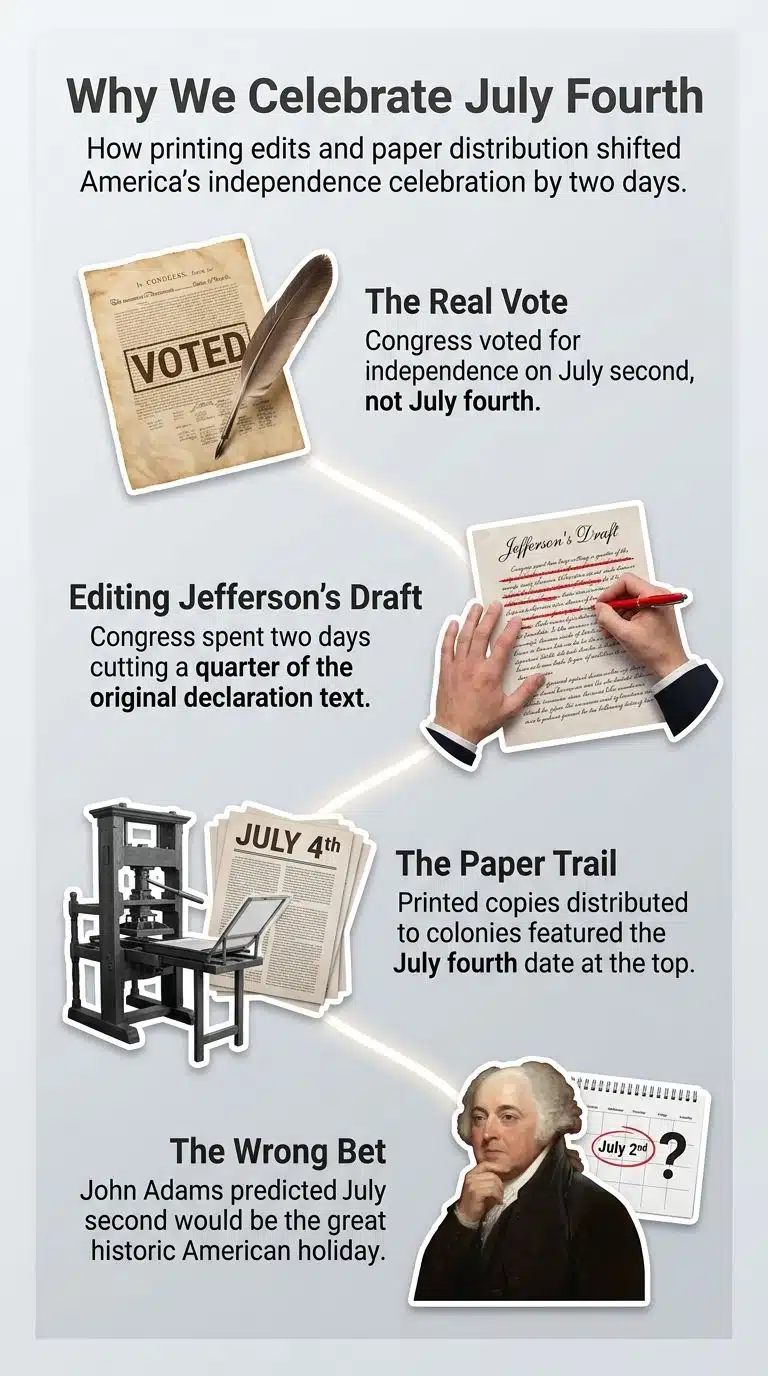
The real vote for independence wasn’t a spontaneous burst of patriotism. It was a motion, debated and tabled, then finally carried after weeks of political maneuvering.
The resolution that did the real work
On June 7, 1776, Richard Henry Lee of Virginia stood in Congress and introduced a blunt resolution: that the colonies “are, and of right ought to be, free and independent States.” This is the sentence that legally severed the tie to Britain. Congress didn’t vote on it right away. Several delegations weren’t authorized to support independence yet, so the matter was postponed for three weeks while cooler heads counted votes and hotter heads lobbied.
In the meantime, Congress appointed a committee of five to draft a formal statement explaining the decision, just in case it passed. Thomas Jefferson did the writing, with Benjamin Franklin, John Adams, Roger Sherman, and Robert Livingston reviewing. Notice the order of operations: the explanation was being written before the vote was taken. The Declaration was always meant to be the announcement of a decision, not the decision itself.
The vote New York sat out
On July 2, 1776, Congress voted on Lee’s resolution. Twelve of the thirteen colonies voted yes. New York abstained, not out of loyalty to the Crown, but because its delegates hadn’t received permission from home to vote either way. (New York’s convention approved independence a week later.) With that vote, the colonies were, in the eyes of the men in the room, no longer part of the British Empire.
That was the moment. July 2 is the day the United States chose to exist. If you wanted a single date to mark independence, this is the historically honest one.
What Happened on July 4?
If the deciding vote was July 2, the obvious question is what the Fourth actually contributed. The answer is editing, and printing.
The document versus the decision
After the July 2 vote, Congress spent the next two days going through Jefferson’s draft line by line. They cut roughly a quarter of his text, including a passage blaming the king for the slave trade, which the southern delegations wouldn’t accept. On July 4, 1776, they approved the revised wording and ordered it printed. So the Fourth marks the approval of a document’s language, not the act of independence, which was already two days old.
Why the date got printed everywhere
Here’s the mechanism that locked July 4 into memory. The night of July 4, printer John Dunlap produced the first published copies of the Declaration, the broadsides that were read aloud in town squares and carried by riders across the colonies. Every one of them carried the same words at the top: “In Congress, July 4, 1776.” That’s the version the public encountered. Ordinary colonists never witnessed the July 2 vote or read the private journals of Congress. They saw a printed sheet dated the Fourth, heard it read from a courthouse step, and that date became the date. Public memory follows the paper trail, and the paper said July 4.
John Adams bet on the wrong date
The best evidence that July 2 was understood at the time as the real milestone comes from John Adams, who was there and voted for it. On July 3, 1776, the day after the vote, he wrote to his wife Abigail with a prediction. He was certain the 2nd of July would become the great American holiday:
“The Second Day of July 1776, will be the most memorable Epocha, in the History of America… It ought to be solemnized with Pomp and Parade, with Shews, Games, Sports, Guns, Bells, Bonfires and Illuminations from one End of this Continent to the other from this Time forward forever more.”
He nailed the celebration down to the fireworks and bells. He just missed the date by two days. Adams reportedly stayed annoyed about it for the rest of his life, and there’s a story that in his later years he’d refuse invitations to Fourth of July events on principle. The date he fought for lost to the date on the printout.
The Signing Myth: August 2, Not July 4
There’s a second layer to the confusion, and it trips up even people who know the July 2 story. Most of the delegates didn’t sign the Declaration on July 4 either.
What Congress approved on the Fourth was the text, printed on Dunlap’s broadsides, which carried only two names: John Hancock, the president of Congress, and Charles Thomson, its secretary. The famous engrossed copy, the big handwritten parchment with all the familiar signatures, wasn’t ready until later. According to the National Archives’ history of the Declaration, most delegates signed it on August 2, 1776, and a few added their names even after that. John Trumbull’s enormous painting, the one on the back of the two-dollar bill, shows the drafting committee presenting their work in June, not a July 4 signing ceremony. The scene most Americans picture never actually happened on the date they picture it.
Three presidents and one very strange date
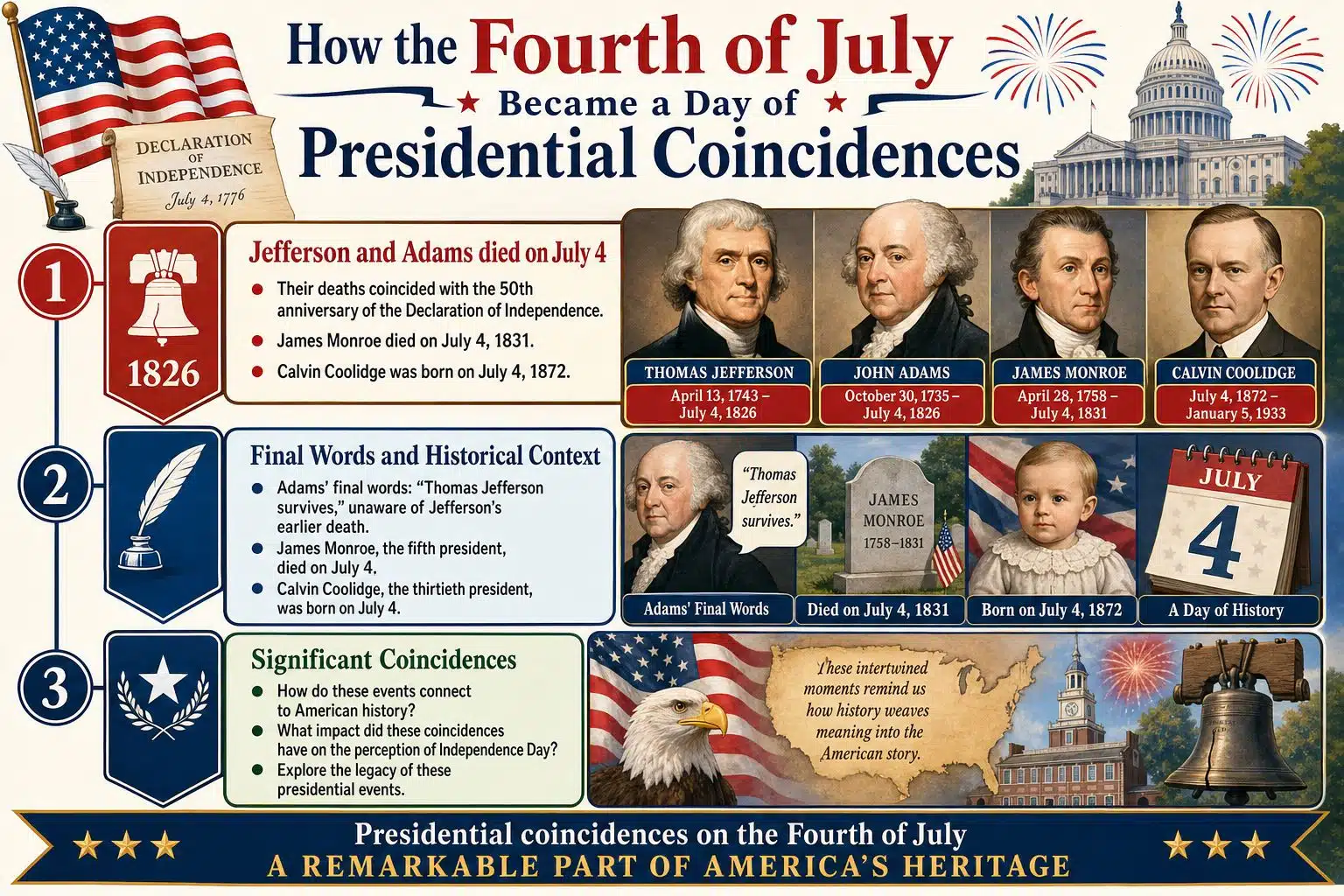
The Fourth of July has a habit of collecting coincidences that sound invented. Both Thomas Jefferson and John Adams died on July 4, 1826, the fiftieth anniversary of the Declaration they’d shaped, within hours of each other. Adams, not knowing his old rival and friend had died earlier that day in Virginia, reportedly said something close to “Thomas Jefferson survives” as his final words. Five years later, James Monroe, the fifth president, also died on July 4, in 1831. And Calvin Coolidge, the thirtieth president, was born on July 4, 1872. Four presidents, one date, and none of it planned.
Does the Wrong Date Actually Matter?
Practically speaking, no. A holiday is a shared agreement, not a historical audit, and July 4 has been that agreement for two and a half centuries. The country made the Fourth official slowly: Congress declared it an unpaid federal holiday in 1870 and a paid one in 1938. The celebrating started much faster. The first Fourth of July celebration in the U.S. came in 1777, when Philadelphia marked the first anniversary with bells, bonfires, and fireworks, exactly the way Adams had imagined, on exactly the day he’d argued against.
What the July 2 story does is add texture to a holiday that’s easy to take for granted. Independence wasn’t a single clean moment. It was a vote, then an edit, then a printing, then a signing weeks later, then decades of argument over what the words actually meant. The messy version is more interesting than the fireworks-box version, and it’s the true one.
The 250th anniversary makes that worth remembering. The semiquincentennial is being marked with a full year of ceremonies, from a special “July 4th” privy mark on Declaration of Independence quarters from the U.S. Mint to an international fleet review in New York Harbor. There’s even a sporting footnote fit for the occasion: part of the 2026 FIFA World Cup runs through Philadelphia, with a Round of 16 match landing on the Fourth itself, which has fans debating whether Argentina can defend its World Cup title in the same city where the Declaration was signed. All of it anchored to a date that commemorates the day the document was approved, two days after the country decided to become one.
Frequently asked questions (FAQs)
Why is July 4th Independence Day and not July 2?
Because July 4 is the date Congress approved the final text of the Declaration of Independence, and that date was printed on every published copy that circulated through the colonies. The public saw the dated document, not the July 2 vote, so the Fourth became the date people remembered and celebrated.
What actually happened on July 2, 1776?
The Continental Congress voted to approve Richard Henry Lee’s resolution declaring the colonies independent from Britain. Twelve colonies voted yes and New York abstained. That vote, not the Declaration two days later, was the legal act of separation.
Did the founders sign the Declaration on July 4, 1776?
Most of them didn’t. The version approved on July 4 was a printed broadside signed only by John Hancock and Charles Thomson. The famous parchment with all the signatures was signed by most delegates on August 2, 1776, and by a few even later.
Who thought July 2 should be Independence Day?
John Adams. In a July 3, 1776 letter to his wife Abigail, he predicted the Second of July would be celebrated forever with parades, fireworks, and bells. He got the festivities right and the date wrong and reportedly resented the Fourth for the rest of his life.
What makes July 4, 2026 different?
It’s the 250th anniversary of the Declaration, the Semiquincentennial. The nation is commemorating 250 years since the signing with a year of national events culminating on the Fourth. If you’re planning your own, here are some fun and unique ways to celebrate the 4th of July.