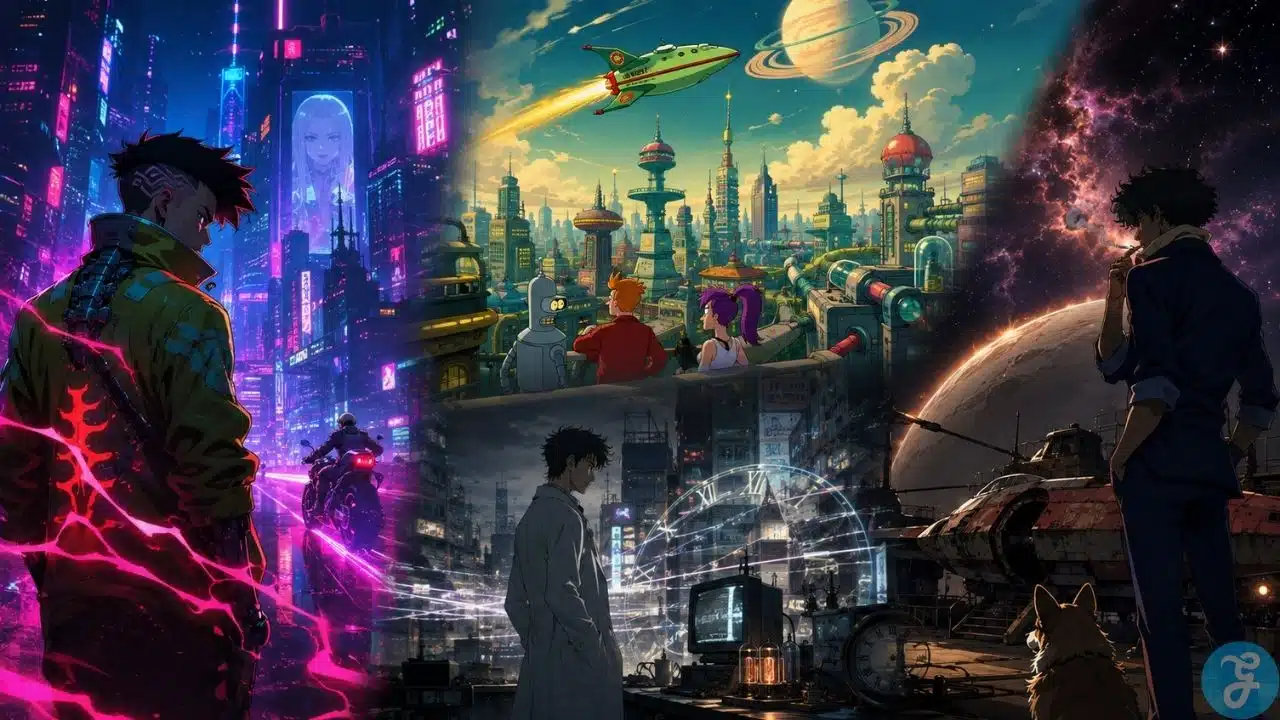
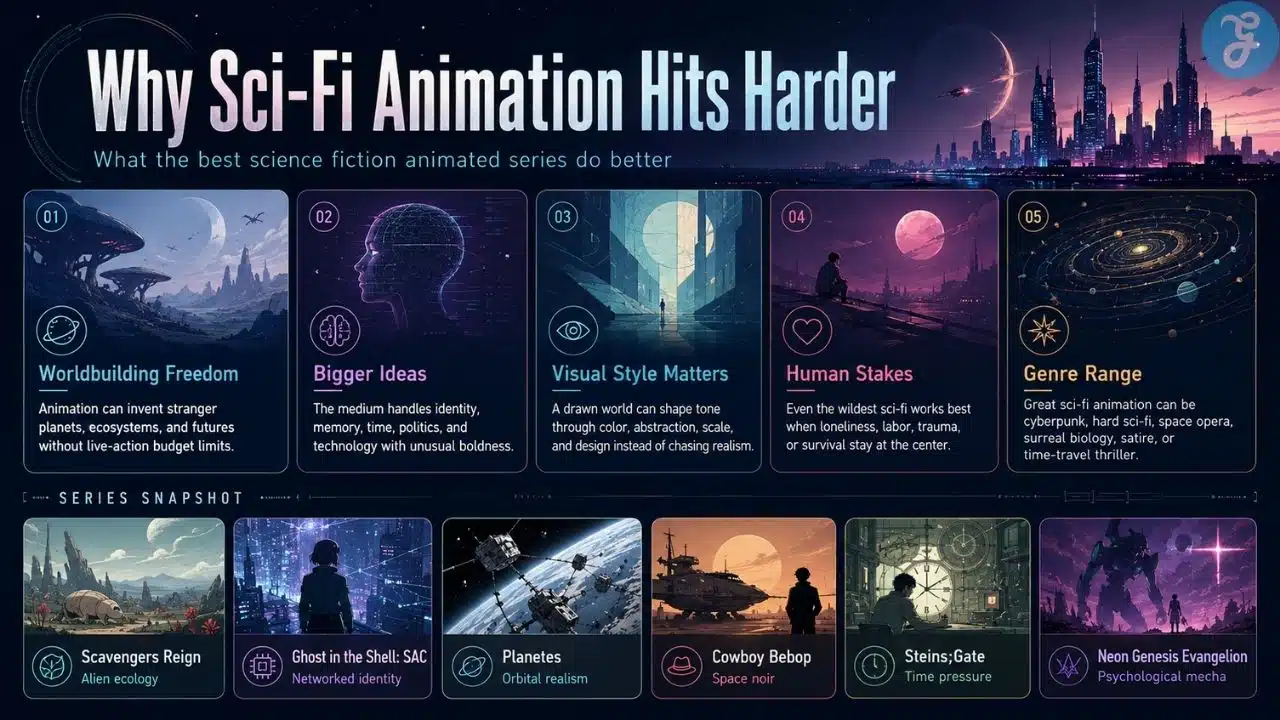
Science fiction animation has always had an unfair advantage: it does not have to ask reality for permission. Animation can simply draw the impossible. It can turn a planet into a living organism, make memory a tradable object, stretch time until it becomes a moral trap, or build a war between democracy and autocracy across the stars without needing to bankrupt a studio.
Whereas a live-action production has to negotiate with budgets, sets, actors, physics, and whatever visual effects pipeline is already on fire.
I often find myself returning to animation when live-action sci-fi starts feeling too cramped for its own ideas. A live-action alien planet often becomes a forest with extra fog. A cyberpunk city becomes neon signs and wet pavement. A space war becomes fleets firing at each other until the budget runs out.
That is why some science fiction animated series can leave you thinking, “Why is this cartoon saying more about humanity than half the prestige dramas on television?”
That is the problem with how animation gets discussed. People still treat it like a side room of science fiction, when it has been doing some of the genre’s boldest work for decades. While live-action sci-fi keeps burning fortunes on green screens, digital sludge, and exhausted franchise jokes, animation has been building stranger planets, sharper political systems, uglier futures, and more honest versions of human collapse.
The shows below deserve to be treated as science fiction animation as art, as philosophy, and as a storytelling weapon. They are not here because they are easy to summarize. They are here because they changed what the medium could do. Not all of them are for comfort watching. Some of these shows are slow. Some are violent. Some are emotionally punishing. A few require more patience than casual viewers may want to give.
The Evolutionary Flashpoints
Before getting to the watch list, it helps to understand the moments where animation escaped the children’s programming corner and started carrying serious intellectual weight.
1988: Legend of the Galactic Heroes begins its 110-episode OVA run and proves animation can handle macro-politics, military history, and ideological decay without needing a live-action empire of sets.
1995: Hideaki Anno releases Neon Genesis Evangelion, turning the giant robot genre into a therapy session with teeth.
1998: Shinichiro Watanabe drops Cowboy Bebop, mixing jazz, noir, space western grit, and corporate rot into something that still looks cooler than half of modern prestige television.
1999: Futurama hides real math, physics jokes, and existential dread behind beer, robots, and workplace comedy.
2002: Ghost in the Shell: Stand Alone Complex brings cybernetic identity, networked terrorism, disinformation, and state power into serialized television.
2003: Planetes ignores laser-gun nonsense and builds drama out of orbital debris, workplace politics, and low Earth orbit physics.
2011: Steins;Gate turns time travel into a pressure cooker instead of a lazy paradox machine.
2022: Studio Trigger takes a broken western video game property and turns Cyberpunk: Edgerunners into a gorgeous corporate meat grinder.
2023: Scavengers Reign arrives and makes most alien planets on television look like theme-park landscaping.
10 Best Science Fiction Animated Series That Fans Shouldn’t Miss
These are not just “good animated sci-fi shows.” They are the series that use animation as a serious speculative tool. Some are easy to watch. Some will punch a hole through your week. All of them understand that a great science fiction animated series should do more than decorate space with neon. Here they are in no particular order:
Scavengers Reign
Scavengers Reign understands alien life better than almost any modern sci-fi animation. Many shows design alien creatures. This one designs an ecosystem. Vesta is not a monster-filled backdrop waiting for humans to arrive. It feels like a biological machine already in motion, full of feeding systems, reproductive cycles, parasites, mimicry, and relationships the stranded humans barely understand.
The series follows survivors of the damaged cargo ship Demeter 227 after they crash on Vesta, a world full of eerie and deadly alien life. Netflix lists Joseph Bennett and Charles Huettner as creators, and the first season has 12 episodes.
What amused me was how little the planet cares about the humans. The creatures are not always hunting them. Sometimes the humans are simply in the way. Sometimes they are useful material. Sometimes they are too ignorant to realize they have stepped into a process much larger than themselves.
That is why Levi, the cargo robot, quietly becomes one of the show’s strongest emotional centers. Levi starts as machinery, then begins changing through contact with Vesta’s biomechanical life. I find that arc more interesting than the usual “robot learns emotion” story because it is not only about feelings. It is about perception. Levi begins to sense the planet in a way the terrified human survivors cannot.
First-time viewers should watch the 12 episodes straight through in release order. The show builds through accumulated biological detail, not through isolated set pieces, so skipping around damages the rhythm. It also helps to give the show quiet. Background noise kills a lot of what makes it special.
Watch Difficulty: Medium
Watch it with: Solo in a dark room, or with mature friends who can handle silence without asking, “So what’s happening?”
Noémie Leroux won a 2024 Emmy for Outstanding Individual Achievement in Animation for background design on the episode “The Dream.” That award makes sense. The backgrounds are not passive scenery. They carry the show’s argument.
Pantheon
Pantheon should be discussed far more often. Not because it is flawless, and not because every viewer will enjoy its density, but because it takes uploaded consciousness more seriously than most prestige live-action sci-fi does.
It is one of the clearest examples of why a science fiction animated series can sometimes handle abstract ideas better than live action. The show does not need to make digital consciousness look “realistic.” It needs to make it feel unstable, intimate, and dangerous.
If a dead person’s mind runs on corporate infrastructure, who owns the mind? If a digital person can think faster than a physical human, does grief happen differently? If a company can preserve someone’s intelligence, can it also exploit that person as labor? The show does not treat immortality as a clean miracle. It treats it as a legal, emotional, and spiritual crisis.
I like how the story begins small: Maddie starts receiving messages that appear to come from her dead father. From there, the show expands into corporate espionage, global competition, family grief, digital personhood, and the politics of minds that no longer need bodies. It is a lot. Sometimes it is almost too much. But that ambition is the reason it belongs here.
Rachel Brooks remains one of the show’s best underappreciated pieces. She is not the loudest character, and she is not driving the main conflict, but her guilt gives the story a necessary human bruise. In a series full of digital minds and strategic warfare, she reminds you that ordinary people still get recruited into monstrous systems one small compromise at a time.
Watch season one in sequence, then move into season two while the details are still alive in your head.
Watch Difficulty: Hard
Watch it with: Partners or close friends who enjoy pausing every twenty minutes to argue about personhood.
Cyberpunk: Edgerunners
Where Pantheon asks you to think, Cyberpunk: Edgerunners instead grabs you by the collar and throws you out a window. At least that’s how I felt.
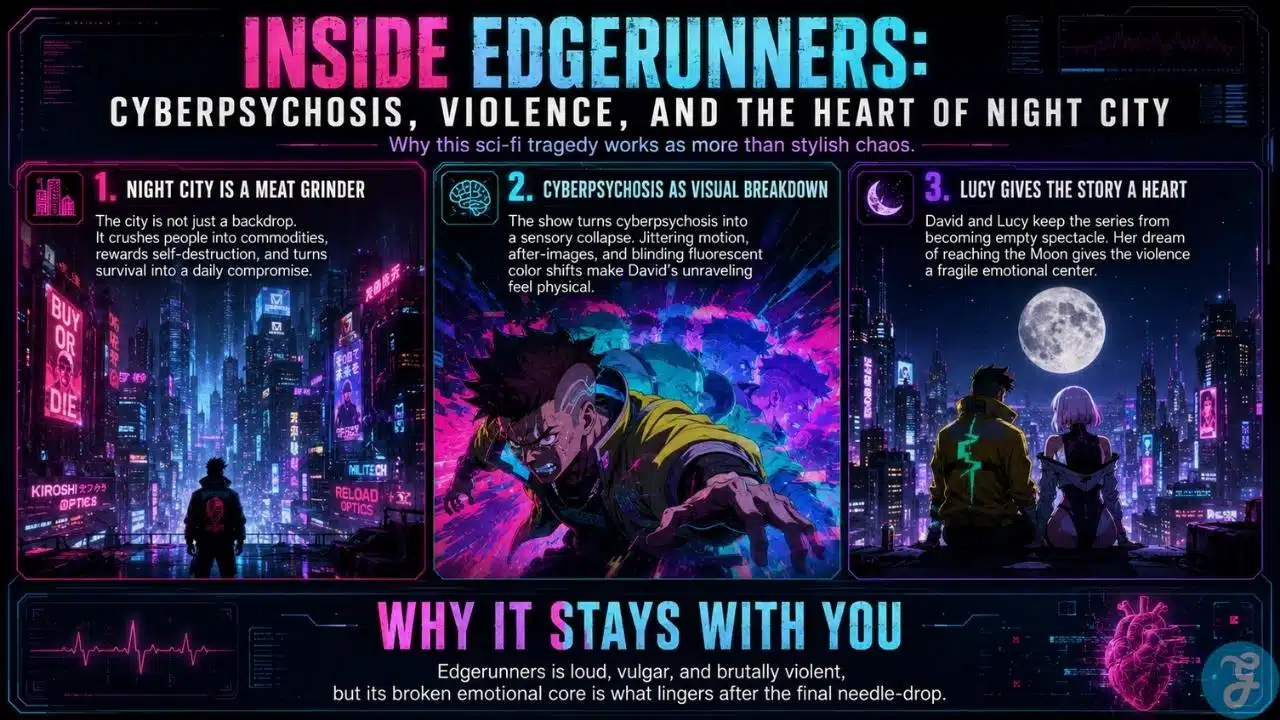
CD Projekt Red described Edgerunners as a standalone 10-episode story about a street kid trying to survive in a future city obsessed with technology and body modification. That setup matters because the body horror is not just visual decoration. It is economic pressure made physical.
David Martinez’s story works because his choices are not framed as clean empowerment. Night City gives him terrible incentives. Upgrade the body. Earn more. Move faster. Become useful. Become feared. Ignore the damage until the damage becomes impossible to separate from the person.
The visual treatment of cyberpsychosis is where Studio Trigger’s style becomes more than flash. The frame jitters. Movement leaves after-images. Color becomes toxic. The show makes mental and physical breakdown feel like a distortion in the image itself.
The 10 episodes are best watched close together, ideally over a weekend. The pacing is built like a runaway train, and stretching it out too much weakens the sense that David is being carried faster than he can think.
Watch Difficulty: Easy
Watch it with: Friends during a weekend watch party, as long as everyone is fine with gore, nudity, and emotional damage arriving in the same package.
Be especially ready for Episode 6. I will not spoil what happens, but that episode changes the shape of the series. Before it, the story can almost pass as a violent rise-through-the-ranks arc. After it, the road narrows.
Planetes
The fact that Planetes finds danger in a job most space operas would ignore really clicked with me. Its characters are not elite pilots, chosen warriors, or royal rebels. They collect orbital trash. Dead satellites, discarded hardware, paint fragments, and debris moving at orbital speed become the threat.
That sounds modest until the show reminds you that space does not need monsters to kill you. It only needs physics.
Planetes won the Seiun Award for Best Dramatic Presentation in 2005, while Makoto Yukimura’s original manga had already won the Seiun comics prize earlier. The recognition makes sense because the series is one of the rare hard sci-fi anime that builds drama from work, regulation, class, and engineering instead of fantasy technology.
The show’s use of Kessler Syndrome is especially strong. The idea is that space debris can become so dense that collisions create more debris, triggering a dangerous cascade in orbit. Planetes turns that scientific risk into a political and moral problem: who gets access to space, who profits from it, and who gets left behind on Earth?
What keeps the series from becoming dry is its workplace texture. People flirt, argue, slack off, dream too loudly, and disappoint each other. The debris section feels like an underfunded department inside a corporate machine, which makes the later geopolitical material hit harder.
First-time viewers should resist the urge to skip the early episodes because they look lighter and more episodic. Those smaller workplace stories create the emotional base for the later political turn. The show needs that ordinary rhythm before it can complicate it.
Watch Difficulty: Medium
Watch it with: Family or partners, especially if they like stories that begin small and slowly reveal the politics underneath.
Ghost in the Shell: Stand Alone Complex
The Stand Alone Complex series is cyberpunk with paperwork, jurisdiction, intelligence files, and public fear. That is what makes it stronger than a lot of slicker cyberpunk. The 1995 film is iconic, but the television series has more room to examine what a networked society does to policing, bureaucracy, terrorism, identity, disability, and state power.
Section 9 investigates terrorism, corruption, and cybercrime in a society where human memories can be hacked and bodies can be replaced. The show’s best idea is the “stand alone complex” itself: people copying behavior without a single leader, creating a social pattern that looks organized even when it is not.
That concept has aged uncomfortably well.
Start with Stand Alone Complex season one, then continue into S.A.C. 2nd GIG if the institutional and political side of the world hooks you. I would not recommend starting here by bouncing between different Ghost in the Shell continuities. The television series works best when treated as its own lane.
What makes the show endure is that it does not reduce cyberpunk to mood. It understands that once the body becomes networked, the state, the corporation, the police file, and the private self all become part of the same battlefield.
Watch Difficulty: Hard
Watch it with: Solo, or with tech-minded friends who enjoy dense political plots and do not panic when a show refuses to explain itself twice.
Neon Genesis Evangelion
I don’t think Neon Genesis Evangelion is difficult to understand because it is “weird.” Plenty of shows are “weird”. Evangelion is difficult because it keeps changing what kind of pain it is asking you to watch.
The original series has 26 episodes, and recent viewing guides still recommend starting with the full television series before moving to The End of Evangelion and then the later Rebuild films. That order matters because the television ending and the film ending do not cancel each other out as neatly as newcomers sometimes assume. They are better understood as different pressures placed on the same wound.
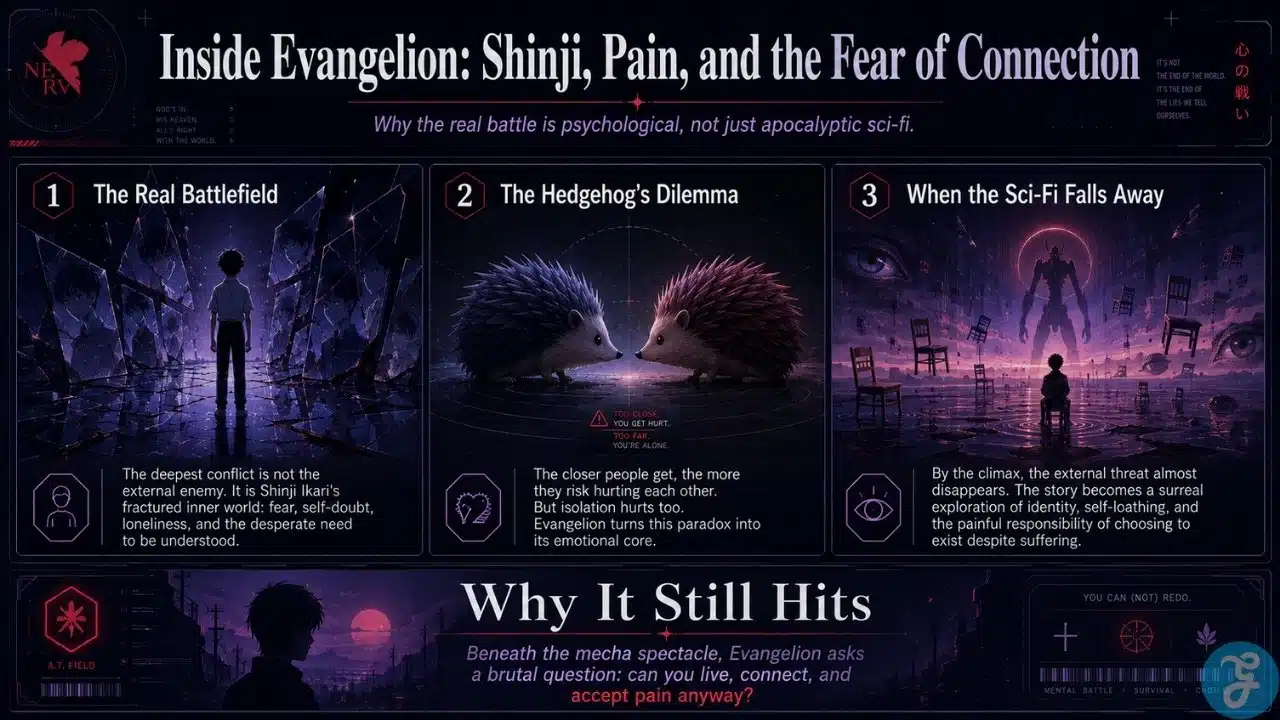
At first, Evangelion looks like a giant robot series with religious imagery and nervous teenagers. Then the machinery starts to feel biological. The pilots look less like heroes and more like children placed inside weapons they do not understand. The organization protecting humanity begins to look morally rotten. The battles become psychological pressure chambers.
The true battlefield is Shinji’s mind. The Hedgehog’s Dilemma gives the series one of its clearest emotional ideas: people need closeness, but closeness can hurt. Isolation protects you from pain and then becomes its own wound. Evangelion takes that problem and pushes it until the whole world seems to collapse into it.
Be especially ready for Episode 18. I will not spoil the specific event, but it changes how the viewer understands the Evangelions, the pilots, and the cost of control. It is one of the points where the series stops letting the viewer enjoy the mecha setup cleanly.
Watch Difficulty: Hard
Watch it with: Solo, unless your watch group is comfortable sitting with depression, isolation, and psychological collapse without making jokes every thirty seconds.
My two cents: Misato Katsuragi deserves more credit as a side character than she often gets. She is not only comic relief, caretaker, or military superior. She is an adult mess trying to protect children inside a system that keeps using them. That contradiction gives the show much of its human sadness.
Cowboy Bebop
Cowboy Bebop is cool in the obvious ways: jazz, bounty hunters, gunfights, cigarettes, old ships, noir lighting, sharp suits, dry jokes, and a future that feels lived in rather than polished. But the show lasts because the coolness is bruised.
As a science fiction animated series, Cowboy Bebop does something deceptively hard. It makes the future feel old. People still need money. They still run from grief. They still make bad meals, take bad jobs, and pretend they are fine.
Sunrise’s official listing describes Cowboy Bebop around Spike and Jet, bounty hunters aboard the Bebop, joined by Ein and Faye Valentine as they chase wanted criminals across space. That summary captures the surface. The deeper story is about people who keep moving because stopping would force them to face what they lost.
Spike Spiegel gets the mythic framing, but I think Jet Black is the soul of the crew more often than he gets credit for. Jet is tired in a very adult way. He has ideals left over from a life that disappointed him. He cooks, fixes the ship, complains about money, and keeps trying to create order around people who resist being cared for.
The episodic structure is one of the show’s strengths. One episode can feel like noir, another like horror, another like a western, another like absurd comedy. That variety makes the world feel wide without burying the viewer in lore. Then the past keeps returning. Quietly at first. Then not quietly.
First-time viewers should watch the 26 sessions in order. The movie, Knockin’ on Heaven’s Door, is better saved until after the viewer understands the crew. Trying to place it too precisely on a first watch is less useful than letting the original series establish its rhythm.
Watch Difficulty: Easy
Watch it with: Anyone who appreciates music, melancholy, and fight scenes that remember cinema exists.
Be especially excited for Episode 5, “Ballad of Fallen Angels.” It is not the finale, and it is not the most obscure pick, but it is the episode where the show first shows how dangerous Spike’s past really is without fully opening the box. The direction, music, and staging make it a turning point.
Steins;Gate
Steins;Gate is the rare time-travel anime that understands the emotional cost of cleverness. It begins with jokes, fake conspiracies, lab-member banter, and Rintaro Okabe’s theatrical “mad scientist” persona. Then the series slowly tightens until the comedy no longer feels like a harmless layer. It starts to look like a defense mechanism.
The anime adaptation was produced by White Fox and aired in Japan in 2011. The main television series is commonly listed as 24 episodes, with later related material including an OVA, a film, and Steins;Gate 0. The story follows Okabe and his friends after their experiments with time messaging pull them into consequences they are not emotionally prepared to handle.
What makes Steins;Gate work is not that time travel is presented as a puzzle box. It is that every adjustment has a human cost. A message sent backward does not just change an abstract timeline. It changes relationships, memory, guilt, and responsibility. The show understands that time travel becomes frightening when the person using it is not a detached scientist but someone desperate to protect people he loves.
For first-time viewers, I would start with the original 24-episode Steins;Gate series and resist the temptation to use complicated chronological orders. After that, Episode 23β and Steins;Gate 0 make more sense as an expansion of the story’s alternate emotional route. The movie works better after the main series, not before it. Watch-order guides often separate release order from chronological order for this reason, because the franchise becomes more tangled once Steins;Gate 0 enters the picture.
Watch Difficulty: Medium
Watch it with: Friends who like slow-burn thrillers and can survive a strange first act without declaring the whole thing “too anime.”
Legend of the Galactic Heroes
Legend of the Galactic Heroes is the kind of series that makes most “epic” television look impatient. The original OVA ran for 110 episodes between 1988 and 1997, adapting Yoshiki Tanaka’s novels into a massive space opera about war, ideology, reform, corruption, and historical memory.
This is not a quick dopamine show. It asks for attention, and then it keeps asking. Give it time, though, and it becomes one of the richest political works in animation.
The central conflict between the Free Planets Alliance and the Galactic Empire is not written as a simple good-versus-evil setup. The democracy is corrupt, decaying, and often cowardly. The empire is autocratic, hierarchical, and brutal, but capable of reform under the right leader. Reinhard von Lohengramm and Yang Wen-li are not just rival commanders. They are opposing arguments about power.
What I find impressive is the show’s refusal to solve politics through spectacle. Battles are massive, but they are not weightless light shows. Logistics matter. Supply lines matter. Command structure matters. Bad institutions can ruin good intentions. Good people can serve damaged systems. Charisma can become terrifying even when it looks noble.
A smoother entrance is to watch My Conquest Is the Sea of Stars, then Overture to a New War, and then move into the main OVA from episode 3. That path gives the central rivalry more room before the long series fully begins. Jumping straight into episode 1 is possible, but it is not the most graceful doorway.
Watch Difficulty: Hard
Watch it with: Solo, or with history and political science nerds who know exactly what they are signing up for.
Futurama
I know Futurama looks like the odd one out beside all this cybernetic misery and space-political despair. That is exactly why I want it here. It proves that a science fiction animated series can be funny, accessible, mathematically strange, and emotionally devastating without changing its face too much.
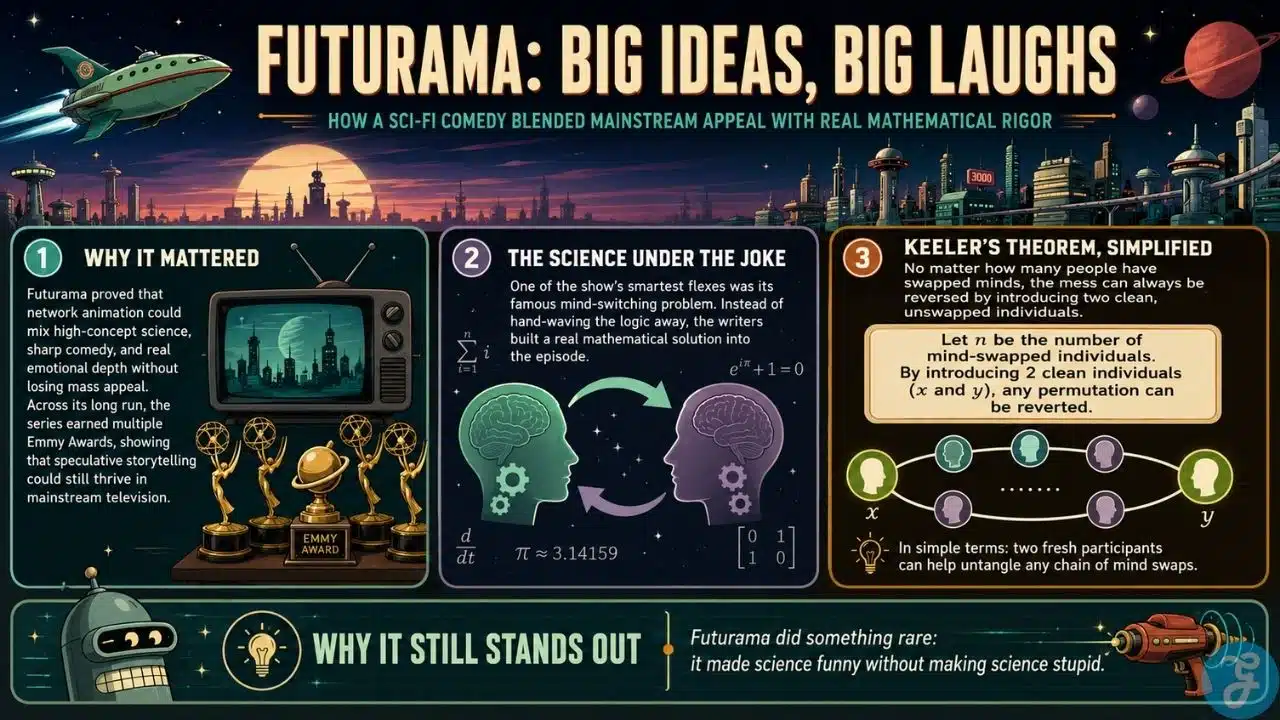
The Television Academy lists Futurama with six Emmy wins, including wins for Outstanding Animated Program. That industry recognition matters, but the show’s real achievement is how much serious science fiction it hides inside jokes.
The most famous example is “The Prisoner of Benda.” Writer Ken Keeler, who has a PhD in applied mathematics, developed a real proof for the episode’s mind-swapping plot. Later mathematical papers have discussed and generalized what became known as Keeler’s Theorem or the Futurama Theorem.
That sounds absurd because it is absurd. It is also wonderful. Most sitcoms use science as decoration. Futurama often builds jokes from actual scientific, mathematical, or philosophical premises, then lets the punchline land before the viewer has fully processed how nerdy the setup was.
The original Fox run is the best starting point, followed by the four feature-length films, then the Comedy Central seasons and later revival material. Release order works because the show’s emotional callbacks build over time, and the later material lands better once the viewer understands the crew’s older rhythms.
Watch Difficulty: Easy
Watch it with: Almost anyone, from casual family viewers to friends who enjoy jokes with footnotes.
I loved Hermes Conrad. He is easy to reduce to bureaucracy jokes, but his obsession with rules gives the show a very specific kind of future texture. The universe may contain aliens, mutants, robots, and time travel, but someone still has to file the forms.
Be especially ready for “The Late Philip J. Fry.” I will not spoil the mechanism, but it is one of the cleanest examples of Futurama turning cosmic scale into something painfully personal.
How These Science Fiction Animated Series Actually Work
Instead of turning this into a dead academic grid, here is the useful breakdown. Each show earns its place because it brings a different kind of speculative pressure.
| Show Title | Sub-Genre | What Makes It Work | Visual Identity | The Real Aftertaste |
|---|---|---|---|---|
| Scavengers Reign | Speculative xenobiology | Humans are not the center of the ecosystem. They are visitors, food, tools, or mistakes. | Clean surrealist lines, strange biology, quiet environmental dread. | You feel small, and the show is right to make you feel that way. |
| Pantheon | Uploaded intelligence | The human mind becomes labor infrastructure. Capitalism immediately starts chewing. | Controlled, grounded, almost too normal, which makes the horror sharper. | Death looks less final, but exploitation gets worse. |
| Cyberpunk: Edgerunners | Dystopian cyberpunk | Body modification becomes ambition, addiction, and corporate disposal. | Neon violence, distorted motion, Studio Trigger excess with purpose. | The system does not need to kill your dreams. It can sell them back to you as upgrades. |
| Planetes | Hard sci-fi | Space is a job, not a fantasy. Debris, class, labor, and politics drive the drama. | Mechanical realism, grounded movement, practical orbital danger. | The future still has bad bosses and ugly economics. |
| Ghost in the Shell: SAC | Tech noir cyberpunk | Identity spreads, mutates, and gets weaponized through networks. | Clean urban tech mixed with military restraint. | The self starts looking less private than you hoped. |
| Cowboy Bebop | Space western noir | The solar system expands, but nobody outruns grief. | Jazz rhythm, noir shadows, cinematic framing. | Coolness is just sadness with better music. |
| Steins;Gate | Time-travel thriller | Tiny changes create unbearable moral consequences. | Muted spaces that grow colder as timelines fracture. | Control over time is mostly another way to suffer. |
| Legend of the Galactic Heroes | Military space opera | Democracy and autocracy both get examined without cartoon shortcuts. | Classical space-opera scale with restrained character design. | History keeps repeating because people keep calling ambition destiny. |
| Neon Genesis Evangelion | Deconstructive mecha | The robot is a body, the pilot is a wound, and the war is psychological. | Biological horror, surreal montage, emotional claustrophobia. | The genre mask falls off and trauma is underneath. |
| Futurama | Satirical space comedy | Real science hides inside stupid jokes, and the stupid jokes are often great. | Bright sitcom animation with sneaky technical depth. | The universe is huge, absurd, and occasionally kind. |
The Expansion Pack: 15 Crucial Additions to Your Watch List
Once you finish the ten masterclasses, do not go crawling back to whatever generic streaming carousel is yelling at you. These fifteen shows are worth tracking next.
- Serial Experiments Lain: A reclusive girl gets pulled into a networked reality where identity, divinity, and the internet start bleeding into each other. It feels less like “old internet sci-fi” and more like a warning people ignored because the modem sounds were funny.
- Ergo Proxy: A dome-city dystopia, self-aware androids, wasteland exile, and enough philosophical gloom to make your living room feel under-lit. It is heavy, stylish, and occasionally ridiculous in the way ambitious sci-fi is allowed to be.
- Psycho-Pass: Imagine a society where a system measures mental stability and predicts criminal potential before action happens. Yes, it is basically authoritarianism with a user interface. That is the point.
- Texhnolyze: A discarded fighter receives weaponized prosthetics and sinks into a subterranean war over power, mutation, and human collapse. Not fun. Not friendly. Not interested in your comfort.
- Outlaw Star: A freelance handyman inherits an experimental spaceship and gets thrown into treasure hunting, space combat, and late-90s sci-fi chaos. It is messy in a way modern shows are often too brand-managed to be.
- Trigun Stampede: A pacifist gunman wanders a desert planet while trying to stop catastrophe without becoming the violence everyone expects from him. The newer visual approach will annoy purists, but the core moral engine still works.
- Space Dandy: A vain alien hunter stumbles through genre experiments, timeline breaks, and cosmic jokes. Do not demand consistency from it. The show is having more fun than you are.
- Mobile Suit Gundam: Iron-Blooded Orphans: Child laborers on Mars seize control of their own survival and weaponize an old mobile suit in a brutal political struggle. It is one of the better Gundam entries for people who want class conflict with their giant robots.
- Macross Plus: Rival test pilots, experimental aircraft, and an AI pop star capable of hijacking mass desire. The hand-drawn mechanical work still embarrasses plenty of newer productions.
- Kaiba: Memories are digitized, bodies are traded, and identity becomes unstable property. It looks soft and strange, then casually walks into existential horror.
- Knights of Sidonia: Humanity survives inside a massive seed ship after Earth’s destruction, fighting shape-shifting alien entities with mechanized frames. The CG may divide viewers, but the survival premise has teeth.
- Gargantia on the Verdurous Planet: A young soldier crashes onto a flooded Earth where people live on linked ships instead of galactic battlefronts. The show works because it lets culture shock matter.
- Id:Invaded: Detectives enter the unconscious landscapes of serial killers to solve crimes from the inside. Think dream logic, trauma mapping, and procedural storytelling shoved into the same machine.
- Dennou Coil: Children use augmented reality glasses to hack, explore, and chase glitches through a city layered with digital ghosts. It understands childhood curiosity better than most “kids and technology” stories.
- Erased: A man is pulled eighteen years into the past to stop a childhood kidnapping. The time-travel rules stay simple, which is exactly why the emotional tension works.
Animation Was Never the Backup Plan
These shows matter because they treat science fiction as a serious narrative frontier, not a bucket of shiny tropes. They are not here to sell toys, pad a streaming catalog, or give bored adults something to half-watch while checking their phones.
The best science fiction animated series use the freedom of the drawn line to go where live action often cannot. They build impossible ecosystems, digital afterlives, orbital workplaces, cybernetic states, wounded gods, and cosmic jokes without asking whether a studio can afford the set.
That is the real lesson here. Animation is not a lesser substitute for live-action science fiction. At its best, it is the superior weapon.