Ever feel like Droven IO cybersecurity updates sound important, but you still are not sure what to do with them? In 2026, that question matters because attackers move faster, AI writes better lures, and one missed fix can turn into real downtime.
Think of Droven IO cybersecurity updates as a practical decision guide. They help you stay ahead of cyber threats, sort real security trends from noise, and turn the latest security headlines into actions your team can actually follow.
I’ll walk you through what these updates cover, what they do not cover, and the 2026 action plan that makes the biggest difference first.
What Droven IO Cybersecurity Updates Cover
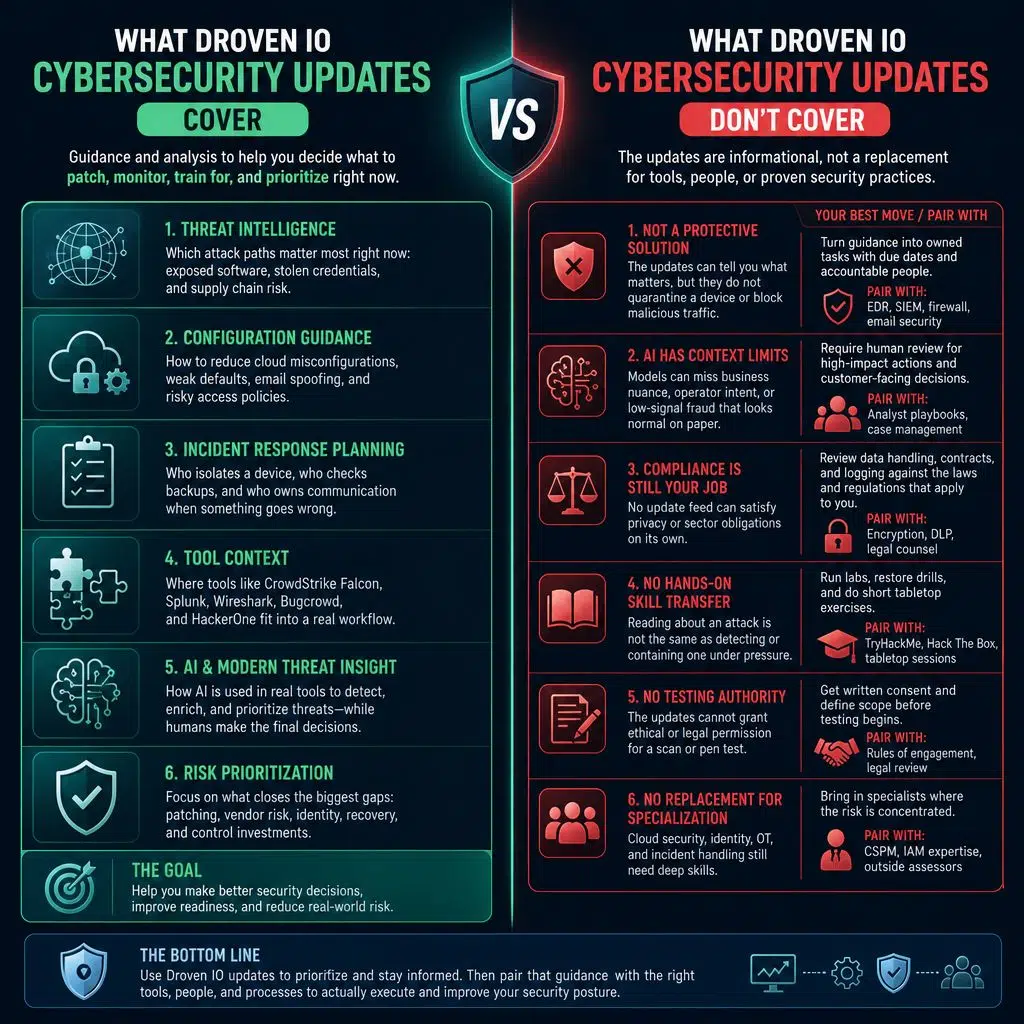
For most readers, Droven IO cybersecurity updates are best understood as guidance and analysis, not as software that sits in your environment. They should help you decide what to patch, what to monitor, what to train for, and which controls deserve budget right now.
As of May 2026, Verizon’s latest DBIR says software vulnerability exploitation now starts 31% of breaches, third-party exposure shows up in 48% of breaches, and ransomware appears in 48% of breaches. That is why useful updates focus on patching, vendor risk, identity, and recovery, not just awareness.
- Threat intelligence: which attack paths matter most right now, such as exposed software, stolen credentials, and supply chain risk.
- Configuration guidance: how to reduce cloud misconfigurations, weak defaults, email spoofing, and risky access policies.
- Incident response planning: who isolates a device, who checks backups, and who owns communication when something goes wrong.
- Tool context: where products like CrowdStrike Falcon, Splunk, Wireshark, Bugcrowd, and HackerOne fit into a real workflow.
How do Droven IO updates address modern cyber threats?
The most helpful updates connect each threat to a control. You do not need one more scary headline. You need to know what closes the gap.
For phishing, that often means tightening DMARC, SPF, and DKIM on your sending domain. Google and Yahoo have required DMARC for bulk senders since 2024, so email authentication is now both a deliverability issue and a security issue.
For ransomware, the focus shifts to fast isolation, protected backups, and patching remote access systems before attackers chain a known flaw into a full outage. CISA’s Known Exploited Vulnerabilities catalog matters here because it lets you rank fixes by evidence of active abuse, not just by a severity label.
- Detect: alert on suspicious email, endpoint behavior, unusual sign-ins, and token misuse.
- Contain: use your EDR to isolate the host and lock the account if the evidence is strong.
- Recover: verify clean backups, open the incident ticket, and hand a clear evidence bundle to a human analyst.
That is what updates should really cover: faster containment, cleaner recovery, and fewer handoffs built on guesswork.
How does Droven IO use AI for threat detection?
In practice, the updates track how artificial intelligence shows up inside the tools you already use. The update itself is guidance. The AI work happens in products like CrowdStrike Falcon on endpoints, analytics inside Splunk, and behavior models that help your security team prioritize noise.
That distinction is important. AI can flag odd network traffic, suspicious macros, or unusual user behavior fast, but Wireshark still matters when you need packet-level proof of what actually crossed the wire. AI speeds triage. It does not remove the need for verification.
The FBI’s 2025 IC3 report added an artificial intelligence section for the first time, logging 22,364 AI-related complaints and nearly $893 million in losses. For you, that means urgent payment requests, voice calls, and executive impersonation now need a second-channel check every time.
If you want AI to help instead of create noise, start with narrow jobs: enrich alerts, summarize evidence, suggest next steps, and open tickets. Keep final authority for account lockouts, legal notices, and production shutdowns with a person.
What Droven IO Cybersecurity Updates Don’t Do
Here is the boundary that trips people up: Droven IO cybersecurity updates are not a managed SOC, not an EDR platform, not a backup service, and not a compliance certificate. They help you make better decisions. They do not secure your network by themselves.
That means reading the updates without fixing identity, logging, backups, and cloud posture will not change your security posture very much. Good information still needs execution.
What are common misconceptions about Droven IO’s capabilities?
- Myth: AI makes all the decisions. Reality: AI can rank suspicious activity, but people still own containment, recovery, and business impact decisions.
- Myth: Updates replace employee training. Reality: phishing, smishing, QR scams, and voice cloning still depend on human judgment at the last mile.
- Myth: Updates solve privacy and compliance. Reality: you still need access to reviews, encryption, retention rules, vendor oversight, and legal review for rules that apply to your business.
- Myth: Updates give you permission to test any system. Reality: written authorization and rules of engagement still come first for penetration testing.
In which cybersecurity areas does Droven IO have limitations?
| Limitation | What It Means in Practice | Your Best Move | Helpful Pairing |
|---|---|---|---|
| It is informational, not protective | The updates can tell you what matters, but they do not quarantine a device or block malicious traffic. | Turn guidance into owned tasks with due dates and accountable people. | EDR, SIEM, firewall, email security |
| AI has context limits | Models can miss business nuance, operator intent, or low-signal fraud that looks normal on paper. | Require human review for high-impact actions and customer-facing decisions. | Analyst playbooks, case management |
| Compliance is still your job | No update feed can satisfy privacy or sector obligations on its own. | Review data handling, contracts, and logging against the laws and regulations that apply to you. | Encryption, DLP, legal counsel |
| No hands-on skill transfer | Reading about an attack is not the same as detecting or containing one under pressure. | Run labs, restore drills, and do short tabletop exercises. | TryHackMe, Hack The Box, tabletop sessions |
| No testing authority | The updates cannot grant ethical or legal permission for a scan or pen test. | Get written consent and define scope before testing begins. | Rules of engagement, legal review |
| No replacement for specialization | Cloud security, identity, OT, and incident handling still need deep skills. | Bring in specialists where the risk is concentrated. | CSPM, IAM expertise, outside assessors |
If you want a simple rule, use Droven IO to prioritize and stay informed, then pair that guidance with tooling and owners who can actually execute.
Key 2026 Cybersecurity Trends from Droven IO
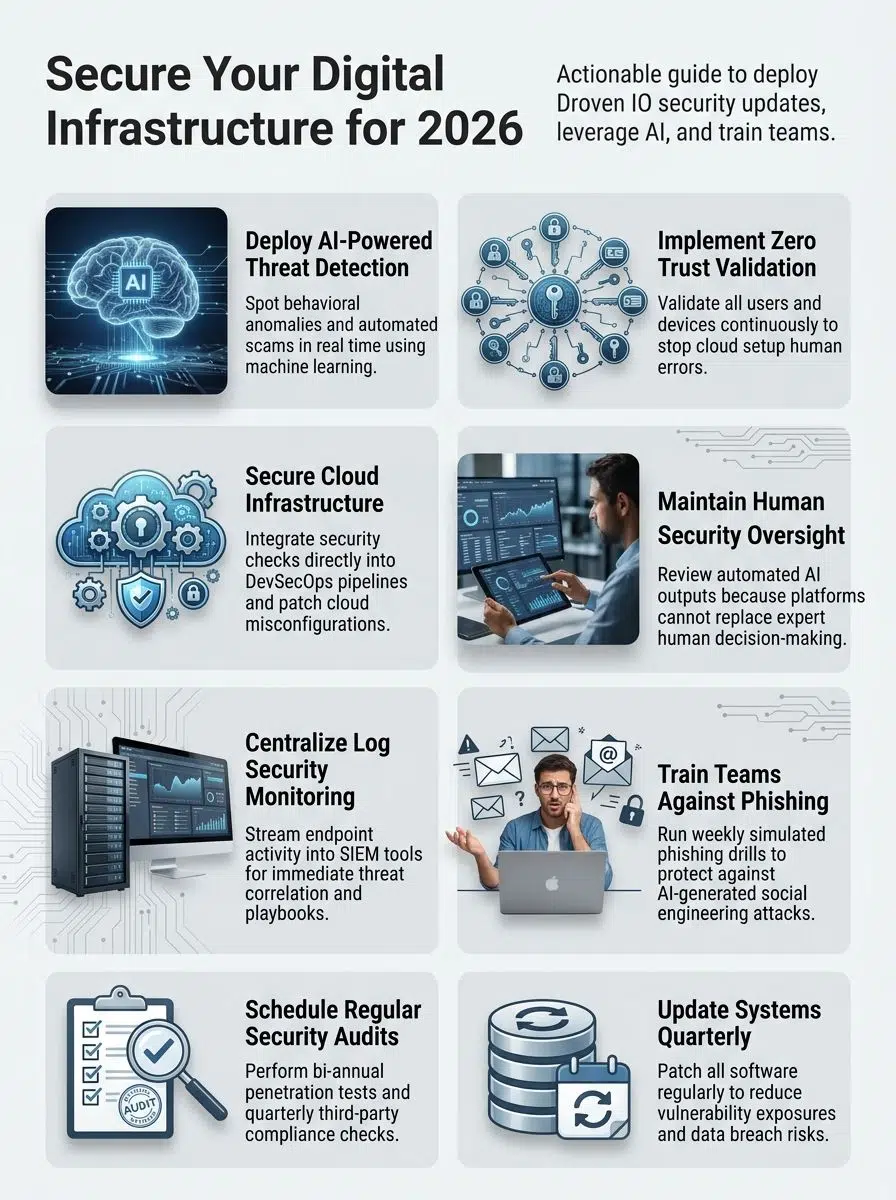
The big 2026 shift is speed. Agentic AI helps defenders automate low-value work, while attackers use faster targeting, better lures, and quicker exploit research.
That is why Zero Trust Security, cloud security, security analytics, device protection, strong backups, and deepfake awareness now belong in one response plan. Updates matter more than ever because point fixes do not hold up well against machine-speed attacks.
Verizon’s May 2026 summary also notes that 15% of attack techniques are now being bolstered by generative AI, and mobile social engineering gets click rates 40% higher than traditional email phishing.
How is agentic AI changing threat detection and response?
Agentic AI works best when you give it bounded jobs. Let it pull endpoint context, compare a new alert with past incidents, enrich a case, or recommend which credentials to rotate first.
Do not let it quietly block a supplier, wipe a host, or trigger a customer notice without review. A staged rollout is safer than handing full control to automation on day one.
- Safe first automations: evidence collection, alert enrichment, ticket creation, duplicate suppression.
- Human approval required: executive account lockouts, production network blocks, public communications, ransom decisions.
- Best success metric: lower time to triage and a cleaner analyst handoff, not just a bigger automation count.
That is the practical value here. Agentic AI should reduce drag for your security team, not hide bad decisions behind a fast workflow.
Why is Zero Trust Security becoming more important?
Zero trust matters because your environment no longer ends at the office wall. It includes SaaS apps, remote admins, contractor laptops, mobile devices, and vendor identities that often stick around longer than the project they were created for.
In its 2025 practice guide, NIST documented 19 example zero trust implementations built with 24 collaborators. That tells you zero trust is no longer just a concept slide. You can build it in stages with identity checks, device posture, microsegmentation, and policy-based access.
- Start with admin accounts and remote access.
- Move high-risk users to phishing-resistant MFA or passkeys where possible.
- Block unmanaged devices from sensitive apps.
- Review stale internal and third-party accounts every month.
If nobody owns access review, zero trust turns into a slogan. If someone owns it, zero trust becomes one of your best protection strategies.
What advances are happening in cloud security and data protection?
Cloud security is getting better at continuous checking. AWS Security Hub CSPM runs automated checks at least every 24 hours, and Microsoft Defender for Cloud offers continuous assessments and recommendations across Azure, AWS, and Google Cloud.
For Microsoft 365 and Google Workspace, CISA’s SCuBA project gives teams secure configuration baselines. That is useful when you know the broad goal, like reducing risky sharing or tightening audit logging, but need product-level settings to make the rule real.
| Cloud Security Task | Named Tool or Baseline | Why It Helps |
|---|---|---|
| Continuous posture checks | AWS Security Hub CSPM | Flags misconfigurations and failed controls before they sit exposed for weeks. |
| Multicloud recommendations | Microsoft Defender for Cloud | Shows findings and hardening steps across hybrid and multicloud setups. |
| SaaS baseline hardening | CISA SCuBA | Gives a practical starting point for Microsoft 365 and Google Workspace settings. |
Your action item is simple: pick one owner for cloud posture. When nobody owns public storage, guest access, or stale keys, the same problems keep coming back.
Droven IO’s Recommended Actions for 2026
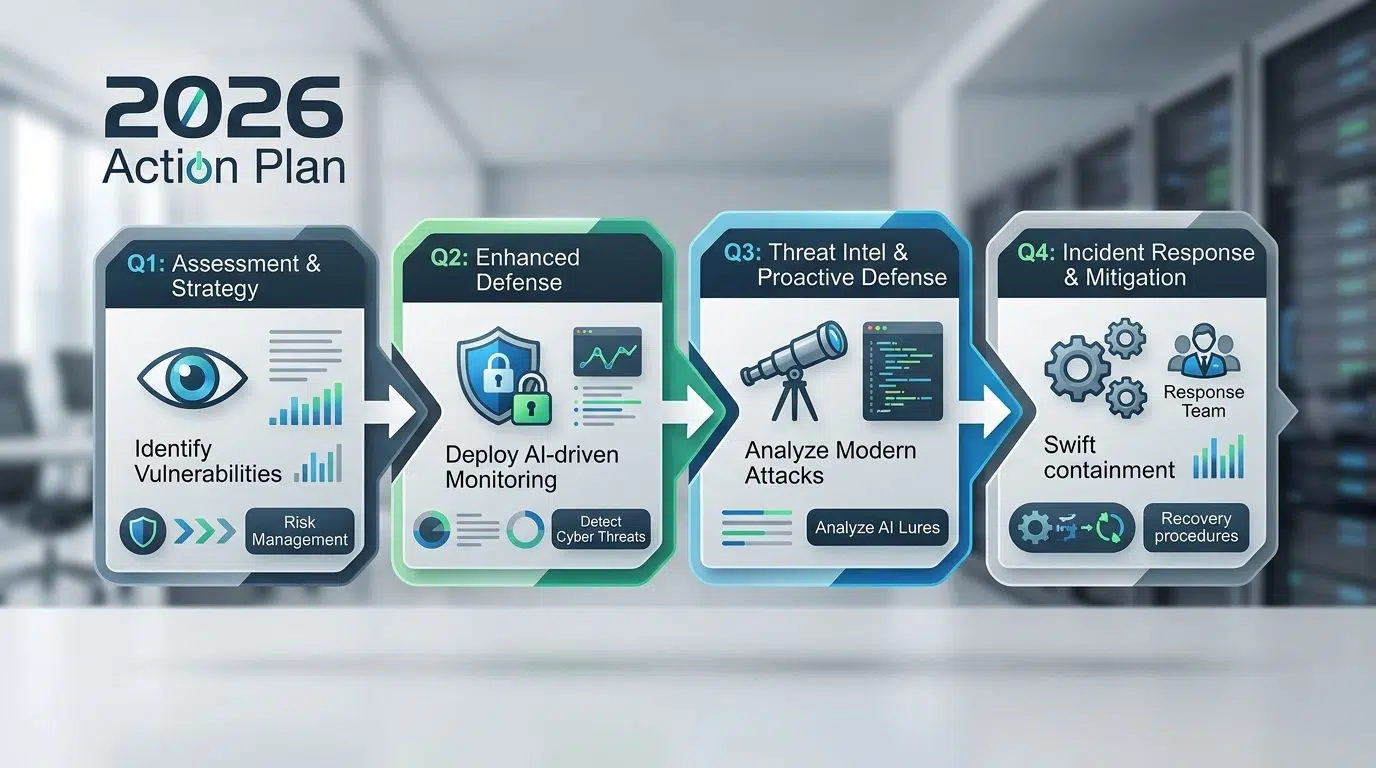
So what should you do next? Start with proactive threat detection, but tie it to a short list of controls you can actually operate. The goal is not to buy every security product. The goal is to close the most common entry points, reduce dwell time, and make recovery boring.
How can you implement proactive threat detection strategies?
Centralize logs in a security information and event management platform such as Splunk, pair it with endpoint telemetry from CrowdStrike Falcon, and keep Wireshark ready for packet-level validation when an alert needs proof.
| Priority | Action for the Next 30 Days | Named Examples | Why It Belongs Early |
|---|---|---|---|
| Identity | Require MFA everywhere you can, then move admins and finance users to phishing-resistant methods first. | Passkeys, hardware keys, conditional access | Credential abuse still stays near the top of real breach paths. |
| Endpoint visibility | Deploy or tune EDR, verify host isolation works, and map alert severities to clear response steps. | CrowdStrike Falcon | You need fast containment before ransomware or lateral movement spreads. |
| Centralized detection | Stream identity, endpoint, firewall, VPN, and cloud logs into one place with usable dashboards. | Splunk, alert correlation rules | A scattered view slows incident response and hides patterns. |
| Exposure reduction | Scan routinely, rank issues against real exploitation evidence, and patch internet-facing systems first. | Nessus, CISA KEV catalog | In 2026, unpatched software is the top breach entry point. |
| Cloud posture | Turn on continuous cloud checks and send high-severity findings into your backlog. | AWS Security Hub CSPM, Microsoft Defender for Cloud | Misconfiguration is still one of the fastest ways to expose data. |
| Recovery | Protect backups from deletion, test restores, and confirm recovery roles before an outage happens. | Immutable backups, restore drills | Backups are only useful if they restore cleanly under pressure. |
If your budget is tight, do identity, endpoint coverage, centralized logging, and backup validation first. Those four moves usually change risk faster than adding another dashboard.
Train for the channels attackers use now, not just the ones you used to worry about. NIST’s small business phishing guidance asks whether employees are regularly trained and whether they know how to report a phish, and CISA offers a six-week Phishing Campaign Assessment because behavior data beats a once-a-year slideshow.
- Cover email, text, voice, QR code, and fake login pages in the same training program.
- Give finance, HR, executive assistants, and help desk staff role-based drills because they receive the highest-impact requests.
- Require callback verification for payroll changes, gift card requests, vendor bank changes, and urgent wire asks.
- Track both click rate and report rate. A rising report rate is often the better sign that people know what to do.
- Make reporting easy, ideally one click in email and a short path in chat or ticketing.
- Use TryHackMe or Hack The Box for technical staff so detection skills do not stay theoretical.
One insider tip matters a lot here: people report faster when they know they will not be punished for a near miss. If your culture shames mistakes, you suppress the signal your security team needs most.
How often should you update your digital security infrastructure?
Use two clocks, one for emergency changes and one for routine hygiene. CISA’s ransomware guidance puts fast updates on VPNs, remote access systems, network devices, antivirus signatures, and backups at the top of the list because attackers keep targeting the paths that open the door fastest.
| Area | Minimum Cadence | What to Review |
|---|---|---|
| Internet-facing and KEV-listed software | Weekly, and faster for emergency fixes | Vendor advisories, active exploitation evidence, compensating controls, rollback plan |
| Identity and access | Monthly | Admin groups, dormant accounts, MFA coverage, risky sign-ins, third-party access |
| Cloud security configurations | Monthly | Public exposure, storage sharing, IAM drift, logging gaps, baseline exceptions |
| Backups and recovery | Quarterly restore test | Clean restore point, immutable copy, recovery time, business owner signoff |
| Pen testing and external validation | Semiannual or after a major change | Web apps, identity flows, internet edge, high-risk vendor integrations |
Recheck sooner after a merger, a major SaaS rollout, remote work expansion, or a new AI deployment. Those are the moments when old assumptions stop matching the threat landscape.
Final Words
Droven IO cybersecurity updates work best when you treat them as a practical guide, not as a product that secures your environment for you.
Use them to prioritize patching, strengthen zero trust security, train staff against modern phishing, and verify that your backups and incident response still hold up. Do that, and Droven IO cybersecurity updates become a real 2026 action plan instead of just more noise in the digital world.
Frequently Asked Questions (FAQs) on Droven IO Cybersecurity Updates
1. What are Droven IO cybersecurity updates?
Droven IO cybersecurity updates refer to short notes on the latest developments in digital security. They track how the cybersecurity landscape continues to evolve, and they flag new security challenges.
2. Why should my organization follow them?
Following Droven IO cybersecurity updates can help organizations spot digital risks fast. The notes guide security practices, and they help teams act before trouble grows.
3. What do the updates highlight?
They highlight security challenges, from threat (computer security) and vulnerability (computer security) to social engineering (security) tactics. They also share cybersecurity intelligence and note new security technologies.
4. How often are updates published?
Droven IO cybersecurity updates frequently come out, so staying current with Droven IO matters.
5. What should my 2026 action plan include?
Start with a quick audit, then apply patch (computing) steps and keep software updated. Add checks for scalability, and test how artificial intelligence and cybersecurity tools behave; do not treat them like a magic wand.
6. Where can I find more help?
Explore resources like Droven IO and other guides that explore Droven IO cybersecurity updates. These resources provide valuable tips, and they serve teams that want to evolve their defense.