

Keyword research used to be simple: find search volume, check difficulty, write the article, and hope Google behaved. That world is gone. Today, the best keyword research tools need to help you understand search intent, SERP competition, content gaps, paid search signals, and whether a keyword is even worth chasing in the first place.
This keyword tools list compares full SEO suites, beginner-friendly platforms, free tools, and niche keyword software ranked for real-world use. Some tools are excellent for agencies managing dozens of campaigns. Others are better for bloggers, small businesses, affiliate sites, or PPC teams that just need clean keyword ideas without drowning in dashboards.
Our Selection Criteria
Before comparing tools, it is important to be clear about what “best” means here. A keyword tool is only useful if it helps you make better content and SEO decisions, not just export a huge spreadsheet you never use.
| Criteria | What We Looked For |
|---|---|
| Keyword data quality | Search volume, difficulty, CPC, intent, trends, and related keyword ideas |
| SERP usefulness | Whether the tool helps you judge ranking difficulty beyond a basic score |
| Competitive research | Ability to reveal competitor keywords, gaps, and ranking opportunities |
| Ease of use | How quickly a marketer, founder, blogger, or SEO team can act on the data |
| Value for money | Whether the tool justifies its cost based on depth, workflow, and scale |
| Best-fit user | Who will get the most practical value from the tool |
The goal is not to crown one tool as perfect for everyone. The goal is to help you choose the right keyword software for your budget, skill level, and publishing strategy.
Whom This Keyword Tools List Is For
This comparison is useful if you are trying to choose a keyword research tool without wasting weeks testing every platform. It is especially relevant for bloggers, niche site owners, SEO freelancers, content teams, startup marketers, PPC specialists, and agencies building repeatable search workflows.
If you only publish one article a month, you probably do not need a premium enterprise SEO suite. But if keyword research drives revenue, client deliverables, or a large content calendar, the right tool can save hours and prevent expensive content mistakes.
9 Best Keyword Research Tools Compared for SEO and Content Strategy
The tools below are ranked by practical usefulness, not just brand popularity. This top keyword research comparison weighs data depth, workflow quality, affordability, and how well each tool helps you move from keyword idea to content decision.
1. Semrush
Semrush is the strongest all-around choice for marketers who want keyword research, competitor analysis, PPC insights, rank tracking, and content planning in one place. Its Keyword Magic Tool and Keyword Overview features are especially useful for building topic clusters, finding related terms, and checking keyword intent before writing. It is one of the best options for agencies, serious content teams, and businesses that want a complete SEO command center. The main reason it ranks first is that it does not stop at keyword ideas; it helps connect those ideas to competitors, content gaps, and commercial opportunities.
Best Feature/For:
- Best for full SEO campaigns, competitor keyword gaps, and content teams.
- Strong for combining organic SEO, paid search, and content strategy.
Why We Chose It:
- Excellent keyword discovery depth for broad and long-tail research.
- Strong competitor analysis helps reveal what already works in your niche.
- Helpful intent and SERP data make content planning less guessy.
- Better suited for teams that want one platform instead of several smaller tools.
Things to consider:
- It can feel overwhelming for beginners.
- Pricing may be too high if you only need occasional keyword ideas.
2. Ahrefs
Ahrefs is a favorite among SEO professionals because it combines keyword research with strong backlink, competitor, and SERP analysis. Its Keywords Explorer is especially useful when you want to evaluate whether a keyword is realistic based on clicks, difficulty, parent topics, and ranking pages. Ahrefs is not just a keyword tool; it is a research platform for understanding why pages rank. For users who care deeply about organic search competition, Ahrefs deserves a high place in any keyword software ranked comparison.
Best Feature/For:
- Best for SEO professionals who want deep SERP and competitor analysis.
- Strong for evaluating ranking difficulty beyond surface-level metrics.
Why We Chose It:
- Excellent for studying competing pages before choosing a keyword.
- Useful keyword metrics help separate attractive keywords from misleading ones.
- Strong backlink data supports better ranking feasibility decisions.
- Works well for SEO teams that care about both content and authority.
Things to consider:
- Some users may find it more technical than beginner-focused tools.
- It is not the cheapest option if you only need simple keyword suggestions.
3. SE Ranking
SE Ranking is one of the strongest value-focused SEO platforms for teams that want keyword research plus rank tracking, site audits, competitor research, and reporting. It is a good middle ground between expensive enterprise-style suites and lightweight keyword tools. The interface is generally approachable, and the platform works well for freelancers, small agencies, and in-house marketers who need broad SEO functionality without paying for the biggest names. It earns a top-three position because it balances depth, usability, and cost better than many alternatives.
Best Feature/For:
- Best for freelancers, small agencies, and growing SEO teams.
- Strong for users who want keyword research and rank tracking together.
Why We Chose It:
- Offers a practical mix of keyword research, audits, and reporting.
- Good choice for managing multiple projects or clients.
- More approachable than some advanced SEO suites.
- Strong value if you need more than keyword ideas alone.
Things to consider:
- It may not match Ahrefs for deep backlink-led research.
- Some advanced features may require higher-tier plans.
4. Google Keyword Planner
Google Keyword Planner is the most important free tool for advertisers and still useful for SEO research when used carefully. It helps users find keyword ideas, estimate search demand, understand paid competition, and plan Google Ads campaigns. For SEO, its main value is that it comes directly from Google’s advertising ecosystem, but its ranges and PPC-first framing can limit organic content decisions. It works best when paired with another SEO-focused tool rather than used alone.
Best Feature/For:
- Best free option for PPC keyword planning and basic search demand research.
- Strong for advertisers building Google Ads campaigns.
Why We Chose It:
- Free to use with a Google Ads account.
- Helpful for CPC, paid competition, and campaign planning.
- Good starting point for validating commercial keyword demand.
- Useful for finding related keyword ideas from seed terms.
Things to consider:
- It is built primarily for advertisers, not organic SEO strategy.
- Search volume ranges can be broad and less useful for precise content planning.
5. Moz Keyword Explorer
Moz Keyword Explorer is a good choice for users who want keyword research without the intimidation factor of heavier SEO suites. It is known for clean keyword suggestions, difficulty metrics, SERP analysis, and prioritization features that help beginners and small teams make sense of keyword opportunities. Moz is especially useful when you want to compare keywords quickly and avoid getting buried in excessive data. It may not be the deepest tool in every category, but it is one of the easiest to understand.
Best Feature/For:
- Best for beginners and small teams that want clear keyword prioritization.
- Strong for users who value simplicity over dashboard complexity.
Why We Chose It:
- Clean interface makes keyword evaluation easier.
- Good balance of keyword difficulty, opportunity, and SERP context.
- Helpful for users learning SEO fundamentals.
- Works well for small businesses that do not need every advanced feature.
Things to consider:
- Advanced SEO teams may want deeper competitive data.
- Data limits can matter if you research large keyword sets often.
6. KWFinder by Mangools
KWFinder is one of the most approachable keyword research tools for bloggers, affiliate marketers, and small businesses. Its biggest strength is simplicity: enter a seed keyword, review long-tail ideas, check difficulty, and move toward a content decision quickly. The Mangools ecosystem also includes related SEO tools, but KWFinder remains the core attraction for users who want keyword discovery without a steep learning curve. It is especially useful for finding lower-competition opportunities in smaller niches.
Best Feature/For:
- Best for simple long-tail keyword research.
- Strong for bloggers, niche sites, and beginner SEO users.
Why We Chose It:
- Very easy to use compared with heavier SEO platforms.
- Good for finding low-difficulty keyword opportunities.
- Clean workflow helps users move quickly from research to content planning.
- Useful for small websites that need realistic ranking targets.
Things to consider:
- Not as deep as Semrush or Ahrefs for competitor intelligence.
- Better for keyword discovery than full SEO campaign management.
7. LowFruits
LowFruits is built for a specific but valuable job: finding keywords where weaker sites already rank. Instead of relying only on keyword difficulty scores, it analyzes SERPs for weak spots such as forums, low-authority websites, and smaller publishers. This makes it especially useful for niche sites, affiliate blogs, and new websites that need realistic ranking opportunities. LowFruits is not the broadest SEO platform, but it can be excellent when your priority is finding achievable content ideas.
Best Feature/For:
- Best for finding low-competition SERP opportunities.
- Strong for niche publishers, affiliate sites, and newer domains.
Why We Chose It:
- Focuses on actual SERP weakness, not just generic difficulty scores.
- Helpful for identifying keywords smaller websites can realistically target.
- Good for long-tail content planning.
- Useful when larger tools produce too many competitive keyword ideas.
Things to consider:
- It is more specialized than a full SEO suite.
- You may still need another tool for audits, backlinks, or broader competitor research.
8. Ubersuggest
Ubersuggest is a budget-friendly SEO tool that covers keyword ideas, volume, CPC, competition, competitor research, and basic SEO analysis. It is particularly useful for beginners, solo founders, and small businesses that want a lower-cost entry into keyword research. The tool is not as deep as Semrush or Ahrefs, but that can also be part of its appeal: it gives enough data to start making decisions without overwhelming new users. For budget-conscious users, it remains a practical option.
Best Feature/For:
- Best for budget-conscious beginners and small businesses.
- Strong for quick keyword ideas and basic SEO checks.
Why We Chose It:
- Easier entry point than many premium SEO tools.
- Covers keyword volume, CPC, and competition in a beginner-friendly format.
- Useful for quick competitor and content idea research.
- Good for users who are still learning SEO workflows.
Things to consider:
- Advanced SEO professionals may find the data and workflow less powerful.
- It is better as a starter tool than a complete agency-grade platform.
9. Keyword Tool
Keyword Tool is a strong option for long-tail keyword discovery, especially when you want autocomplete-based ideas from platforms beyond Google. It is useful for SEO, YouTube, Amazon, app store, and international keyword research because it helps uncover phrases people naturally type into search boxes. This makes it valuable for content ideation, ecommerce research, and multilingual keyword expansion. It ranks lower than full SEO suites because it is more focused on discovery than full competitive analysis.
Best Feature/For:
- Best for autocomplete-based long-tail keyword discovery.
- Strong for YouTube, Amazon, ecommerce, and multilingual research.
Why We Chose It:
- Excellent for finding keyword variations that broader tools may miss.
- Supports research across multiple platforms.
- Useful for ecommerce and content teams looking beyond Google SEO.
- Simple workflow makes it good for fast idea generation.
Things to consider:
- It is not a complete SEO suite.
- Deeper metrics and advanced analysis often require a paid plan.
A Quick Overview
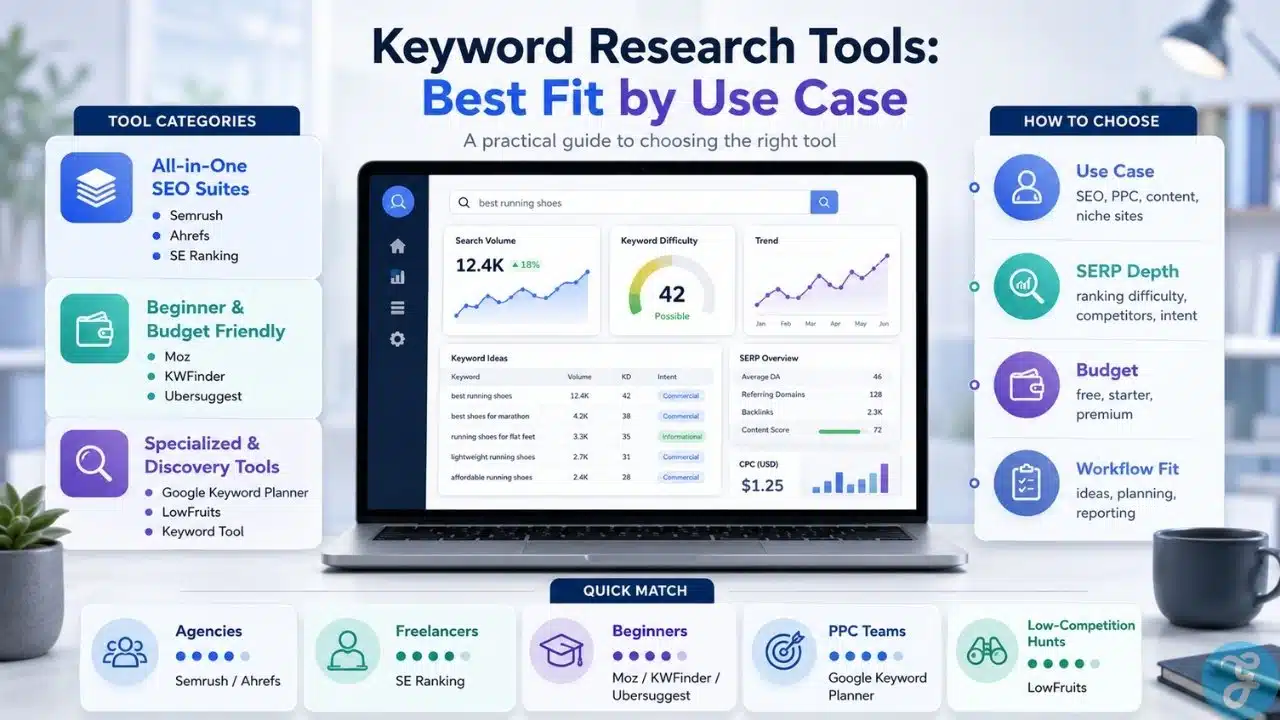
By now, the main pattern should be clear: some tools are built for serious SEO operations, while others are better for quick ideation or low-competition discovery. Here is a side-by-side snapshot to help you compare them faster.
Overview Comparison
| Rank | Tool | Best For | Main Strength | Biggest Limitation |
| 1 | Semrush | Agencies and content teams | Full SEO and competitor research | Can feel complex and costly |
| 2 | Ahrefs | SEO professionals | SERP, backlink, and ranking analysis | Less beginner-friendly |
| 3 | SE Ranking | Freelancers and small agencies | Value-focused SEO suite | Some advanced features need higher plans |
| 4 | Google Keyword Planner | PPC teams and free research | Google Ads keyword demand data | PPC-first, not SEO-first |
| 5 | Moz Keyword Explorer | Beginners and small teams | Clear prioritization and usability | Less deep for advanced competitor work |
| 6 | KWFinder | Bloggers and niche sites | Simple long-tail keyword research | Not a full SEO command center |
| 7 | LowFruits | Newer sites and affiliate publishers | SERP weakness discovery | Specialized use case |
| 8 | Ubersuggest | Budget beginners | Affordable keyword and SEO basics | Less advanced than premium suites |
| 9 | Keyword Tool | Long-tail and platform research | Autocomplete keyword expansion | Limited full SEO analysis |
This comparison should make the buying decision less emotional. The most expensive tool is not automatically the best choice, and the simplest tool is not automatically too basic.
Our Top 3 Picks and Why?
For most serious SEO workflows, three tools stand out above the rest. They cover different user needs, so the “best” choice depends on how you actually work.
| Pick | Best Match | Why It Stands Out |
| Semrush | Best overall SEO and content platform | Strong keyword research, competitor gaps, PPC data, and content planning in one workflow |
| Ahrefs | Best for SEO professionals | Excellent SERP, backlink, and competitive research for judging ranking difficulty |
| SE Ranking | Best value SEO suite | Good balance of keyword research, tracking, audits, and reporting for growing teams |
If you run client campaigns or publish at scale, Semrush is the safest all-around pick. If your SEO strategy depends heavily on ranking feasibility and competitor analysis, Ahrefs is hard to ignore. If you want a capable SEO platform without jumping straight into the highest-cost tier of the market, SE Ranking is the practical middle path.
How to Choose the Right Keyword Research Tool for Your SEO Workflow
Choosing software is easier when you stop asking, “Which tool is best?” and start asking, “Which tool fits my actual decisions?” A freelancer publishing five articles a month does not need the same keyword workflow as an agency managing 40 client campaigns.
The Selection Framework
- Start with your use case: Choose a full SEO suite for campaigns, a simple keyword tool for blogging, or a niche tool for low-competition discovery.
- Check the SERP depth: A useful keyword tool should help you understand who ranks now, not just show a difficulty number.
- Match cost to publishing volume: Premium tools make more sense when keyword research directly drives revenue or client output.
- Look for workflow fit: The right tool should help you move from keyword idea to content brief, not just export a spreadsheet.
A smart keyword stack may include more than one tool. For example, you might use Google Keyword Planner for PPC demand, LowFruits for weak SERPs, and Semrush or Ahrefs for competitive research.
The Final Checklist
Before choosing from this keyword software ranked comparison, run through these five checks:
- Does the tool show keyword intent, difficulty, and SERP context clearly?
- Can it help you find long-tail keywords your site can realistically rank for?
- Does it support competitor research or only seed keyword expansion?
- Is the pricing justified by how often you will use it?
- Can your team turn the data into content briefs, pages, or campaigns quickly?
If the answer is “no” to most of these, the tool may look impressive but fail in daily use. The best tool is the one that improves decisions, not the one with the most decorative dashboard.
The Smarter Way to Think About Keyword Tools
The uncomfortable truth is that keyword tools do not guarantee rankings. They estimate demand, reveal patterns, and reduce uncertainty, but they cannot replace judgment, strong content, topical authority, technical SEO, or links. The best keyword research tools are decision-support systems, not magic traffic machines.
The future of keyword research will likely become more intent-based, SERP-aware, and influenced by AI search behavior. Search volume alone will matter less if users get answers directly from AI results, snippets, forums, videos, and marketplaces. That means the winners will be marketers who use keyword tools to understand demand and then create content that deserves to be chosen.
My practical view: Do not buy the most advanced tool until your workflow is advanced enough to benefit from it. Start with the tool that helps you publish smarter today, then upgrade when your content system, team, or revenue justifies deeper research.
Frequently Asked Questions (FAQs) About Best Keyword Research Tools
What are the best keyword research tools for beginners?
KWFinder, Moz Keyword Explorer, Ubersuggest, and Google Keyword Planner are good beginner-friendly options. They are easier to understand than more advanced SEO suites and help users learn keyword volume, difficulty, and search intent basics.
Which keyword research tool is best for agencies?
Semrush, Ahrefs, and SE Ranking are the strongest choices for agencies. They support competitor analysis, rank tracking, reporting, and broader SEO workflows beyond simple keyword discovery.
Can I do keyword research for free?
Yes, you can start with Google Keyword Planner, Google Trends, free keyword generators, and limited free versions of paid tools. However, free tools usually have limits around search volume precision, competitor data, SERP analysis, or export capacity.
Is keyword difficulty always accurate?
No, keyword difficulty is only an estimate. You should also inspect the actual SERP, ranking page quality, backlink strength, search intent, domain authority, and whether smaller sites are already ranking.
Do I need more than one keyword research tool?
Many serious SEO teams use more than one. A common setup is one full SEO suite for competitor and SERP analysis, plus a niche tool for long-tail keywords, trends, PPC validation, or low-competition opportunities.