

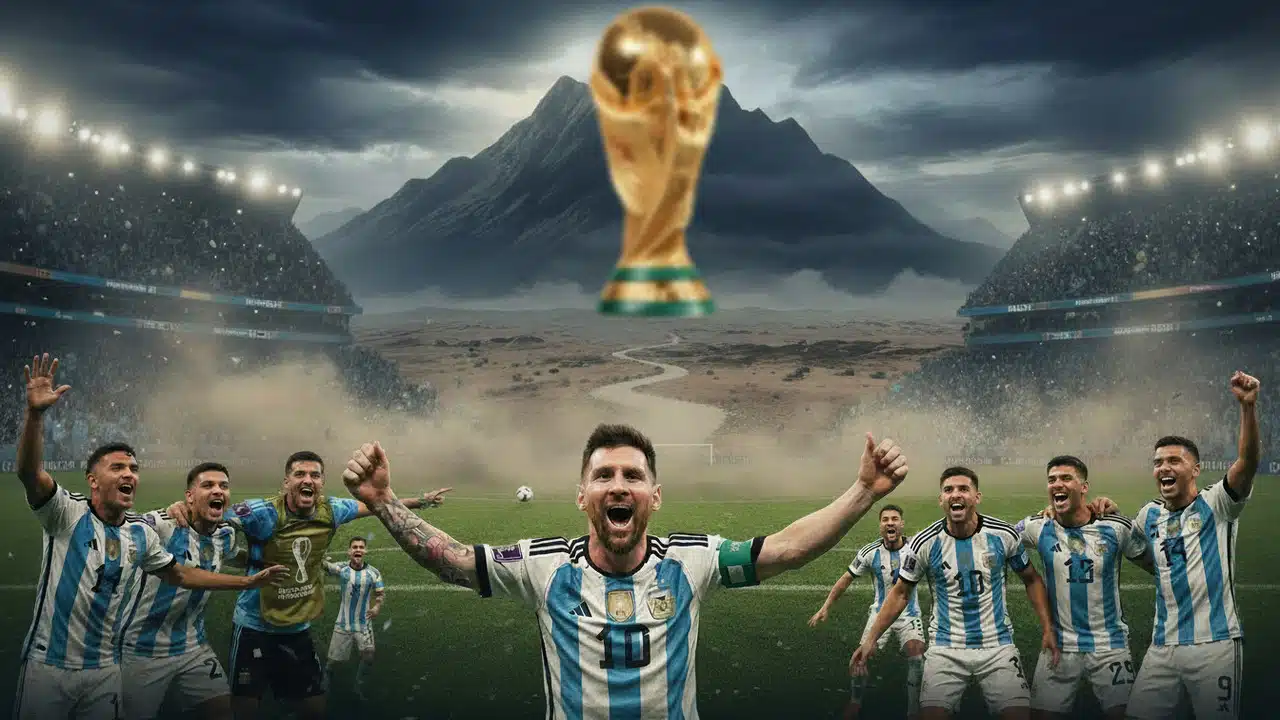
After a magical hat trick against Algeria, Argentina’s title defense begins with romance, history, and one unavoidable concern: can the champions evolve beyond Messi while still being inspired by him?
Lionel Messi gave Argentina the opening night every defending champion dreams of and every football romantic secretly wants. Argentina beat Algeria 3-0. Messi scored all three. He marked his 200th appearance for his country, reached 16 World Cup goals, and once again made age look like a detail rather than a limit. With 16 career FIFA World Cup goals, Lionel Messi now stands alongside Germany’s Miroslav Klose as the all-time highest goal scorer in World Cup history.
For one evening, the story was simple enough to fit inside a headline: Messi still owns the stage.
Argentina should enjoy that. They should not hide behind it.
The Argentina World Cup title defense began with beauty, control, and a reminder that the greatest player of his generation can still decide a match almost by himself. But this is where the romance needs a harder editorial frame. Messi’s brilliance is still Argentina’s greatest weapon. It can also become a tactical comfort blanket if Lionel Scaloni’s team allows one perfect night to blur the larger question.
Can Argentina defend the World Cup as a complete side, or will this campaign slowly become another exercise in asking Messi to solve whatever the system cannot?
Against Algeria, the answer looked easy. The tournament will not stay that generous.
Messi’s Masterclass Was Real. So Were the Questions It Covered
There is no need to shrink what Messi did. A World Cup hat-trick at 38 is not ordinary. Doing it in the first match of a title defense, on his 200th Argentina appearance, gives the performance a different weight. This was not a late-career cameo dressed up by sentiment. It was a decisive display from a player who still understands space, timing, and pressure better than almost anyone on the pitch.
The risk is not that people will praise Messi too much. The risk is that praise becomes analysis.
Argentina’s opener showed their strengths clearly. They found Messi in dangerous zones. Rodrigo De Paul’s connection with him still gives Argentina a familiar route through midfield. Alexis Mac Allister offered a threat from a distance. The defensive performance was strong enough to prevent Algeria from turning promising moments into serious pressure. Once Argentina had the match under control, they did not let the evening become chaotic.
That matters. Defending champions need authority as much as inspiration.
Yet Algeria also gave Argentina room that better opponents may not. Messi’s first goal came after he received space to turn and drive. His second followed a goalkeeper error after a speculative shot. His third was a superb finish, but it also came in a match already leaning heavily Argentina’s way. None of that weakens his achievement. It simply reminds us that one match can be both historic and incomplete as evidence.
A great opener can reveal quality. It can also disguise structural questions.
The Argentina World Cup Title Defense Cannot Be Built on Memory
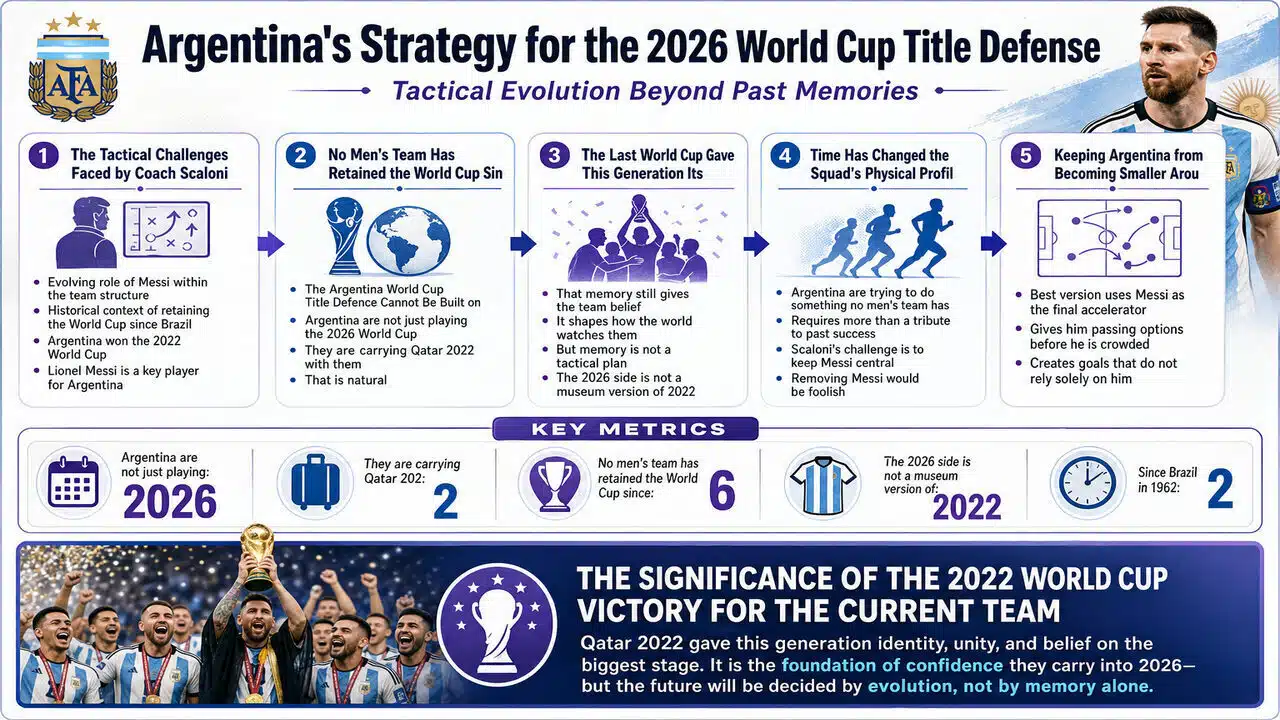
Argentina are not just playing the 2026 World Cup. They are carrying Qatar 2022 with them.
That is natural. The last World Cup gave this generation its defining image: Messi finally lifting the trophy, Scaloni’s squad finding resilience after a shocking opening defeat to Saudi Arabia, and Argentina blending emotional intensity with tournament discipline. That memory still gives the team belief. It also shapes how the rest of the world watches them.
But memory is not a tactical plan.
The 2026 Argentina side is not a museum version of the 2022 champions. Time has changed the squad’s physical profile, the pressure around Messi, and the way opponents prepare. Argentina are trying to do something no men’s team has done since Brazil in 1962: retain the World Cup. That task requires more than a tribute to what worked four years ago.
Scaloni’s challenge is not to remove Messi from the center of the story. That would be foolish. His challenge is to keep Argentina from becoming smaller around Messi.
The best version of this team uses Messi as the final accelerator, not the entire engine. It gives him passing options before he is crowded. It creates goals that do not need him to invent the first, second, and third action. It protects him without forcing the rest of the team into a passive supporting role.
That distinction will decide how serious this title defense becomes.
Scaloni Does Not Need to Replace Messi. He Needs to Reduce the Rescue Missions
The most tired question around Argentina is who replaces Messi. Nobody does. There is no tactical department where a coach orders another player with his vision, touch, rhythm, and historical nerve.
The useful question is different: how often does Argentina need Messi to rescue them?
If the answer is “often,” the title defense is fragile, even if the highlights look beautiful. If the answer is “rarely, but decisively,” Argentina become far more dangerous.
That starts with chance creation. Argentina need attacks that do not always bend back toward Messi’s left foot. Wide players must beat defenders. Midfielders must arrive in the box. Full-backs must give width without leaving the team exposed. The ball can still find Messi often, but it cannot find him because everyone else has run out of ideas.
It also means managing transitions. A late-career superstar can still be devastating with the ball, but the team around him must be precise without it. When Argentina loses possession, the distances between midfield and defense matter. The first five seconds after a turnover matter. The positioning of the full-backs matters. Stronger opponents will not need many invitations.
Then there is the quieter issue: minutes.
Scaloni’s most difficult decisions may not come before kickoff. They may come after the hour mark, when emotion tells a coach to keep Messi on the pitch and tournament management asks a colder question. How much energy should be spent in a group-stage match? When does control matter more than another moment? When does protecting Messi help Argentina more than indulging the crowd’s desire to keep watching him?
Those are not romantic questions. They are the questions title-winning coaches have to answer.
Where the Messi-First Argument Has a Point
The strongest counterargument is simple: if Messi can still win matches like this, Argentina would be foolish not to build around him.
That is fair.
This is not a case of a great player being carried by reputation. Messi just delivered the defining performance of Argentina’s opening match. He remains the player opponents fear most, the player teammates look for under pressure, and the player who changes the emotional temperature of a stadium simply by receiving the ball between the lines.
There is also a practical tactical argument for giving Messi central importance. Argentina know how to play with him. The midfield understands his rhythm. The squad has years of shared tournament experience. In a World Cup, where training time is limited and pressure arrives quickly, familiarity has value.
So the issue is not whether Argentina should build around Messi. They should.
The issue is whether building around him becomes waiting for him.
Those are not the same thing. A team built around Messi still runs, presses, covers, rotates, and creates alternative routes to goal. A team waiting for Messi slows down, narrows its own imagination, and hands the opposition a clearer defensive task.
Algeria could not punish that danger. A knockout-level opponent might.

What Most People Get Wrong About Messi and Argentina
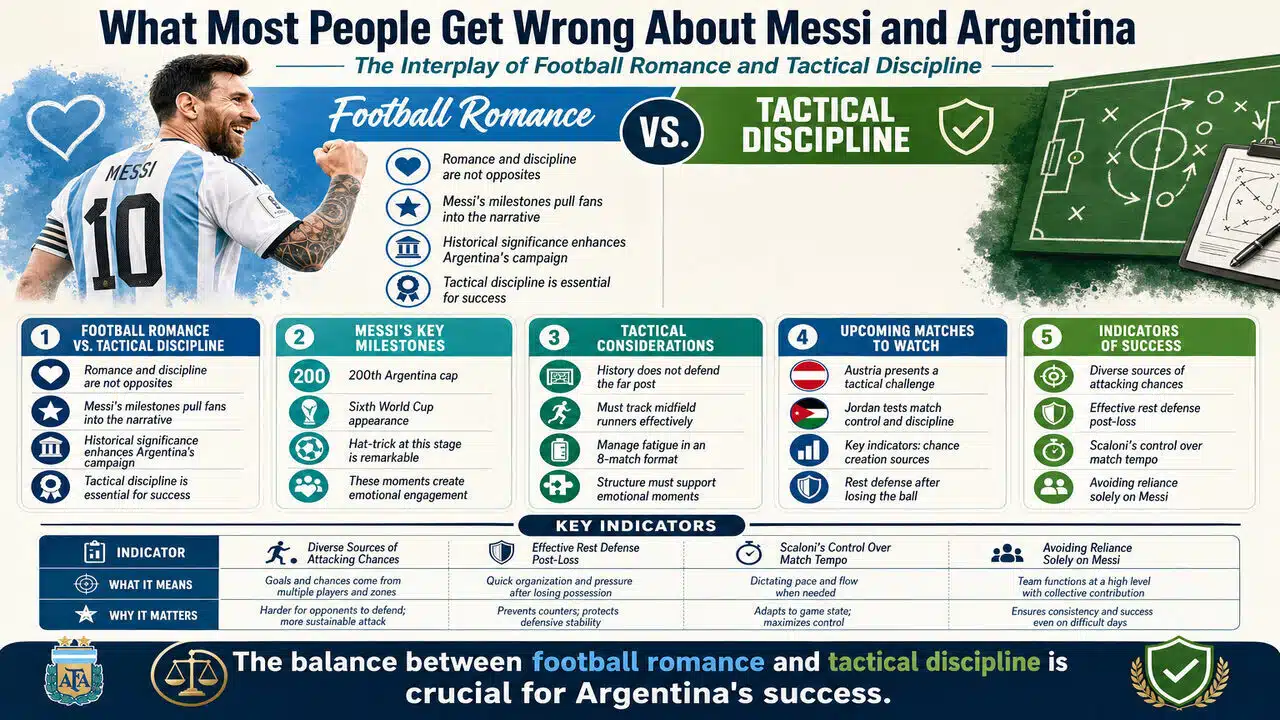
What most people get wrong is treating football romance and tactical discipline as opposites.
They are not.
The romance matters because football is not only a systems exercise. Messi’s 200th Argentina cap matters. His sixth World Cup matters. A hat-trick at this stage of his career matters. These moments pull casual fans into the tournament and give Argentina’s campaign a sense of historical theater that few teams can match.
But tactical discipline matters because history does not defend the far post. It does not track the late runner from midfield. It does not stop a fast winger attacking space behind a full-back. It does not manage fatigue across a longer 48-team World Cup format, where the finalists must now play eight matches instead of seven.
Argentina’s task is not to choose between emotion and structure. Their task is to make sure the structure is strong enough for the emotion to matter.
That is the version of Argentina other contenders should fear: not a side merely waiting for Messi to deliver a miracle, but a side organised enough that Messi only has to provide the final difference.
What Argentina Should Watch Next
The next matches in Group J will tell us more than the Algeria opener did. Austria should give Argentina a different physical and tactical problem, especially if they press with more organization and deny the central spaces Algeria left open. Jordan may ask another question: can Argentina control a match professionally without drifting into comfort or overplaying the Messi storyline?
Three signs will matter more than the scoreline alone.
First, where do Argentina’s chances come from? If the best openings come through wide overloads, midfield runners, cutbacks, and quick combinations that involve more than Messi, the system is healthy. If every dangerous attack still requires Messi to receive, turn, and invent, the warning remains.
Second, how does Argentina look after losing the ball? The champions cannot allow emotional momentum to cover poor rest defense. Better sides turn those gaps into shots, not near-misses.
Third, how brave is Scaloni with control? That means substitutions, tempo management, and resisting the temptation to let the match become a Messi exhibition when the team needs tournament discipline.
Argentina does not need to become cold. They need to stay serious.
Final Thoughts
Messi gave Argentina the perfect start. It would be small-minded to treat that as a problem. Football should still have room for awe, and Messi has earned every bit of the awe that followed his hat-trick against Algeria.
But awe is not a title defense.
The Argentina World Cup title defense will now be judged by a harder standard than one brilliant night. The champions have the result, the leader, the memory, and the emotional force. What they still need to show is whether the team can keep expanding around Messi instead of shrinking into dependence on him.
Messi has already answered the easiest question: yes, he can still produce magic.
The question for Argentina is more demanding. Can they build enough football around that magic to survive the nights when the opponent is sharper, the space is smaller, and history alone is not enough?





















