


SaaS content marketing fails when teams treat the blog like a traffic machine instead of a growth system. That is the mistake I see most often. A SaaS team publishes weekly posts, targets broad keywords, shares updates on LinkedIn, and waits for leads. Traffic may grow, but demos stay flat. Trial users do not convert.
Sales still says the leads are weak. Customer success still answers the same questions every week. The problem is not the content itself. The problem is unfocused content. For SaaS, content has a harder job than simple brand awareness. It must educate buyers, explain the problem, show product value, reduce objections, support activation, help retention, and sometimes create expansion opportunities.
A strong SaaS content marketing strategy connects search intent, product value, customer pain, sales questions, and lifecycle education. This guide explains how to build that system in a practical way, especially for B2B SaaS companies, founders, marketers, and content teams that want content to support real growth.
What Is SaaS Content Marketing?
SaaS content marketing is the process of creating helpful content that attracts, educates, converts, retains, and expands software customers. It is not only blogging.
A SaaS content system can include:
- Blog articles
- SEO landing pages
- Use-case pages
- Comparison pages
- Alternative pages
- Product tutorials
- Templates
- Webinars
- Case studies
- Email sequences
- Help center content
- Customer education
- Reports and benchmarks
- Video explainers
- Founder-led posts
- Integration pages
The goal is not to publish more content. The goal is to help the right people move from problem awareness to product trust. Good content marketing for SaaS answers the questions your buyers are already asking. It also helps users succeed after they sign up.
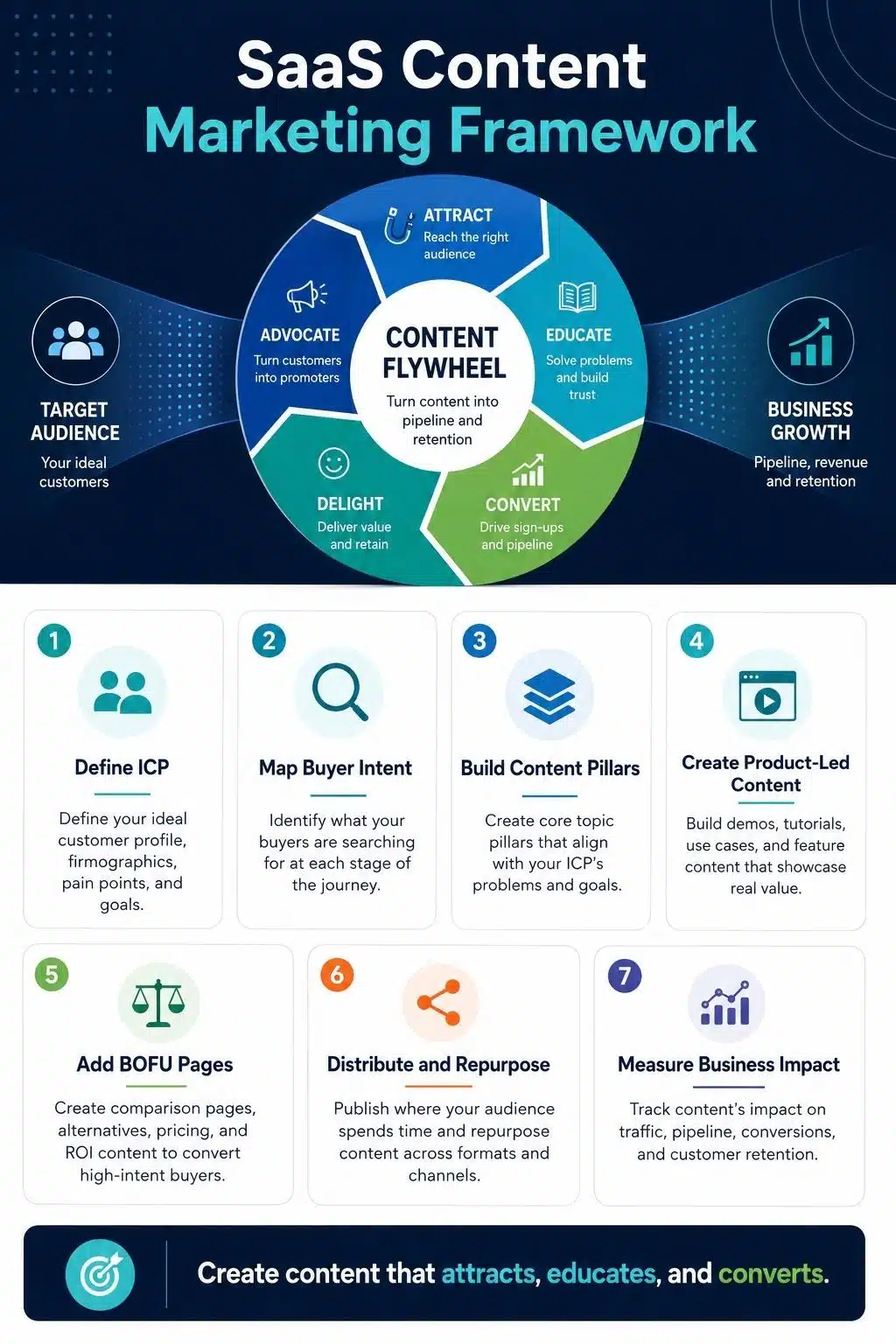
Why SaaS Content Is Different From Normal Blog Content
SaaS content has to support a recurring revenue business. That changes the purpose of the content. A media website may publish for a readership. An ecommerce brand may publish for product discovery. A SaaS company publishes to support the full customer journey.
A good SaaS content strategy should help with:
- Awareness
- Education
- Lead generation
- Trial activation
- Sales enablement
- Customer onboarding
- Retention
- Expansion
- Referrals
This is why a random blog calendar does not work well for SaaS.
A SaaS article should usually connect to a business question:
- Will this attract the right buyer?
- Will this explain a painful problem?
- Will this support a product use case?
- Will this help sales handle objections?
- Will this help trial users activate?
- Will this reduce support questions?
- Will this help existing customers get more value?
If the answer is no, the topic may not deserve priority.
Start With the SaaS Growth Goal
Before choosing keywords, define the content goal. Different SaaS companies need different content strategies.
- A new SaaS startup may need problem education.
- A product-led SaaS may need templates and onboarding content.
- An enterprise SaaS may need case studies and comparison content.
- A mature SaaS may need retention and expansion content.
- A category creator may need thought leadership.
- A competitive SaaS may need alternative and comparison pages.
Your content should match the growth stage.
| SaaS Stage | Content Priority | Example Content |
| Early stage | Problem validation and education | Founder posts, guides, pain-point articles |
| Pre-launch or beta | Demand building | Waitlist pages, beta guides, use-case content |
| Post-launch | Activation and conversion | Tutorials, templates, onboarding content |
| Growth stage | SEO and sales enablement | Comparisons, alternatives, case studies |
| Mature stage | Retention and expansion | Customer education, advanced workflows |
This keeps the strategy focused. Content should not exist because “we need a blog.” It should exist because it helps the SaaS business grow.
Define Your SaaS Content Audience
A weak SaaS blog strategy usually starts with a vague audience. “Marketers,” “founders,” “small businesses,” or “teams” are too broad.
A better content audience includes:
- Industry
- Company size
- Role
- Pain point
- Buying stage
- Current tool or workaround
- Budget level
- Decision-maker
- Daily workflow
- Success outcome
For example, instead of targeting “project managers,” a SaaS company might target:
“Client-facing marketing project managers who need approval workflows, deadline visibility, and better collaboration with freelancers.”
That audience is easier to write for. You can create sharper articles, better examples, stronger CTAs, and more relevant product connections. For a B2B content SaaS strategy, this matters even more because the reader is often not the only buyer. You may need to speak to users, managers, finance teams, IT teams, and executives at different points in the journey.
Build Content Around Search Intent, Not Just Keywords
Keyword research is useful, but search intent matters more. Two keywords can look similar and have very different business value.
For example:
- “What is project management?” may bring beginners.
- “Best project management software for agencies” may bring buyers.
- “Asana alternative for client approval” may bring high-intent switchers.
- “How to create a client approval workflow” may bring problem-aware users.
A practical SaaS content plan should include different intent levels.
| Funnel Stage | Reader Intent | Best Content Type |
| Top of funnel | Understand a problem | Educational guides |
| Middle of funnel | Compare solutions | Use-case pages, frameworks |
| Bottom of funnel | Choose a product | Comparison, alternative, pricing support |
| Customer stage | Get more value | Tutorials, playbooks, help content |
Do not ignore top-of-funnel content. It builds trust and authority. But do not build your entire strategy around broad informational posts. SaaS needs content that eventually connects to product value.
Create a Strong SaaS Blog Strategy
A SaaS blog should not be a dumping ground for random topics. It should be organized around content pillars that match your product category, customer pain, and buyer journey.
A simple SaaS blog strategy can include:
- Problem education
- Use-case content
- Product-led tutorials
- Industry insights
- Comparison content
- Customer stories
- Templates and checklists
- Founder-led thought leadership
- Retention and best-practice content
For example, a customer onboarding SaaS might build pillars around:
- User onboarding
- Customer activation
- Product adoption
- Churn reduction
- Customer success operations
- Lifecycle emails
- SaaS retention metrics
Each pillar can support multiple articles, templates, examples, and product pages. This is how the blog becomes part of topical authority, not just a publishing schedule.
Product-Led Content: The SaaS Advantage
Product-led content shows readers how to solve a problem while naturally demonstrating how your product fits into the solution. For example, a SaaS analytics platform might publish a guide on tracking trial activation, then offer a free activation dashboard template inside the article. That makes the content useful while naturally connecting it to the product.
It is not a disguised sales pitch. Bad product-led content says, “Our tool is the answer” too early. Good product-led content teaches the reader first, then shows the product where it genuinely helps.
For example:
- A reporting SaaS can publish a guide on building client dashboards and include a reusable dashboard template.
- An email SaaS can publish a guide on trial onboarding emails and include example sequences.
- A customer success SaaS can publish a churn risk checklist and show how to track those signals.
- A project management SaaS can publish an approval workflow guide and include a workflow template.
The reader should leave with value, even if they do not sign up immediately. That builds trust.
The Best SaaS Content Types to Prioritize
Not all content formats carry the same business value. For SaaS, these formats usually work well.
1. Pain-Point SEO Articles
These target problems your customers actively feel.
Examples:
- Why users abandon onboarding
- How to reduce trial drop-off
- Why sales teams miss follow-ups
- How to manage content approvals
These articles attract readers who already feel the pain.
2. Use-Case Pages
Use-case pages connect the product to specific workflows.
Examples:
- CRM for small agencies
- Onboarding software for B2B SaaS
- SEO reporting tool for consultants
- Project management for remote design teams
These pages usually convert better than broad blog posts.
3. Comparison and Alternative Pages
These help buyers evaluate options.
Examples:
- Tool A vs Tool B
- Best alternatives to Tool A
- Best software for a specific workflow
They are especially useful for competitive SaaS categories.
4. Templates and Checklists
Templates reduce friction. They help users act quickly and give your product a natural role in the workflow.
Examples:
- Onboarding email template
- SaaS launch checklist
- Customer health score template
- Content calendar template
5. Case Studies
Case studies provide proof. A strong case study shows the customer, problem, process, result, and lesson. Avoid vague “success story” content without specifics.
6. Product Tutorials
Tutorials support activation and retention. They help trial users and paying customers reach value faster.
7. Thought Leadership
Thought leadership works when it is specific and earned. It should offer a clear point of view, not generic trend commentary.
Content Mapping for the SaaS Customer Journey
Your content should not stop at acquisition. SaaS needs content after signup, too.
| Journey Stage | User Question | Content Needed |
| Awareness | What is causing this problem? | Educational guide |
| Consideration | What are my options? | Comparison and use-case content |
| Decision | Why should I choose this product? | Case study, demo page, pricing support |
| Activation | How do I get started? | Onboarding guide, tutorial, checklist |
| Retention | How do I get more value? | Advanced workflows, best practices |
| Expansion | How do I bring my team in? | Team guides, admin resources |
This is where many SaaS teams lose opportunity. They invest heavily in acquisition content but ignore activation and retention content. Then users sign up and struggle alone. Content can reduce that friction.
How to Connect Content With Product
Every SaaS article does not need a hard CTA. But every important article should have a logical next step.
Possible next steps include:
- Start a free trial
- Use a template
- Download a checklist
- Watch a product demo
- Compare plans
- Read a case study
- Try a calculator
- Join a webinar
- Book a consultation
- Read a related cluster article
The CTA should match intent:
- A beginner’s guide may invite the reader to download a checklist.
- A comparison page may invite the reader to start a trial.
- A product tutorial may invite the reader to use a feature.
- A retention guide may point to customer success resources.
This is how SaaS growth marketing and SaaS content marketing work together. The content attracts and educates. The product path helps the reader take the next step.
Founder-Led Content for SaaS
Founder-led content is especially useful for early SaaS companies. It helps build trust before the brand is widely known.
Founders can write about:
- Lessons from building the product
- Customer problems, they keep hearing
- Market shifts
- Behind-the-scenes product decisions
- Strong opinions about the category
- Early mistakes
- Customer stories
- Use-case insights
The key is to be useful, not self-promotional. A founder post should make the reader think, “This person understands my problem.” That trust can support demand, beta signups, investor interest, partnerships, and early sales conversations.
B2B Content SaaS Strategy
B2B SaaS content needs more depth because buying decisions often involve multiple people. A single user may love the product, but a manager, finance lead, IT team, or executive may still need confidence.
That means B2B SaaS content should answer different objections:
- Will this save time?
- Will the team adopt it?
- Is it secure?
- Does it integrate with our tools?
- Is the pricing justified?
- Can we migrate easily?
- What proof exists?
- How does it compare to alternatives?
- What happens after purchase?
This is why B2B SaaS content often needs:
- Comparison pages
- Security pages
- ROI content
- Implementation guides
- Customer stories
- Integration pages
- Admin guides
- Procurement support
- Team adoption playbooks
Do not write only for the end user. Write for the buying committee, too.
SaaS Content Distribution
Publishing is not distribution. A strong SaaS content system needs a plan for getting content in front of the right people.
Useful distribution channels include:
- SEO
- LinkedIn
- Founder profiles
- Email newsletters
- Customer onboarding emails
- Sales follow-ups
- Webinars
- Partner newsletters
- Communities
- Product in-app messages
- YouTube
- Podcast appearances
- Paid retargeting
- Repurposed social posts
One strong article can become:
- A LinkedIn post
- A carousel
- A webinar topic
- A sales enablement asset
- A newsletter section
- A short video
- A product tutorial
- A checklist
- A customer success email
Do not create once and forget it. Good SaaS content compounds when it is reused across the buyer journey.

Measuring SaaS Content Performance
SaaS content should be measured beyond pageviews. Traffic matters, but it is not enough.
Track metrics such as:
- Organic traffic
- Qualified demo requests
- Trial signups
- Free account signups
- Email subscribers
- Content-assisted conversions
- Template downloads
- Feature adoption from tutorials
- Sales usage of content
- Pipeline influenced
- Activation improvements
- Churn reduction from education content
- Expansion from customer content
Different content has different jobs:
- Top-funnel content may build audience and authority.
- Bottom-funnel content should support conversion.
- Tutorials should improve activation.
- Customer education should improve retention.
Do not judge every article by the same metric.
Common SaaS Content Marketing Mistakes
Mistake 01: Publishing Without a Product Connection
Many SaaS blogs attract readers who will never buy.
Content should connect to customer pain, product use cases, or buyer questions.
Mistake 02: Targeting Only High-Volume Keywords
High search volume can look attractive, but it often brings weak intent.
A lower-volume keyword with buying intent may be more valuable.
Mistake 03: Ignoring Bottom-Funnel Content
Educational content is useful, but SaaS buyers also need comparison, alternative, pricing, security, and proof content.
Skipping bottom-funnel content can leave revenue on the table.
Mistake 04: Writing Only for Users, Not Buyers
In B2B SaaS, the user and buyer may be different people.
Your content should support both adoption and decision-making.
Mistake 05: Treating the Blog as the Whole Strategy
A SaaS content strategy includes landing pages, tutorials, templates, case studies, email content, webinars, and customer education.
The blog is only one part.
Mistake 06: Forgetting Customer Content
Content should help existing customers succeed.
Retention content can reduce support burden and improve product adoption.
Mistake 07: Measuring Only Traffic
Traffic is not the same as growth.
Measure how content supports trials, demos, pipeline, activation, retention, and expansion.
SaaS Content Marketing Checklist
Use this checklist before building your content calendar.
- Define the ICP.
- Map the buying journey.
- Identify customer pain points.
- Collect sales and support questions.
- Group topics into content pillars.
- Prioritize bottom-funnel opportunities.
- Build product-led examples.
- Create templates and practical assets.
- Plan internal links to the SaaS growth marketing pillar.
- Add CTAs based on search intent.
- Repurpose articles across channels.
- Measure content by business role, not only traffic.
- Update high-value articles regularly.
This checklist keeps content tied to growth instead of output.
A Smarter Way to Build SaaS Demand
SaaS content marketing works best when it is useful before it is promotional. The reader should feel understood. The problem should be clear. The advice should be practical. The product should appear only where it naturally helps the reader make progress.
That is how content earns trust. A strong SaaS blog strategy does not chase random topics. It builds authority around customer pain, product use cases, buyer objections, and long-term customer success.
If you do this well, content becomes more than a traffic channel. It becomes part of acquisition, activation, conversion, retention, and expansion. That is the real value of content marketing for SaaS.
Frequently Asked Questions About SaaS Content Marketing
1. What is SaaS content marketing?
SaaS content marketing is the process of creating useful content that helps attract, educate, convert, retain, and expand software customers. It includes blogs, SEO pages, tutorials, templates, case studies, emails, webinars, and customer education.
2. How is SaaS content marketing different from normal content marketing?
SaaS content marketing must support recurring revenue. It needs to help with acquisition, activation, conversion, retention, and expansion. A SaaS article should often connect to product value, not just generate traffic.
3. What should a SaaS blog strategy include?
A SaaS blog strategy should include pain-point articles, use-case content, product-led tutorials, comparison pages, templates, customer stories, thought leadership, and content that supports the full buyer journey.
4. Is SEO important for SaaS content marketing?
Yes. SEO is one of the strongest long-term SaaS content channels when it targets the right intent. The best SaaS SEO focuses on pain points, use cases, comparisons, alternatives, integrations, templates, and product-led educational content.
5. What is product-led content?
Product-led content teaches the reader how to solve a problem while naturally showing how the product helps. It should provide real value first and introduce the product only where it fits the workflow.
6. What content works best for B2B SaaS?
B2B SaaS content often works best when it includes use-case pages, comparison pages, case studies, ROI content, integration pages, implementation guides, security content, and customer education.
7. How do you measure SaaS content success?
Measure SaaS content by its role. Track organic traffic, trial signups, demo requests, content-assisted conversions, pipeline, activation, product usage, retention, and expansion. Do not measure every article by traffic alone.





















