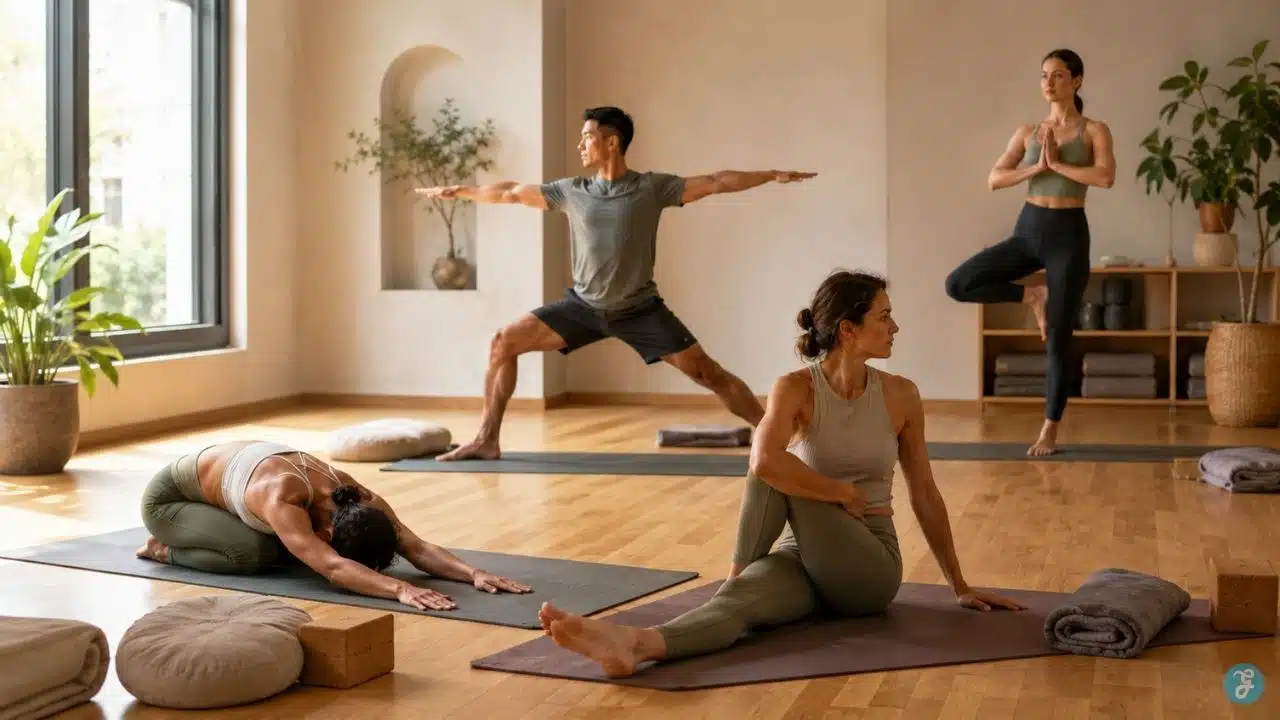
Most people do not need a random yoga routine. They need the right routine for the kind of day their body is having. Some mornings feel stiff before the day even starts. Some evenings need quiet movement because the mind is still running. Some weeks call for strength, balance, or recovery instead of another intense workout. That is why choosing yoga flows with different goals is more useful than picking the first routine that looks popular.
A flow for mobility should not feel like power training. A bedtime routine should not leave the body alert and restless. A recovery flow should not secretly become another workout. The poses may overlap, but the pace, intensity, and purpose change the result.
This guide organizes yoga by real needs: mobility, strength, back comfort, stress relief, sleep, posture, balance, and recovery. The point is not to do all eight. The point is to choose better.
Before Choosing a Flow, Check the Real Need First
Yoga can be gentle, athletic, slow, meditative, or demanding. That variety is useful, but it also creates confusion. Many people choose a class because it looks calming, sweaty, trendy, or short. A better question is simpler: what does the body need today?
If the body is tired from training, a strong vinyasa session may not be the smartest choice. If the lower back feels sensitive, deep twists and big forward folds may need to wait. If the goal is sleep, the routine should lower stimulation, not turn into a late-night challenge.
Think through three checks before starting:
- Purpose: stiffness, strength, stress, sleep, posture, balance, or recovery.
- Intensity: gentle, moderate, or athletic.
- Body condition: pain, pregnancy, injury history, age, dizziness, heat sensitivity, or medical concerns.
A useful yoga session does not have to be dramatic. Often, the best routine is the one that leaves the body clearer, steadier, and easier to live in.
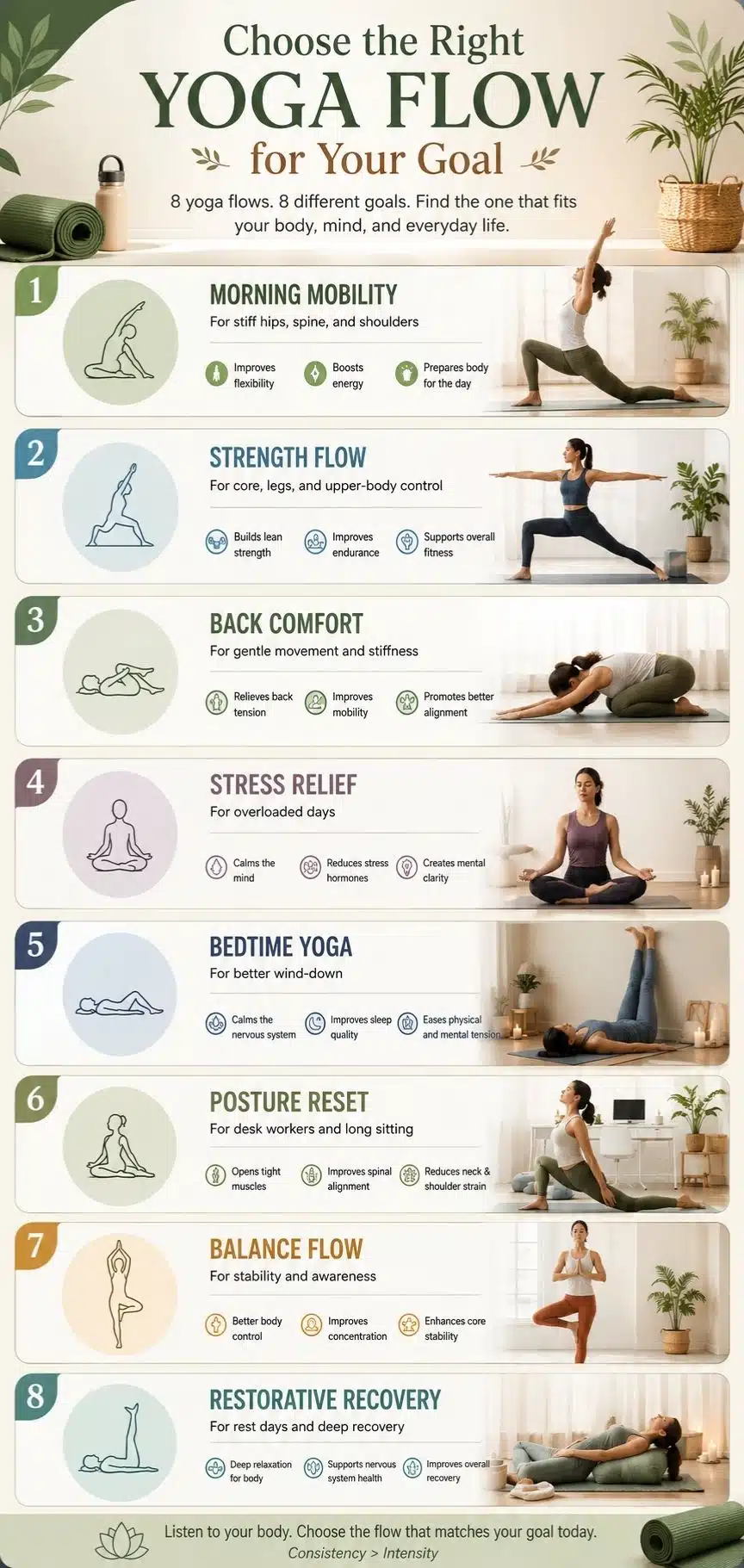
8 Yoga Flows with Different Goals: Which Flow Fits Your Day?
These yoga flows with different goals are practical starting points, not medical prescriptions. Move slowly if you are new. Use props when needed. Stop if a pose causes sharp pain, dizziness, numbness, or unusual discomfort. Anyone with persistent pain, recent injury, pregnancy-related concerns, heart issues, breathing problems, or balance risks should get proper guidance before pushing further.
1. Morning Mobility Flow for Stiff Hips, Spine, and Shoulders
Morning yoga should not feel like punishment. The body is often colder and less mobile after sleep, so the first job is to restore movement without forcing range.
A good morning mobility flow can include cat-cow, thread-the-needle, seated side bends, low lunges, gentle hamstring movement, child’s pose, and downward-facing dog with bent knees. These poses wake up the spine, hips, shoulders, ankles, and breathing pattern without demanding too much too early.
This flow suits office workers, students, drivers, remote workers, and anyone who wakes up feeling folded or heavy. It also fits a realistic schedule. Ten minutes can be enough if the sequence is focused.
A simple flow might look like this:
- Cat-cow for spinal movement
- Thread-the-needle for upper-back rotation
- Low lunge with gentle rocking
- Half split with a soft knee
- Downward-facing dog with bent knees
- Standing forward fold without pulling
- Mountain pose with slow breathing
The common mistake is going too deep too soon. Strong forward folds, aggressive hip openers, and long static holds may feel productive, but morning stiffness usually responds better to repeated, controlled movement.
Choose this flow when you want to feel less stuck before work, study, travel, or training.
2. Strength-Building Flow for Core, Legs, and Upper Body
Yoga is not the same as progressive weight training, but certain flows can build useful bodyweight strength. This is especially true for beginners, people training at home, or anyone who wants better control over movement.
A strength-focused flow may include plank, modified chaturanga, chair pose, warrior II, crescent lunge, side plank, bridge pose, and boat pose. The work comes from control, not speed. Slow transitions often make the routine harder than rushing through it.
This flow is useful when someone wants a no-equipment session that challenges the core, legs, shoulders, and balance at the same time. It also builds patience. Holding chair pose with steady breathing teaches more than collapsing quickly into the next pose.
Wrist and shoulder load deserve caution. Many people copy fast vinyasa classes and rush through chaturanga before they have the strength for it. Beginners can lower the knees, skip chaturanga, use blocks, or move from plank to child’s pose instead.
Good signs during this flow:
- Breathing stays controlled.
- Wrists do not feel sharp pain.
- The lower back does not collapse during the plank or boat pose.
- Knees feel stable in lunges and chair pose.
- The session feels challenging without becoming frantic.
This flow is valuable, but it should not be oversold. People who want serious muscle growth, progressive loading, or stronger bones may still need dedicated resistance training. Yoga can support strength. It does not automatically replace a full-strength plan.
3. Slow Flow for Back Comfort and Gentle Movement
Back discomfort is one of the most common reasons people search for yoga. It is also where vague advice can become risky.
A back-comfort flow should be slow, controlled, and modest. Good options include cat-cow, pelvic tilts, knees-to-chest, bird dog, sphinx pose, low cobra, supported bridge, and gentle supine twists. The purpose is to create comfortable movement, not to prove flexibility.
This is where many people make the wrong choice. They feel tight, so they push into deep forward folds or strong twists. That can feel fine for one person and irritating for another. A safer approach is to stay in a range that feels calm and repeatable.
A practical 20-minute version could include:
- A few minutes of relaxed breathing while lying down
- Cat-cow, child’s pose, and gentle side stretches
- Low lunges and easy hip mobility
- Supported bridge and a light supine twist
- Quiet rest at the end
Yoga may help some people with low-back pain and function, but it is not a guaranteed fix. Pain that travels down the leg, numbness, weakness, unexplained pain, or pain after a fall or injury needs proper assessment.
For general stiffness from sitting, travel, or low movement, this can be one of the most useful yoga flows with different goals because it keeps the body moving without turning the session into a performance.
4. Stress-Relief Flow for Overloaded Days
Stress-relief yoga should not feel like another task to complete perfectly. The routine should be simple enough that the mind does not have to keep solving instructions.
A useful stress-relief flow may include child’s pose, tabletop breathing, puppy pose, low lunge, seated forward fold with support, legs-up-the-wall, and a longer final rest. A few slow sun salutations can help if the body feels restless, but the sequence should gradually become quieter.
Breathing is the detail people often skip. When someone is overstimulated, fast breath cues and complex transitions can add more tension. Simple nasal breathing, longer exhales, and supported poses usually work better.
This flow fits screen-heavy workdays, emotional conversations, travel fatigue, or evenings when the mind keeps jumping between unfinished tasks. It should not be framed as therapy or a cure for anxiety or depression. It can, however, create a useful pause when the body is carrying too much tension.
The practical warning is to remove the phone from the mat. Stress-relief yoga loses much of its value when notifications keep pulling the nervous system back into the same noise.
5. Bedtime Yoga Flow for Better Wind-Down
A bedtime flow should be quiet and almost boring. That is part of the point. This is not the time for power yoga, handstand drills, intense core work, or fast transitions. Better choices include reclined bound angle pose, seated forward fold with support, legs-up-the-wall, happy baby, supine twist, and a comfortable final rest.
The biggest mistake is stretching too aggressively at night. Strong sensations can wake the body up instead of calming it down. Gentle pressure, longer exhales, dim lighting, and comfortable support are more useful than chasing range.
A good bedtime routine can take 10 to 20 minutes. Use pillows, folded blankets, cushions, or blocks. The pose does not need to look impressive. It needs to feel safe enough for the body to settle.
This flow is useful for people dealing with late-night scrolling, tension from sitting, or mental restlessness before sleep. It also works better when paired with basic sleep habits. Yoga cannot fully cancel out late caffeine, irregular sleep timing, or a bright phone screen in bed.
Pregnant readers should be careful with long periods lying flat on their backs, especially later in pregnancy. Prenatal instruction is safer than following a general bedtime flow without modification.
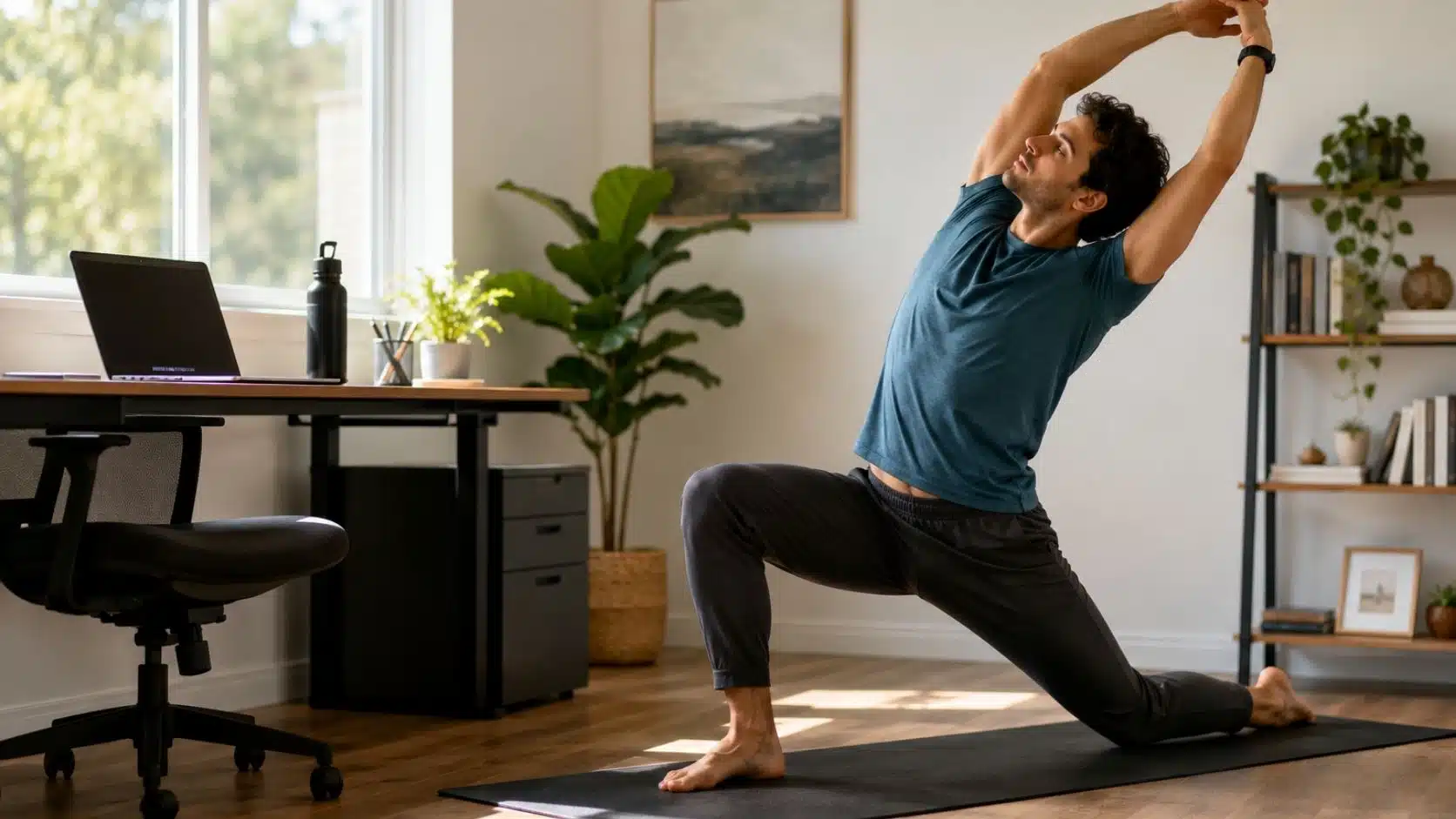
6. Posture Reset Flow for Desk Workers
Desk posture is not usually ruined by one bad position. The bigger issue is staying in the same position for too long. A posture reset flow should move the upper back, open the chest, wake up the glutes, and give the neck and shoulders different options. It does not need to be long. Eight to 12 minutes between work blocks can be useful.
Good choices include standing side bends, doorway chest stretch, thread-the-needle, puppy pose, sphinx, low lunge, bridge pose, and small controlled neck movements. The upper back matters more than many people realize. If the thoracic spine stays stiff, the neck and shoulders often take the blame.
A short reset could include:
- Standing reach and side bend
- Doorway or wall chest stretch
- Thread-the-needle
- Low lunge with arms raised
- Bridge pose
- Sphinx pose
- Small neck circles or gentle side bends
This flow is not about forcing “perfect posture.” That idea is too rigid for real life. A better aim is movement variety. Sit, stand, walk, stretch, and change positions often enough that one posture does not dominate the day.
Skip strong neck stretches if they cause tingling, dizziness, sharp pain, or symptoms down the arm. Those are not normal stretching sensations.
7. Balance Flow for Stability and Body Awareness
Balance flows often look advanced online, but they are not only for people chasing impressive poses. Balance work matters for coordination, confidence, and daily movement. It becomes especially important with age.
A beginner balance flow can include mountain pose, heel raises, chair pose, tree pose near a wall, warrior III with hands on blocks, low-lunge transitions, and simple single-leg standing work. A chair or wall is not cheating. It is smart setup.
This flow should be slow. Fast transitions hide balance problems instead of improving them. The useful work happens when the body makes small corrections without panic.
Older adults, people with fall concerns, and anyone recovering from injury should use support. A wall, chair, yoga block, or trained instructor can make the session safer. The aim is not to wobble dramatically in the middle of the room. The aim is steadiness with good judgment.
Balance yoga also works well as a short add-on after walking, strength training, or mobility work. Five focused minutes of single-leg control and calm breathing can be more useful than a flashy sequence that feels unsafe.
8. Restorative Recovery Flow for Rest Days
Restorative yoga is the flow many active people ignore until the body starts asking for it. It uses support, longer holds, and stillness. The intensity is low, but the discipline is real because many people find it hard to stop moving.
A recovery flow can include supported child’s pose, reclined bound angle with cushions, supported bridge, legs-up-the-wall, side-lying rest, and a longer savasana. Props matter here. Pillows, blankets, bolsters, blocks, or folded towels can reduce strain and help the body settle.
This flow is useful after demanding workouts, long travel, poor sleep, stressful weeks, or periods when the body feels heavy rather than energized. It is also a good option for people who want yoga without a sweat-heavy session.
Restorative flow is sometimes underrated because it does not look productive. That is exactly why it helps. It gives the body a low-pressure environment to downshift.
The limitation is clear: restorative yoga will not replace cardiovascular exercise or strength training. It is recovery work. Used that way, it becomes more valuable, not less.
What Most Yoga Flow Lists Miss
Many yoga articles sort routines by style name: hatha, vinyasa, yin, power, restorative, ashtanga, and so on. Those labels can help, but they do not fully solve the reader’s problem.
Most people are not asking which yoga category sounds right. They are asking what to do when their back feels stiff, sleep is poor, their shoulders are tight, their balance feels weak, or the body needs recovery.
That is why goal-based selection is more useful. A slow flow and a restorative flow may both feel gentle, but they do different jobs. A strength flow and a mobility flow may share some poses, but pacing and intention change the result.
Sweat is another misleading signal. More sweat does not automatically mean a better session. Some days call for effort. Other days call for enough restraint to stop before the body is overloaded.
How to Use These Flows During a Real Week
A balanced week does not require all eight flows. That would be too much for many people. Choose two or three based on what keeps showing up in your body and schedule.
A simple approach could look like this:
- Use the morning mobility flow three to five times a week if stiffness is your main issue.
- Add the strength-building flow once or twice a week if you want more bodyweight control.
- Use the posture reset flow on desk-heavy days, even if it is only for 8 minutes.
- Keep the stress-relief or bedtime flow for evenings when your body feels tense or alert.
- Save restorative recovery for rest days, travel fatigue, or weeks with harder workouts.
People who already train hard should use yoga to support their plan, not quietly add more stress. People who are mostly sedentary may do better starting with mobility, posture reset, and balance before jumping into advanced flows.
Heated yoga deserves separate judgment. It may feel good for some people, but heat does not automatically make yoga safer or more effective. Anyone who is pregnant, has heart concerns, struggles with heat, has breathing issues, or feels dizzy during class should avoid pushing through.
Frequently Asked Questions About Yoga Flows with Different Goals
1. How often should beginners do yoga flows?
Two or three short sessions a week is a realistic starting point for many beginners. A 10-minute routine done consistently is often more useful than one long class that leaves the body sore and discouraged. Start small enough that the habit feels repeatable.
2. Can yoga replace strength training?
Yoga can support strength through planks, lunges, chair pose, bridge pose, and controlled transitions. It may not be enough for people who want significant muscle growth, progressive loading, or a full strength plan. For many readers, yoga works best beside walking, resistance training, or another regular exercise routine.
3. Which yoga flow is best for stress?
A slow stress-relief flow or restorative recovery flow is usually more appropriate than a fast athletic class. Supportive poses, slower breathing, and longer rests create a calmer session. Anyone dealing with ongoing anxiety, trauma, or depression should treat yoga as support, not a replacement for professional care.
4. What should I do if my wrists hurt during yoga?
Reduce weight-bearing poses first. Try forearms, fists, blocks, wedges, or shorter holds. If pain is sharp, persistent, or linked with numbness, stop the routine and get a proper assessment.
A Simple Way to Start
The best yoga routine is not the hardest one. It is the one that fits the reason you came to the mat.
Choose mobility when the body feels stiff. Choose strength when you want more control. Choose a slow back-comfort flow when movement feels limited but not medically alarming. Choose stress-relief or bedtime yoga when the body needs quiet. Choose posture reset when work has kept you folded over a screen. Choose balance when steadiness matters. Choose restorative flow when recovery is the real need.
Using yoga flows with different goals removes guesswork. Instead of asking which routine looks impressive, ask what your body needs today. That small shift makes yoga easier to continue, safer to adjust, and more useful over time.