
Fashion brands do not need another soft-focus “eco fabric” claim. They need materials that can survive the less glamorous parts of the business: sampling, cost sheets, factory trials, compliance checks, durability testing, and repeat orders.
That is where regenerative fabrics sustainable fashion becomes interesting. Also messy.
A useful regenerative material should improve something beyond the garment. It might support wetland restoration, reduce pressure on farmland, use crop waste, cut fossil-based inputs, avoid plastic coatings, or create better incentives for farmers and manufacturers. Some companies are close to that idea. Others are still early, expensive, or commercially fragile.
The timing matters. Global fiber production keeps rising, and polyester still dominates the market. That makes next-generation materials important, but it also keeps the conversation honest. A few beautiful capsule collections will not change the textile system on their own.
This list is not ranked by hype. It is shaped by practical editorial value: which companies are pushing meaningful material science, which ones offer useful sourcing lessons, and which ones show the risks behind sustainable fashion-tech.
What Most Lists About Regenerative Fabrics Sustainable Fashion Miss
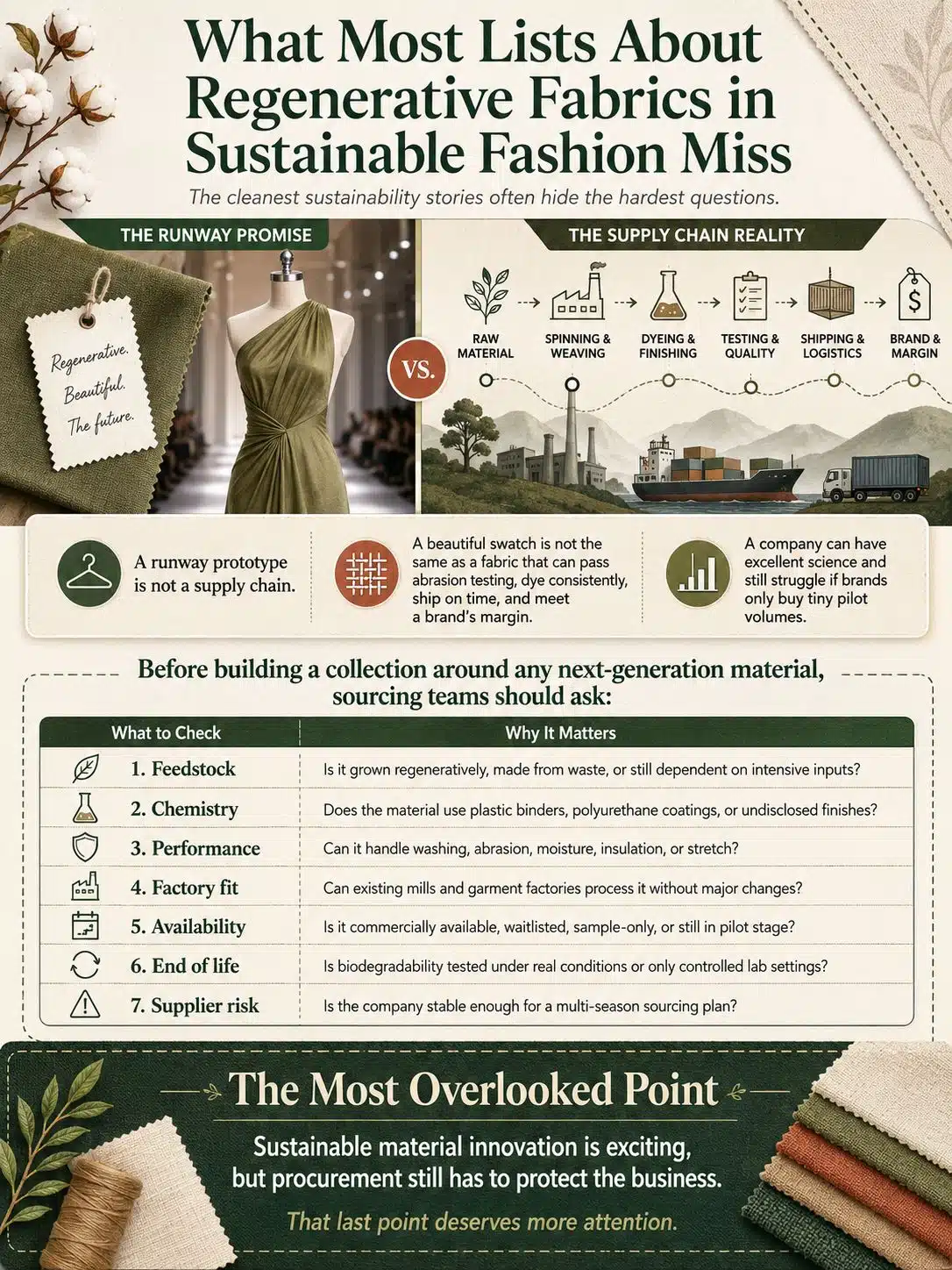
The cleanest sustainability stories often hide the hardest questions.
A runway prototype is not a supply chain. A beautiful swatch is not the same as a fabric that can pass abrasion testing, dye consistently, ship on time, and meet a brand’s margin. A company can have excellent science and still struggle if brands only buy tiny pilot volumes.
Before building a collection around any next-gen material, sourcing teams should ask:
| What to Check | Why It Matters |
|---|---|
| Feedstock | Is it grown regeneratively, made from waste, or still dependent on intensive inputs? |
| Chemistry | Does the material use plastic binders, polyurethane coatings, or undisclosed finishes? |
| Performance | Can it handle washing, abrasion, moisture, insulation, or stretch? |
| Factory fit | Can existing mills and garment factories process it without major changes? |
| Availability | Is it commercially available, waitlisted, sample-only, or still in pilot stage? |
| End of life | Is biodegradability tested under real conditions or only controlled lab settings? |
| Supplier risk | Is the company stable enough for a multi-season sourcing plan? |
That last point deserves more attention. Sustainable material innovation is exciting, but procurement still has to protect the business.
1. Ponda — Wetland-Based Insulation With Real Regeneration Logic
Ponda is one of the clearest examples of a material tied to landscape repair.
Its BioPuff insulation uses Typha latifolia, a wetland plant often known as cattail. The wider idea is built around paludiculture, which means farming on wet or rewetted land instead of draining it. That matters because drained wetlands and peatlands can release large amounts of stored carbon. Rewetting those landscapes can support carbon storage, biodiversity, water resilience, and new income streams for landowners.
BioPuff is best understood as insulation, not a general apparel fabric. It belongs in jackets, puffers, cold-weather layers, and outdoor products where warmth and loft matter.
One correction is important here. BioPuff Wadding should not be described as purely plant-based. Ponda’s current sample information lists the wadding composition as 80% Typha fibre and 20% recycled polyester with enhanced biodegradation. That nuance should stay in the article because serious readers will care about the full material mix.
The opportunity is strong. Down has animal-welfare concerns. Synthetic fill depends heavily on fossil-based polymers. Ponda offers a more interesting option for brands that want insulation with a better land-use story.
The practical starting point would be a premium outerwear capsule with clear material disclosure. The weak version would be vague marketing that says “plant-based insulation” and avoids the recycled-polyester detail.
2. Bananatex — Abacá Fabric Built Around Regenerative Farming
Bananatex does not try to replace every fabric in the wardrobe. That is part of its appeal.
The material is made from abacá, a banana-family plant grown in the Philippines. Bananatex presents its sourcing system as regenerative permaculture, with abacá cultivated without pesticides or fertilizers and nourished by rainfall.
This makes the material especially relevant for bags, accessories, structured panels, travel gear, laptop sleeves, caps, and durable lifestyle products. It is less convincing as a direct replacement for soft jersey, stretchwear, or delicate shirting. Not every sustainable material needs to do everything.
For brand founders, the useful lesson is focus. Bananatex has a clear lane: tough, plant-based, plastic-free textile development with an agricultural story rooted in a specific region. A backpack brand may find it more useful than a womenswear label looking for drapey dresses.
The mistake is treating abacá as magic. Designers still need to test hand feel, color behavior, abrasion, trims, coatings, and final product construction. A regenerative base fiber can lose some of its advantage if the finished product depends on heavy synthetic coatings or hard-to-separate components.
3. Circular Systems — Crop Waste as a Serious Textile Feedstock
Circular Systems is not the flashiest name in fashion-tech. It may be one of the more practical ones.
Its Agraloop platform refines natural fibers from agricultural leftovers into textile-grade Agraloop BioFibre. The company lists possible feedstocks such as oilseed hemp, flax, CBD hemp, banana, and pineapple residues. It also works across other circular material platforms, including Texloop and Orbital Hybrid Yarn technology.
The real value is not just “waste becomes fabric.” That phrase is too easy. The stronger point is that agricultural residue already exists near many farming and manufacturing regions. South Asia, Southeast Asia, Latin America, and parts of Africa all have potential here if collection, cleaning, grading, processing, and mill integration can be solved.
This is especially relevant for Bangladesh and India. The region already has deep apparel manufacturing capacity. It also has agricultural residues, jute knowledge, cotton systems, and growing pressure to reduce environmental impact. A crop-waste-to-fiber supply chain could connect farms, mills, exporters, and global brands in a more regionally grounded way than simply importing every new biomaterial from Europe or the United States.
The hard part is consistency. Factories need predictable fiber length, strength, contamination control, dye behavior, and delivery windows. Circular Systems deserves attention because it works closer to these industrial realities than many concept-stage biomaterial startups.
4. Keel Labs — Seaweed-Based Kelsun and the Blue Materials Push
Keel Labs brings the ocean into the textile conversation without relying on recycled ocean-plastic storytelling.
Its Kelsun fiber is made from seaweed biopolymers and positioned as bio-based, biodegradable under a listed testing framework, non-toxic, and free from microplastic shedding. Seaweed is attractive because it does not require arable land or freshwater in the same way land crops do.
That does not make it simple.
Marine feedstocks raise their own questions: supply consistency, ecological harvesting, processing infrastructure, regional regulation, and cost. Brands should not treat “ocean-derived” as a shortcut to sustainability.
Kelsun is still one of the more interesting textile ideas because it challenges both fossil synthetics and land-intensive fibers. It may be useful for lightweight apparel, blends, nonwovens, or limited editions where the material story can carry real educational value.
The sensible path is narrow testing. Try a top, a blend, a lining, or a high-visibility collaboration. Then test the boring things: pilling, care labels, dyeing, shrinkage, abrasion, and customer comfort.
That is where seaweed moves from clever concept to material strategy.
5. Spiber — Fermentation-Made Protein Fibers for Premium Textiles
Spiber sits at the biotech end of sustainable materials.
Its Brewed Protein fiber is produced through fermentation using plant-derived inputs. The company describes the material as designed at the molecular level, with sugar from sugarcane used as a primary ingredient for protein production. At its Thailand plant, Spiber says it uses Bonsucro-certified sugar.
This is not regenerative in the same way as wetland restoration or crop-waste fiber. Its value sits elsewhere. Spiber questions fashion’s dependence on animal-derived luxury fibers and fossil-based performance materials.
The best early uses are premium: knitwear, luxury blends, couture, experimental outerwear, and high-value collaborations where cost pressure is less punishing. Brewed Protein can be positioned near materials such as wool, cashmere, or silk in feel and application, but brands should avoid pretending it can replace every luxury fiber in every product category.
Fermentation materials also bring their own questions. Feedstock sourcing, energy use, plant utilization, cost, and downstream processing all shape the real impact. The science is impressive. The sourcing team still needs the spreadsheet.
For green tech observers, Spiber is one of the clearest signs that fashion materials are becoming a biotechnology sector, not only a textile sector.
6. Natural Fiber Welding — Plastic-Free Ambition With a Scale-Up Warning
Natural Fiber Welding deserves a place here for both its material ambition and its cautionary value.
Its platforms include MIRUM, a plastic-free alternative to leather made from inputs such as natural rubber, plant oils and waxes, natural pigments, and minerals. It has also worked on CLARUS for natural yarn performance, PLIANT for footwear outsoles, and TUNERA as a foam platform.
The company’s ambition is exactly what fashion needs: fewer plastic coatings, fewer hidden petrochemical binders, and better-performing natural material systems.
But NFW also shows how hard this category can be. After major brand interest, the company faced serious financial pressure and announced a wind-down plan in 2025 before receiving new investment in early 2026.
For brands, the lesson is not “avoid NFW.” The lesson is that innovation risk is sourcing risk.
Before making a public launch promise, a brand should verify what is currently available, which platform is commercially supported, what the minimums are, what the lead times look like, and whether the factory can process the material without special failure points.
NFW remains important. It just should not be treated as a plug-and-play supplier story.
7. MycoWorks — Fine Mycelium, Luxury Potential, and a Changed Business Phase
MycoWorks helped make mycelium materials credible in luxury fashion.
Its Fine Mycelium platform and Reishi material showed that fungus-based materials could move beyond novelty. The company’s collaborations and design projects gave mycelium a level of seriousness many “vegan leather” materials never reached.
But this section needs careful framing. MycoWorks opened a South Carolina facility in 2023, later faced a shift in its operating model, and entered a strategic restructuring phase after being acquired by DFX Corp in early 2026. That does not erase its innovation. It changes how buyers should read the company.
It should not be presented as a simple scaled supplier without qualification. It is better understood as a high-profile biomaterials platform moving through a new commercial chapter.
The material idea still matters. Many leather alternatives disappoint because they rely heavily on polyurethane or other plastics. Mycelium offers a more interesting route: grow a material structure, tune it, finish it, and aim for the feel and performance expected in luxury goods.
The procurement warning is simple. Ask what is currently being produced, where it is produced, what the finishing chemistry involves, whether Reishi is available for new projects, and how the new ownership affects delivery.
MycoWorks remains one of the most important names in biomaterials. It is also proof that good material science does not remove business risk.
8. Kintra Fibers — A Bio-Based Challenge to Polyester
Kintra is not the most obvious “regenerative” company on this list. It earns its place because polyester is such a huge problem.
If a bio-based synthetic-like fiber can run through familiar polyester systems, it has a clearer route into mainstream supply chains than many niche biomaterials. Kintra describes its yarn as 100% bio-based and traceable, intrinsically compostable, and a drop-in fit for commercial polyester manufacturing equipment.
That technical compatibility matters. Mills are more likely to test a material if it does not force them to rebuild their process from scratch.
The careful wording matters too. Compostability and biodegradability depend on conditions. A material may perform in controlled composting or wastewater-related testing but not break down harmlessly in a landfill, ocean, or backyard compost pile. Brands should avoid broad consumer-facing claims unless they can explain the testing conditions.
Kintra addresses one of the biggest questions in regenerative fabrics sustainable fashion: how can brands reduce fossil dependence without asking factories to abandon familiar equipment?
The best early fit is likely performance-fashion blends, athleisure, linings, soft synthetic-like fabrics, and product categories where polyester behavior is still useful. For mass-market basics, cost and supply will decide how far it can go.
How Brands Should Use This List
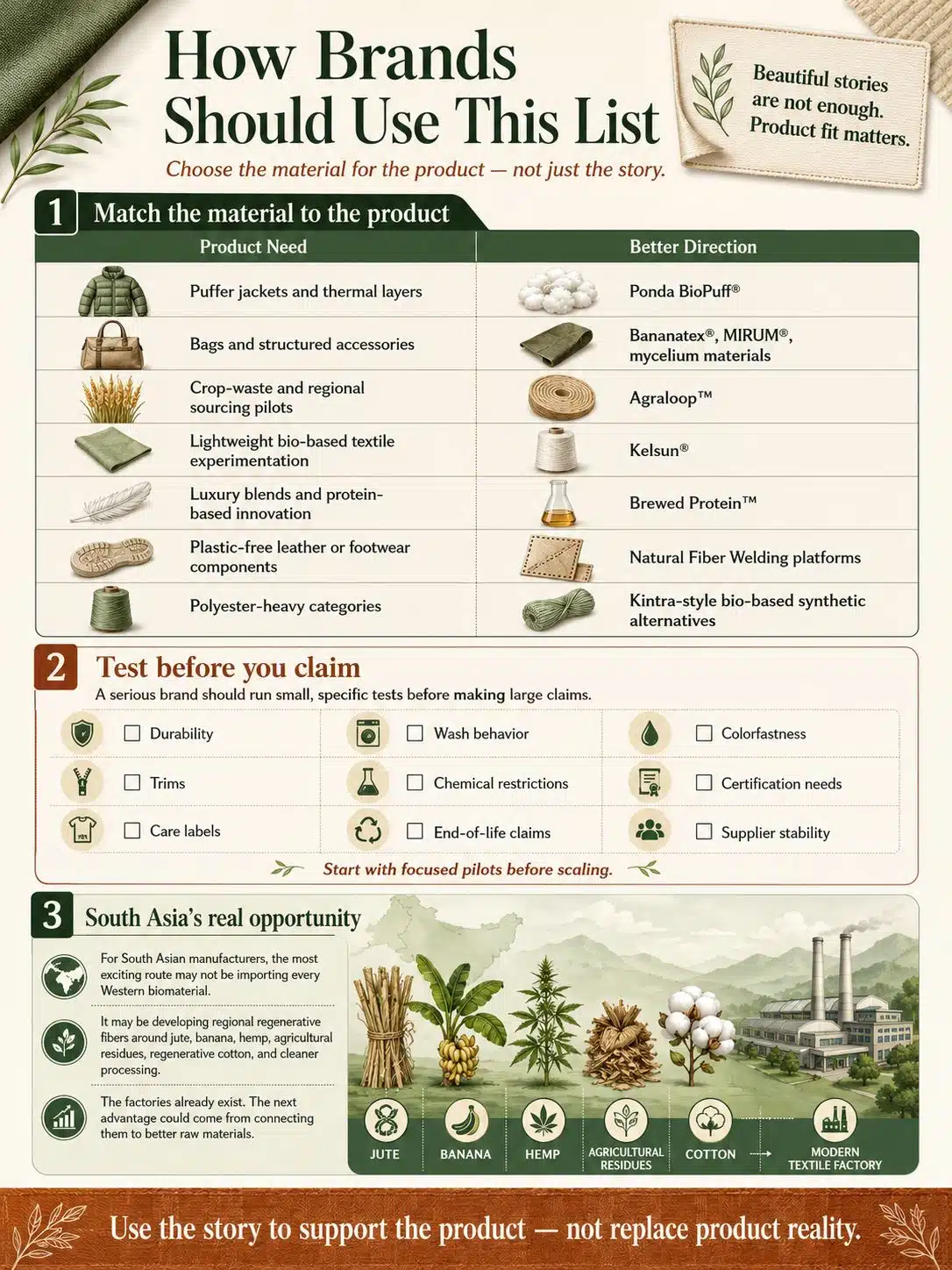
Do not choose a material because the story sounds beautiful. Match it to the product.
| Product Need | Better Direction |
|---|---|
| Puffer jackets and thermal layers | Ponda BioPuff |
| Bags and structured accessories | Bananatex, MIRUM, Reishi-style mycelium materials |
| Crop-waste and regional sourcing pilots | Circular Systems Agraloop |
| Lightweight bio-based textile experimentation | Keel Labs Kelsun |
| Luxury blends and protein-based innovation | Spiber Brewed Protein |
| Plastic-free leather or footwear components | Natural Fiber Welding platforms |
| Polyester-heavy categories | Kintra-style bio-based synthetic alternatives |
A serious brand should run small, specific tests before making large claims. That means checking durability, wash behavior, colorfastness, trims, chemical restrictions, certification needs, care labels, end-of-life claims, and supplier stability.
For South Asian manufacturers, the most exciting route may not be importing every Western biomaterial. It may be developing regional regenerative fibers around jute, banana, hemp, agricultural residues, regenerative cotton, and cleaner processing. The factories already exist. The next advantage could come from connecting them to better raw materials.
The Practical Takeaway
Regenerative fabrics sustainable fashion will not be built by slogans. It will be built by sourcing teams that ask difficult questions early.
What is the material really made from? What percentage is bio-based? Does it contain plastic? Can it be dyed and finished safely? What testing backs the end-of-life claim? Can the supplier deliver the quantity promised? Will the factory hate working with it?
The eight innovators above point to a better textile future: wetland insulation, abacá fabrics, crop-waste fiber, seaweed yarns, fermentation-made proteins, plastic-free leather alternatives, mycelium materials, and bio-based synthetic replacements.
None of them solves fashion’s impact problem alone. Some are still early. Some are expensive. Some are commercially uncertain. But they are asking the right material questions.
For brand founders and supply-chain managers, that is the real value. Start with one product category. Choose one material that fits the job. Test it honestly. Then make only the claims the evidence can support.