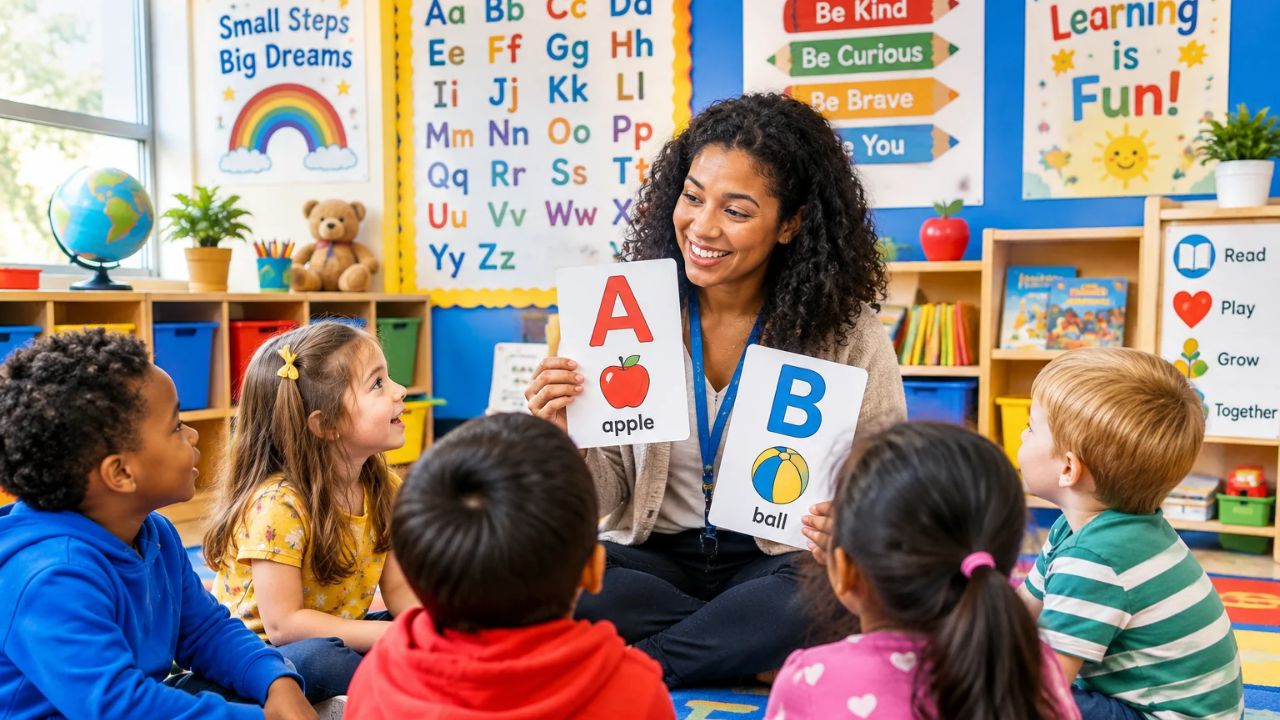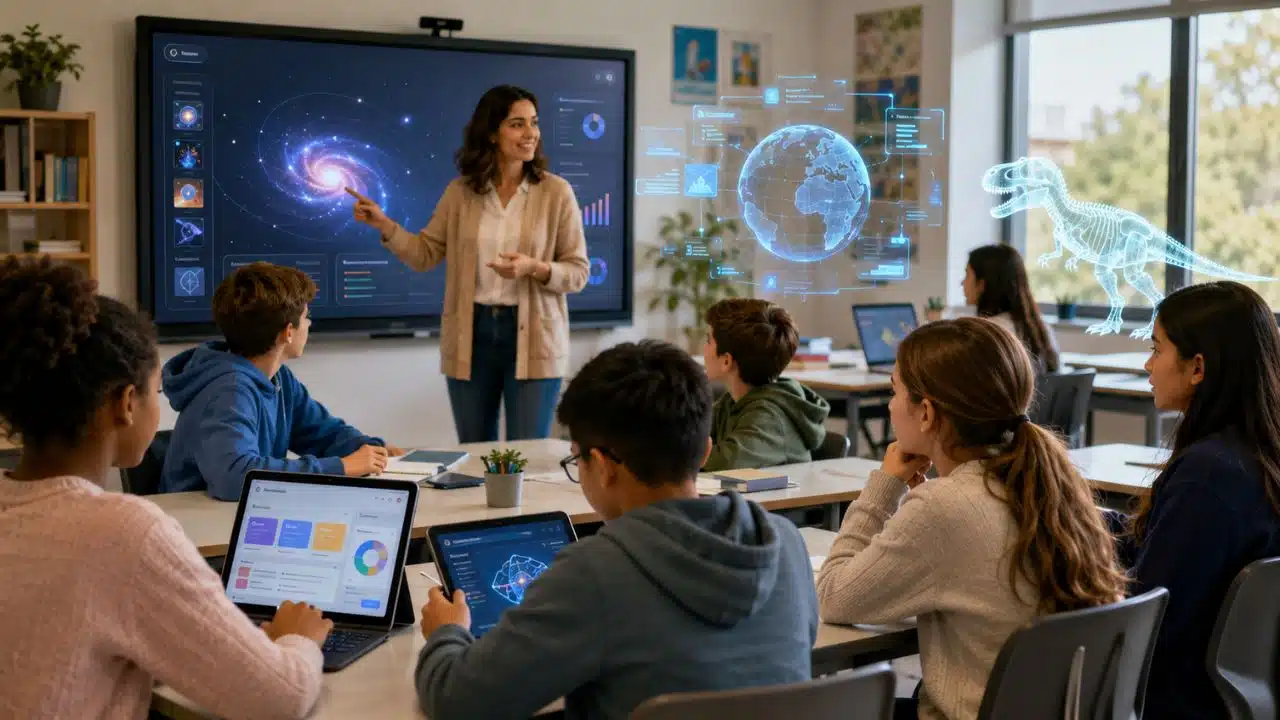
Walk into a classroom today and the change may not look dramatic at first. There may still be a whiteboard. Students may still sit in rows or small groups. A teacher still explains the lesson, checks notebooks, answers questions, and reminds everyone to stay focused.
But something new is happening quietly.
AI in modern classrooms is changing how students learn, how teachers prepare lessons, how feedback is given, and how schools think about the future of education. It is not always visible. Sometimes it appears as a chatbot helping a student understand a math step. Sometimes it is an app that adjusts reading practice. Sometimes it is a teacher using AI to draft a quiz, simplify a passage, or create a lesson activity in minutes.
This shift is not about replacing teachers with machines. That fear gets attention, but it misses the real story. The stronger story is about support. AI can reduce repetitive work, offer faster practice, help students who need extra support, and make learning more personal.
The numbers show the shift is already real. In the United States, NCES reported that 73% of public schools had at least a few teachers using AI for tasks such as lesson planning, administrative work, creating tailored materials, instruction support, assessments, grading, or feedback. At the same time, only 31% of U.S. public schools had written policies on student AI use, while 67% offered AI training to at least some teachers, staff, or administrators.
AI in Modern Classrooms: What Is Actually Changing?
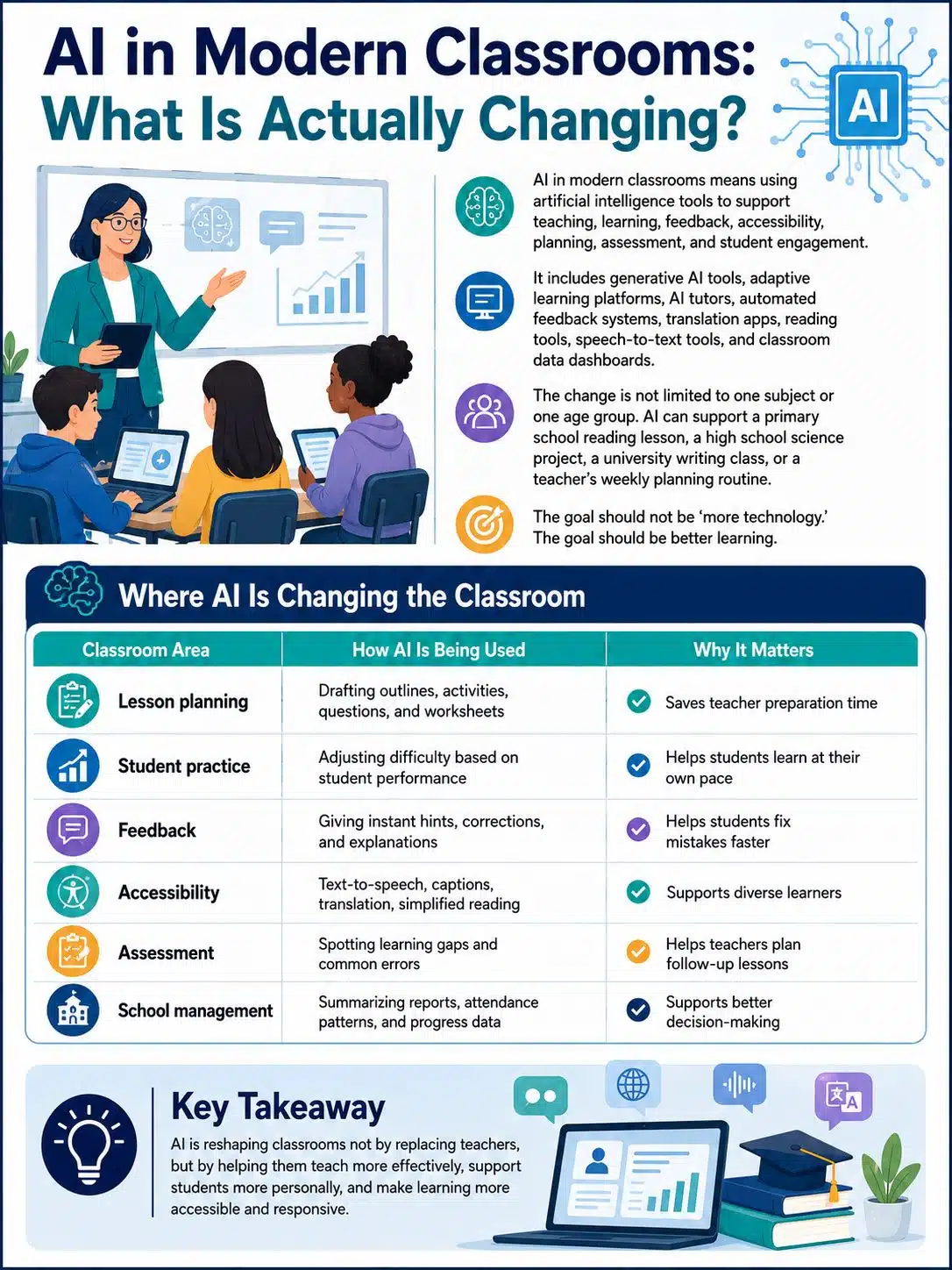
AI in modern classrooms means using artificial intelligence tools to support teaching, learning, feedback, accessibility, planning, assessment, and student engagement.
It includes generative AI tools, adaptive learning platforms, AI tutors, automated feedback systems, translation apps, reading tools, speech-to-text tools, and classroom data dashboards.
The change is not limited to one subject or one age group. AI can support a primary school reading lesson, a high school science project, a university writing class, or a teacher’s weekly planning routine.
The goal should not be “more technology.” The goal should be better learning.
| Classroom Area | How AI Is Being Used | Why It Matters |
|---|---|---|
| Lesson planning | Drafting outlines, activities, questions, and worksheets | Saves teacher preparation time |
| Student practice | Adjusting difficulty based on student performance | Helps students learn at their own pace |
| Feedback | Giving instant hints, corrections, and explanations | Helps students fix mistakes faster |
| Accessibility | Text-to-speech, captions, translation, simplified reading | Supports diverse learners |
| Assessment | Spotting learning gaps and common errors | Helps teachers plan follow-up lessons |
| School management | Summarizing reports, attendance patterns, and progress data | Supports better decision-making |
AI Is More Than Chatbots
Many people hear “AI” and think only of ChatGPT or similar tools. Those tools are important, but AI in education is much wider.
A reading app that listens to a child read aloud uses AI. A math platform that changes the next question based on the last answer uses AI. A tool that turns a long passage into a simpler version uses AI. A speech-to-text tool for students with writing difficulties also uses AI.
That variety matters because schools do not need one giant AI system. They need the right tool for the right learning problem.
The Teacher Still Sets the Direction
AI should not decide what a class must learn. It should not decide what a child is capable of. It should not replace professional judgment.
The teacher still chooses the learning goal, checks the quality of the content, corrects mistakes, notices student behavior, and understands classroom context.
AI can suggest. The teacher decides.
That simple rule can prevent many problems.
A Good AI Tool Solves a Real Classroom Problem
Schools should avoid using AI only because it sounds modern.
A good question to ask before using any AI tool is: What problem does this solve?
Does it help students understand a hard topic? Does it save teachers time? Does it support a student with a disability? Does it improve feedback? Does it help the class practice better?
If the answer is unclear, the tool may be more distraction than support.
Personalized Learning Becomes More Practical
Personalized learning has been a dream in education for years. Every teacher knows students learn at different speeds.
Some students need more examples. Some need harder challenges. Some need visual support. Some need extra reading help. Some understand the topic but struggle to explain it in writing.
The problem is time. One teacher may have 25, 30, or even 50 students. Giving each student a different learning path every day is difficult.
AI makes personalization more practical. It can analyze student responses, recommend practice, adjust difficulty, and provide explanations in different ways.
| Student Need | AI Support | Classroom Benefit |
| Struggles with basics | Easier practice and step-by-step hints | Builds confidence |
| Learns quickly | Advanced questions and extension tasks | Prevents boredom |
| Needs reading support | Simplified text and vocabulary help | Improves access |
| Makes repeated errors | Pattern-based feedback | Helps teachers target the issue |
| Needs revision | Custom quizzes and study plans | Makes practice more focused |
Adaptive Practice Helps Students Move at the Right Speed
In a traditional worksheet, every student gets the same questions. That can work, but it does not always fit everyone.
AI-powered practice tools can adjust the next task based on how a student performs. If a student keeps missing multiplication facts, the system can pause and offer extra practice. If another student solves the problems easily, it can move to word problems or higher-level questions.
This kind of adaptive learning can reduce frustration. Students do not feel pushed too fast or held back too long.
It also gives the teacher a clearer view of where students are stuck.
Students Get Feedback While the Mistake Is Still Fresh
Feedback matters most when students can still remember what they were thinking.
If a student writes an answer on Monday and gets feedback on Friday, the learning moment may be gone. AI tools can give immediate hints, grammar suggestions, math corrections, or reading support while the student is still working.
That quick response can help students revise earlier and build better habits.
Still, quick feedback is not always deep feedback. AI may catch a grammar issue, but a teacher can explain tone, argument, creativity, and effort.
Both types of feedback have value.
Personalization Should Not Mean Isolation
One risk of personalized learning is that students may spend too much time alone with screens.
Classroom learning should still include discussion, teamwork, debate, questions, and shared problem-solving. AI can personalize practice, but students also need social learning. They need to hear how classmates think. They need to explain ideas out loud.
A healthy classroom uses AI for support, not separation.
How AI Helps Teachers Save Time and Improve Lessons
Teachers do far more than stand in front of a class.
They plan, grade, write comments, prepare activities, create materials, answer parent messages, track progress, attend meetings, and handle school paperwork.
Much of this work happens outside school hours.
AI can help reduce that load. It can draft lesson plans, create quiz questions, simplify reading passages, generate examples, suggest rubrics, organize notes, and turn rough ideas into usable classroom materials.
| Teacher Task | How AI Helps | What the Teacher Must Check |
| Lesson planning | Creates structure, warm-ups, and activities | Curriculum match and student level |
| Quiz creation | Generates questions and answer keys | Accuracy and fairness |
| Differentiation | Creates easier and harder versions | Quality and learning goal alignment |
| Parent communication | Drafts clear messages | Tone and personal context |
| Rubrics | Suggests grading criteria | School standards and expectations |
| Administrative work | Summarizes notes and reports | Privacy and accuracy |
Lesson Planning Can Start Faster
A teacher may begin with a simple idea: “I need a 45-minute lesson on photosynthesis for Grade 7.”
AI can turn that into a structure with a warm-up, explanation, group task, short quiz, homework idea, and extension activity. The teacher can then adjust it for the class.
This saves time at the beginning of planning. It also gives teachers a starting point when they feel stuck.
The best result comes when teachers add their own classroom knowledge. They know which students need more visuals. They know which examples work locally. They know which activities will succeed with their students.
Differentiated Materials Become Easier to Create
Differentiation is one of the hardest parts of teaching.
A teacher may need one reading passage at three levels. Or a worksheet with basic, standard, and advanced questions. Or a vocabulary list for English-language learners. Or a shorter version of instructions for students who need extra support.
AI can create these versions quickly.
For example, a teacher can use AI to:
- Rewrite a science passage for younger readers
- Create vocabulary definitions with examples
- Turn a chapter into a summary
- Make five challenge questions for advanced learners
- Create a matching activity from key terms
- Generate a debate prompt from a history topic
This gives teachers more flexible materials without adding hours of extra work.
AI Can Help Reduce Teacher Workload
Teacher workload is one of the strongest arguments for responsible AI use.
Gallup and the Walton Family Foundation reported that six in 10 U.S. K-12 teachers use AI for work, and three in 10 use it at least weekly. Their research also found that teachers who use AI weekly save an estimated 5.9 hours per week.
That is not a small change.
AI cannot fix low pay, overcrowded classrooms, weak infrastructure, or poor school leadership. But it can reduce repetitive work. If a teacher saves time on formatting, drafting, or routine feedback, that time can go back into student support, planning, or rest.
The goal is not to make teachers work more. The goal is to help them work with better support.
AI Makes Student Engagement More Interactive
Students today live in a world of search engines, videos, apps, games, and instant information.
School should not become entertainment. But it cannot ignore how students now access information and ask questions.
AI can make learning more interactive when used with care. It can help students ask questions privately, explore examples, simulate real-world problems, and practice without fear of embarrassment.
Good engagement is not about flashy screens. It is about attention, curiosity, and effort.
| Engagement Challenge | AI-Based Support | Better Learning Outcome |
| Students fear asking questions | Private AI tutoring or guided prompts | More confidence |
| Topic feels abstract | Simulations and visual explanations | Better understanding |
| Students lose interest | Examples linked to real life | More relevance |
| Weak revision habits | AI-generated quizzes and flashcards | More active practice |
| Passive learning | Guided inquiry tasks | More student thinking |
Quiet Students Get Another Way to Ask Questions
Some students do not raise their hands.
They may feel shy. They may fear being wrong. They may need more time to form a question. They may not want classmates to know they are confused.
AI tutors and classroom chat tools can give these students a private way to ask for help. They can request another example. They can ask for a simpler explanation. They can review a topic before speaking in class.
This can build confidence. It should not replace teacher support, but it can help students take the first step.
Simulations Can Make Difficult Topics Easier to See
Some topics are hard because students cannot easily see what is happening.
AI-powered simulations and digital tools can help students explore ideas like:
- How blood moves through the heart
- How planets orbit the sun
- How an ecosystem changes when one species disappears
- How supply and demand affect prices
- How a chemical reaction changes under different conditions
- How a historical decision might lead to different outcomes
When students can test, change, and observe, learning becomes more active.
Students Can Create More Original Projects
AI can help students brainstorm project ideas, organize research questions, plan presentations, generate outlines, and test arguments.
For example, a student working on climate change could ask AI for possible research angles, then choose one and gather reliable sources. A student preparing a debate could ask for arguments from both sides, then evaluate which ones are strong or weak.
This kind of use can improve learning.
But the student must still think, choose, write, and defend the final work.
AI should support creativity, not replace it.
Assessment and Feedback Need a Smarter Approach
Assessment is one of the most difficult parts of AI in modern classrooms.
AI can help teachers give faster feedback and understand student progress. But it can also make cheating easier when assignments are poorly designed or rules are unclear.
Schools need a better approach. Banning AI completely may not work. Allowing it without limits is also risky.
The better path is clear guidance, better assessment design, and stronger focus on the learning process.
| Assessment Issue | Risk | Better Solution |
| AI-written homework | Students may skip learning | Require drafts and process notes |
| AI detectors | False positives or missed AI use | Use multiple checks |
| Generic essays | Easy to outsource | Use personal, local, and oral elements |
| Slow feedback | Mistakes continue longer | Use AI for formative feedback |
| Unclear rules | Students get confused | Create simple AI-use policies |
AI Can Improve Formative Assessment
Formative assessment means checking learning during the learning process.
AI can help teachers identify:
- Which students missed the same concept
- Which questions caused confusion
- Which topics need reteaching
- Which students are ready for harder work
- Which students may need one-on-one help
This helps teachers respond faster.
Instead of waiting until the final test, teachers can adjust instruction during the week.
AI Detection Tools Are Not Enough
Some schools use AI detection tools to catch AI-written work. These tools may help in some cases, but they are not reliable enough to be the only evidence.
They can wrongly accuse students. They can also miss AI-assisted writing. This creates stress and mistrust.
Teachers need a broader strategy:
- Ask students to submit outlines and drafts
- Include in-class writing
- Add oral explanation
- Use handwritten reflection when needed
- Ask students to explain how they used AI
- Compare final work with earlier work
- Grade reasoning, not only polished language
This approach is fairer and more educational.
Assignments Should Ask for Thinking, Not Just Answers
If a student can complete an assignment by copying one prompt into an AI tool, the task may need redesign.
Teachers can ask students to:
- Critique an AI-generated answer
- Find missing evidence
- Compare AI output with a textbook
- Add personal observation
- Use local examples
- Defend their answer in class
- Reflect on what they changed after feedback
This turns AI from a shortcut into part of the learning process.
AI Can Make Classrooms More Inclusive
A strong classroom does not treat every student as if they learn the same way.
Some students have disabilities. Some are learning in a second language. Some struggle with reading. Some have speech or hearing challenges. Some need more time to organize thoughts. Some are gifted but underchallenged.
AI can help remove barriers when schools use it carefully.
| Learner Need | AI Support | Important Safeguard |
| Reading difficulty | Text-to-speech and simplified text | Keep learning goals strong |
| Writing difficulty | Speech-to-text and planning tools | Teach structure and expression |
| Hearing support | Captions and transcripts | Check accuracy |
| Language barrier | Translation and vocabulary support | Review meaning and context |
| Attention challenges | Reminders and task breakdowns | Avoid overdependence |
| Advanced learners | Enrichment tasks | Keep challenge meaningful |
Language Support Can Keep Students Included
A student who is new to English may understand the concept but struggle with the language of the textbook.
AI translation and simplification tools can help that student follow instructions, understand vocabulary, and review lesson summaries. This can prevent silence from being mistaken for weakness.
Still, AI translation is not perfect. It may miss tone, culture, or subject-specific terms.
Teachers should check important materials before relying on them.
Assistive Technology Can Build Independence
AI-supported assistive tools can help students participate more fully.
Examples include:
- Captions for video lessons
- Speech-to-text for writing tasks
- Text-to-speech for reading support
- Image descriptions for visually impaired students
- Smart organizers for students who struggle with planning
- Reading-level adjustments for difficult passages
These tools can give students more independence and dignity.
Inclusion Still Needs Human Care
AI can help students access learning, but it cannot replace empathy.
A student using assistive technology may still need encouragement. A multilingual student may still need social support. A child with learning differences may still need patience and trust.
Inclusive education is not only about tools.
It is about how students feel inside the classroom.
Real Classroom Examples of AI Use
The best way to understand AI in modern classrooms is to look at daily classroom life.
AI is not always dramatic. Often, it helps with small but useful tasks. A teacher saves time. A student gets another explanation. A class gets better practice. A parent receives a clearer update.
These small improvements can add up.
The strongest AI use cases are practical, simple, and tied to learning goals.
| Subject or Area | Example AI Use | Learning Value |
| English | Students compare their paragraph with AI feedback | Improves revision skills |
| Math | AI gives step-by-step hints after wrong answers | Builds problem-solving habits |
| Science | Students run a virtual experiment | Makes abstract ideas visible |
| History | AI creates different viewpoints for debate | Builds critical thinking |
| Languages | Translation and pronunciation support | Improves access and confidence |
| Special education | Text-to-speech and task breakdowns | Supports independence |
English and Writing Classes
In writing lessons, AI can help students brainstorm ideas, organize outlines, and improve grammar.
But the teacher should make clear that AI is not the author.
A useful activity is to give students an AI-generated paragraph and ask them to improve it. They can check weak claims, add evidence, fix tone, and make the writing sound more natural.
This teaches writing and AI judgment at the same time.
Math and Science Lessons
In math, AI can offer hints rather than just answers. That is important.
A strong AI math tool should show the step, explain the reason, and ask the student to try again. If it only gives the final answer, it weakens learning.
In science, AI can support simulations, lab preparation, vocabulary review, and experiment predictions. Students can ask, “What might happen if we change this variable?” Then they can test the idea.
That keeps curiosity alive.
Social Studies and Critical Thinking
Social studies teachers can use AI to help students compare perspectives.
For example, students may ask AI to summarize arguments for and against a public policy. Then they must check sources, find missing voices, and identify bias.
This builds a habit students need in real life: never accepting the first answer without questioning it.
The Risks Schools Cannot Ignore
AI brings real value, but schools should not treat it like a harmless toy.
Students are minors. Classrooms handle sensitive data. Education shapes trust, habits, confidence, and future opportunities.
That makes responsible AI use very important.
The risks are not a reason to reject AI completely. They are a reason to use it carefully.
| Risk | What Can Go Wrong | How Schools Can Reduce It |
| Privacy | Student data may be collected or exposed | Use approved tools and strict data rules |
| Bias | Outputs may reflect unfair patterns | Teach students to question AI |
| Misinformation | AI may produce wrong facts | Require source checking |
| Cheating | Students may submit work they did not do | Redesign assignments |
| Overdependence | Students may stop thinking deeply | Limit AI use and require reflection |
| Inequality | Some schools may have better tools than others | Invest in access and teacher training |
Student Privacy Must Come First
AI tools may collect names, writing samples, voice recordings, grades, learning patterns, or personal information.
Schools should ask serious questions before using any tool:
- What data does it collect?
- Is student data used to train models?
- Can data be deleted?
- Where is the data stored?
- Who can access it?
- Does it meet child privacy laws?
- Can parents review the policy?
No school should use AI with students without clear answers.
UNESCO warns that publicly available generative AI tools are developing faster than many national regulations. That leaves student privacy and institutional readiness exposed in many places.
The UK Department for Education also advises schools to treat safety as the top priority, protect personal data, follow age restrictions, review homework policies, and use clear safeguards when students use generative AI.
Bias Can Hide Inside Polished Answers
AI can sound confident even when it is unfair, incomplete, or wrong.
If a system is trained on biased data, it may repeat stereotypes or ignore certain groups. It may give examples that fit one culture better than another. It may judge writing style unfairly. It may offer weaker support for students from underrepresented backgrounds.
Teachers and students need to treat AI as something to question, not worship.
A polished answer is not always a correct answer.
Overdependence Can Hurt Real Learning
Learning often requires effort.
Students need to struggle with ideas, make mistakes, try again, and build patience. If AI removes every difficult step, students may lose the ability to think independently.
OECD’s Digital Education Outlook 2026 makes an important point: generative AI can support learning when it is guided by clear teaching principles. But if students simply outsource tasks, AI may improve the final product without producing real learning.
A good rule is simple: AI can help students climb the stairs, but it should not carry them to the top.
AI Literacy Should Become a Core Skill
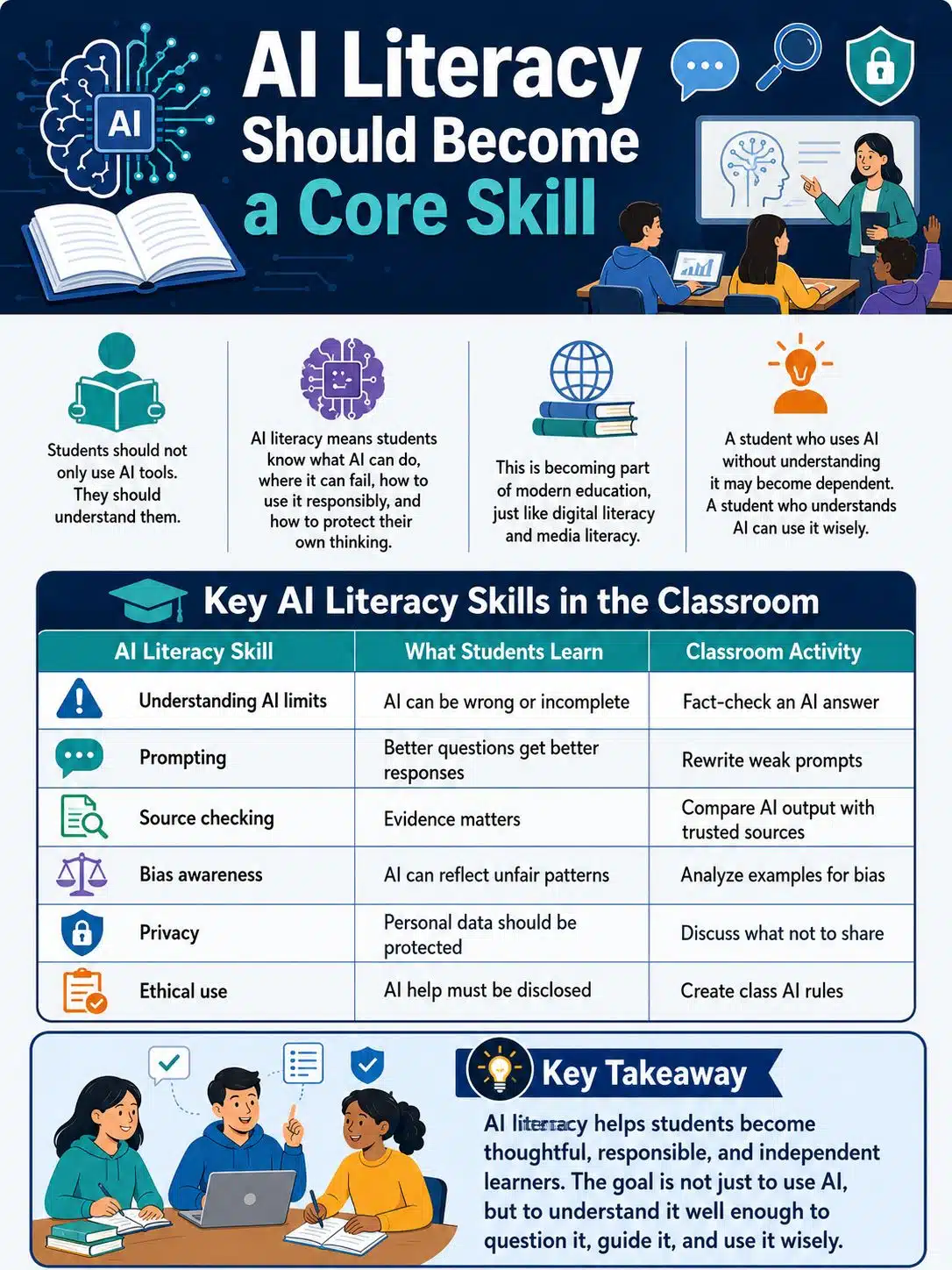
Students should not only use AI tools. They should understand them.
AI literacy means students know what AI can do, where it can fail, how to use it responsibly, and how to protect their own thinking.
This is becoming part of modern education, just like digital literacy and media literacy.
A student who uses AI without understanding it may become dependent. A student who understands AI can use it wisely.
| AI Literacy Skill | What Students Learn | Classroom Activity |
| Understanding AI limits | AI can be wrong or incomplete | Fact-check an AI answer |
| Prompting | Better questions get better responses | Rewrite weak prompts |
| Source checking | Evidence matters | Compare AI output with trusted sources |
| Bias awareness | AI can reflect unfair patterns | Analyze examples for bias |
| Privacy | Personal data should be protected | Discuss what not to share |
| Ethical use | AI help must be disclosed | Create class AI rules |
Students Need to Know AI Does Not “Know” Like Humans
AI can generate strong-looking answers. But it does not understand the world like a person.
It predicts patterns. It produces likely responses. It may sound fluent while being wrong.
Students should learn this early.
It helps them avoid blind trust.
Prompting Is Useful, But Judgment Matters More
Prompt writing is a practical skill. Students should learn how to ask clear questions, add context, request examples, and refine answers.
But prompting is not enough.
The deeper skill is judgment. Students must ask:
- Is this answer true?
- What source supports it?
- What is missing?
- Is there bias?
- Can I explain this in my own words?
- Did I use AI honestly?
That is where real learning happens.
AI Literacy Belongs in Every Subject
AI should not be taught only in computer class.
English teachers can teach AI and writing ethics. Science teachers can teach AI and evidence. History teachers can teach AI and bias. Math teachers can teach AI and data. Art teachers can teach AI and originality.
Stanford HAI’s 2025 AI Index reported that 81% of U.S. K-12 computer science teachers agree that using and learning about AI should be part of foundational computer science education. But less than half of high school computer science teachers felt ready to teach it.
That gap matters.
Schools cannot expect students to use AI responsibly if teachers are not supported first.
A Practical Roadmap for Schools
Schools do not need to rush into AI.
They need a clear, careful plan.
A responsible AI roadmap should protect students, support teachers, inform parents, and improve learning. It should also be simple enough for real classrooms.
Complicated policies that no one reads will not help. Schools need practical rules teachers and students can actually follow.
| Step | What Schools Should Do | Why It Matters |
| Review tools | Check privacy, safety, cost, and learning value | Prevent risky adoption |
| Train teachers | Provide hands-on examples | Build confidence |
| Set student rules | Explain allowed and banned uses | Reduce cheating and confusion |
| Inform parents | Share how AI is used | Build trust |
| Start small | Test AI in limited areas | Learn before scaling |
| Review results | Track impact and problems | Improve policy over time |
Start With a Small Approved Tool List
Schools should not allow every teacher and student to use random tools with student data.
A better approach is to create a short approved list. Each tool should be reviewed for privacy, safety, accessibility, age suitability, cost, and educational value.
This protects students and reduces confusion.
Give Teachers Practical Training
Teachers do not need abstract speeches about AI. They need examples.
Good training should show how to:
- Create lesson plans
- Build quizzes
- Write better prompts
- Check AI accuracy
- Design assignments that reduce cheating
- Support students with disabilities
- Teach responsible AI use
- Protect student data
Training should also give teachers time to practice.
Create Simple Student Rules
Students need clear language.
A school AI policy should answer:
- When can I use AI?
- When is AI not allowed?
- Do I need to say I used it?
- Can AI help me brainstorm?
- Can AI write my final answer?
- What happens if I misuse it?
- How will teachers check my work?
Clear rules reduce fear and confusion.
How Parents Can Support Responsible AI Use
Parents are part of the classroom technology conversation.
Many students will use AI at home even if schools do not allow it. That means parents need to understand the basics. They do not need to be AI experts.
They need enough knowledge to guide children safely.
The best parent role is not to ban every tool or allow everything. It is to ask better questions.
| Parent Concern | Helpful Action | Why It Works |
| Homework misuse | Ask the child to explain their answer | Checks understanding |
| Privacy | Teach children not to share personal data | Reduces risk |
| Overdependence | Set AI-free study time | Builds independent thinking |
| Misinformation | Ask for source checking | Builds research habits |
| School rules | Ask teachers about AI policies | Keeps home and school aligned |
Parents Should Ask Children to Explain Their Work
One simple test works well: “Explain this to me in your own words.”
If a student used AI but still understands the topic, they should be able to explain it. If they cannot explain it, the tool may have done too much of the work.
This approach is better than immediate suspicion.
It focuses on learning.
AI Should Not Replace Reading, Writing, or Practice
Children still need basic skills.
They need to read full texts, write their own sentences, solve problems, memorize important facts, and practice without shortcuts.
AI can help, but it should not become the child’s brain.
Parents Should Know the School’s Rules
Schools should tell parents how AI is used in class.
Parents should ask:
- Which AI tools are approved?
- Is student data protected?
- Are students taught AI ethics?
- Can students use AI for homework?
- How do teachers handle cheating concerns?
- Are children allowed to enter personal data into AI tools?
This creates a healthier partnership between home and school.
The Future of AI in Modern Classrooms
The future of AI in modern classrooms will depend on the choices schools make now.
If schools use AI only to chase trends, the results may be shallow. If they use AI with clear goals, strong teacher training, and student protection, it can improve learning support.
Future classrooms may include AI tutors, smarter feedback tools, better accessibility support, personalized study plans, and new types of assessment.
But the human side of learning will still matter most.
| Future Shift | What It May Look Like | What Schools Need |
| AI tutors | More personal practice support | Teacher supervision |
| Smarter feedback | Faster comments on drafts and exercises | Accuracy checks |
| New assessments | More oral, project-based, and process work | Better rubrics |
| AI literacy | Students learn responsible AI use | Cross-subject teaching |
| Inclusive tools | More support for disabilities and language needs | Equity planning |
| Teacher workflow support | Less repetitive admin work | Clear boundaries |
Assessment Will Become More Process-Based
Schools may move away from simple take-home essays that are easy to outsource.
Instead, they may use more:
- In-class writing
- Oral defense
- Project journals
- Draft history
- Personal reflection
- Group presentation
- Real-world problem solving
This does not mean traditional tests will disappear. But assessment will need to show how students think, not only what final answer they submit.
Teachers Will Need Stronger AI Training
AI will likely become part of teacher professional development.
Teachers will need to know how to use AI tools, spot weak outputs, protect student privacy, teach AI literacy, and design better assignments.
This training should not be optional forever.
If AI is part of the classroom, teacher support must be part of the plan.
Equity Will Be a Major Challenge
AI could either narrow or widen education gaps.
Students in well-funded schools may get safer tools, better devices, trained teachers, and strong internet. Students in under-resourced schools may get little support or rely on free tools with weaker safeguards.
That is why public investment matters.
AI in education should not become another advantage only for students who already have more.
Final Thoughts: AI in Modern Classrooms Needs Human Direction
AI in modern classrooms is changing education in real ways.
It can help teachers save time. It can make practice more personal. It can support students with different learning needs. It can improve feedback. It can help schools rethink assessment and prepare students for a future where AI will be part of work and life.
But AI is not the teacher.
It does not know a child’s story. It does not understand classroom emotion. It does not build trust. It does not replace patience, encouragement, fairness, or human judgment.
The best classroom future is not AI instead of teachers. It is teachers using AI wisely.
Students should still think deeply. Teachers should still lead. Schools should still protect privacy. Parents should still ask questions. And every AI tool should serve one goal: better learning.
That is the real promise of AI in modern classrooms.
FAQs about AI in modern classrooms
How is AI changing classroom teaching?
AI is helping teachers plan lessons, create learning materials, give faster feedback, personalize practice, and identify student learning gaps. It supports teaching work, but it does not replace the teacher’s role.
Can AI improve student learning outcomes?
AI can support better learning when it is used with clear goals, teacher guidance, and quality content. It can help students practice at the right level, get quick feedback, and review difficult topics. But results depend on how well the tool is used.
What is the biggest benefit of AI for teachers?
The biggest benefit is time support. AI can help teachers draft materials, quizzes, rubrics, summaries, and differentiated tasks faster. This gives teachers more time for feedback, planning, and student support.
What is the biggest danger of AI in education?
The biggest danger is careless use. Problems include student privacy risks, inaccurate information, bias, cheating, overdependence, and weak school policies.
Should schools ban AI tools?
A full ban may not work because students can access AI outside school. A better approach is to create clear rules, teach responsible use, redesign assignments, and approve safe tools.
Can AI help students with disabilities?
Yes. AI can support students through speech-to-text, text-to-speech, captions, reading support, task breakdowns, and translation. These tools work best when teachers and specialists guide their use.
How can teachers stop students from copying AI answers?
Teachers can use draft checks, in-class writing, oral explanations, personal reflection, project journals, and process-based grading. AI detectors alone are not enough.
Is AI reliable for homework help?
AI can be useful for explanations and practice, but it can also give wrong answers. Students should verify facts, check sources, and make sure they understand the topic.