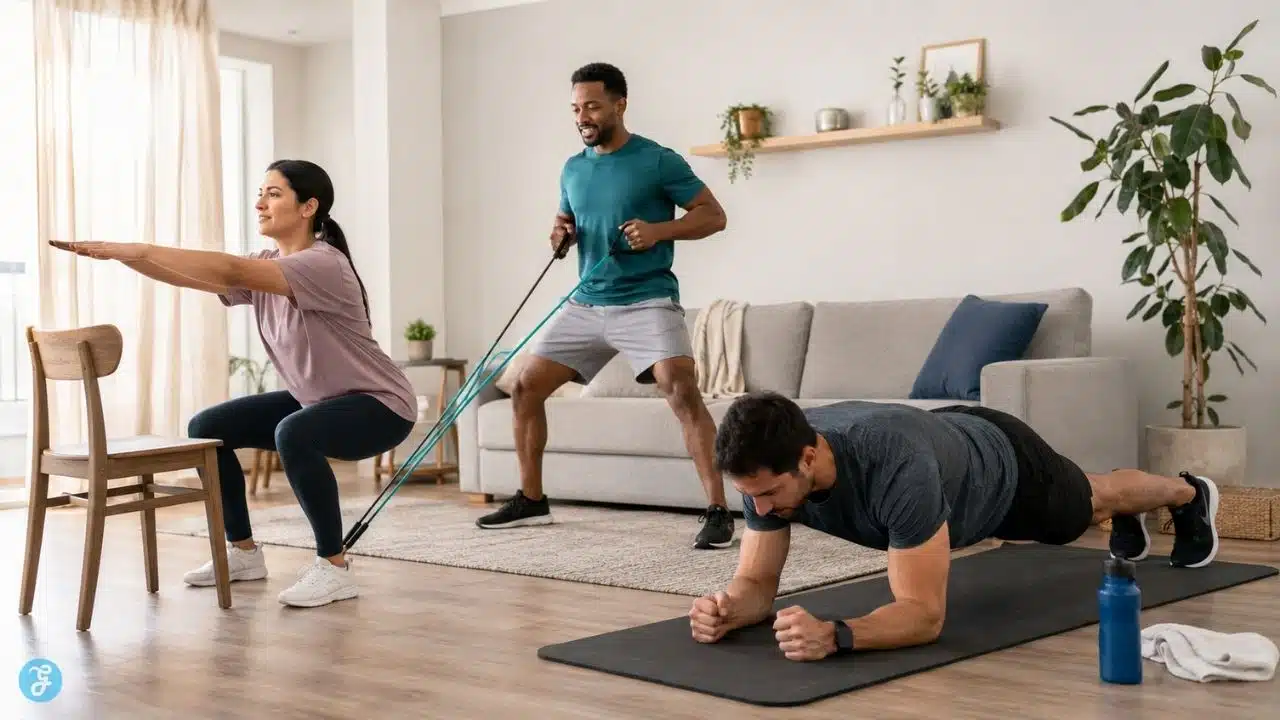
The best home workouts are not the ones that make you collapse in a pool of sweat and then disappear from your routine forever. They are the ones you can repeat, adjust, and actually live with. That is the part most people miss. I have seen the same pattern too many times: someone gets motivated, starts with a brutal HIIT video, adds random push-ups, tries to “fix” years of inactivity in one week, then quits because their knees hurt, their back feels tight, or the workout simply feels miserable.
That is not a discipline problem. That is usually a programming problem. A good home workout plan should feel practical. It should give you strength, joint-friendly movement, mobility, cardio, core training, and recovery. It should also respect your current fitness level. A beginner does not need the same routine as someone who has been training for years. A desk worker does not need the same warm-up as a college athlete. And someone training in a small apartment does not need a noisy jump-heavy routine that annoys the whole building.
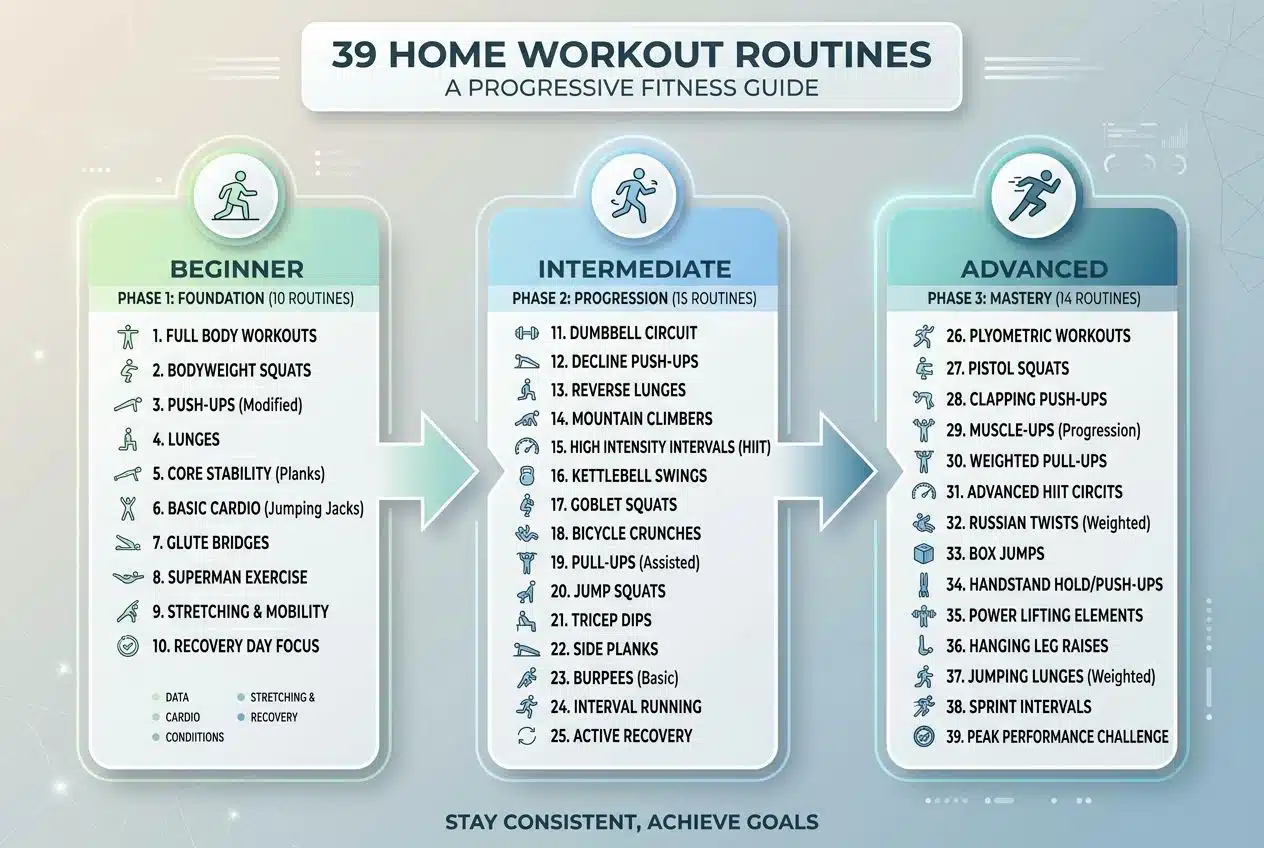
In this guide, I brought together 39 home workout routines for different fitness levels and goals. You will find beginner routines, bodyweight strength workouts, resistance band sessions, yoga flows, desk-worker mobility routines, core workouts without crunches, and short HIIT options under 20 minutes.
The structure is simple: choose your current level, pick a routine that matches your goal, and progress slowly. That is how at-home fitness becomes sustainable.
Why Home Workouts Still Matter in 2026
Home workouts are no longer just a backup plan for people who cannot go to the gym. They are now a serious fitness option for busy professionals, parents, remote workers, beginners, and anyone who wants to stay active without turning fitness into another expensive subscription.
The need is real. WHO reported that nearly one-third of adults worldwide, around 31%, did not meet recommended physical activity levels in 2022. That equals about 1.8 billion adults.
For adults, the CDC recommends at least 150 minutes of moderate-intensity physical activity per week, or 75 minutes of vigorous activity, plus at least 2 days of muscle-strengthening work. That is where no-gym workouts can make a big difference. You do not need a perfect home gym. You need a repeatable system.
The American College of Sports Medicine’s 2026 resistance-training update also supports this shift. It notes that elastic bands, bodyweight exercises, and home-based routines can produce meaningful benefits in strength, muscle size, and physical function.
In plain English: if you train properly at home, it counts.
How I Selected These Best Home Workouts
Before listing the routines, I want to make the selection process clear. This is not a random list of trendy exercises. Each routine was chosen based on usefulness, safety, progression, and how easy it is to repeat at home.
| Selection Factor | Why It Matters |
| Beginner accessibility | A good routine should not scare off new exercisers |
| Progression potential | The workout should get harder as you improve |
| Low equipment requirement | Most people should be able to start with bodyweight or basic tools |
| Joint-friendliness | Not every effective workout needs jumping |
| Full-body balance | Strength, mobility, cardio, and core should all be covered |
| Real home practicality | The routine should work in a bedroom, living room, or small apartment |
I also avoided routines that rely too much on ego exercises. Burpees, jump squats, and mountain climbers have their place, but they are not magic. For many beginners, they are just fast ways to lose form.
Before You Start: A Simple Safety Check
This article is for general fitness education. If you have heart disease, uncontrolled blood pressure, recent surgery, severe joint pain, pregnancy-related concerns, or any medical condition, speak with a qualified health professional before starting a new workout plan.
Use the talk test to manage intensity. According to the CDC, during moderate-intensity activity, you should be able to talk but not sing. During vigorous activity, you should not be able to say more than a few words without pausing for breath.
Here is my practical rule: most home workouts should finish with you feeling challenged, not destroyed. If your form falls apart, the set is over.
What You Need for At-Home Fitness
You can start with nothing but your bodyweight. Still, a few simple tools can make your home workout routines more comfortable and flexible.
| Home Workout Tool | Why It Helps | Priority |
| Exercise mat | Makes floor work, yoga, and core training more comfortable | High |
| Resistance bands | Add pulling, glute, shoulder, and strength work | High |
| Stable chair | Useful for squats, step-ups, incline push-ups, and balance | Medium |
| Timer | Keeps circuits structured | Medium |
| Towel | Helps with stretching, sliders, sweat, and grip | Medium |
| Water bottle | Keeps hydration nearby | Basic |
| Optional dumbbells | Useful, but not required | Optional |
One mistake I made early with home training was thinking more gear would fix inconsistent habits. It did not. A simple setup works better. A mat, bands, and a timer can cover most people’s needs.
If you want to build a cleaner, low-waste home fitness corner, choose durable basics instead of buying random gadgets you will not use. You can also explore practical wellness and lifestyle products through our Eco Shop if you prefer a more intentional, sustainable setup.
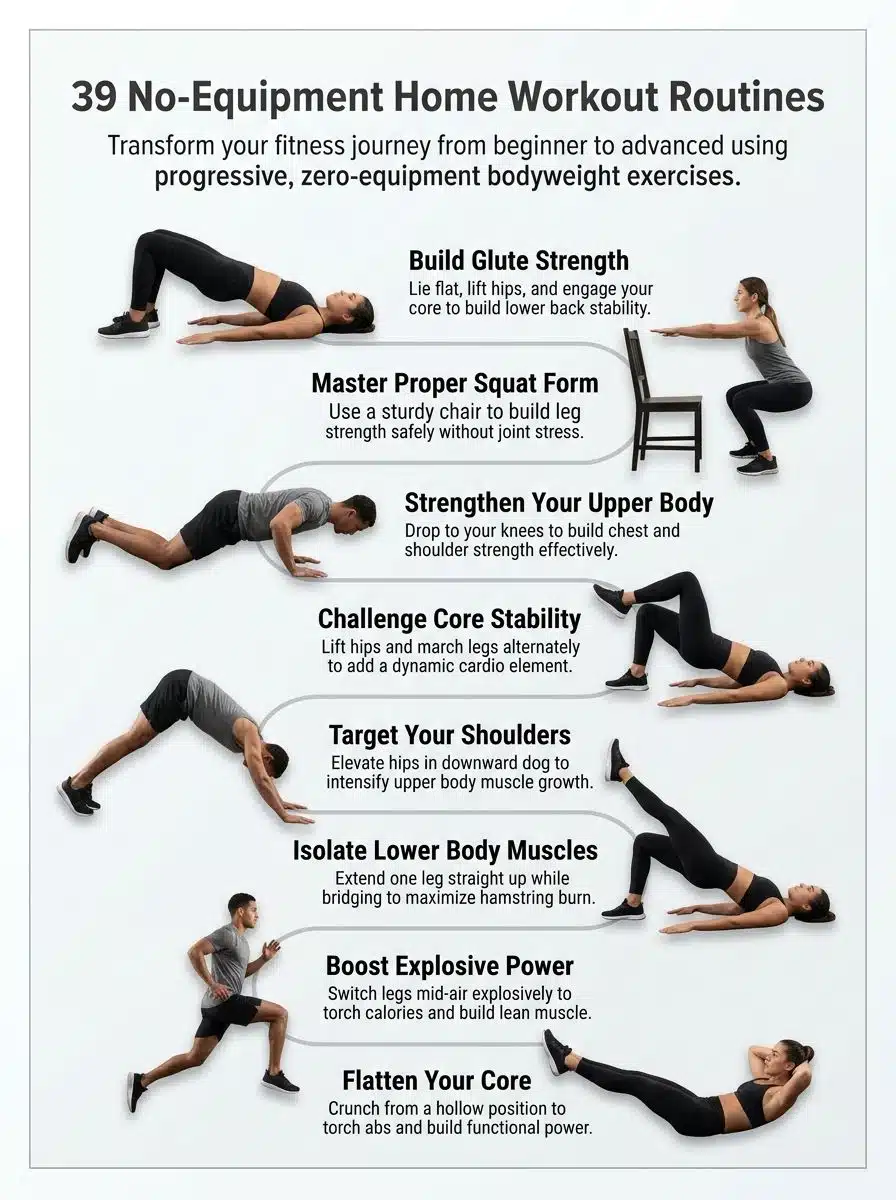
How to Use These 39 Home Workout Routines
You do not need to do all 39 routines. Think of this as a menu.
Choose based on your goal:
| Your Goal | Best Routine Type |
| Start exercising after a long break | Beginner home workouts |
| Build strength without equipment | Bodyweight workouts |
| Add resistance without dumbbells | Resistance band workouts |
| Improve flexibility and recovery | Yoga flows |
| Reduce desk stiffness | Mobility routines |
| Strengthen abs without crunches | Core workouts |
| Sweat fast in a limited time | HIIT under 20 minutes |
For beginners, start with 3 workouts per week. For intermediate exercisers, use 4–5 sessions weekly. Advanced users can train 5 days weekly, but recovery still matters.
Beginner Home Workouts
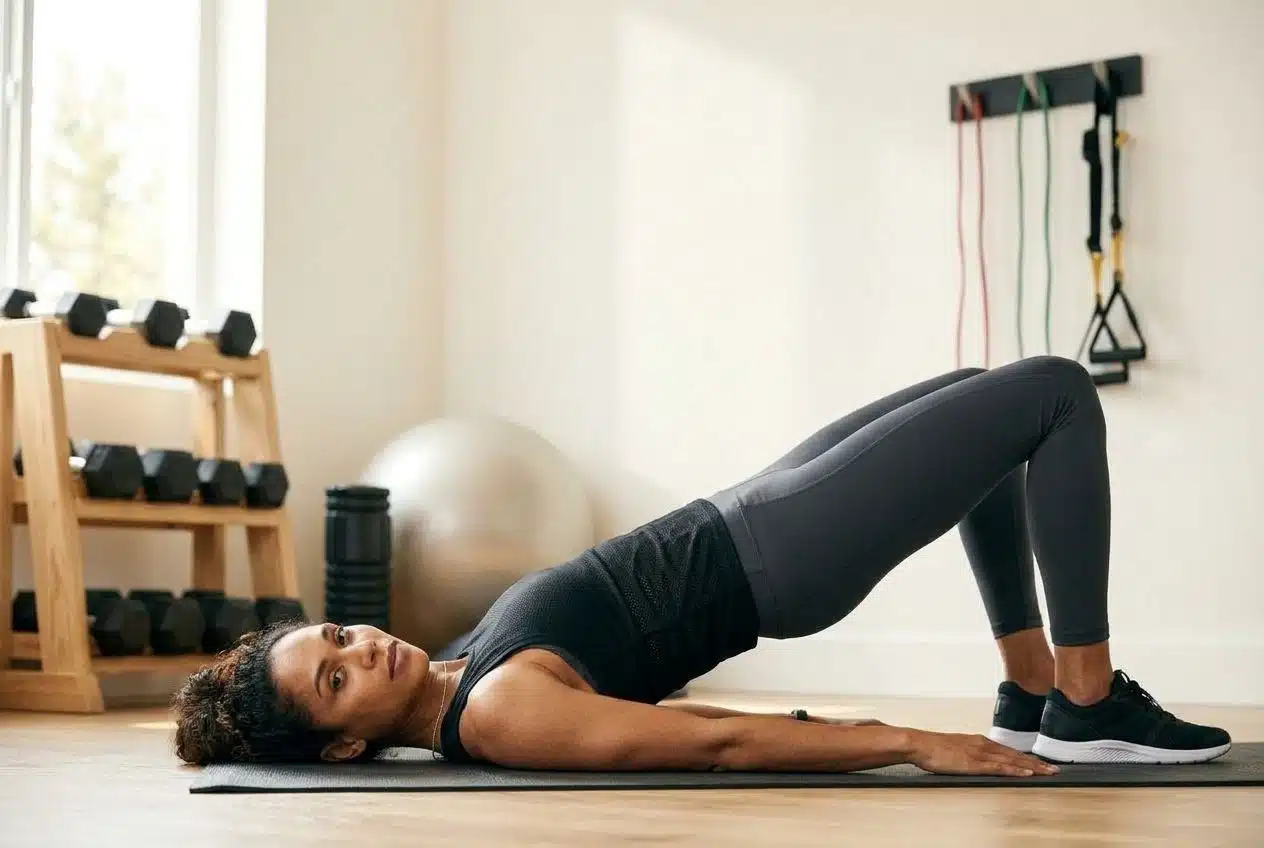
Beginner workouts should do three things: teach basic movement, build confidence, and leave you ready to come back tomorrow. If a beginner routine makes you dread the next session, it is too much. These routines are also useful for people returning after a long break.
1. The 15-Minute Starter Circuit
| Detail | Routine |
| Best For | Complete beginners |
| Time | 15 minutes |
| Equipment | Chair optional |
| Exercises | Chair squats, wall push-ups, marching, glute bridges, and standing shoulder circles |
| Structure | 30 seconds work, 30 seconds rest, 3 rounds |
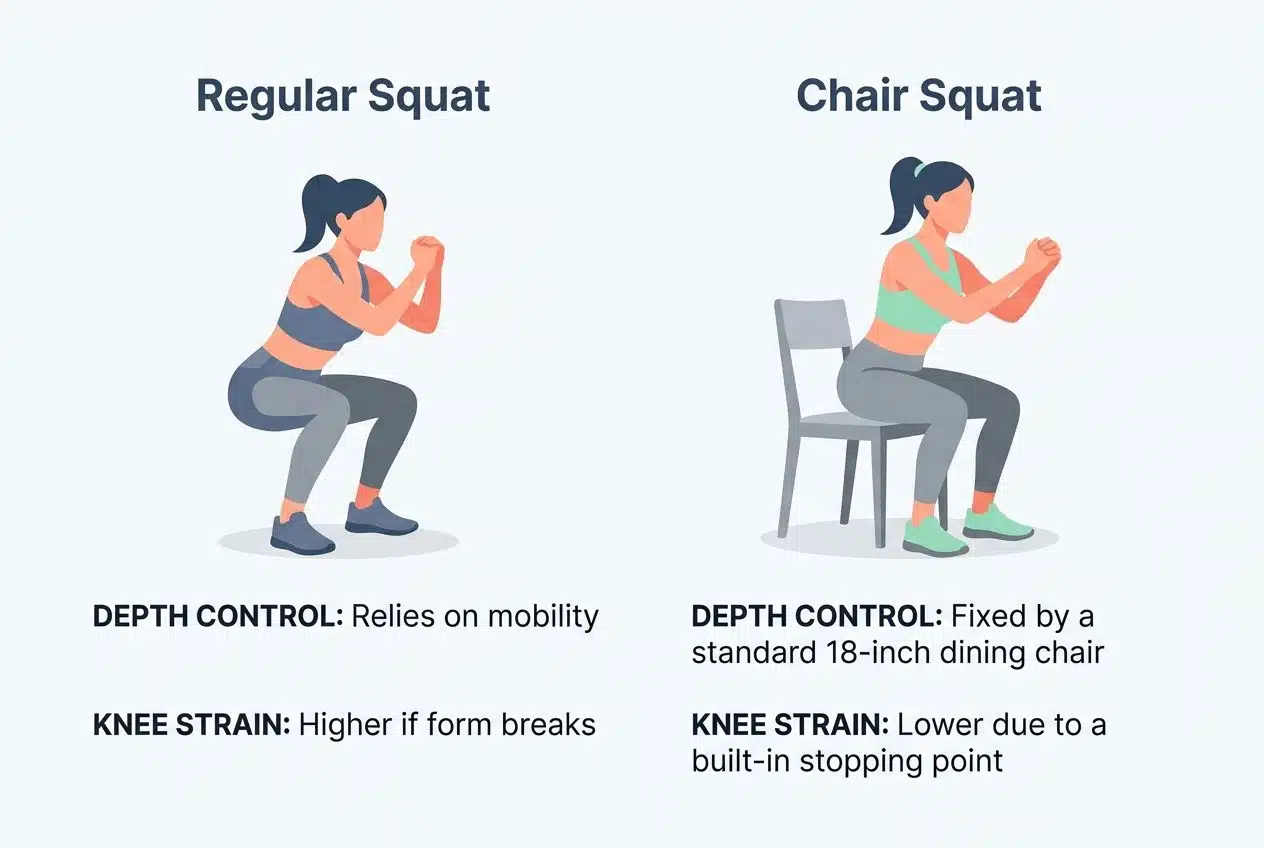
This is one of the best home workouts for someone who feels out of shape but wants to start safely. It covers the basic movement patterns: squat, push, hip extension, light cardio, and shoulder mobility. The biggest mistake is rushing. Move slowly. For chair squats, sit down with control instead of dropping into the chair.
Progression tip: after one week, increase each work period to 40 seconds.
2. The No-Jump Beginner Cardio Routine
| Detail | Routine |
| Best For | Apartment workouts and joint-sensitive beginners |
| Time | 12–18 minutes |
| Equipment | None |
| Exercises | Step touches, marching, standing punches, low-impact jacks, side steps |
| Structure | 40 seconds work, 20 seconds rest, 3 rounds |
This routine raises your heart rate without jumping. That matters because many beginners assume cardio must be loud, fast, and painful. It does not. Keep your breathing steady. You should feel warm and slightly breathless, but still in control.
Modification: slow the pace and reduce arm movement if your shoulders feel tired.
3. The Chair Strength Workout
| Detail | Routine |
| Best For | Older adults, beginners, and people rebuilding confidence |
| Time | 15–20 minutes |
| Equipment | Stable chair |
| Exercises | Sit-to-stand, seated knee lifts, incline push-ups, seated band row, heel raises |
| Structure | 10–12 reps each, 2–3 rounds |
A chair is not a weak tool. It is a control tool. This routine helps you build strength while giving your body extra support. Sit-to-stands are especially useful because they train a real-life movement. If you can stand up from a chair more easily, daily life gets easier too.
Progression tip: Use a lower chair only when your form is solid.
4. The Beginner Full-Body No-Gym Workout
| Detail | Routine |
| Best For | New exercisers ready for a complete session |
| Time | 20 minutes |
| Equipment | None |
| Exercises | Bodyweight squats, incline push-ups, reverse lunges, dead bugs, step touches |
| Structure | 40 seconds work, 20 seconds rest, 3 rounds |
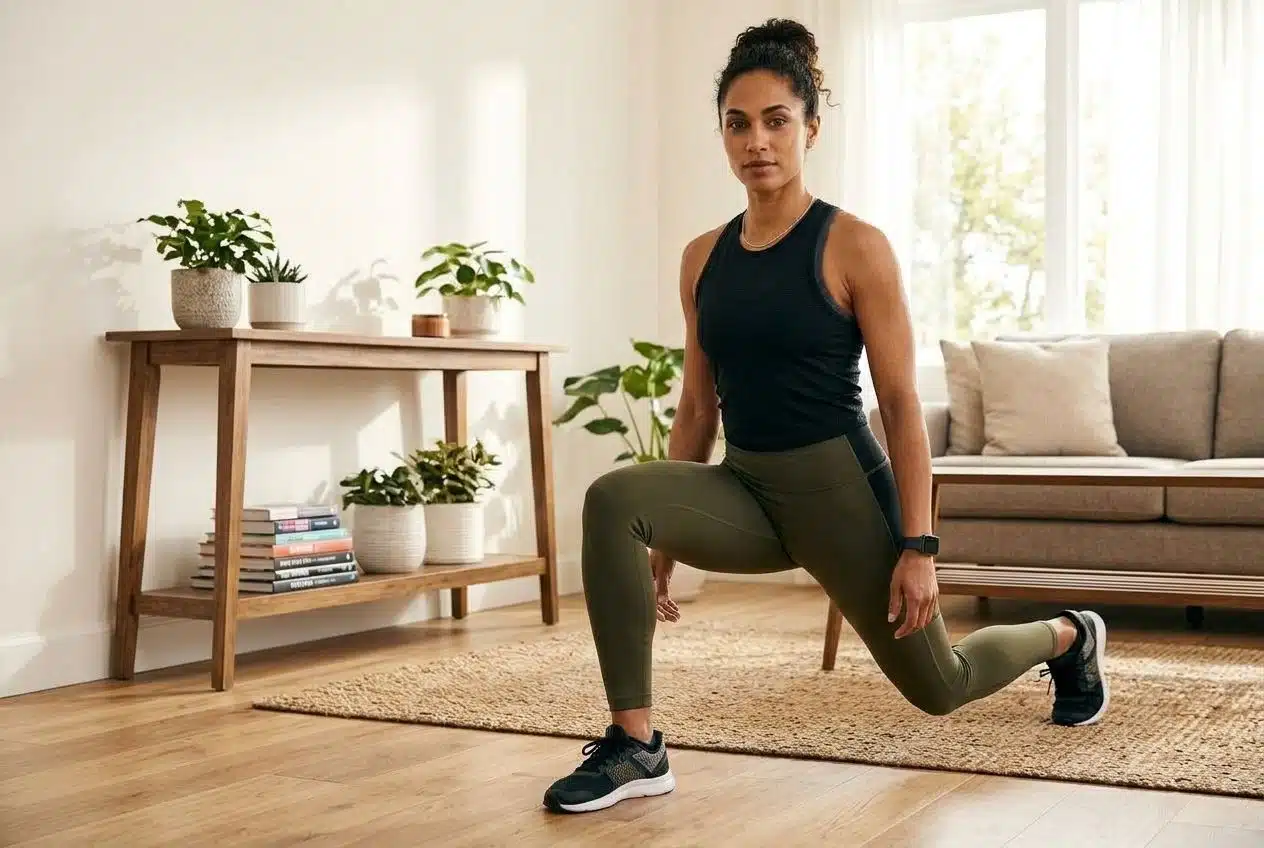
This workout feels like a proper full-body session without becoming extreme. It trains legs, chest, core, balance, and cardio. For reverse lunges, take a small step back. You do not need a deep lunge at first. If lunges feel unstable, replace them with split squats while holding a chair.
Common mistake: letting the knees collapse inward during squats or lunges.
5. The Walk-and-Strength Combo
| Detail | Routine |
| Best For | Beginners who prefer gentle starts |
| Time | 25–30 minutes |
| Equipment | None |
| Exercises | 15-minute brisk walk, then squats, wall push-ups, glute bridges, plank hold |
| Structure | Walk first, then 2 strength rounds |
This is one of the easiest ways to build consistency. Walking gives you moderate cardio, while the strength moves cover the major muscle groups. I like this routine because it does not feel intimidating. It is also easy to repeat 3–4 times per week.
Progression tip: add 5 minutes to the walk before adding more strength exercises.
6. The Morning Energy Routine
| Detail | Routine |
| Best For | Stiff mornings and low motivation days |
| Time | 8–12 minutes |
| Equipment | None |
| Exercises | Arm circles, hip circles, bodyweight good mornings, slow squats, calf raises, easy marching |
| Structure | 45 seconds per move, 2 rounds |
This is not designed to crush calories. It is designed to make your body feel awake. Use it on days when you do not feel like training. Often, once you start moving, you will feel ready for more. Even if you stop after 10 minutes, you still keep the habit alive.
7. The Return-to-Fitness Reset
| Detail | Routine |
| Best For | People restarting after months away |
| Time | 20 minutes |
| Equipment | Mat optional |
| Exercises | Marching, chair squats, hip hinges, wall shoulder taps, bird dogs |
| Structure | 8–10 reps each, 3 rounds |
This routine is intentionally simple. When you return after a break, your brain may remember your old fitness level, but your joints, lungs, and muscles may not. Start lower than your ego wants. That is how you avoid the classic “first week soreness disaster.”
Progression tip: add one extra round after two successful weeks.
Bodyweight Workouts That Build Strength
Bodyweight training works because your body is the resistance. The secret is not doing random reps. The secret is adjusting leverage, tempo, range of motion, rest time, and volume.
If you want deeper variations later, this section naturally expands into bodyweight workouts that build strength.
8. The Squat-Push-Plank Circuit
| Detail | Routine |
| Best For | Simple full-body strength |
| Time | 18–22 minutes |
| Equipment | None |
| Exercises | Squats, incline or floor push-ups, plank, glute bridges |
| Structure | 10–15 reps each, 3–4 rounds |
This is a clean foundation workout. It is not flashy, but it works. Squats train the lower body. Push-ups train the chest, shoulders, and triceps. Planks teach core tension. Glute bridges wake up the hips.
Progression tip: Slow the lowering phase to 3 seconds on squats and push-ups.
9. The Push-Up Progression Workout
| Detail | Routine |
| Best For | Building upper-body strength |
| Time | 15 minutes |
| Equipment | Wall, table, or floor |
| Exercises | Wall push-ups, incline push-ups, knee push-ups, full push-ups |
| Structure | Choose one level and do 5 sets of 5–10 reps |
Push-ups are one of the most honest strength exercises. They reveal your pressing strength, core control, and shoulder stability. Start with the version you can do cleanly. A strong incline push-up is better than a collapsing floor push-up.
Common mistake: letting the hips sag. Keep your body like one straight line.
10. The Lower-Body Strength Builder
| Detail | Routine |
| Best For | Legs and glutes |
| Time | 25 minutes |
| Equipment | Chair optional |
| Exercises | Squats, reverse lunges, glute bridges, calf raises, wall sit |
| Structure | 12 reps each, 3–4 rounds; wall sit 30–45 seconds |
This is a strong lower-body session without weights. It works well for people who want more leg strength but do not own dumbbells. The wall at the end adds a serious burn. Keep your back flat against the wall and breathe steadily.
Modification: replace reverse lunges with supported split squats.
11. The Tempo Strength Routine
| Detail | Routine |
| Best For | Making bodyweight exercises harder |
| Time | 20 minutes |
| Equipment | None |
| Exercises | Tempo squats, slow push-ups, slow lunges, slow mountain climbers |
| Structure | 3 seconds down, 1-second pause, controlled return |
Tempo training changed the way I look at home workouts. When you slow down, simple exercises become much harder. Do not chase speed here. The goal is control. You should feel the muscle working through the full movement.
Progression tip: add a 2-second pause at the hardest part of each rep.
12. The Isometric Strength Workout
| Detail | Routine |
| Best For | Joint-friendly strength and control |
| Time | 15–18 minutes |
| Equipment | Wall and mat are optional |
| Exercises | Wall sit, plank, side plank, glute bridge hold, hollow hold variation |
| Structure | Hold each move for 20–45 seconds, repeat 3 rounds |
Isometrics are underrated. You hold a position instead of moving through reps, which can be useful when you want strength without impact. This routine is especially useful for core, legs, and posture. It also teaches mental patience, which is surprisingly important in fitness.
Modification: do side planks from the knees.
13. The Athletic Bodyweight Circuit
| Detail | Routine |
| Best For | Intermediate conditioning and strength |
| Time | 22–25 minutes |
| Equipment | None |
| Exercises | Fast squats, push-ups, skater steps, bear crawl, plank shoulder taps |
| Structure | 40 seconds work, 20 seconds rest, 4 rounds |
This is a stronger workout for people who already have some base fitness. It blends strength, coordination, and cardio. Bear crawls are the exercise most people underestimate. Move slowly and keep your knees close to the floor.
Modification: Replace bear crawls with bird dogs if your wrists feel uncomfortable.
14. The Full-Body Strength Ladder
| Detail | Routine |
| Best For | Progression without equipment |
| Time | 20–25 minutes |
| Equipment | None |
| Exercises | Squats, push-ups, lunges, plank taps |
| Structure | 2 reps each, then 4, 6, 8, 10 |
Ladders are useful because they make progression visible. You start small and build up step by step. Rest as needed between rounds. Do not turn this into a race unless your form stays clean.
Progression tip: once you finish 10 reps easily, go back down the ladder: 10, 8, 6, 4, 2.
Resistance Band Workout Routines
Resistance bands are one of the smartest tools for at-home fitness. They are affordable, portable, and useful for movements that bodyweight alone does not train well, especially pulling exercises.
15. The Band Full-Body Starter
| Detail | Routine |
| Best For | Beginners using bands |
| Time | 20 minutes |
| Equipment | Long resistance band |
| Exercises | Band squats, band rows, band chest press, band deadlift, band pull-aparts |
| Structure | 10–12 reps each, 3 rounds |
This is a balanced first band workout. It gives you lower-body, pushing, pulling, hinge, and upper-back work. Keep the band tension light at first. Your goal is to understand the movement, not fight the band.
Common mistake: letting the band snap back. Control both directions.
16. The Upper-Back and Posture Band Routine
| Detail | Routine |
| Best For | Desk workers and rounded shoulders |
| Time | 15 minutes |
| Equipment | Light band |
| Exercises | Band pull-aparts, face pulls, seated rows, external rotations |
| Structure | 12–15 reps each, 3 rounds |
If you sit at a laptop all day, this routine can feel like medicine. It trains the upper back and shoulder muscles that often get ignored. Use a light band. Shoulder work does not need heavy resistance.
Progression tip: pause for 1 second when your shoulder blades squeeze together.
17. The Lower-Body Mini-Band Workout
| Detail | Routine |
| Best For | Glutes, hips, and leg stability |
| Time | 20 minutes |
| Equipment | Mini band |
| Exercises | Lateral band walks, band glute bridges, band squats, clamshells, and standing kickbacks |
| Structure | 12–20 reps each, 3 rounds |
This routine is small-space friendly and deceptively hard. The lateral band walks will make your hips work quickly. Keep your knees aligned with your toes. Do not let the band pull your knees inward.
Modification: remove the band and do the same movements with bodyweight.
18. The Band Push-Pull Workout
| Detail | Routine |
| Best For | Upper-body strength balance |
| Time | 25 minutes |
| Equipment | Long band and safe anchor point |
| Exercises | Band chest press, band row, band overhead press, band lat pulldown, band triceps pressdown |
| Structure | 10–15 reps each, 3–4 rounds |
A good home strength plan needs to be pulled. Push-ups are great, but they do not replace rows and pulldowns. Anchor the band carefully. If the anchor is unstable, do not use it.
Progression tip: step farther from the anchor to increase tension.
19. The Band Core Stability Routine
| Detail | Routine |
| Best For | Core strength without crunches |
| Time | 15–20 minutes |
| Equipment | Resistance band |
| Exercises | Pallof press, band dead bug, band wood chop, band march, side plank |
| Structure | 8–12 reps per side, 3 rounds |
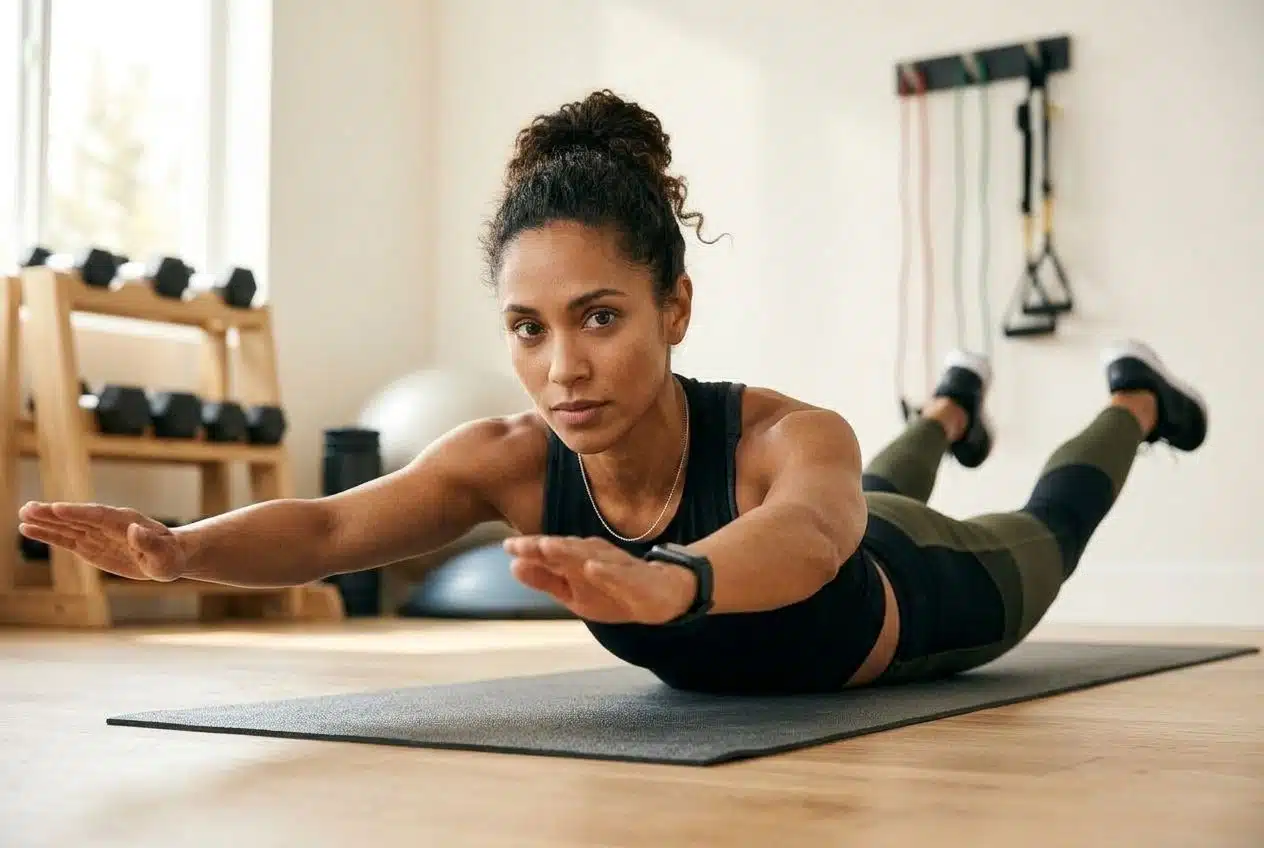
This routine trains the core to resist movement, not just create movement. That is useful for real life because your core often works to stabilize your spine. The Pallof press is the star here. Press the band away from your chest without letting your body rotate.
Modification: Stand closer to the anchor to reduce resistance.
20. The Travel Band Workout
| Detail | Routine |
| Best For | Hotel rooms and busy days |
| Time | 15–20 minutes |
| Equipment | One long band |
| Exercises | Band row, band squat, band good morning, band curl, band press |
| Structure | 45 seconds each, 3 rounds |
This is the routine I would choose if I only had one band and very little space. It is simple, fast, and covers the whole body. Keep the pace moderate. The band should stay under control during every rep.
Progression tip: Use a thicker band or add a fourth round.
Yoga Flows for Different Goals
Yoga is not just stretching. It can improve mobility, breathing, body awareness, recovery, and strength endurance. These flows are designed for practical home use, not complicated studio performance.
21. The Morning Mobility Yoga Flow
| Detail | Routine |
| Best For | Stiff mornings |
| Time | 10–15 minutes |
| Equipment | Mat optional |
| Movements | Cat-cow, downward dog, low lunge, forward fold, child’s pose |
| Structure | 3–5 slow breaths per pose |
This flow is best done before the day takes over. It opens the spine, hips, hamstrings, and shoulders. Do not force flexibility in the morning. Your body may need time to warm up.
Progression tip: add gentle sun salutations after one week.
22. The Stress-Relief Evening Flow
| Detail | Routine |
| Best For | Relaxation and recovery |
| Time | 15 minutes |
| Equipment | Mat or carpet |
| Movements | Child’s pose, thread-the-needle, seated forward fold, legs-up-the-wall, slow breathing |
| Structure | Hold each pose for 45–90 seconds |
This flow is for calming down, not chasing intensity. It pairs well with stressful workdays. The breathing matters. Slow exhales help your body shift out of “go mode.”
Modification: Place a pillow under the knees during forward folds.
23. The Hip-Opening Yoga Flow
| Detail | Routine |
| Best For | Tight hips |
| Time | 15–20 minutes |
| Equipment | Mat |
| Movements | Low lunge, pigeon variation, 90/90 stretch, deep squat hold, figure-four stretch |
| Structure | Hold each position for 30–60 seconds |
Tight hips are common for people who sit for long hours. This flow helps restore a comfortable range of motion. Do not force pigeon pose. A figure-four stretch on your back is often safer and more comfortable.
Progression tip: add gentle hip rotations before deeper holds.
24. The Back-Friendly Yoga Reset
| Detail | Routine |
| Best For | Gentle decompression |
| Time | 10–15 minutes |
| Equipment | Mat |
| Movements | Cat-cow, child’s pose, pelvic tilts, knees-to-chest, bird dog |
| Structure | Move slowly and avoid pain |
This is useful after long sitting or light stiffness. It is not a treatment plan for serious back pain, but it can help many people move more comfortably. The bird dog adds control. Keep your hips level and avoid twisting.
Modification: keep hands elevated on a chair if floor work is difficult.
25. The Post-Workout Recovery Flow
| Detail | Routine |
| Best For | After strength or HIIT |
| Time | 15–20 minutes |
| Equipment | Mat |
| Movements | Low lunge, hamstring stretch, chest opener, spinal twist, box breathing |
| Structure | 45–60 seconds per position |
This flow helps you transition from workout mode to recovery mode. It is especially useful after leg training or HIIT. Do not treat recovery work like a competition. The goal is to reduce tension, not win a flexibility contest.
Mobility Routines for Desk Workers
Desk work creates predictable problems: stiff hips, tight chest, rounded shoulders, irritated neck, and weak glutes. Mobility routines do not need to be long. They just need to be consistent.
26. The 8-Minute Desk Break Routine
| Detail | Routine |
| Best For | Midday stiffness |
| Time | 8 minutes |
| Equipment | None |
| Movements | Neck glides, shoulder rolls, chest opener, hip flexor stretch, calf raises |
| Structure | 45 seconds per move |
This is the kind of routine people actually do because it is short. You can use it between calls, writing sessions, or study blocks. Keep it gentle. Desk mobility should refresh you, not make you sweaty.
Progression tip: Do it twice per workday.
27. The Shoulder and Upper-Back Mobility Routine
| Detail | Routine |
| Best For | Laptop posture |
| Time | 10–12 minutes |
| Equipment | Wall optional |
| Movements | Wall angels, thoracic rotations, band pull-aparts, doorway chest stretch |
| Structure | 8–12 reps or 30-second holds |
This routine targets the “rounded forward” position that shows up after hours at a desk. Wall angels may feel difficult at first. Keep your ribs down and move only through a comfortable range.
Modification: do floor angels if standing against a wall feels awkward.
28. The Hip Flexor and Glute Wake-Up
| Detail | Routine |
| Best For | Tight hips from sitting |
| Time | 10 minutes |
| Equipment | Mat optional |
| Movements | Hip flexor stretch, glute bridges, 90/90 switches, standing hip circles |
| Structure | 8–12 reps or 30-second holds |
This routine works because it stretches the front of the hips and activates the glutes. That combination is better than stretching alone. Focus on control during glute bridges. Do not arch your lower back to fake a higher lift.
Progression tip: pause for 2 seconds at the top of each bridge.
29. The Neck and Chest Reset
| Detail | Routine |
| Best For | Screen-heavy workdays |
| Time | 8–10 minutes |
| Equipment | None |
| Movements | Chin tucks, doorway stretch, neck side stretch, shoulder blade squeezes |
| Structure | 8–10 reps or 30-second holds |
This is one of the most practical routines in the whole article. It directly addresses the posture many people live in all day. Do not crank your neck into deep stretches. Use light pressure and slow breathing.
Common mistake: shrugging the shoulders during shoulder blade squeezes.
30. The Full-Body Mobility Flow
| Detail | Routine |
| Best For | Daily movement maintenance |
| Time | 12–15 minutes |
| Equipment | None |
| Movements | Cat-cow, world’s greatest stretch, deep squat hold, thoracic rotations, hamstring sweeps |
| Structure | Move slowly through 2–3 rounds |
This routine is a strong all-purpose mobility option. It works well before bodyweight training or on recovery days. The world’s greatest stretch is especially useful because it combines hip mobility, hamstring stretch, and upper-back rotation.
Modification: Keep the back knee down during lunging movements.
Core Workouts That Do Not Require Crunches
Crunches are not required for a strong core. In fact, many people feel crunches more in their neck or hip flexors than in their abs. These routines focus on stability, anti-rotation, breathing, and full-body control.
31. The Dead Bug Core Routine
| Detail | Routine |
| Best For | Beginners and back-friendly core work |
| Time | 10–12 minutes |
| Equipment | Mat |
| Exercises | Dead bug, heel taps, glute bridge, knee plank |
| Structure | 8–12 reps each, 3 rounds |
Dead bugs teach your core to stay stable while your arms and legs move. That is more useful than it looks. Keep your lower back controlled. If it arches, reduce the range of motion.
Progression tip: extend the legs farther only when control stays strong.
32. The Plank Builder
| Detail | Routine |
| Best For | Core endurance |
| Time | 10–15 minutes |
| Equipment | Mat |
| Exercises | Forearm plank, side plank, plank shoulder taps, plank step-outs |
| Structure | 20–40 seconds each, 3 rounds |
A clean plank is not passive. Squeeze your glutes, brace your abs, and push the floor away. Shorter quality holds beat long, sloppy holds. Stop before your hips sag.
Modification: plank from the knees.
33. The Bird Dog Stability Workout
| Detail | Routine |
| Best For | Balance, posture, and spinal control |
| Time | 10 minutes |
| Equipment | Mat |
| Exercises | Bird dog, bird dog hold, quadrupod shoulder taps, glute bridge |
| Structure | 8–10 reps per side, 3 rounds |
Bird dogs look easy until you do them properly. The goal is to avoid twisting. This is a great core workout for beginners, desk workers, and anyone who wants control without crunches.
Progression tip: pause for 2 seconds with the arm and leg extended.
34. The Standing Core Routine
| Detail | Routine |
| Best For | People who dislike floor workouts |
| Time | 12–15 minutes |
| Equipment | None or band |
| Exercises | Standing knee drives, standing cross-body chops, suitcase march, single-leg balance |
| Structure | 30–40 seconds each, 3 rounds |
Standing core work is underrated. It trains balance, coordination, and core control in a position you actually use in daily life. If you have a band, add resistance to the chops. If not, move slowly and focus on rotation control.
Common mistake: swinging the arms without bracing the core.
HIIT Routines Under 20 Minutes
HIIT is useful, but it is not something most people need every day. For many readers, 1–2 short HIIT sessions per week is enough when combined with strength, mobility, and easier cardio. These HIIT routines are short by design.
35. The 10-Minute Beginner HIIT Routine
| Detail | Routine |
| Best For | New HIIT users |
| Time | 10 minutes |
| Equipment | None |
| Exercises | Marching, incline push-ups, bodyweight squats, step touches |
| Structure | 30 seconds work, 30 seconds rest, 2 rounds |
This is HIIT without chaos. It raises intensity but keeps movements beginner-friendly. You should feel challenged, not panicked. If breathing gets too intense, slow down.
Progression tip: move to 40 seconds work and 20 seconds rest.
36. The 12-Minute Bodyweight HIIT Workout
| Detail | Routine |
| Best For | Intermediate exercisers |
| Time | 12 minutes |
| Equipment | None |
| Exercises | Squats, push-ups, mountain climbers, reverse lunges |
| Structure | 40 seconds work, 20 seconds rest, 3 rounds |
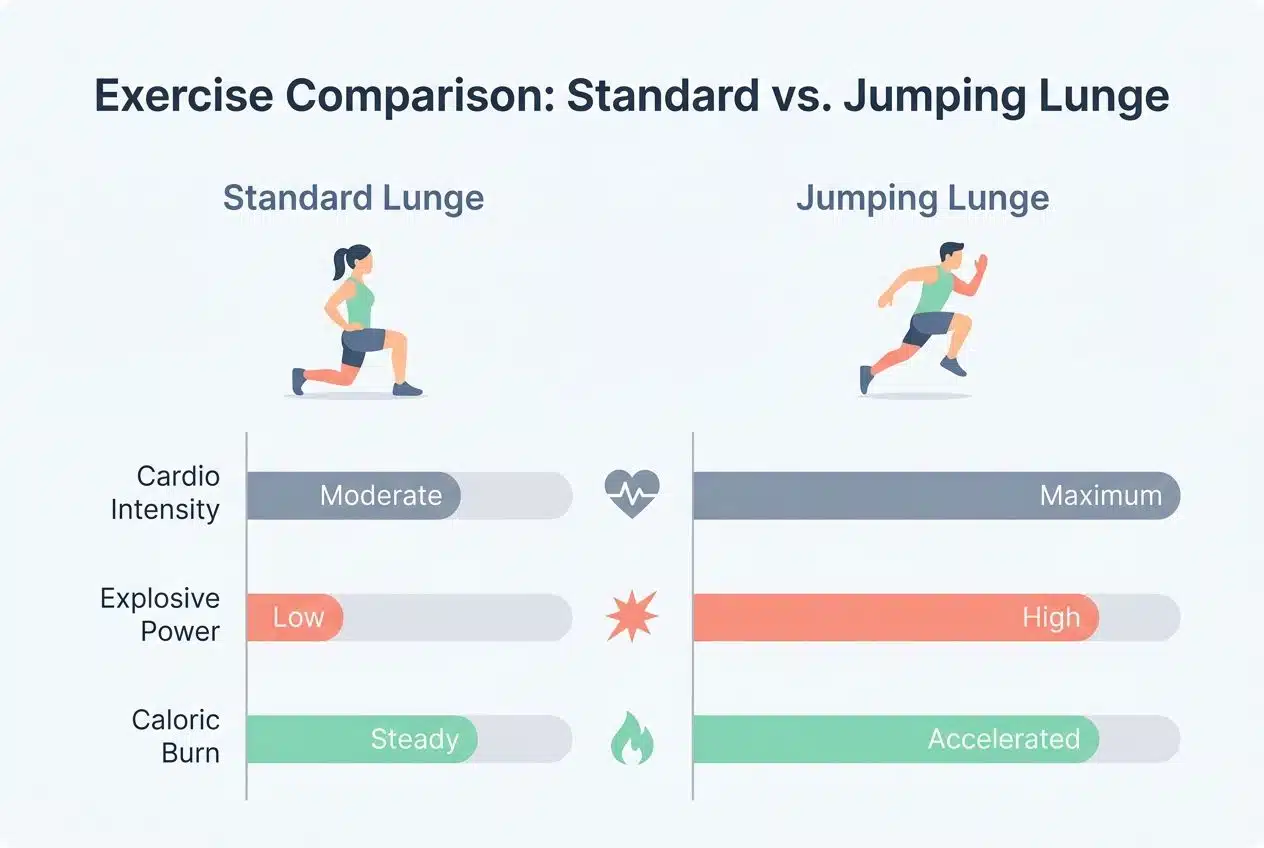
This routine is short but demanding. The mountain climbers will raise your heart rate fast. Keep the push-ups clean. Drop to incline push-ups if needed.
Modification: replace mountain climbers with slow step-in climbers.
37. The 15-Minute EMOM Workout
| Detail | Routine |
| Best For | Structured conditioning |
| Time | 15 minutes |
| Equipment | Timer |
| Exercises | Minute 1: squats, Minute 2: push-ups, Minute 3: plank taps |
| Structure | Repeat for 5 cycles |
EMOM means “every minute on the minute.” Do the target reps, then rest for the remainder of the minute.
Example: complete 12 squats in minute one, then rest until minute two starts.
Progression tip: add 1–2 reps per minute over time.
38. The 18-Minute No-Jump HIIT Workout
| Detail | Routine |
| Best For | Apartment-friendly intensity |
| Time | 18 minutes |
| Equipment | None |
| Exercises | Fast squats, standing punches, reverse lunges, plank shoulder taps, step jacks |
| Structure | 40 seconds work, 20 seconds rest, 3 rounds |
This is one of the most practical HIIT options for the home. It gives intensity without jumping. Keep the standing punches controlled. Rotate through your torso instead of just flailing your arms.
Modification: replace reverse lunges with step-backs or supported split squats.
39. The Advanced 20-Minute Conditioning Circuit
| Detail | Routine |
| Best For | Advanced home exercisers |
| Time | 20 minutes |
| Equipment | None |
| Exercises | Skaters, push-ups, squat jumps, plank jacks, reverse lunges |
| Structure | 45 seconds work, 15 seconds rest, 4 rounds |
This is the toughest routine in the article. Use it only if your joints, conditioning, and movement quality are ready. If jumping bothers your knees, replace squat jumps with fast squats and plank jacks with plank step-outs.
Progression tip: Track how many clean reps you complete per round and try to improve slowly.
Best Home Workouts by Fitness Level
If you feel overwhelmed by the list, use this quick guide.
| Fitness Level | Best Routines to Start With |
| Complete beginner | 1, 2, 3, 5, 7 |
| Beginner with some confidence | 4, 6, 8, 21, 26 |
| Intermediate | 9, 10, 14, 15, 18, 32, 36 |
| Desk worker | 22, 26, 27, 28, 29, 30 |
| Core-focused | 19, 31, 32, 33, 34 |
| Short-time training | 6, 20, 35, 36, 37 |
| Advanced | 13, 14, 18, 38, 39 |
The best plan is not the most complicated one. It is the one that matches your current body and your real schedule.
Common Home Workout Mistakes to Avoid
Most home workout problems are not caused by laziness. They come from a poor structure.
| Mistake | Why It Hurts | Better Approach |
| Starting too hard | Creates soreness and burnout | Start below your maximum |
| Doing HIIT every day | Increases fatigue and joint stress | Use HIIT 1–2 times weekly |
| Ignoring strength training | Limits muscle and functional progress | Train at least twice weekly |
| Skipping mobility | Makes movement feel stiff | Add 8–15 minutes regularly |
| Chasing soreness | Soreness is not proof of progress | Track consistency and performance |
| No progression | Results stall | Add reps, rounds, tempo, or resistance |
| Poor form | Raises injury risk | Stop sets when form breaks |
| Too much variety | Makes progress hard to measure | Repeat core routines for 4–6 weeks |
The biggest mistake is treating home fitness like entertainment only. Fun matters, but structure matters more.
Finally: The Best Home Workouts Are the Ones You Can Build Into Real Life
The best home workouts do not require a gym, a perfect schedule, or expensive equipment. They require honesty. You need to know your current level, choose routines that match your body, and progress with patience.
Start with beginner routines if you are new. Use bodyweight workouts if you want strength without equipment. Add resistance bands when you need more variety. Use yoga and mobility to keep your joints happy. Train your core without forcing crunches. Add HIIT carefully when your base fitness improves.
Home fitness works because it removes friction. No commute. No waiting for machines. No pressure to perform in front of strangers. Just you, your space, and a plan that actually makes sense. If you stay consistent, the results will come. Not overnight. Not because of one heroic workout. But because you kept showing up.
Frequently Asked Questions About The Best Home Workouts
1. What Are the Best Home Workouts for Beginners?
The best beginner home workouts include chair squats, wall push-ups, glute bridges, marching, dead bugs, bird dogs, and low-impact cardio. These exercises teach basic movement without overwhelming your joints.
2. Can I Build Strength With No-Gym Workouts?
Yes. You can build strength with bodyweight training, resistance bands, tempo work, isometrics, and progressive overload. ACSM’s 2026 resistance-training update also recognizes bodyweight exercises, elastic bands, and home-based routines as effective options for strength and physical function.
3. How Many Days a Week Should I Do Home Workouts?
Beginners can start with 3 days per week. Intermediate exercisers can train 4–5 days weekly. Adults should also aim for at least 2 days of muscle-strengthening activity each week, according to CDC guidance.
4. Are 20-Minute Home Workouts Enough?
Yes, 20-minute home workouts can be enough when they are focused and consistent. You can combine short workouts throughout the week to reach your activity goals.
5. Do I Need Equipment for At-Home Fitness?
No. You can start with bodyweight only. However, a mat, resistance bands, a stable chair, and a timer can make your home workout routines more comfortable and easier to progress.
6. Should I Do HIIT Every Day?
No. Most people do better with 1–2 HIIT sessions per week, especially if they also do strength training, mobility, and lower-intensity cardio. Daily HIIT can create unnecessary fatigue.
7. What Is the Best Weekly Home Workout Plan?
A balanced weekly plan should include strength training, cardio, mobility, core work, and rest. For many people, 3–5 sessions per week is realistic and sustainable.