Hiring a marketing agency can either feel like unlocking a smarter growth partner or accidentally signing up for a monthly invoice with a logo attached. The right agency brings strategy, execution, reporting, accountability, and fresh thinking. The wrong one brings vague promises, confusing dashboards, recycled ideas, and a strange talent for explaining why nothing is ever their fault.
That is why spotting Marketing Agency Red Flags before you sign matters. A bad agency does not always look bad at first. In fact, some of the worst ones have the cleanest pitch decks, the loudest confidence, and the most suspiciously perfect case studies. The danger is not just wasted money. It is lost time, damaged campaigns, weak positioning, confused customers, and six months of “we’re still optimizing” while your budget quietly disappears into the marketing afterlife.
This guide breaks down the real warning signs to watch before hiring a marketing agency. Some are obvious. Some are subtle. All of them are worth taking seriously before your brand becomes someone else’s “learning experience.”
Our Selection Criteria
Before getting into the warning signs, it helps to define what actually counts as a red flag. Not every agency with a rough onboarding call is terrible. Not every small agency lacks ability. Not every expensive agency is a scam wearing a blazer.
The signs below were selected based on practical business risk. These are the patterns that often lead to weak results, poor communication, messy execution, budget waste, or client regret.
The selection focused on:
- Lack of transparency in pricing, ownership, or reporting.
- Unrealistic promises around rankings, leads, or revenue.
- Weak discovery process before strategy.
- No clear measurement framework.
- Poor communication or vague accountability.
- Overdependence on vanity metrics.
- Generic strategy with no business context.
- Contract terms that quietly trap the client.
- No proof of relevant experience.
- Resistance to client access, data, or control.
A good agency does not need to be perfect. But it should be clear, honest, strategic, and accountable. If the agency cannot explain what it will do, why it will do it, how it will measure success, and what happens if results are weak, that is not a “growth partner.” That is a subscription-based guessing machine.
Whom This Guide Is For
This guide is useful if you are about to hire a marketing agency, replace your current one, or review whether your existing agency is actually helping. It is especially useful for founders, small business owners, marketing managers, e-commerce teams, SaaS companies, local businesses, and content-led brands.
It also helps if you have been burned before. You know the type: big promises during the sales call, mysterious silence after onboarding, and then a monthly report full of charts that somehow say everything and nothing at the same time. Beautiful design. Zero clarity. Classic.
12 Marketing Agency Red Flags To Watch Before You Sign
The signs below are not random complaints. They are practical warnings that should make you pause, ask better questions, and read the contract before the agency starts calling itself your “growth engine.”
1. They Promise Guaranteed Results Too Quickly
A marketing agency that guarantees specific rankings, revenue, viral growth, or lead numbers before deeply understanding your business is waving a flag so red it should come with its own siren. Marketing is influenced by competition, budget, market demand, offer quality, customer behavior, product fit, sales process, and timing. Anyone promising exact outcomes before proper research is either careless, desperate, or very comfortable with fantasy.
Strong agencies talk about realistic projections, testing, benchmarks, and risk. Weak agencies sell certainty because certainty sounds better in a sales call.
Best for: Businesses that want to avoid unrealistic promises before signing.
Why We Chose It:
- Guarantees often hide weak strategy.
- Serious agencies explain variables and assumptions.
- Fast promises usually mean shallow discovery.
- Overconfidence early often becomes excuses later.
Things to consider:
- Ask what data supports the promise.
- Avoid any agency that guarantees Google rankings or fixed revenue without context.
2. They Do Not Ask Enough Questions About Your Business
A good agency should be annoyingly curious. It should ask about your margins, ideal customers, sales cycle, competitors, past campaigns, offers, analytics, conversion rates, brand positioning, and internal resources. If the agency jumps straight into solutions without understanding the business, it is probably selling a template.
The first call should not feel like a pitch monologue. It should feel like a diagnostic session. If they are not asking sharp questions, they are not building a real strategy.
Best for: Founders and marketing managers evaluating agency discovery quality.
Why We Chose It:
- Poor discovery leads to generic execution.
- Strategy depends on business context.
- Agencies should understand sales, not just traffic.
- The best partners ask before they prescribe.
Things to consider:
- Pay attention to their questions, not just their answers.
- A shallow onboarding process usually predicts shallow work.
3. Their Strategy Sounds Like It Could Fit Any Company
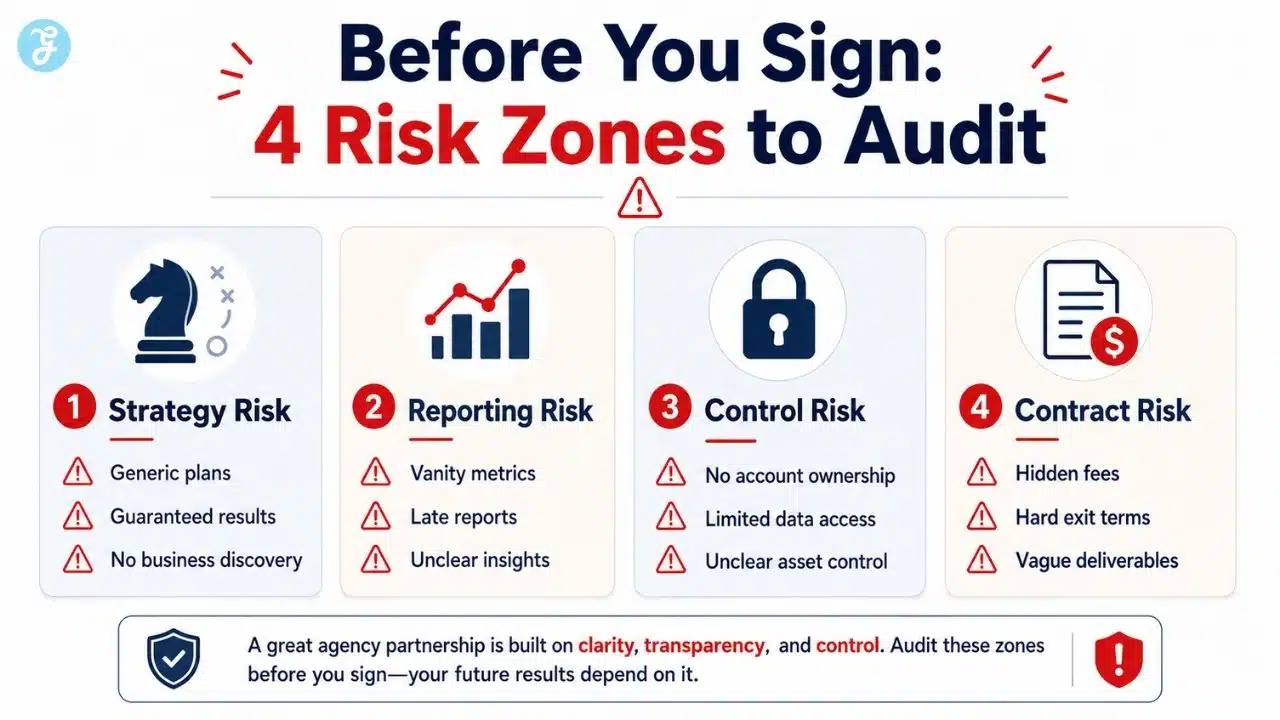
If the agency’s strategy could apply to a dentist, SaaS brand, clothing store, law firm, and crypto newsletter with only the logo changed, you have a problem. Generic strategies are easy to sell because they sound familiar: SEO, paid ads, social media, email campaigns, content calendar, monthly reporting. Wonderful. Also not enough.
Your business needs a plan shaped around your audience, budget, category, competition, funnel, and sales process. A good agency explains why specific channels matter for your situation. A weak one gives you a buffet of tactics and hopes something works.
Best for: Businesses tired of one-size-fits-all marketing packages.
Why We Chose It:
- Generic plans waste time and budget.
- Strong strategy should reflect your market.
- Channel choice should be tied to business goals.
- Copy-paste marketing rarely creates durable growth.
Things to consider:
- Ask why they chose each channel.
- If they cannot explain what they would not do, they probably have no strategy.
4. They Focus More On Vanity Metrics Than Business Outcomes
Impressions, likes, followers, reach, traffic, and clicks can matter. But they are not automatically success. If an agency keeps bragging about engagement while leads, sales, conversion rates, and qualified pipeline stay flat, you may be paying for attractive noise.
Good agencies connect marketing activity to business outcomes. That does not mean every campaign must immediately print money like a confused ATM. It means the agency should define what matters, track progress properly, and explain how top-of-funnel metrics connect to revenue or customer acquisition.
Best for: Businesses that want reporting tied to real performance.
Why We Chose It:
- Vanity metrics can hide poor commercial impact.
- Strong reporting connects activity to outcomes.
- Business goals should guide campaign measurement.
- Traffic without conversion is just digital sightseeing.
Things to consider:
- Ask which metrics define success.
- Make sure reports include leads, sales, cost per acquisition, conversion rate, and quality indicators where relevant.
5. Their Reporting Is Confusing, Late, Or Too Polished
A report should make performance easier to understand. It should not feel like a 40-slide magic trick. If the agency sends late reports, hides weak results behind colorful charts, or uses language so vague it could be mistaken for weather forecasting, be careful.
Good reporting is clear, honest, and useful. It explains what happened, why it happened, what was learned, what will change, and what needs attention. A polished report that avoids hard truths is not professional. It is decorative damage control.
Best for: Teams that need transparency and practical performance updates.
Why We Chose It:
- Bad reporting hides problems until they become expensive.
- Clear reports build trust.
- Reports should guide decisions, not just fill meetings.
- Late reporting often signals poor internal process.
Things to consider:
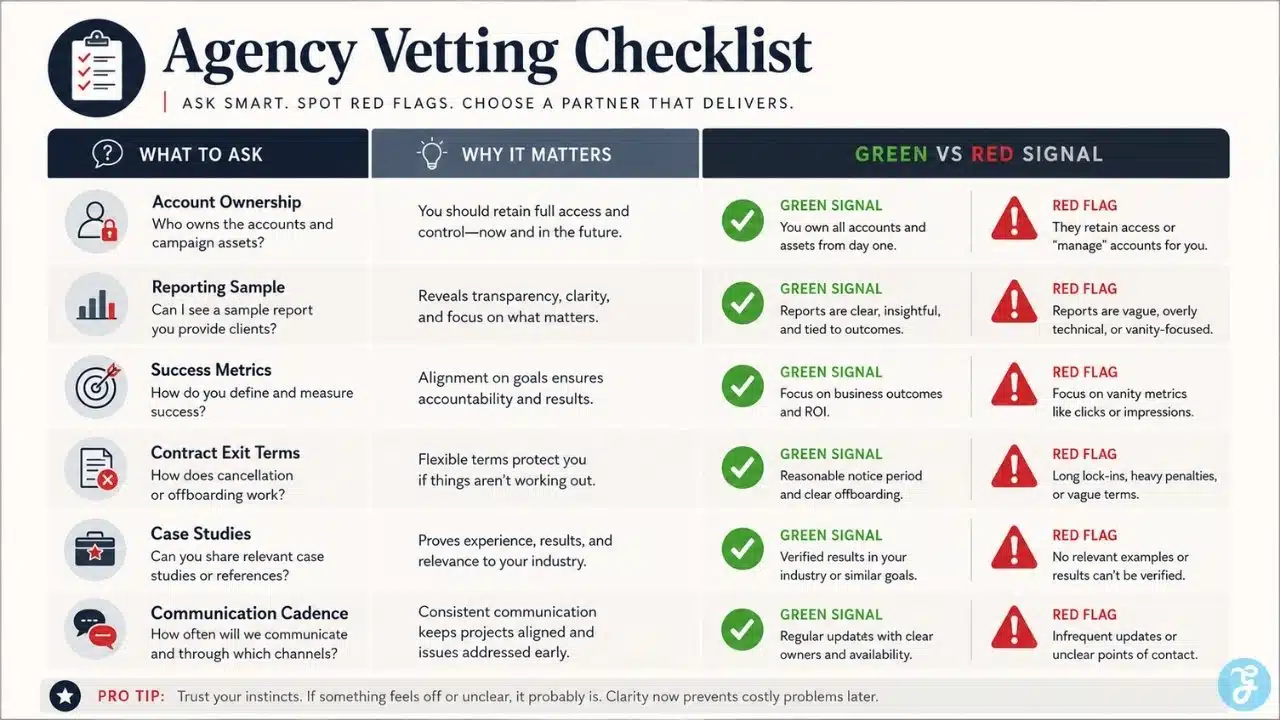
- Ask for a sample report before signing.
- Make sure reporting includes insights, not just screenshots.
6. They Avoid Clear Ownership Of Accounts And Data
This is one of the biggest Marketing Agency Red Flags because it can create serious problems later. You should own your ad accounts, analytics, website access, social accounts, creative assets, tracking data, landing pages, and campaign history wherever possible. If the agency insists everything must live under its accounts, ask why.
Some agencies use account ownership as a trap. When the client leaves, the data, campaigns, audiences, pixels, creatives, and history suddenly become difficult to access. That is not partnership. That is digital hostage-taking with monthly billing.
Best for: Businesses hiring agencies for paid ads, SEO, analytics, or web management.
Why We Chose It:
- Account ownership protects your business.
- Data history is valuable.
- Switching agencies becomes harder without access.
- Transparency depends on shared visibility.
Things to consider:
- Confirm ownership before signing.
- Make sure you have admin access to key platforms.
7. The Contract Is Hard To Leave
Long contracts are not automatically bad. Some work takes time. SEO, brand building, content systems, and complex paid campaigns often need months to show meaningful results. But a contract that makes it painful, expensive, or confusing to leave should make you pause.
Watch for long lock-ins, vague termination clauses, unclear deliverables, hidden fees, auto-renewals, and ownership restrictions. If the agency believes in its work, it should not need to trap you like a gym membership with a marketing department.
Best for: Businesses comparing agency proposals before signing.
Why We Chose It:
- Bad contracts create unnecessary risk.
- Exit terms should be clear.
- Deliverables should be specific.
- Clients should not need a legal treasure map to leave.
Things to consider:
- Read termination terms carefully.
- Ask what happens to assets, accounts, and data if you cancel.
8. They Cannot Show Relevant Proof Or Case Studies
A good agency should be able to show proof of work. That does not mean every case study has to reveal private client data. But the agency should explain what it did, what problem it solved, what process it used, and what kind of results it achieved.
Be careful with vague case studies. “We helped a brand grow by 300%” means nothing without context. Was that traffic, revenue, impressions, followers, leads, or newsletter clicks from the founder’s cousin? Details matter.
Best for: Businesses that want evidence before hiring.
Why We Chose It:
- Relevant proof reduces hiring risk.
- Real case studies show process, not just outcomes.
- Strong agencies can explain trade-offs and constraints.
- Vague success claims often hide weak evidence.
Things to consider:
- Ask for examples in your industry or similar business models.
- Look for process clarity, not just big numbers.
9. They Say Yes To Everything
An agency that agrees with every idea is not a partner. It is a service vendor with a fear of uncomfortable conversations. Good agencies should challenge weak assumptions, explain trade-offs, and sometimes say no.
If you ask for SEO, TikTok, LinkedIn, Google Ads, email marketing, PR, influencer outreach, web design, brand strategy, video production, and conversion optimization, and the agency says “absolutely” to all of it without hesitation, be careful. Either they are truly full-service with serious depth, or they are about to outsource half your strategy to chaos.
Best for: Businesses that need strategic guidance, not order-taking.
Why We Chose It:
- Real experts set priorities.
- Saying yes to everything dilutes focus.
- Strong agencies know their limits.
- Healthy disagreement improves strategy.
Things to consider:
- Ask what they would prioritize first.
- Ask what they do not specialize in.
10. Their Pricing Is Vague Or Full Of Surprises
Marketing pricing does not always need to be cheap, but it should be clear. You should understand what you are paying for, what is included, what is not included, what tools cost extra, what ad spend is separate, and what happens when scope changes.
Vague pricing creates conflict later. The agency says something was not included. You thought it was. Everyone becomes annoyed. The invoice becomes a horror story with line items.
Best for: Businesses comparing agency retainers, project fees, or performance packages.
Why We Chose It:
- Clear pricing prevents scope confusion.
- Hidden fees damage trust.
- Budget planning depends on transparency.
- Good agencies explain cost structure upfront.
Things to consider:
- Ask for a detailed scope of work.
- Clarify ad spend, tools, reporting, content production, revisions, and meeting frequency.
11. They Have Weak Communication Habits Before You Even Sign
How an agency communicates before the sale often predicts how it will communicate after the sale. If they are slow, vague, disorganized, or forgetful during the proposal stage, do not assume things will magically improve once they have your money. Hope is not a project management system.
A strong agency sets clear next steps, responds professionally, documents decisions, and explains timelines. A weak agency creates confusion early and calls it “moving fast.”
Best for: Teams that need reliable coordination and execution.
Why We Chose It:
- Early communication reveals internal discipline.
- Disorganization gets worse under pressure.
- Marketing requires coordination.
- Strong agencies reduce confusion, not create it.
Things to consider:
- Notice response time, clarity, and follow-through.
- If onboarding feels messy, execution may be messier.
12. They Blame Everything Except Their Own Strategy
Every campaign has outside factors. Markets change. Competitors react. Algorithms shift. Buyers behave strangely because they are humans, which is inconvenient. But if an agency always blames the client, algorithm, budget, economy, seasonality, platform, sales team, website, or moon phase, be careful.
Good agencies take responsibility for what they control. They explain what went wrong, what they learned, and what they will change. Weak agencies protect their ego harder than they protect your results.
Best for: Businesses reviewing current agency performance.
Why We Chose It:
- Accountability is essential for improvement.
- Excuses delay necessary changes.
- Good agencies learn from weak results.
- Blame-heavy communication destroys trust.
Things to consider:
- Ask how they handle underperforming campaigns.
- Look for ownership, not perfection.
An Overview Of Marketing Agency Red Flags Before You Hire
The warning signs are easier to spot when you group them by risk. Some red flags affect performance. Some affect control. Some affect trust. Some affect how painful it will be to leave if things go badly.
Here is a quick way to review the danger areas before signing anything.
Overview Comparison
| Risk Area | Red Flag | Why It Matters |
|---|---|---|
| Strategy | Generic plan | Your business gets a template, not a strategy |
| Sales Process | Guaranteed results | Unrealistic promises create false expectations |
| Discovery | Few questions | Weak understanding leads to weak execution |
| Reporting | Vanity metrics | Activity looks good while business results stay weak |
| Transparency | No account ownership | You may lose access to data and campaign history |
| Contract | Hard exit terms | Leaving becomes expensive or complicated |
| Proof | Weak case studies | Claims are not backed by relevant evidence |
| Communication | Slow or vague replies | Execution may become messy |
| Accountability | Constant blame | Problems do not get fixed |
| Pricing | Hidden fees | Budget becomes unpredictable |
Our Top 3 Marketing Agency Red Flags
Some red flags are annoying. Others are dangerous. If I had to pick the three that should make you slow down immediately, these would be the ones.
1. No Clear Account And Data Ownership
This is one of the fastest ways to lose control of your own marketing. If you do not own your accounts, tracking, campaign history, and data, you may be trapped later. Always clarify ownership before work begins.
2. Guaranteed Results Without Proper Research
A serious agency cannot guarantee exact outcomes before understanding your offer, budget, market, conversion path, and competition. Quick guarantees usually mean the agency is selling comfort, not strategy.
3. Confusing Reporting
If you cannot understand what is working, what is failing, and what will change next, you cannot make good decisions. Reporting should create clarity. If it creates fog, something is wrong.
How To Choose The Right Marketing Agency By Yourself
Choosing the right agency is not about finding the loudest pitch or the prettiest proposal. It is about finding a team that understands your business, communicates clearly, measures the right things, and has the discipline to improve performance over time.
Start by asking better questions. Do not only ask what they can do. Ask how they think, how they report, how they handle weak performance, how they define success, and what they need from you to make the work effective.
The Selection Framework
Use this framework before hiring:
- Check strategy fit: Ask how they would approach your specific business, audience, and offer.
- Review ownership terms: Confirm who owns accounts, data, creative assets, tracking, and campaign history.
- Inspect reporting quality: Ask for a sample report and look for clear insights, not just charts.
- Validate proof: Ask for relevant case studies, examples, or process breakdowns.
- Clarify communication: Know who your point of contact is, how often you meet, and how decisions are documented.
- Read the contract carefully: Look for lock-ins, exit clauses, hidden fees, and deliverable details.
A good agency should be able to explain its process without hiding behind buzzwords. If the explanation sounds like it was generated by a corporate fog machine, ask again.
The Final Checklist
Before you sign, check these five things:
- Do I understand exactly what the agency will deliver?
- Do I know which metrics define success?
- Do I own the accounts, data, and assets?
- Can I leave the contract without unreasonable penalties?
- Do I trust their communication, proof, and strategic thinking?
If the answer is no to more than one of these, slow down. Marketing contracts are easier to sign than to undo. Funny how that works.
The Final Gut Check Before You Sign
A bad marketing agency rarely looks bad in the proposal stage. That is the whole trick. The pitch is polished, the promises sound exciting, the case studies sparkle, and suddenly you feel like growth is only one signature away. Then the real work starts, and the truth quietly walks in wearing sweatpants.
The best way to protect yourself is to look beyond the sales energy. Ask harder questions. Demand clarity. Check ownership. Read the contract. Review reporting examples. Look for relevant proof. Notice how they communicate before money changes hands.
Most Marketing Agency Red Flags are visible early if you are willing to see them. The problem is that many businesses ignore them because they want the promise to be true. That is understandable. It is also expensive.
Choose the agency that tells the truth clearly, not the one that flatters your growth dreams the loudest.
Frequently Asked Questions About Marketing Agency Red Flags
What Are The Biggest Marketing Agency Red Flags?
The biggest red flags include guaranteed results, vague pricing, poor reporting, weak discovery, no account ownership, hard-to-leave contracts, and generic strategies. These signs often lead to poor performance, budget waste, and client frustration.
How Do I Know If A Marketing Agency Is Legit?
A legit agency should show relevant proof, explain its process clearly, provide transparent pricing, ask thoughtful business questions, and give you access to your accounts and data. It should also be honest about timelines, risks, and what it can realistically control.
Should A Marketing Agency Guarantee Results?
Be careful with guaranteed results, especially around SEO rankings, revenue, or fixed lead numbers. A good agency can forecast, estimate, and set goals, but exact guarantees before proper research are usually a warning sign.
What Should I Ask Before Hiring A Marketing Agency?
Ask who owns the accounts, how reporting works, what metrics matter, what is included in the fee, what happens if results are weak, and how you can exit the contract. Also ask for relevant examples of past work.
How Long Should I Give A Marketing Agency To Show Results?
It depends on the channel. Paid ads can show early signals within weeks, while SEO and content may need several months. The key is not instant results but clear progress, honest reporting, and a logical plan for improvement.