In 2026, the landscape of digital PR and link building has evolved far beyond the traditional methods that once defined the industry. Platforms like HARO (Help a Reporter Out) played a major role in connecting journalists with expert sources, but changing workflows, faster content cycles, and the rise of AI-driven media outreach have led to a new generation of tools and platforms. Today, marketers, SEO professionals, and content creators are no longer relying on a single channel—they are operating within a broader, more dynamic ecosystem of HARO alternatives designed for speed, precision, and higher-quality backlinks.
This article explores the most effective HARO alternatives in 2026 and how they are reshaping modern link building strategies. From AI-powered PR platforms to niche journalist networks and real-time media opportunity tools, these solutions are helping brands secure authoritative backlinks more efficiently than ever before. Whether you’re focused on SEO growth, digital PR campaigns, or brand visibility, understanding this new ecosystem is essential for staying competitive in today’s search-driven world.
Why HARO Died and What That Means for Link Builders
HARO’s closure caught many SEO teams off guard. Cision, which had acquired HARO, rebranded it as Connectively in late 2023 and then discontinued the service entirely by early 2024. The reasons cited included platform abuse — mass AI-generated responses flooding journalist inboxes — and a business model that couldn’t sustain the volume of low-quality pitches.
The collapse left a real gap. For years, HARO had been one of the most reliable free channels for earning editorial backlinks from major publications. When it disappeared, outreach managers had to rebuild their workflows from scratch.
The good news: the underlying model (journalists need expert sources; experts need coverage) didn’t die with HARO. Several platforms had been building competing services for years, and 2026 finds that ecosystem mature enough to replace what was lost — often with better targeting tools.
What Are the Best HARO Alternatives in 2026?
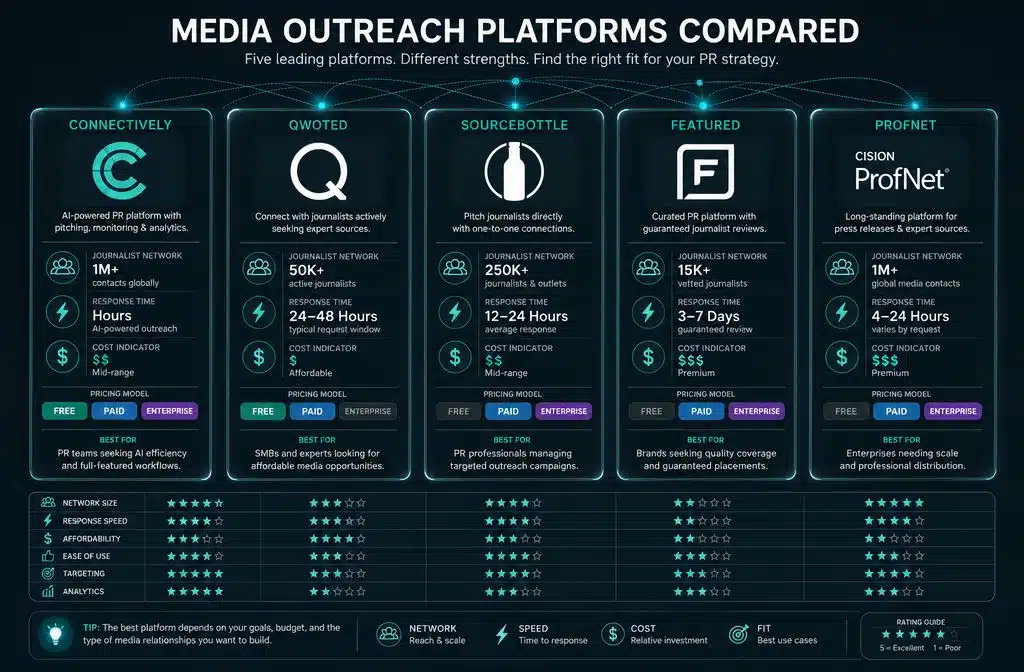
The strongest HARO alternatives in 2026 fall into three categories: direct journalist-source matching platforms, PR wire and media database tools, and community-based outreach networks. Each serves a different use case.
Direct Journalist-Source Matching Platforms
These are the closest functional replacements for HARO’s core feature: journalists post queries, sources respond, and placements follow.
| Platform | Best For | Free Tier? | Approx. Paid Cost (2026) |
|---|---|---|---|
| Qwoted | B2B brands, finance, tech | Yes (limited) | ~$100–$300/month |
| Featured | Agencies, content teams | Yes (limited) | ~$99–$499/month |
| SourceBottle | Small businesses, solopreneurs | Yes | ~$29–$79/month |
| ProfNet (Cision) | Enterprise PR, large agencies | No | Custom/enterprise pricing |
| Terkel (now part of Featured) | Thought leadership content | Merged into Featured | — |
Note: Pricing estimates above are based on publicly available information as of early 2026. Always verify current pricing directly with each platform, as tiers change frequently.
Qwoted has grown significantly since HARO’s closure. It positions itself as a premium network where journalists from outlets like Forbes, Bloomberg, and Reuters post source requests. The vetting process is stricter on both sides, which reduces noise.
Featured (which absorbed Terkel) focuses on turning expert responses into both backlinks and syndicated content. It’s popular with content marketing teams that want to repurpose pitches into blog posts or social proof.
SourceBottle is the budget-friendly option. It’s particularly strong in Australia and the UK but has expanded its North American journalist base. Response rates tend to be lower than Qwoted, but the free tier is genuinely usable.
ProfNet is the enterprise choice. It’s part of the Cision ecosystem (the same company that killed HARO), which is either reassuring or ironic depending on your perspective. It’s best suited for PR agencies managing multiple clients.
PR Wire and Media Database Tools
Platforms like Muck Rack, Prowly, and Roxhill don’t replicate HARO’s query-response model exactly, but they let outreach teams proactively pitch journalists based on beat and recent coverage. These are better for teams with dedicated PR staff who can build relationships over time rather than respond reactively to queries.
Community-Based Outreach Networks
Slack communities, LinkedIn journalist groups, and niche Discord servers have quietly become effective channels for source-journalist connections. Several journalism communities now post source requests directly to members. These require more manual monitoring but often yield higher-quality placements because the relationships are warmer.
How Do These Platforms Compare on Backlink Quality?
Backlink quality from journalist-source platforms varies more than most guides admit. The platform itself doesn’t guarantee a high-DR backlink — the publication the journalist works for does.
Here’s a practical breakdown:
- Qwoted tends to attract journalists from established publications (DR 70+), but query volume is lower than legacy HARO.
- Featured has a wider range — some placements land on major sites, others on small niche blogs. Useful for volume-focused strategies.
- SourceBottle skews toward regional outlets and smaller publications. Good for local SEO or brand awareness, less reliable for pure link authority.
- ProfNet historically connects sources with top-tier media (Wall Street Journal, AP, major trade press), but the cost reflects that.
Decision rule: Choose Qwoted or ProfNet if domain authority of the linking site is your primary metric. Choose Featured or SourceBottle if you want volume and are willing to filter for quality manually.
What Makes a Winning Pitch in 2026?
Journalists using these platforms now receive more AI-generated responses than ever. The ones who get placements share a few consistent traits.
A strong pitch in 2026 does the following:
- Answers the specific question asked — not a tangential point the source wants to make.
- Leads with credentials — name, title, company, and one relevant data point or experience.
- Stays under 200 words — journalists are scanning dozens of responses; brevity wins.
- Includes one concrete example or stat — vague opinions get ignored; specific claims get quoted.
- Avoids AI-sounding language — phrases like “certainly,” “absolutely,” and “it’s worth noting” are now red flags for many editors.
Common mistake: Sending the same generic response to every query. Journalists can tell. Personalization to the specific query — even one sentence — meaningfully improves response rates.
Are There Free HARO Alternatives in 2026 Worth Using?
Yes, but with realistic expectations. Free tiers on most platforms in 2026 are limited in meaningful ways — typically capping the number of queries you can see per day or restricting response volume.
SourceBottle’s free tier is the most functional for individual contributors or small businesses. It gives access to a reasonable number of queries without requiring a credit card.
Qwoted’s free tier lets you build a profile and respond to a limited number of queries monthly. It’s enough to test whether the platform suits your niche before committing to a paid plan.
LinkedIn is technically free and increasingly used by journalists to source quotes. Following journalists in your industry and engaging with their content genuinely (not just pitching) can open direct source relationships without any platform fee.
Edge case: If your team has strong existing media relationships, you may not need any of these platforms. Direct journalist outreach via email, built on prior coverage or a warm introduction, still produces the highest conversion rates of any method.
How to Build a Sustainable Link Building Workflow Without HARO
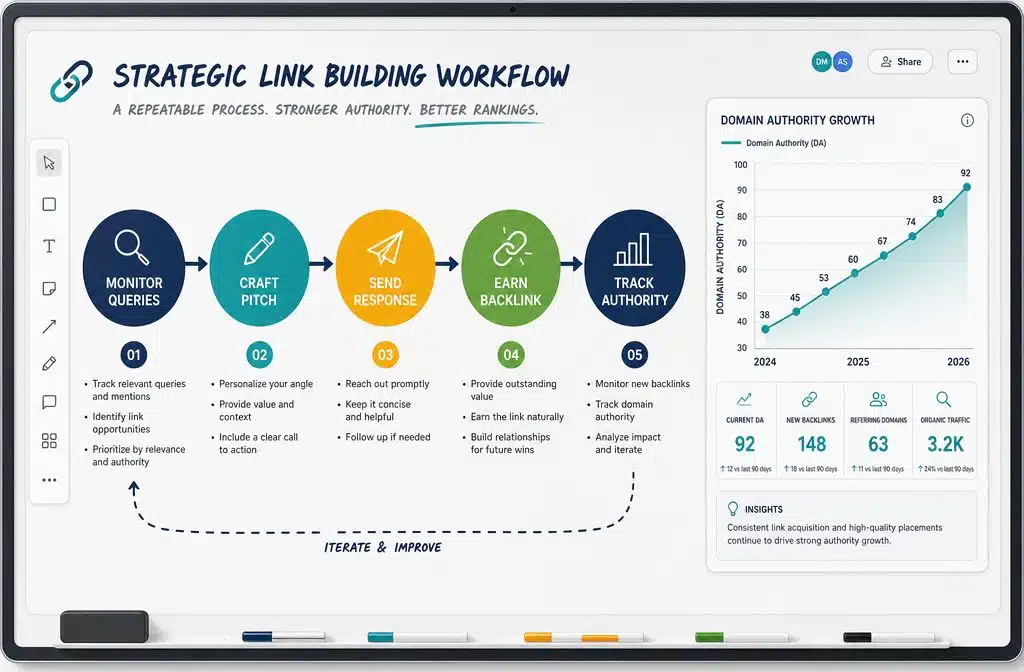
Relying on a single platform — as many teams did with HARO — is a structural risk. The 2024 shutdown proved that. A more resilient approach uses multiple channels simultaneously.
A practical 2026 workflow for a small-to-mid-size SEO team:
- Monitor two platforms daily (e.g., Qwoted + Featured). Set up email alerts for relevant query categories.
- Dedicate 30–45 minutes per day to reviewing and responding. Speed matters — many journalists close queries within hours.
- Maintain a pitch template library for common query types in your niche. Customize the top 3–4 sentences for each specific query.
- Track placements in a shared sheet — publication name, DR, anchor text, live date. This helps measure ROI and identify which platforms deliver.
- Supplement with proactive outreach using a media database (Muck Rack, Prowly) for relationship-building alongside reactive query responses.
- Review and prune quarterly — drop platforms that aren’t converting and reallocate budget or time to what works.
What Should You Avoid When Using HARO Alternatives?
Several practices that worked on old HARO actively hurt performance on modern platforms.
- Mass-responding to every query — platforms now flag accounts with high response volume and low journalist engagement. Quality over quantity is enforced algorithmically on some platforms.
- Using AI to generate full pitches without editing — detectable AI writing patterns are increasingly filtered or deprioritized by journalists and some platforms themselves.
- Ignoring niche fit — responding to queries outside your genuine area of expertise wastes time and damages your credibility score on platforms that track journalist feedback.
- Neglecting your profile — on Qwoted and Featured especially, a complete, credentialed profile dramatically improves the likelihood a journalist selects your response over a competitor’s.
Final Thoughts
The shutdown of HARO was disruptive, but it accelerated a shift that was already underway: the link building ecosystem in 2026 is more specialized, more quality-focused, and less dependent on a single platform than it was five years ago.
Actionable next steps for SEO and outreach teams:
- Audit your current link building channels — if you haven’t replaced HARO in your workflow, start with Qwoted or Featured this week.
- Set up free accounts on two platforms and spend two weeks responding to queries before deciding whether a paid tier makes sense.
- Build a credential-forward profile on each platform — a complete profile is one of the highest-leverage actions you can take before sending a single pitch.
- Create a pitch template library for your top five query categories. Customize per query, but don’t start from scratch every time.
- Track every placement — DR, publication, anchor text, and traffic impact. Without data, you can’t optimize.
The platforms change. The principle doesn’t: journalists need credible sources, and credible sources need coverage. Teams that build systematic, quality-focused outreach workflows will keep earning links regardless of which platform dominates next year.
Frequently Asked Questions (FAQs)
Is HARO completely gone in 2026?
Yes. HARO was rebranded as Connectively by Cision in 2023 and then shut down entirely in early 2024. No version of the original HARO service is currently active.
Which HARO alternative is best for beginners?
SourceBottle or Featured’s free tier are the most accessible starting points. They require no upfront cost and have lower query volumes, making them easier to manage without a dedicated PR team.
How long does it take to earn a backlink through these platforms?
Timelines vary widely. Some placements go live within days of a pitch being accepted; others take weeks if the journalist is working on a long-form piece. On average, expect two to six weeks from pitch to published link.
Do these platforms work for local SEO?
SourceBottle has the strongest regional focus, particularly for Australian, UK, and Canadian markets. For hyperlocal U.S. SEO, community-based channels (local journalism Slack groups, regional press contacts) often outperform national platforms.
Are paid tiers worth the cost?
For teams actively pursuing link building as a core strategy, yes. Paid tiers typically unlock more query visibility, faster alerts, and better profile placement — all of which directly affect response-to-placement conversion rates.
Can agencies use these platforms for multiple clients?
Most platforms allow agency accounts, but pricing scales with the number of users or client profiles. ProfNet and Featured have the most developed agency-tier offerings as of 2026.
How many platforms should a team use simultaneously?
Two to three is the practical sweet spot for most teams. More than that creates monitoring overhead without proportional return. Start with two, evaluate results over 90 days, then adjust.