Have you ever wondered why you keep having the exact same argument with your partner? It is a frustrating loop. Many people struggle in their adult partnerships without understanding why they repeat these exhausting patterns. You might pick the wrong partners or find it hard to trust. These patterns almost always trace back to your early years. The way your parents treated you left marks on your heart. How siblings interacted with you and even your first playground friendships, played a massive role too.
You might not realize it, but you carry these early experiences into every relationship you form today. Research shows that how childhood relationships shape adult partnerships is a powerful, undeniable connection. Scientists have found that the way you bonded with your caregivers directly impacts how you love today. It affects how you trust and talk with your partner right now.
Your brain literally learned love lessons in childhood. Those lessons still guide your choices and behaviors. Understanding this link gives you your power back. You can finally see why you act certain ways, and more importantly, you can change those habits. I am going to walk you through the science behind this connection, childhood relationships vs adult partnerships.
We will look at how your early attachment style shapes your romantic choices. We will discover why you might push people away or cling too tightly. So, grab a cup of coffee, and let’s go through it together. I will show you everything you need to know to break unhealthy cycles and build stronger relationships.
The Influence of Childhood on Adult Relationship Dynamics
Your early years plant seeds that grow into how you love, fight, and connect with partners today. The bonds you formed with caregivers shape the blueprint you carry into your love life. The arguments you watched and the comfort you received all play a massive role.
Early Attachment Styles Influence
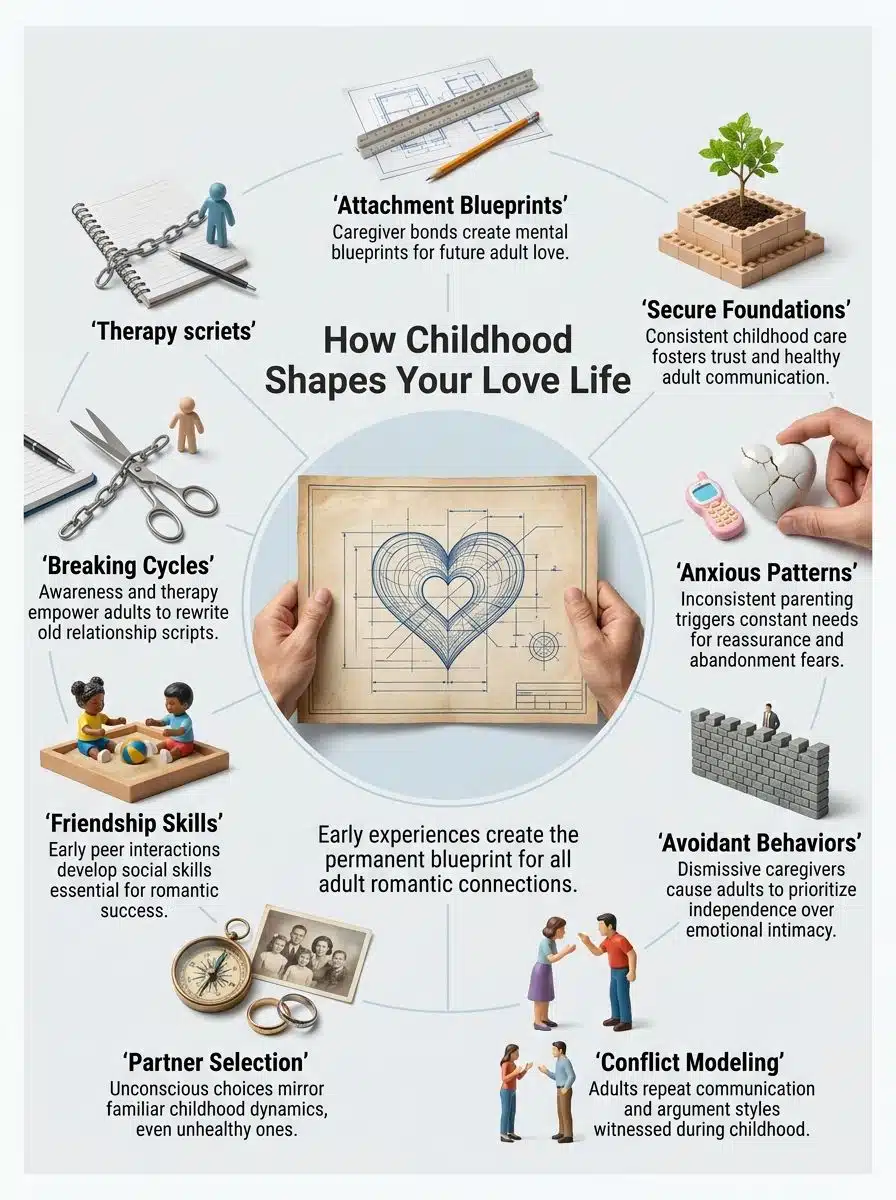
Your earliest relationships shape how you connect with partners later in life. Infants who receive consistent care develop secure attachment styles. These children learn that adults respond to their needs. A 2026 Gitnux market report revealed that about 56% of US adults exhibit a secure attachment style. This means a staggering 44% of us operate from insecure blueprints.
Secure kids grow into adults who trust others and feel comfortable with intimacy. Kids who experience neglect or unpredictable caregiving develop different patterns entirely.
Anxious attachment emerges when care feels inconsistent. Avoidant attachment forms when caregivers dismiss emotional needs. These early bonds create internal working models, which are mental blueprints that guide how you approach relationships.
Psychiatrist John Bowlby pioneered attachment theory through decades of research. His work reveals powerful connections between childhood experiences and adult romantic behavior. Secure attachment in childhood predicts healthier partnerships in adulthood.
Adults with this foundation communicate better, handle conflict more effectively, and maintain stronger emotional bonds. Those with anxious attachment patterns often seek constant reassurance from partners. Avoidant individuals tend to pull away when relationships get close. Understanding these styles helps you recognize your own dynamics.
Internalized Models of Relationships
Your brain acts like a camera, recording how your parents and caregivers handled love, conflict, and support. These mental recordings become your internal blueprint for relationships. You watch how your mom and dad talk to each other. You see how they solved problems and how they showed affection. All of this gets stored in your mind as the normal way relationships work.
Later, you pull from this mental library when you build your own partnerships. If your caregivers showed warmth and respect, you likely expect the same. If they fought constantly or ignored each other, you might think that is just how couples behave.
These internalized models shape everything from how you pick partners to how you handle disagreements. The tricky part is that these models operate in the background like an autopilot system. Most people do not realize they follow a script written in childhood. Someone might choose a partner who mirrors their parent’s behavior, good or bad.
Another person might recreate the exact communication patterns they watched growing up. These family dynamics teach you what to expect from romantic partnerships.
Awareness changes everything. Once you see your internalized model, you can decide if it serves you well. Therapy and honest self-reflection help people examine these deep patterns and build healthier dynamics based on what they actually want.
The patterns we learn in childhood become the lens through which we view all future relationships.
Childhood Experiences and Their Impact on Partner Choice
Your childhood shaped how you pick romantic partners. You gravitate toward people who feel familiar, even if that familiarity hurts you.

Trust and Intimacy Patterns
Your early relationships teach you how to trust, or not to trust, other people. If your parents showed up for you consistently, you likely feel comfortable opening up to partners. If they let you down repeatedly, you might guard your heart like a fortress.
These trust patterns stick with you into adulthood. They shape how quickly you share secrets, how vulnerable you become, and whether you believe your partner will stay. Childhood experiences create a blueprint for intimacy that runs deep, influencing everything from physical closeness to emotional sharing.
Intimacy patterns also reflect what you saw growing up. Kids who watched their parents express affection openly tend to feel more at ease with hugs, kind words, and tender moments.
Kids who grew up in cold households often struggle to show warmth, even when they desperately want to connect. These attachment patterns travel with you into adult relationships.
Understanding these patterns gives you the power to change them. This leads us to explore how different attachment styles actually show up in your romantic life.
Repeat Early Relationship Dynamics
People often find themselves stuck in loops, repeating the same relationship patterns they witnessed as children. Dr. Harville Hendrix coined the term “Imago” to describe this phenomenon. He found that we unconsciously seek out partners who recreate the positive and negative traits of our early caregivers.
If your parents argued constantly without resolving conflicts, you might pick partners who do the exact same thing. If a caregiver withdrew emotionally during tough times, you might seek out partners who seem distant. This happens because your brain learned these dynamics as normal, even if they hurt.
Adults who grew up with insecure attachment styles tend to recreate those same emotional bonds. The cycle continues because familiarity feels safe, even when it causes pain. A 2026 data review by WifiTalents showed that mixed anxious-avoidant pairs actually have a 55% predictability rate for breakups or divorce.
Breaking this pattern requires honest self-examination. Look at how your parents handled trust, intimacy, and support. Notice if you gravitate toward similar personality types.
Therapy helps many people identify these repeating cycles and make different choices. Conscious effort matters more than anything else. You must actively decide to build secure attachments instead of defaulting to old habits. People who recognize their patterns early can interrupt them and create healthier bonds with their partners.
The greatest discovery of all time is that a person can change his future by merely changing his attitude., Oprah Winfrey
Exploring Attachment Styles in Adult Relationships
Your attachment style acts like your relationship blueprint, shaping how you connect with partners and handle conflict. Understanding your attachment pattern gives you real power to build stronger, more satisfying partnerships.
Secure Attachment for Healthy Relationships
Secure attachment forms the foundation of healthy adult partnerships. People with secure attachment styles feel comfortable relying on their partners. They allow their partners to depend on them, too.
They trust easily, communicate openly, and handle conflict without shutting down or exploding. These individuals typically grew up with caregivers who responded to their needs consistently.
Recent 2026 market data indicate that securely attached individuals report 40% higher relationship satisfaction scores. They also see a 45% reduction in the risk of infidelity. Secure attachment does not mean relationships run perfectly. It simply means partners face problems together and work through disagreements with respect.
Building secure attachments in adulthood takes conscious effort, especially if childhood did not provide the best model. Adults can develop stronger emotional bonds through honest conversations and showing up during tough times.
Therapy, support groups, and self-reflection all help people strengthen their attachment styles. Partners who practice vulnerability create safe spaces where both people feel valued and understood.
Anxious and Avoidant Attachment Patterns
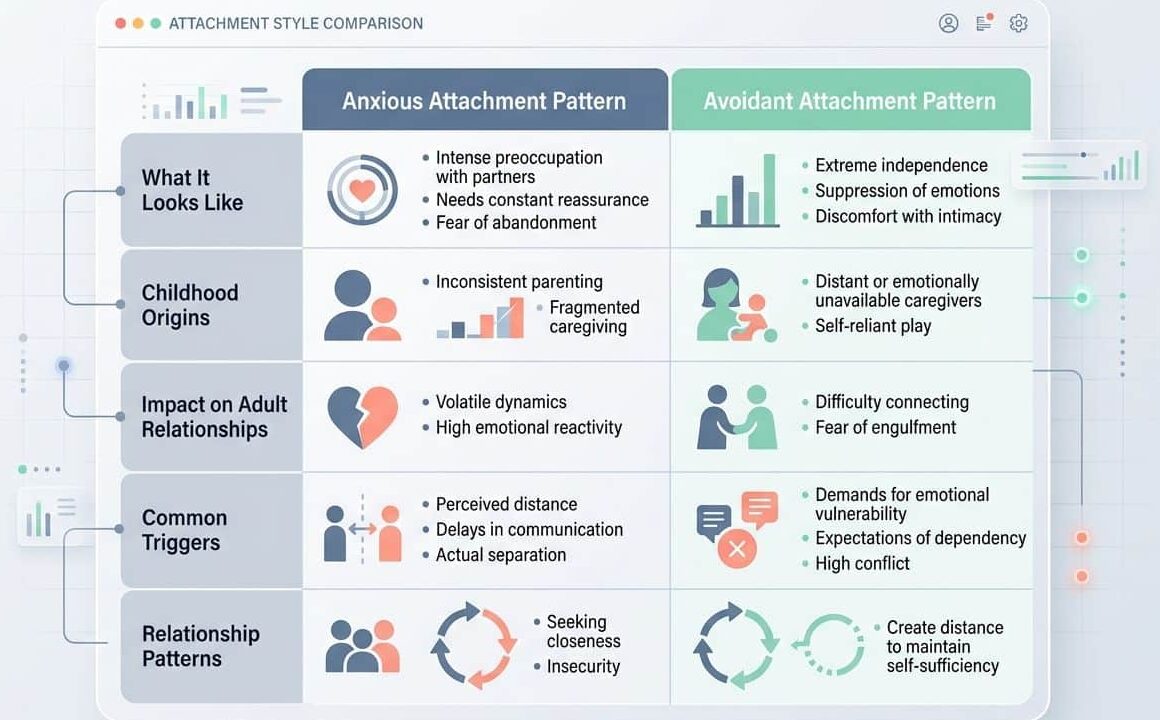
Not all secure attachments develop naturally. Many adults find themselves caught in patterns that pull them in opposite directions. Two main attachment styles emerge when security never took root in childhood. These anxious and avoidant patterns completely shape how we love, fight, and connect with partners.
| Anxious Attachment Pattern | Avoidant Attachment Pattern |
|---|---|
| What It Looks Like
People with anxious attachment crave closeness constantly. They need reassurance from their partners regularly. Uncertainty about the relationship creates deep anxiety. Small conflicts feel like relationship endings. Their phone buzzes with frequent check-in texts. They interpret slow responses as rejection. Partners sometimes feel suffocated by the constant need for validation.
|
What It Looks Like
People with avoidant attachment pull away when relationships get close. Emotional intimacy triggers their discomfort. They value independence above partnership. Partners describe them as distant or emotionally unavailable. They struggle to express feelings openly. Space matters more than connection for them. Vulnerability feels dangerous, so they keep walls up.
|
| Childhood Origins
Inconsistent caregiving created this pattern. A parent might show affection one day and coldness the next. The child never knew which version would appear. They learned to monitor adults constantly for mood shifts. This hypervigilance becomes a permanent relationship habit. Unpredictable love teaches children to chase reassurance.
|
Childhood Origins
Emotionally distant or rejecting caregivers caused this response. A parent might dismiss a child’s feelings repeatedly. Asking for comfort got ignored or criticized. The child learned that needing others brings pain. Independence became the survival strategy. Emotional needs felt like weakness to avoid. Detachment kept them safe from disappointment.
|
| Impact on Adult Relationships
Partners feel drained by the constant emotional labor. Anxious individuals often sabotage relationships through excessive monitoring. They interpret ambiguous situations as proof of abandonment. Jealousy and possessiveness can emerge. Their partners feel guilty for having independent time. The relationship becomes about managing their anxiety rather than mutual growth. Arguments escalate quickly because the stakes feel existential.
|
Impact on Adult Relationships
Partners struggle with the emotional distance and withdrawal. Avoidant individuals shut down during conflict instead of discussing it. They avoid commitment conversations or put them off indefinitely. Their partners feel unseen and unimportant. Intimacy remains surface-level and never deepens. When partners push for closeness, avoidant people retreat further. The relationship lacks the warmth and connection that sustains long-term bonds.
|
| Common Triggers
Silence from a partner triggers panic. Being alone for extended periods creates anxiety. Perceived criticism feels like total rejection. Partners spending time with friends without them sparks worry. Changes in routine or communication patterns feel catastrophic. Anything suggesting distance activates their fear response.
|
Common Triggers
Requests for emotional sharing feel invasive. Partners wanting to discuss the future creates dread. Expressions of strong emotions make them uncomfortable. Pressure to deepen the relationship pushes them away. Dependence on them for emotional support triggers escape urges. Feeling trapped, they seek distance or distractions.
|
| Relationship Patterns
Anxious people often attract avoidant partners, creating a painful dance. The anxious person pursues, while the avoidant person withdraws. This cycle repeats until one person breaks. Anxious individuals may stay in unhealthy relationships too long. They tolerate poor treatment to avoid abandonment. Each rejection reinforces their fear of being unlovable.
|
Relationship Patterns
Avoidant people often attract anxious partners. The avoidant person withdraws while the anxious person pursues. This cycle creates intense frustration for both partners. They may prefer casual relationships to avoid emotional risk. They end relationships quickly when things feel too close. Their independence serves as a shield against potential heartbreak.
|
Communication and Conflict Styles from Childhood
Your parents argued behind closed doors, or they yelled across the dinner table. Either way, you learned how to handle disagreements from watching them. The words your caregivers used, the tone they took, and how they solved problems became your blueprint for talking things out with your partner today.
Conflict Resolution Observations in Early Life
Kids watch how their parents handle fights, and those lessons stick around like gum on a shoe. If your mom and dad yelled at each other, you probably learned that conflict means raising your voice.
If they shut down and refused to talk, you picked up the silent treatment as a tool. These childhood observations shape how you handle disagreements in adult relationships. You learned what works and what fails, even if your lessons were unhealthy.
Renowned relationship experts at The Gottman Institute discovered that 69% of all relationship problems are unsolvable, perpetual issues. Many of these ongoing fights stem from early childhood triggers, which psychologists call “attachment injuries.”
If your caregivers swept issues under the rug, you probably struggle to bring up problems now. Some people grew up in homes where conflict meant anger, making them highly aggressive as adults.
These relationship patterns do not disappear on their own. Recognizing how your family handled disagreements gives you the power to change your own approach. You can break cycles that hurt you and build healthier communication habits with your partner today.
Communication Habits Learned from Caregivers
Your caregivers taught you how to talk, argue, and connect with others. If your parents spoke kindly during disagreements, you probably do the same. If they yelled or shut down conversations, you might repeat those identical patterns now.
Your early family conversations shaped your emotional development and interpersonal relationships in ways you might miss entirely. The words your caregivers used, their tone, and their willingness to listen became your blueprint for adult behavior.
- Tone of voice: Did your parents speak softly or raise their voices frequently?
- Active listening: Did they look each other in the eye and truly listen during a disagreement?
- Silent treatment: Did they withdraw and refuse to speak for days at a time?
Your parenting styles shaped how you express feelings and handle conflict resolution today. Some people learned to discuss problems openly at the dinner table. They tackle relationship dynamics with complete confidence.
Others grew up in homes where difficult topics stayed hidden. This creates trust issues that follow them straight into romantic partnerships.
These learned behaviors influence how you bond with partners, express intimacy, and build secure attachments. The good news is that recognizing these patterns gives you the power to change them.
Overcoming Negative Relationship Cycles
You can break free from patterns that hurt you, but you have to do the work first. Therapy, self-reflection, and honest conversations with your partner all help you build stronger bonds and leave old wounds behind.
Identify and Address Unhealthy Patterns
Spotting unhealthy relationship patterns takes honest self-reflection and courage. Your childhood experiences shaped how you love, argue, and trust today.
- Look at your past relationships and find repeating themes that hurt you, such as partners who withdrew emotionally or relationships that felt chaotic and unstable.
- Write down specific moments when you felt triggered or upset in your adult partnerships, then trace those feelings back to similar childhood experiences with parents or caregivers.
- Notice if trust issues pop up frequently in your romantic partnerships, especially if your early caregivers broke promises or showed inconsistency in their emotional support.
- Examine your conflict resolution style and ask yourself whether you learned to yell, shut down, or run away from disagreements by watching your family handle arguments.
- Identify anxious attachment patterns if you find yourself constantly seeking reassurance from partners or fearing abandonment, which often stems from inconsistent parenting styles.
- Recognize avoidant attachment behaviors when you push partners away or struggle with intimacy, a common response to caregivers who were emotionally distant or dismissive.
- Track communication habits you picked up from your family, such as using sarcasm to deflect, giving silent treatment, or failing to express your actual needs and feelings.
- Assess whether you choose partners who remind you of problematic family dynamics, repeating early relationship patterns in your adult romantic life.
- Evaluate your independence levels and determine if you struggle with healthy boundaries because your parents either controlled you too much or neglected your emotional needs.
- Reflect on intimacy patterns and consider whether physical or emotional closeness feels scary, comfortable, or confusing based on how your family members bonded with each other.
- Examine your support system and notice if you have difficulty asking for help or accepting emotional support from your partner, rooted in childhood experiences of self-reliance.
- Challenge beliefs about relationships that feel automatic, such as thinking love means sacrifice or that conflict means the partnership is failing, ideas often inherited from your family.
Understanding these patterns opens the door to fostering secure attachments through conscious effort and intentional change in your adult relationships.
Foster Secure Attachments Through Conscious Effort
You can build secure attachments in your adult relationships through intentional work and self-awareness. This process requires you to examine your past, understand your patterns, and make different choices moving forward.
For instance, couples who use Emotionally Focused Therapy (EFT), a method developed by Dr. Sue Johnson, see incredible results. Recent 2026 statistics show that 70% to 75% of couples who complete EFT move from severe distress to full recovery. This proves that intentional effort works.
- Examine your own attachment style first, because understanding whether you lean anxious, avoidant, or secure helps you recognize triggers in your current partnership.
- Talk openly with your partner about your childhood experiences, since sharing vulnerable moments creates emotional bonds that strengthen your connection.
- Practice consistent communication with your loved one, making sure you express your needs clearly and listen when they share theirs.
- Set healthy boundaries that respect both your independence and your need for closeness, which prevents resentment from building up over time.
- Show up reliably for your partner in small ways each day, because trust grows through repeated positive actions and genuine presence.
- Address conflicts calmly instead of shutting down or exploding, since the way you handle disagreements shapes your entire relationship dynamic.
- Seek professional support through therapy if childhood trauma or negative relationship patterns keep repeating in your adult life.
- Validate your partner’s feelings even when you disagree with them, because emotional support strengthens the secure attachments you are building together.
- Create safe spaces where both of you can express fears without judgment, allowing vulnerability to deepen your interpersonal relationships.
- Celebrate small moments of connection with your partner, noticing when they show up for you and acknowledging their effort.
- Work on your own emotional development through self-reflection, journaling, or meditation to understand how family dynamics shaped you.
- Respond to your partner’s needs with patience rather than defensiveness, which helps break cycles of unhealthy relationship patterns.
Understanding how to foster these secure attachments sets the stage for exploring therapeutic interventions that address deeper childhood emotional wounds.
Early Friendships and Their Role in Adult Social Skills
Your childhood friendships taught you how to share, argue, and make up. Those early social lessons stick with you into adulthood and shape how you connect with romantic partners.
Develop Social Skills and Emotional Support
Early friendships teach kids how to handle emotions and connect with others. Kids who share toys, resolve disagreements, and celebrate wins together build strong social skills. These friendships create a safe space where children practice trust and discover how to support friends through tough times.
The Minnesota Longitudinal Study followed children from birth into their twenties. Researchers found a fascinating link. Teens who struggled with conflict resolution with their best friend at age 16 were significantly more likely to become the less committed partner in romantic relationships at age 21.
The emotional support kids receive from peers shapes how they later show up for spouses. A child who learned to comfort a sad friend often becomes an adult who knows how to be there for a partner during a crisis.
Social skills developed in childhood friendships directly transfer to adult romantic partnerships. Adults who played well with others as kids tend to communicate better, handle conflict more smoothly, and build deeper emotional bonds.
Impact on Adult Interactions and Partnerships
Your childhood friendships taught you how to show up for other people. Those early bonds shaped your ability to listen, share feelings, and stand by someone through tough times.
You learned to read social cues, pick up on what others needed, and offer support without being asked. These skills travel with you right into romantic partnerships and professional relationships.
Adults who had solid friendships as kids tend to build stronger emotional bonds with their partners. They know how to ask for help, celebrate wins together, and work through conflicts without shutting down. Your social development during childhood created a blueprint for how you interact with the world around you.
Childhood friendships provide the very first practice ground for adult love and loyalty.
Partners notice when you bring these friendship skills into your relationship. You show up with better communication habits, a stronger emotional connection, and a genuine interest in your partner’s life.
Secure attachments formed through childhood friendships make it easier to trust others. People who struggled with friendships early on sometimes carry that struggle into adult romantic partnerships. They find it hard to open up or rely on someone else.
You can learn these skills at any point in your life. Therapy, self-reflection, and conscious effort help you develop the social skills you missed.
Therapeutic Interventions for Childhood Influence
Therapy helps you dig up old wounds from your past, so you can finally heal them and stop repeating the same patterns in your adult relationships. A skilled therapist works with you to untangle those childhood knots.
Address Childhood Emotional Wounds
Childhood emotional wounds run deep. They shape how you love, trust, and connect with partners later in life. These wounds form when caregivers fail to meet your emotional needs, leaving you with attachment issues that follow you right into adulthood.
You might struggle with trust, push people away, or cling too tightly to relationships. Identifying these wounds takes courage. Start by noticing your patterns, your triggers, and your automatic reactions in romantic partnerships.
Many adults find success using targeted trauma treatments like EMDR, which stands for Eye Movement Desensitization and Reprocessing. This specific therapy helps your brain reprocess painful childhood memories so they no longer trigger extreme emotional reactions in your current relationship.
Ask yourself what happened in the family dynamics that taught you these responses. Did your parents show affection openly, or did they keep emotions locked away? Your parenting styles shaped your emotional development in ways you may not fully recognize yet.
Addressing these wounds means sitting with uncomfortable feelings instead of running from them. You must acknowledge the pain your childhood caused, validate your experiences, and stop blaming yourself for how your family treated you.
Working through childhood trauma opens doors to healthier emotional bonds. A skilled therapist guides you through your emotional wounds, helping you separate past pain from present reality. You learn that your caregivers’ limitations were not your fault.
Strategies for Healthier Adult Relationships
Your childhood shaped how you love, trust, and connect with others. Learning to break old patterns takes work, but it absolutely changes your life.
- Seek therapy or counseling to unpack your early experiences and understand how they influence your current relationships; a trained therapist helps you see patterns you might miss on your own.
- Practice self-awareness by noticing when you react strongly in your relationship; these moments often point back to something from your past that still bothers you.
- Communicate openly with your partner about your attachment style and childhood wounds; honesty builds emotional connection and helps them support you better.
- Set healthy boundaries that reflect your needs rather than repeating what your family modeled; boundaries protect your emotional development and show respect for yourself.
- Work on developing secure attachments by being consistent, reliable, and emotionally present with your partner; these interpersonal relationships thrive when both people show up.
- Challenge negative self-talk that stems from parenting styles you experienced; your inner voice often echoes your caregivers, so rewriting that script takes conscious effort.
- Learn conflict resolution skills that differ from what you observed growing up; many people repeat family dynamics without realizing there are better ways to handle disagreements.
- Build trust gradually through small acts of vulnerability and follow-through; trust issues fade when your partner proves they deserve your confidence over time.
- Develop emotional regulation by naming your feelings before you react; this skill prevents you from dumping old relationship patterns onto your current partner.
- Invest time in friendships and social development outside your romantic partnership; strong bonds with others reduce pressure on one relationship to meet all your needs.
- Journal about your intimacy patterns to spot recurring themes in how you connect with others; writing reveals truths that stay hidden in your head.
- Celebrate small wins when you handle situations differently than your family would have; progress matters more than perfection in breaking relationship cycles.
The Science Behind the Connection
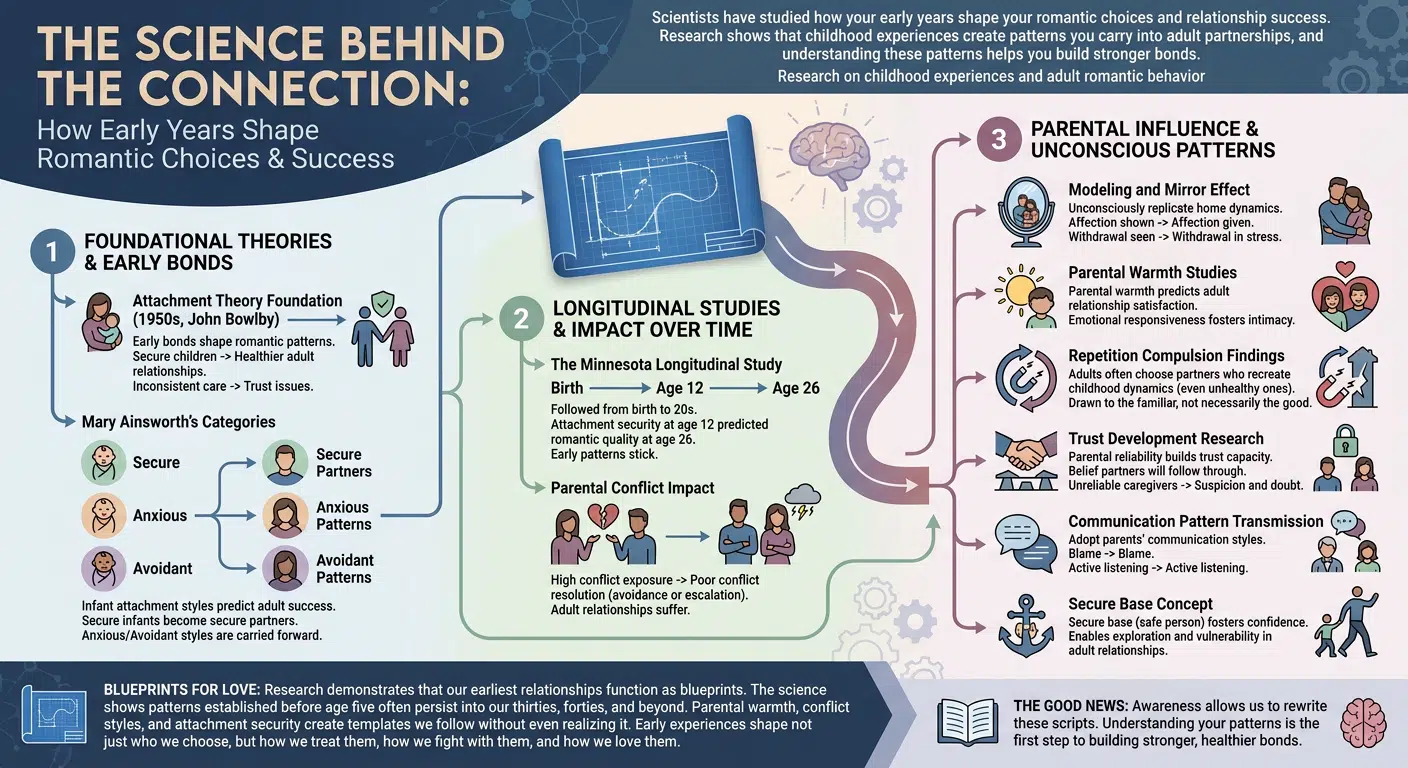
Scientists have studied how your early years shape your romantic choices and relationship success. Research shows that childhood experiences create patterns you carry into adult partnerships, and understanding these patterns helps you build stronger bonds.
Research on childhood experiences and adult romantic behavior
Decades of research reveal clear connections between what happens in childhood and how we love as adults.
| Research Finding | Key Insight |
|---|---|
| Attachment Theory Foundation | John Bowlby’s groundbreaking work in the 1950s established that early bonds with caregivers shape our romantic patterns for life. Children who feel secure develop healthier adult relationships. Those with inconsistent care often struggle with trust later on. |
| Mary Ainsworth’s Categories | Ainsworth expanded Bowlby’s theory by identifying three distinct attachment styles in infants. Her observations directly predicted relationship success decades into adulthood. Secure children became secure partners. Anxious or avoidant children carried those patterns forward. |
| The Minnesota Longitudinal Study | Researchers followed children from birth into their twenties, documenting relationship quality at each stage. Results showed attachment security at age twelve predicted romantic relationship quality at age twenty-six. Early patterns truly stick with us. |
| Parental Conflict Impact | Children exposed to high parental conflict adopt poor conflict resolution skills. They either avoid disagreements entirely or escalate them quickly. Adult romantic relationships suffer when partners cannot communicate due to tension. |
| Modeling and Mirror Effect | We unconsciously replicate what we witnessed at home. If parents show affection freely, we tend to do the same. If they withdraw during stress, we likely withdraw too when adult relationships get rocky. |
| Parental Warmth Studies | Research consistently shows that parental warmth in childhood predicts relationship satisfaction in adulthood. Emotionally responsive parents raise adults capable of emotional intimacy. Cold or dismissive parenting creates distance in romantic bonds. |
| Repetition Compulsion Findings | Adults often choose partners who recreate their childhood dynamics, even unhealthy ones. This happens unconsciously. We feel drawn to what feels familiar, not necessarily to what feels good. |
| Trust Development Research | Children who experienced parental reliability develop stronger trust capacity as adults. They believe partners will follow through on promises. Those with unreliable caregivers approach adult relationships with suspicion and doubt. |
| Communication Pattern Transmission | Studies show we adopt our parents’ communication styles word-for-word sometimes. If they blame during disagreements, we likely do too. If they listened actively, we probably developed that skill as well. |
| Secure Base Concept | Children who have a secure base, meaning a safe person to return to, develop confidence in adult relationships. They explore new experiences with partners because they trust that support exists. Insecure children hesitate to be vulnerable. |
Research demonstrates that our earliest relationships function as blueprints. The science shows patterns established before age five often persist into our thirties, forties, and beyond. Parental warmth, conflict styles, and attachment security create templates we follow without even realizing it. Early experiences shape not just who we choose, but how we treat them, how we fight with them, and how we love them. The good news, supported by therapeutic research, is that awareness allows us to rewrite these scripts.
Key studies linking early dynamics to long-term relationship success
Research reveals clear patterns in how childhood shapes romantic futures. Scientists have spent decades studying these connections, and their findings paint a compelling picture of cause and effect. Let me walk you through the research that changed how we understand adult love.
| Study | Key Findings | Relevance to Adult Partnerships |
|---|---|---|
| Bowlby’s Attachment Theory (1950s to 1980s) | Children form internal working models of relationships based on early caregiver interactions. Secure attachments in infancy predict stable adult bonds. | Adults with secure childhood attachments show greater relationship satisfaction, trust, and emotional stability with partners. |
| Hazan and Shaver’s Romantic Attachment Study (1987) | Adult romantic attachment styles mirror infant attachment patterns. Three primary styles emerged: secure, anxious, and avoidant. | Secure individuals maintain healthier partnerships. Anxious partners seek constant reassurance. Avoidant partners struggle with intimacy. |
| Sprecher, Wenzel, and Harvey Research (1998) | Childhood relationship models directly influence mate selection and relationship longevity. People repeat familiar patterns, even unhealthy ones. | Adults unconsciously choose partners matching their early experiences. This explains why some repeat toxic cycles. |
| Coan and Gottman’s Brain Imaging Study (2007) | Partners with secure attachments showed different neural responses during threat. Their brains activated calm-down regions when near spouses. | Secure attachment creates physiological safety. Insecure attachment leaves the nervous system in constant alert mode. |
| Walton’s Intergenerational Study (2015) | Parental conflict patterns are transferred to children’s adult relationships. Witnessing poor communication made conflict resolution harder for offspring. | Children observing healthy conflict resolution develop better communication skills. Those witnessing hostility struggle with partnership arguments. |
| Rhoades Study on Relationship Stability (2008) | Cohabiting couples with insecure attachment styles showed 50 percent higher breakup rates. Secure attachment predicted long-term commitment. | Early attachment security functions as a protective factor for relationship endurance and satisfaction across years. |
| Feeney and Monin’s Caregiving Research (2008) | Adults who received consistent emotional support in childhood became better caregivers to partners. They showed greater empathy and responsiveness. | Secure childhoods produce partners who genuinely support others. Neglected children struggle to provide emotional comfort to their spouses. |
These findings matter because they show attachment is not destiny. Understanding your patterns opens doors to change. Science proves that awareness plus effort can reshape your relationship future. Your past does not lock you into one outcome.
Wrapping Up
Your childhood relationships act as the foundation for how you love today. The bonds you formed with caregivers and friends shaped your communication habits. They built your attachment style and conflict resolution skills. Understanding these patterns gives you real power to change them. You can break cycles that hurt you. You can build stronger emotional connections and create the adult partnerships you truly want.
Therapy, self-reflection, and conscious effort help rewire old relationship dynamics into healthier ones. Your social development started long ago. Yet, it continues to influence your interpersonal relationships right now. Secure attachments do not happen by accident. They develop through awareness and intentional action.
The good news is that you are not stuck with patterns from your past. Adult behavior can shift when you recognize how childhood relationships shape adult partnerships. Take time to examine your relationship patterns. Seek support when needed, and invest in building the emotional bonds you deserve.
Frequently Asked Questions (FAQs) on Childhood Relationships Vs Adult Partnerships
1. How do early friendships affect adult partnerships?
Research shows that children who learn to resolve conflicts with friends carry those communication skills into adult romantic relationships. If you practiced talking through problems with childhood friends, you’ll likely handle partnership challenges the same way.
2. Can family ties from childhood shape romantic choices as an adult?
Absolutely. The way your parents or siblings treated you often echoes in who you pick as a partner and how you relate to them. Attachment theory research finds that people who felt secure at home as kids usually look for that same safety and warmth in romantic relationships.
3. Why do some adults struggle with closeness because of their early years?
When someone grew up feeling ignored or left out, opening up as an adult can feel really hard. Old protective patterns become automatic, making people keep their distance without fully understanding why.
4. Is it possible to change patterns learned from childhood connections?
Yes, early patterns aren’t permanent! Neuroscience research on brain plasticity shows you can develop healthier relationship habits through self-awareness and practice, often with support from a therapist or trusted friends.