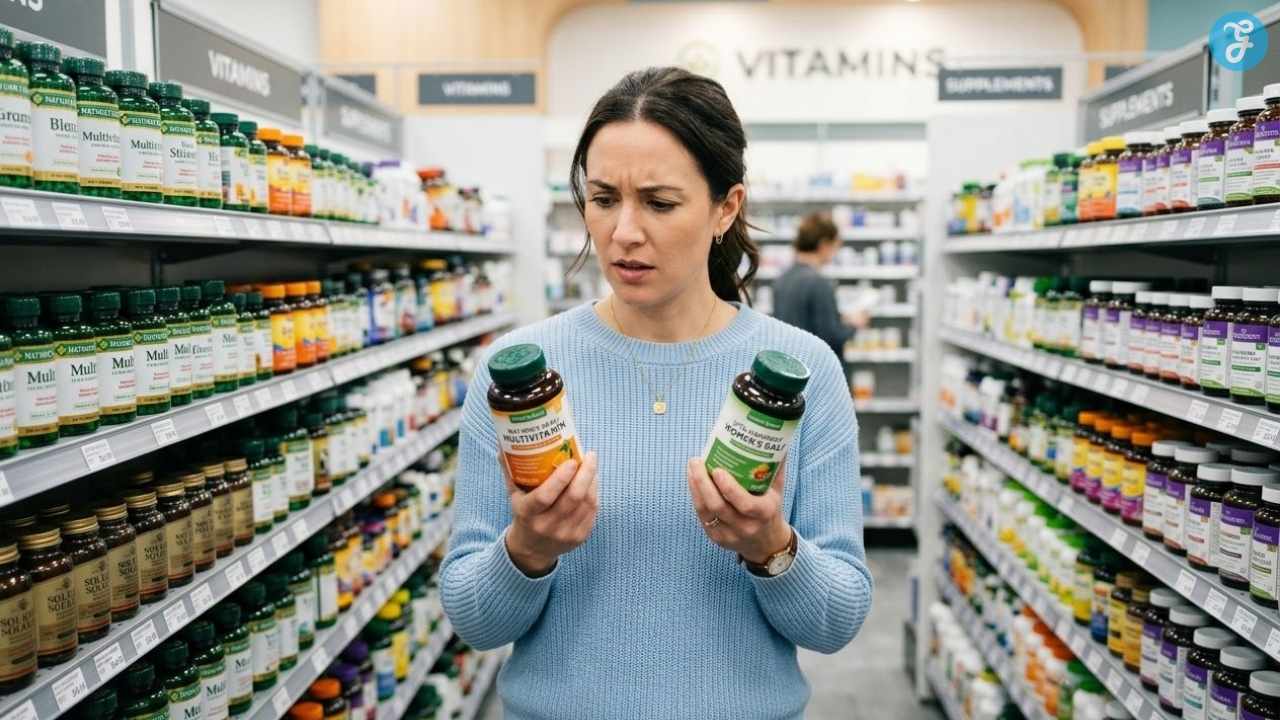
Do you ever feel confused standing in the supplement aisle? You look at hundreds of bottles, all promising better energy and stronger bones. You probably just grab a few and hope they work. But here is a secret I learned as a health researcher. Most people do not actually know what they are buying. You might be surprised to learn that Americans spend over 53 billion dollars every year on these products. That is a massive amount of money going toward things many folks simply do not require.
The truth about vitamins and supplements most people don’t know looks very different from what the marketing tells you. I am going to walk you through the exact steps you need to make smart choices.
We will separate the facts from the fiction together, so you can stop wasting cash on pills you do not need.
Understanding Vitamins and Supplements
Your body absolutely requires vitamins and minerals to survive. Supplements are simply tools meant to fill nutritional gaps when your daily diet falls short of what your body actually needs.
Defining Vitamins
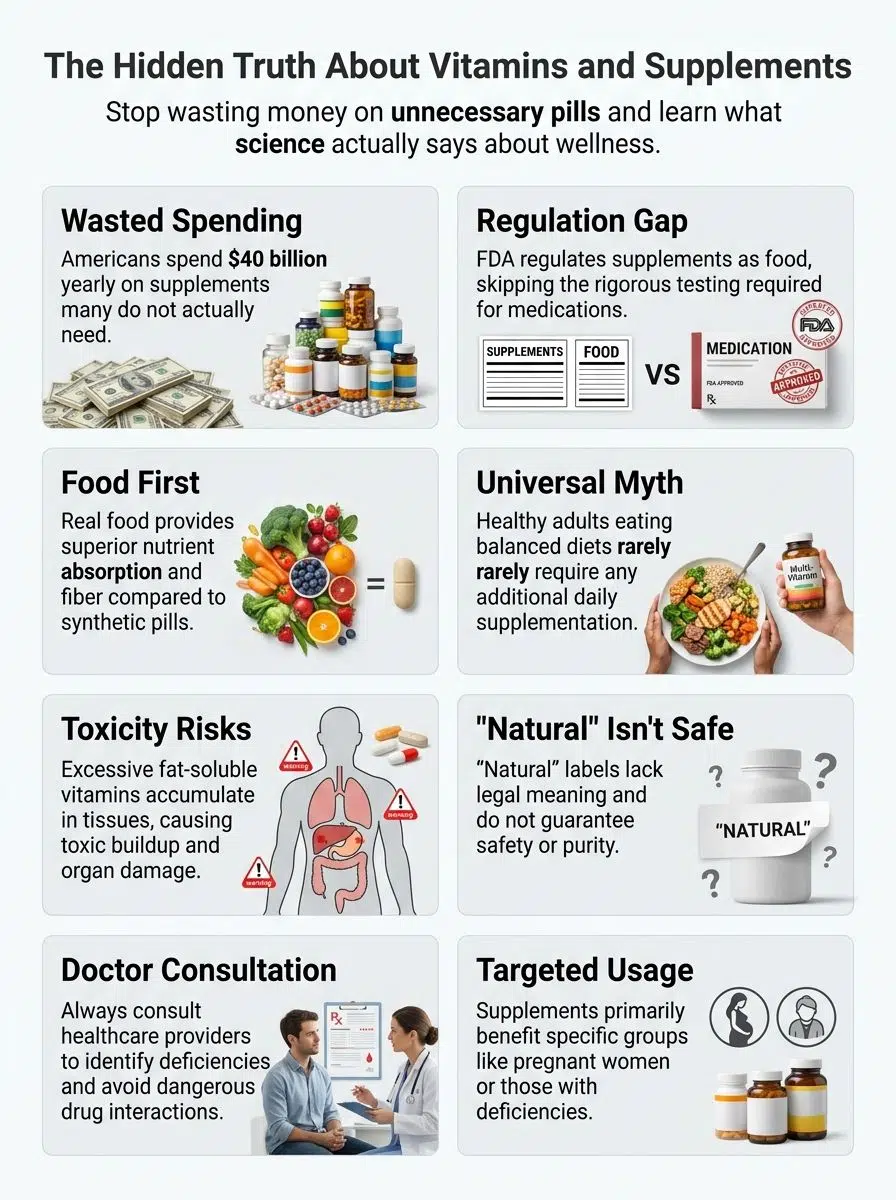
Your body needs thirteen essential vitamins to work the way it should. These organic compounds come from food, plants, and animals. Because your body cannot make most of them on its own, you have to get them from your diet.
Vitamins help your cells grow, keep your immune system fighting off germs, and ensure your bones stay strong. Some dissolve in water, like vitamin C and the B complex. Others dissolve in fat, like vitamins A, D, E, and K.
Your body stores fat-soluble vitamins in your fatty tissues. However, it flushes water-soluble vitamins out through urine, so you need to consume them more frequently.
Vitamins are the vital spark plugs of nutrition, keeping your body’s complex engine running smoothly.
Getting vitamins from real food beats taking pills in almost every case. An apple, a handful of spinach, or a piece of salmon delivers vitamins in their natural form. This food synergy includes natural fiber and other active nutrients mixed in.
Your digestive system absorbs these nutrients much better when they come straight from whole food sources. Deficiencies usually happen when people lack access to nutrient-rich foods.
Differences Between Supplements and Vitamins
Vitamins are essential organic compounds your body needs to function. Supplements encompass a much broader category that includes vitamins, minerals, herbs, and amino acids meant to boost general health.
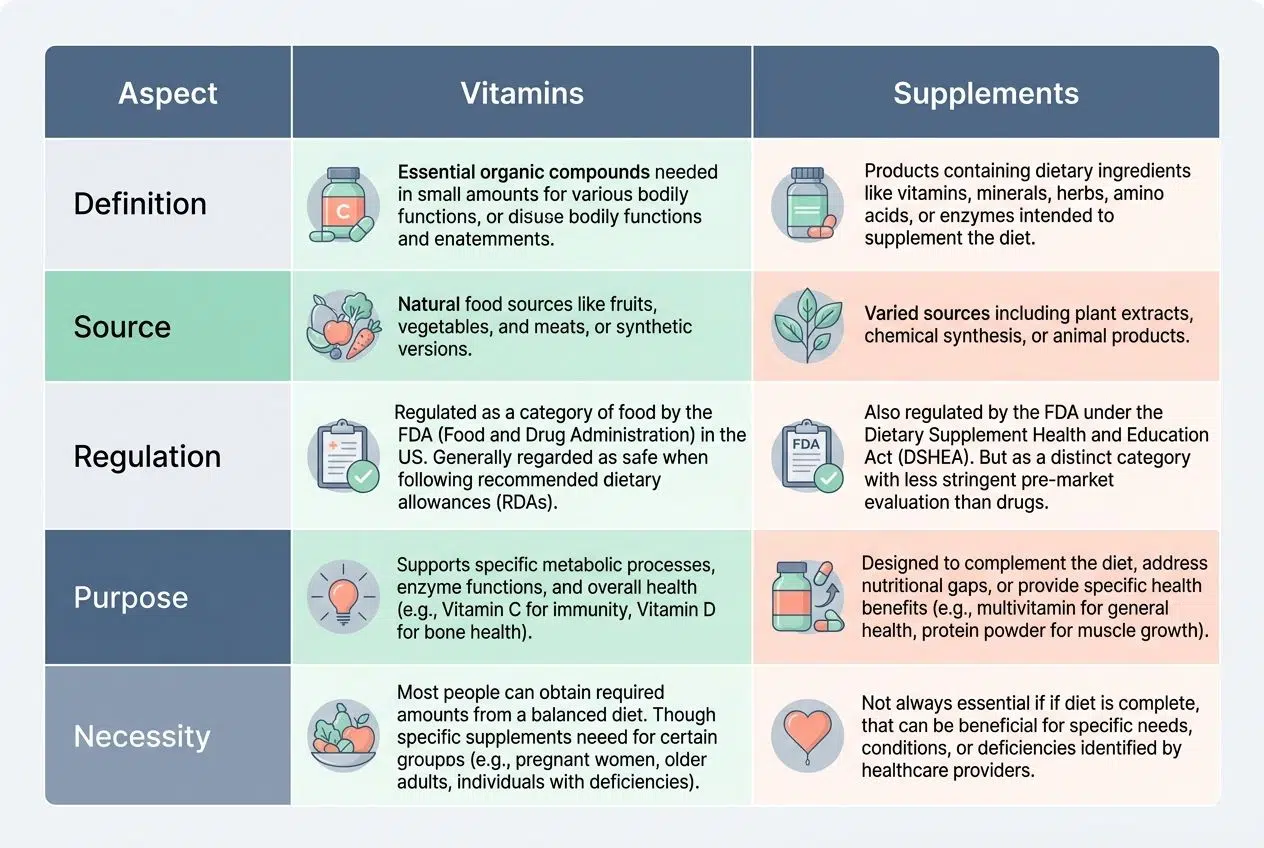
| Aspect | Vitamins | Supplements |
|---|---|---|
| Definition | Essential organic substances produced by plants or animals. Your body cannot make most vitamins on its own. Thirteen vitamins are required. | Products meant to add dietary ingredients to your routine. This broad category includes vitamins, minerals, herbs, and amino acids. |
| Source | Found naturally in whole food sources like fruits, vegetables, and animal products. Laboratories can also synthesize them. | Manufactured exclusively in pill, powder, liquid, or capsule form. Made from various natural or synthetic ingredients. |
| Regulation | Classified as dietary supplements by the FDA. Subject to the Dietary Supplement Health and Education Act (DSHEA) standards. | Regulated under DSHEA. The FDA does not approve them before they hit store shelves like prescription medications. |
| Purpose | Support critical bodily functions like energy production, immune response, and bone strength. Prevent serious deficiency diseases. | Support general wellness, fill specific nutritional gaps, or address targeted health concerns. |
| Necessity | Absolutely essential for survival and human health. Deficiencies cause severe health problems like scurvy. | Not always necessary for healthy individuals to eat a balanced diet. Highly beneficial for specific populations with identified medical needs. |
| Examples | Vitamin A, B complex vitamins, vitamin C, vitamin D, vitamin E, and vitamin K. | Fish oil, probiotics, ginseng, turmeric, calcium, magnesium, CoQ10, and Ashwagandha. |
Understanding this distinction shapes how you approach your personal wellness strategy. Vitamins serve as the non-negotiable building blocks your body absolutely needs to survive. Supplements work differently. They fill specific gaps or support wellness goals beyond basic survival.
Regulations for Vitamins and Supplements
The FDA watches over vitamins and supplements, but they treat them very differently from prescription drugs. You need to understand these basic rules because they dictate what companies can sell you.
How Supplements Are Regulated as Food
The government treats supplements as food products, not drugs. This classification means manufacturers face far fewer rules before selling them. Companies do not need official approval from regulators before putting supplements on store shelves. They can make bold claims about health benefits with less scrutiny than pharmaceutical companies must follow.
Your safety depends on manufacturers doing the right thing voluntarily. Because the government does not check products before they hit shelves, smart shoppers must protect themselves.
You should always look for third-party testing seals on the bottle. These independent organizations verify supplement quality and purity:
- United States Pharmacopeia (USP): The gold standard certifier for verifying the exact identity, strength, and purity of dietary supplements.
- NSF International: A highly respected organization that ensures products contain exactly what is on the label without unsafe levels of contaminants.
- ConsumerLab.com: An independent laboratory that regularly tests and publishes clear reports on popular supplement brands.
The Role of the FDA in Vitamin Oversight
The FDA steps in only after problems arise in the real world. This makes their oversight a reactive system rather than a preventive one. This system means manufacturers can sell vitamins without proving they actually work. The agency can pull dangerous products off shelves, but this action requires documented evidence of public harm.
To help protect consumers, the FDA launched a new tracking tool in 2024 called the Dietary Supplement Ingredient Directory. This public database lists specific substances that raise safety concerns, helping doctors and consumers stay informed.
The primary role of the FDA is to monitor the supplement market after products are already widely available to consumers.
Companies must legally report serious side effects to the FDA. Yet, many consumers never learn about the dangerous risks associated with unregulated nutrients and minerals.
The FDA works incredibly hard to protect public health with limited resources. Still, gaps in safety regulations remain a very real danger to everyday shoppers.
The Truth About Vitamins And Supplements Most People Don’t Know: Debunking Common Myths
The supplement industry thrives on myths that sound great in advertisements. We are going to break down what people get wrong about vitamins, so you can make smarter, safer choices.
Myth: Everyone Requires Supplements
Most people do not need daily supplements to stay healthy. Your body gets its necessary vitamins and minerals directly from food.
According to the 2024 CRN Consumer Survey, an astonishing 74 percent of US adults take dietary supplements. But healthy adults who eat a variety of fruits, vegetables, whole grains, and proteins rarely face true nutrient deficiencies.
Taking supplements when your body already has enough nutrients just creates expensive urine. Your kidneys simply filter out the excess vitamins you do not use.
Myth: Natural Always Means Safe
Many folks assume that natural ingredients automatically mean safe ingredients. This assumption can lead to serious, preventable health problems.
You need to be very careful with herbal supplements, because they can interact dangerously with prescription medications. Here are a few common examples that surprise many people:
- St. John’s Wort: This popular mood supplement severely reduces the effectiveness of birth control pills and antidepressants.
- Kava Root: Marketed heavily for anxiety relief, this natural plant extract has caused documented liver failure in certain users.
- Ashwagandha: A massive viral social media trend pushed this herb for stress, but it can dangerously interact with thyroid medications.
- Berberine: Often called “Nature’s Ozempic” online, this natural compound can cause severe drops in blood sugar if mixed with diabetes drugs.
Your liver and kidneys work hard to process everything you consume. Flooding them with unregulated natural products can cause hidden damage over time.
Myth: More Supplements Are Always Better
Taking extra vitamins does not guarantee better health results. Your body can only absorb and use a specific amount of each nutrient.
A landmark study published by the CDC revealed some startling numbers about the real dangers of taking too many pills. They found that adverse events from these products send tens of thousands of people to the hospital.
CDC researchers estimate that dietary supplements cause over 23,000 emergency room visits every single year in the United States.
Even scarier, unsupervised children account for more than 20 percent of those hospital visits. Young adults frequently end up in the ER with chest pain and a racing heart after taking excessive weight loss or energy products.
Fat-soluble vitamins like A, D, E, and K are stored heavily in your body’s fatty tissues. Taking too much builds up to toxic levels over time, causing massive organ strain.
Myth: Supplements Can Substitute for Healthy Eating
Some folks think they can skip nutritious meals and rely entirely on supplements to do all the heavy lifting. This idea misses the mark completely.
Food gives your body essential compounds that isolated pills simply cannot replicate. Whole foods contain fiber, phytonutrients, and minerals that work together in highly complex ways.
A fresh carrot delivers beta-carotene alongside natural fiber that aids absorption. Eating a balanced diet provides a biological foundation for wellness that no plastic bottle can replace.
Insights on Multivitamins
Most people swallow daily multivitamins without knowing whether they actually need them. Let’s look at what the latest clinical research really shows.
The Limited Benefits for Most Individuals
Most multivitamins fail to deliver the massive health boost that marketing campaigns promise.
A massive 2024 study published in JAMA Network Open tracked nearly 400,000 healthy US adults for over 20 years. The results completely disrupted the supplement industry’s core claims.
- No Lifespan Increase: The researchers found absolutely no association between regular multivitamin use and a lower risk of death.
- No Disease Prevention: Daily multivitamin users did not see any meaningful reductions in mortality from cancer or heart disease.
- Food Remains Superior: The data confirms that your body absorbs nutrients far better from a balanced diet than from a pill.
Taking supplements when you do not need them creates false confidence about your health. Spending hundreds of dollars yearly on generic multivitamins provides no real medical benefit for healthy adults.
Circumstances Where Multivitamins Are Beneficial
While general multivitamins often fail to extend your life, targeted supplementation works wonders for specific groups. For example, a recent COSMOS-MIND study showed that daily multivitamins can help slow cognitive decline in older adults by about three years.
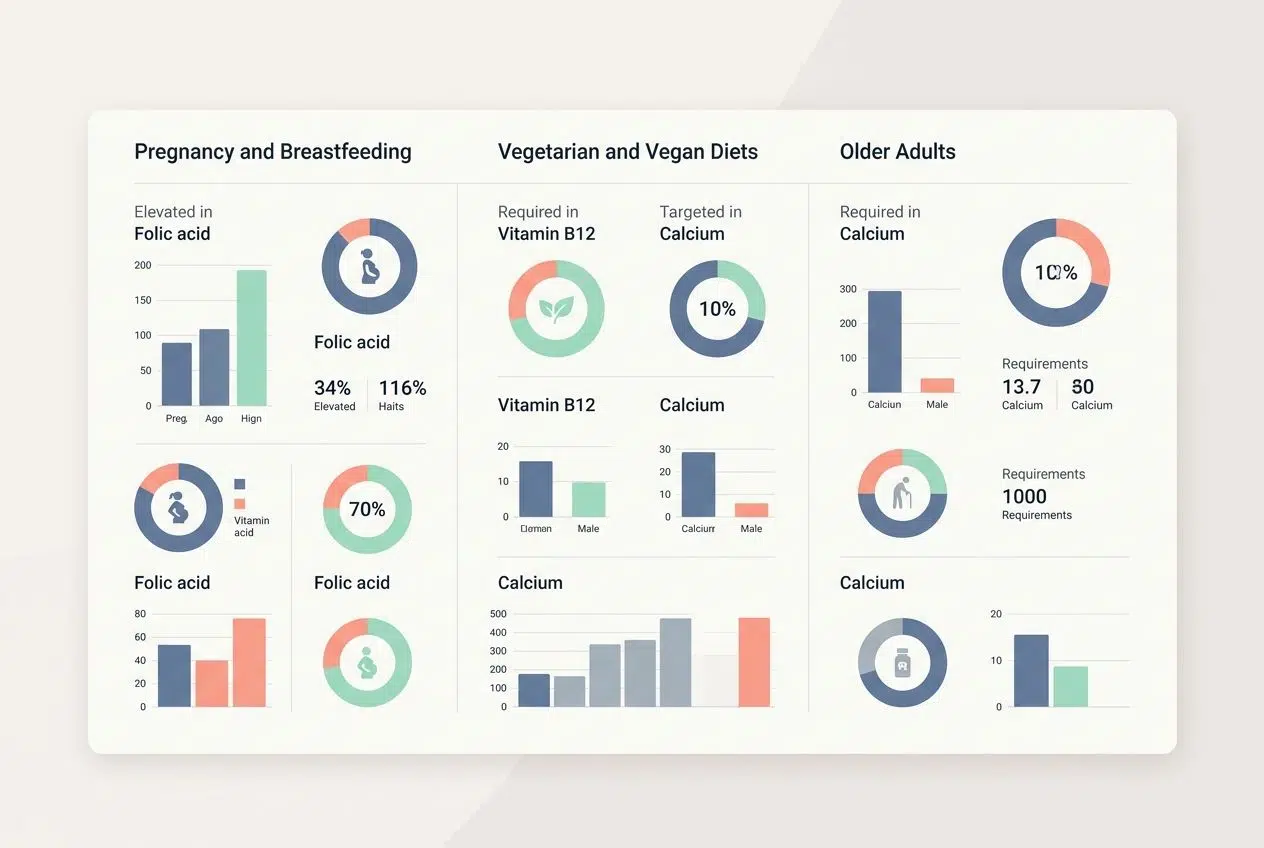
| Circumstance | Why Multivitamins Help | Key Nutrients Addressed |
|---|---|---|
| Pregnancy and Breastfeeding | Women require extra nutrients to support fetal development. Prenatal vitamins contain higher levels of folic acid to prevent neural tube defects. | Folic acid, iron, calcium, vitamin D, DHA |
| Vegetarian and Vegan Diets | Plant-based eaters frequently lack vitamin B12, which is found primarily in animal products. Iron absorption also differs significantly in vegetarian sources. | Vitamin B12, iron, zinc, vitamin D, omega-3s |
| Older Adults | Digestive systems absorb nutrients less efficiently with age. Reduced stomach acid severely impairs vitamin B12 absorption from food. | Vitamin B12, calcium, vitamin D, B vitamins |
| Chronic Digestive Disorders | Conditions like celiac disease and Crohn’s disease damage the intestinal lining. Supplements bypass these damaged areas to deliver essential minerals directly. | Iron, B vitamins, vitamin D, calcium |
| Medication Interactions | Certain prescriptions deplete specific nutrients over time. For example, common heartburn medications can drastically reduce vitamin B12 absorption. | B vitamins, calcium, iron, CoQ10 |
Your doctor can run simple blood tests to identify specific deficiencies. A healthcare provider will determine exactly whether supplements address your particular needs.
The Dangers of Excessive Vitamin and Supplement Use
Taking too many vitamins can actually harm your body instead of helping it. Let’s look at what really happens when you overdo your daily dose.
Side Effects of High Vitamin Doses
High doses of specific vitamins trigger serious medical problems that catch many people completely off guard.
| Vitamin or Supplement | Side Effects from Excessive Doses | Health Risks |
|---|---|---|
| Vitamin A | Nausea, headaches, dizziness, skin peeling, rapid hair loss | Liver damage, severe bone pain, birth defects in pregnant women |
| Vitamin D | Nausea, vomiting, severe weakness, kidney problems | Kidney stones, hypercalcemia, major cardiovascular complications |
| Vitamin E | Fatigue, profound weakness, headaches, blurred vision | Increased bleeding risk, stroke risk, interactions with blood thinners |
| Vitamin B6 | Nerve damage, numbness, sharp tingling in hands and feet | Peripheral neuropathy, difficulty walking, lasting sensory problems |
| Iron | Constipation, severe nausea, vomiting, dark stools | Iron overload, permanent organ damage, increased infection risk |
| Calcium | Constipation, nausea, dry mouth, deep muscle weakness | Painful kidney stones, dangerous interference with other medications |
Your body cannot store water-soluble vitamins like B and C, so excess amounts simply exit through urine. But fat-soluble vitamins accumulate rapidly in your tissues and organs.
Megadoses of vitamin A cause extreme bone pain and increase fracture risk in older adults. Excessive vitamin D consumption leads directly to kidney stones and dangerous calcium levels in your blood.
The Economic Cost of Unnecessary Supplements
Americans spend billions each year on vitamins and supplements. A 2024 CRN industry survey revealed that the US dietary supplement market reached an astounding 53 billion dollars.
Yet, many of these individual purchases are completely unnecessary. Your wallet takes a serious hit when you buy pills your body does not actually need.
Spending money on supplements you do not need drains your budget and provides zero medical benefits.
People often grab generic multivitamins off the shelf without checking for real deficiencies. That simple impulse costs them hundreds of dollars annually.
The supplement industry profits heavily from consumer confusion and aggressive social media marketing. You might take five different supplements daily, thinking you are investing in your wellness.
In reality, you might just be funding corporate profits. Skip the expensive guesswork and protect both your physical health and your bank account.
Smart Practices for Vitamin and Supplement Usage
You make smarter choices about your health when you learn what doctors recommend and what science actually proves. Keep reading to discover the practical steps that work.
Consulting Doctors About Supplement Use
Your doctor holds the key to safe supplement use. A healthcare professional will review your health history and current medications to guide your decisions.
You should also use free digital tools like the Drugs.com Interaction Checker before your appointment. This practice helps you spot potential issues between your prescriptions and your supplements early.
- Review your current medications with your doctor to avoid dangerous interactions.
- Bring a complete physical list of your daily vitamins and herbal products to your appointments.
- Discuss your actual dietary habits so your provider can pinpoint real nutritional gaps.
- Ask your doctor for research-backed recommendations instead of relying on internet marketing.
- Work with your healthcare professional to establish safe dosages, as taking too much causes side effects.
Seeking Evidence-Based Recommendations
Your doctor provides great guidance, but clinical research should also shape your supplement choices. Evidence-based recommendations come from high-quality, peer-reviewed studies.
You want to rely entirely on solid clinical data, not flashy marketing claims or viral social media trends.
- Look for products supported by human clinical trials that measure actual results and safety profiles.
- Check if major organizations like the National Institutes of Health back the specific supplement claims.
- Avoid relying on testimonials from friends, as personal stories do not replace rigorous scientific data.
- Investigate the funding behind the research to spot potential bias from supplement companies.
- Search for systematic reviews and meta-analyses that combine multiple studies for a clearer, more accurate picture.
Customizing Supplements to Personal Health Needs
Evidence gives you a solid foundation, but your personal health needs stand alone. Customizing your supplements to match your own wellness goals takes this knowledge one crucial step further.
You must look at your own body’s signals instead of following generic, one-size-fits-all advice.
- Track your diet for a few days to identify your actual vitamin and mineral gaps.
- Request a simple blood test to reveal true deficiencies before buying unnecessary products.
- Factor in your life stage, as nutritional requirements shift heavily during pregnancy or older age.
- Account for dietary restrictions, like veganism, which might limit your access to specific food groups.
- Start with lower doses and keep a simple health journal to track how the new addition makes you feel.
Wrapping Up
Your health depends on making smart choices. It does not depend on buying every trendy supplement on the shelf.
Talk to your doctor before you start taking new vitamins or minerals. This step is absolutely critical if you take other prescription medicines.
Your doctor knows your health history and can spot what your body actually needs.
A balanced diet gives you most of the nutrients you require every single day. Supplements only exist to fill in the gaps when real deficiencies show up.
Skip the marketing hype. Focus on what clinical research actually proves will work for your specific situation.
Now you understand the truth about vitamins and supplements most people don’t know. You get the best results when you pair them with exercise, good sleep, and whole foods.
Your wellness journey looks different from everyone else’s. Customize your approach to match your actual health goals.
Start small, track how you feel, and adjust based on real results.
Frequently Asked Questions (FAQs) on The Truth About Vitamins And Supplements
1. Why do people think vitamins and supplements are always safe?
Many folks believe that if it’s sold in a store, it must be harmless. The truth is, the FDA doesn’t approve dietary supplements before they reach shelves, and some can cause serious side effects or interact badly with your medications.
2. Can taking more vitamins help me feel better faster?
Not really. Your body only absorbs what it needs; the rest gets flushed out or, in the case of fat-soluble vitamins like Vitamin D, can build up to toxic levels and damage your kidneys.
3. Are all supplements tested by the government before they hit shelves?
Nope. Under the 1994 Dietary Supplement Health and Education Act, companies can sell supplements without proving they work or are safe first, unlike prescription drugs that go through years of testing.
4. Should I take supplements if I eat healthy foods already?
If your meals cover all food groups and colors of the rainbow, you probably don’t need extra pills at all. Real food delivers vitamins alongside fiber and other nutrients that work together better than isolated supplements can. Always talk to your doctor before adding anything new; they know your health story best.