


Are you feeling overwhelmed by the endless mountain of articles sitting in your browser tabs? Emails pile up in your inbox, and work documents demand your attention every single day. Most people feel stuck between reading everything slowly and missing important details. You want to finish faster, yet you worry that speeding up means you will forget what you read. This struggle is completely normal.
The average person reads about 238 words per minute. A recent study in the Journal of Memory and Language confirmed this baseline for adults reading non-fiction. But trained readers easily reach 700 to 1,000 words per minute while keeping their understanding sharp.
You do not need to become a superhero to read faster and smarter. I am going to show you exactly how to speed read effectively without losing comprehension.
Grab a comfortable seat, and let’s go through it together. I will show you everything you need to know.
Exploring Speed Reading Techniques
Speed reading is not magic. It just feels like it when you suddenly finish a book in half the time. You can learn practical methods that train your eyes and brain to work together. This helps you read faster while keeping your understanding sharp.
Defining Speed Reading
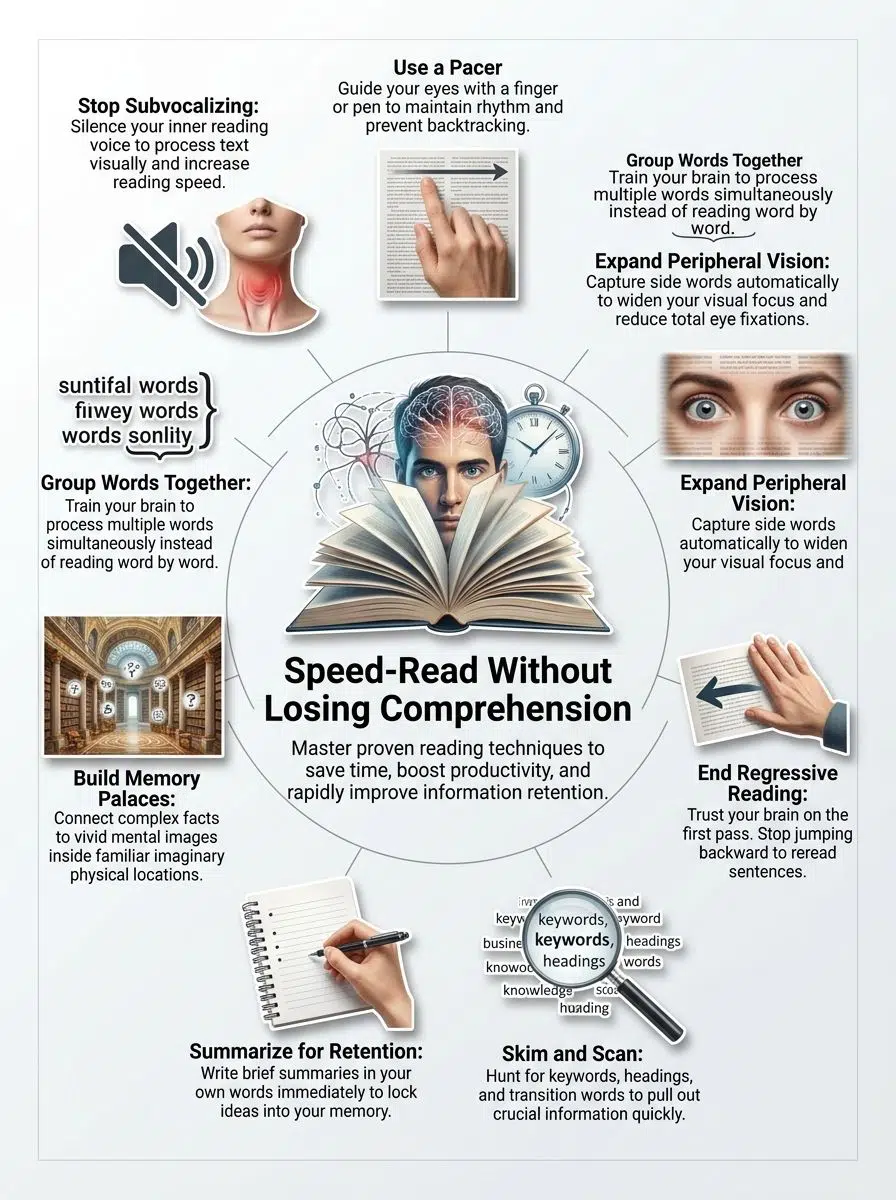
Speed reading is the art of consuming text faster than your normal pace. You do this while keeping your brain engaged with the material. As we mentioned, most adults read non-fiction at about 238 words per minute. Speed readers push that number to 700 or even 1,000 words per minute.
This technique trains your eyes and brain to work together in a new way. You grab information more quickly without sacrificing what you actually understand.
“The more that you read, the more things you will know. The more that you learn, the more places you’ll go.” As noted by Dr. Seuss.
Debunking Speed Reading Myths
Many people think that faster reading means you skip over words and miss important details. This myth stops readers from trying new techniques. The truth is that you do not have to ignore content.
Research proves that comprehension does not vanish when you speed up. A 2021 study evaluated speed readers and found they maintained a strong 68 to 72 percent comprehension rate on non-fiction texts.
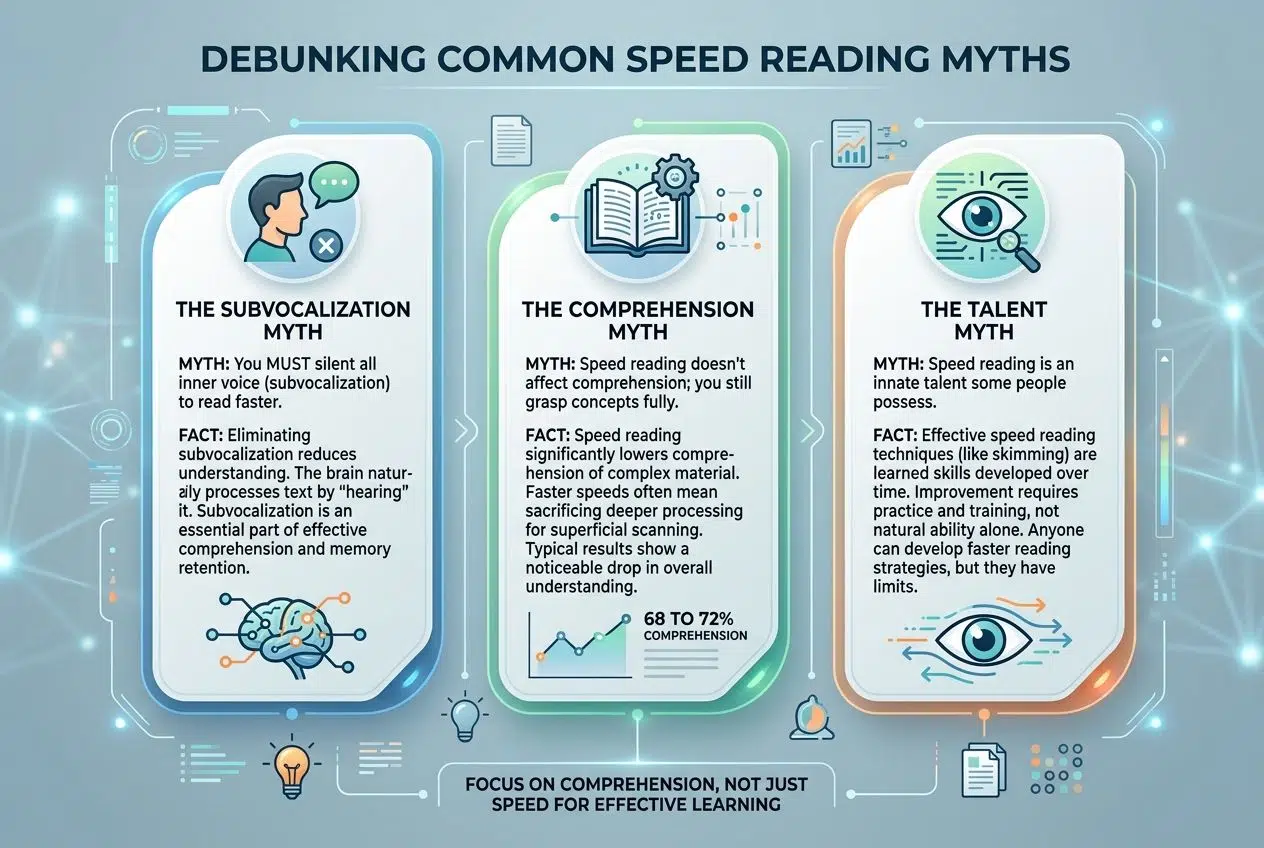
Here are the facts behind common misconceptions:
- The Comprehension Myth: You do not lose understanding. You focus on key ideas rather than filler words.
- The Talent Myth: You do not need a special brain. Anyone can train their eye muscles with consistent practice.
- The Subvocalization Myth: You do not need your inner voice to understand a word. Your brain processes visual information much faster than you can speak.
Your eyes move with intention and purpose across the page. Information retention actually improves when you use specific memory tactics.
Core Principles of Speed Reading
Speed reading works best when you master a few fundamental principles. These core strategies form the foundation that separates casual readers from experts.
Reduce Subvocalization
The mind can process words faster than the mouth can speak them. Silence your inner voice to unlock your reading potential.
Subvocalization is that little voice in your head that reads every single word out loud. Your brain does this naturally, but it slows you down. Cognitive psychologist Stephen K. Reed notes that translating printed words into speech limits how fast we read.
Most readers vocalize at a speaking pace of 150 to 250 words per minute. This caps your reading speed at a hard ceiling. To break free, you need to train your eyes to grab words without your voice chiming in. Try pressing your tongue against the roof of your mouth while reading.
You can also hum softly to occupy your vocal cords. These tactics interrupt the habit and force your brain to process text visually. Start with easier materials like news articles, and then work up to tougher scholarly articles.
Utilize a Pacer Tool
Your eyes move faster than your brain can process, so a pacer tool keeps both in sync. A pacer tool is any object you use to guide your eyes across the page. You can use your finger, a pen, or a stylus on a screen.
Moving your pacer smoothly under each line forces your eyes to follow a steady rhythm. This prevents them from jumping back to words you have already read.
Untrained readers regress, or look backward, about 10 to 15 percent of the time. A pacer tool eliminates these costly backward movements. Try gliding your pacer from left to right at a comfortable pace for one week. Then, gradually increase the speed.
Your brain adapts quickly to this new pattern. Pacer tools work exceptionally well with digital reading apps that highlight text as you move through it.
Group Words for Faster Reading
Grouping words together, also known as chunking, transforms how your eyes move across a page. Instead of reading one word at a time, your brain processes multiple words as a single unit. This technique cuts your reading time in half.
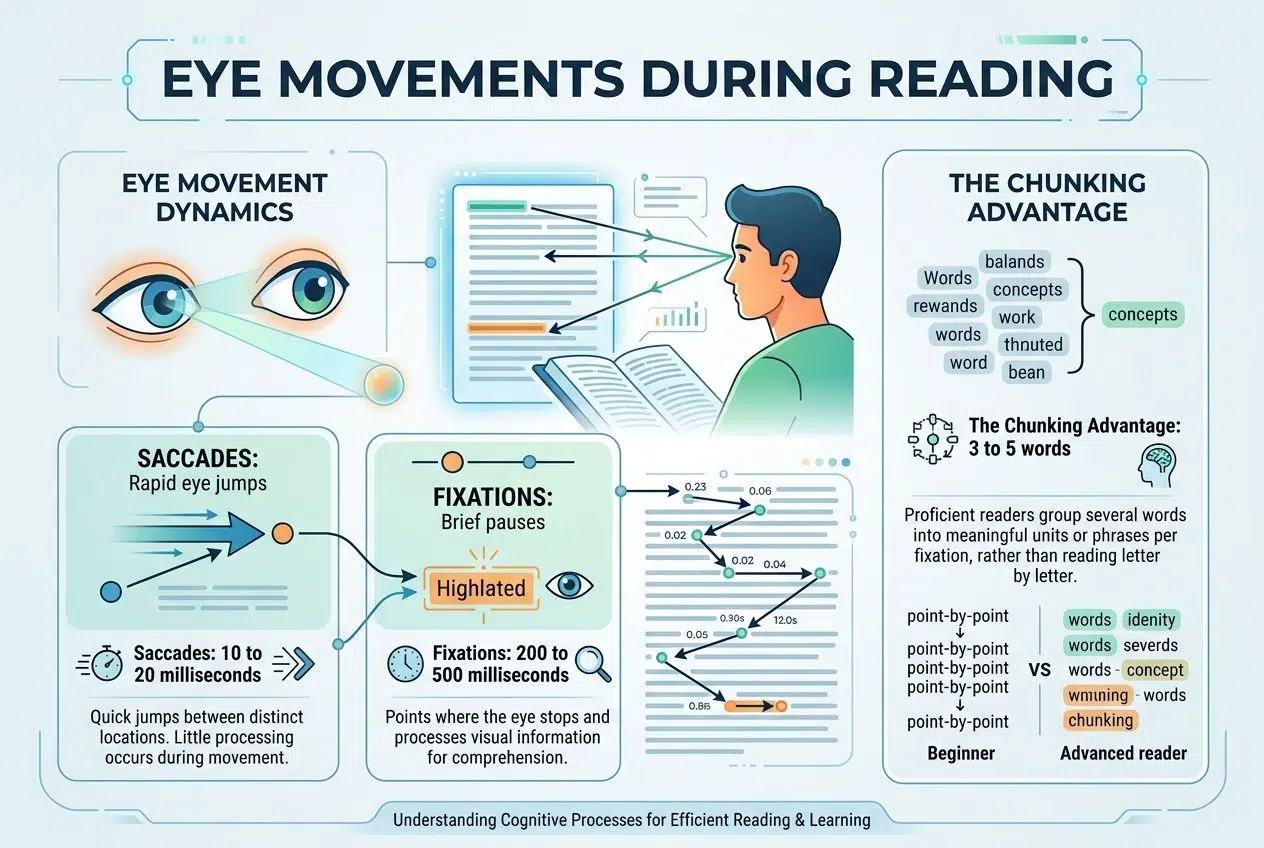
The physical mechanics of your eyes make this possible. Here is how it works:
- Saccades: Your eyes leap across the text in quick movements called saccades. Each leap takes 10 to 20 milliseconds.
- Fixations: Between leaps, your eyes pause for 200 to 500 milliseconds. This is when actual reading happens.
- The Chunking Advantage: Untrained readers fixate on 1 or 2 words. Chunking allows you to grab 3 to 5 words per fixation.
Practice chunking by focusing on the middle of word groups. Read short phrases as one thought, not separate ideas.
Develop Peripheral Vision Skills
Your eyes can take in much more than you think. Most readers focus on one word at a time. Peripheral vision lets you grab words on both sides of your center focus point.
Your brain processes these side words faster than you realize. A normal saccade length is about 7 to 9 characters, but training expands this. With practice, your peripheral vision can catch words across a 1.5-inch span. This equals about ten words at a single glance.
Start by using a pacer tool down the middle of each line. Let your peripheral vision catch words on the left and right without moving your eyes there directly.
Advanced Techniques for Faster Reading and Better Retention
Master advanced methods that transform how you absorb information. You will discover why readers who apply these strategies retain far more data.
Techniques for Skimming and Scanning
Skimming and scanning form the backbone of speed reading. They let you pull out key information fast without reading every single word. These reading techniques work like a metal detector, finding the treasures you actually need.
- Skim the first and last sentences of each paragraph to grab the main idea.
- Scan for specific keywords, names, dates, numbers, or bolded text.
- Move your eyes in a Z-pattern across the page to cover more ground quickly.
- Focus on headings, subheadings, and bullet points.
- Glance at tables, charts, graphs, and images to process data faster than text.
- Identify transition words like “therefore” or “however” to spot shifts in thought.
Use Priming and Visual Guides
Priming and visual guides take your speed reading to a higher level. These tools prepare your brain and guide your eyes efficiently.
- Priming activates your background knowledge before you start reading. Spend two minutes reviewing the title and headings to get a mental preview.
- Use a visual guide, like a pen, to increase your pace and reduce regressive reading.
- Create mental anchors by connecting new information to what you already know.
- Highlight or underline key phrases before you read to prime your attention.
- Use color coding to categorize definitions, examples, or statistics.
- Place a blank card below each line you read to maintain consistent eye fixations.
Mix Different Reading Materials
Mixing different reading materials keeps your brain sharp and flexible. You might read a novel one day and a technical manual the next. Cognitive psychologists call this “interleaved practice.” A 2025 educational study confirmed that interleaving different topics improves long-term learning and skill transfer better than studying one subject endlessly.
Your eyes and mind adapt to different fonts, layouts, and writing styles when you switch materials. This variety strengthens your reading techniques. Fiction teaches you to move quickly, while scientific papers force you to focus on dense information. Diverse materials also prevent reading fatigue and boredom. Your brain stays fully engaged.
Master the U.S.S.R. Speed Reading Strategy
The U.S.S.R. method gives you a powerful framework to boost your reading speed and comprehension skills.
- Survey the text first by scanning the title and summary sections to grasp the main ideas.
- Question yourself about what you want to learn from the material to activate your brain.
- Read the content actively while using your pacing tool to maintain steady eye fixations.
- State the key points aloud or in writing right after finishing each section to lock information into your memory.
Digital Tools to Enhance Speed Reading
Technology transforms how you read faster and retain information. Apps give your brain the power to absorb content at incredible speeds.
Apps and Software for Speed Reading
Speed reading apps put powerful tools right at your fingertips. Many use Rapid Serial Visual Presentation (RSVP) technology to eliminate eye movement.
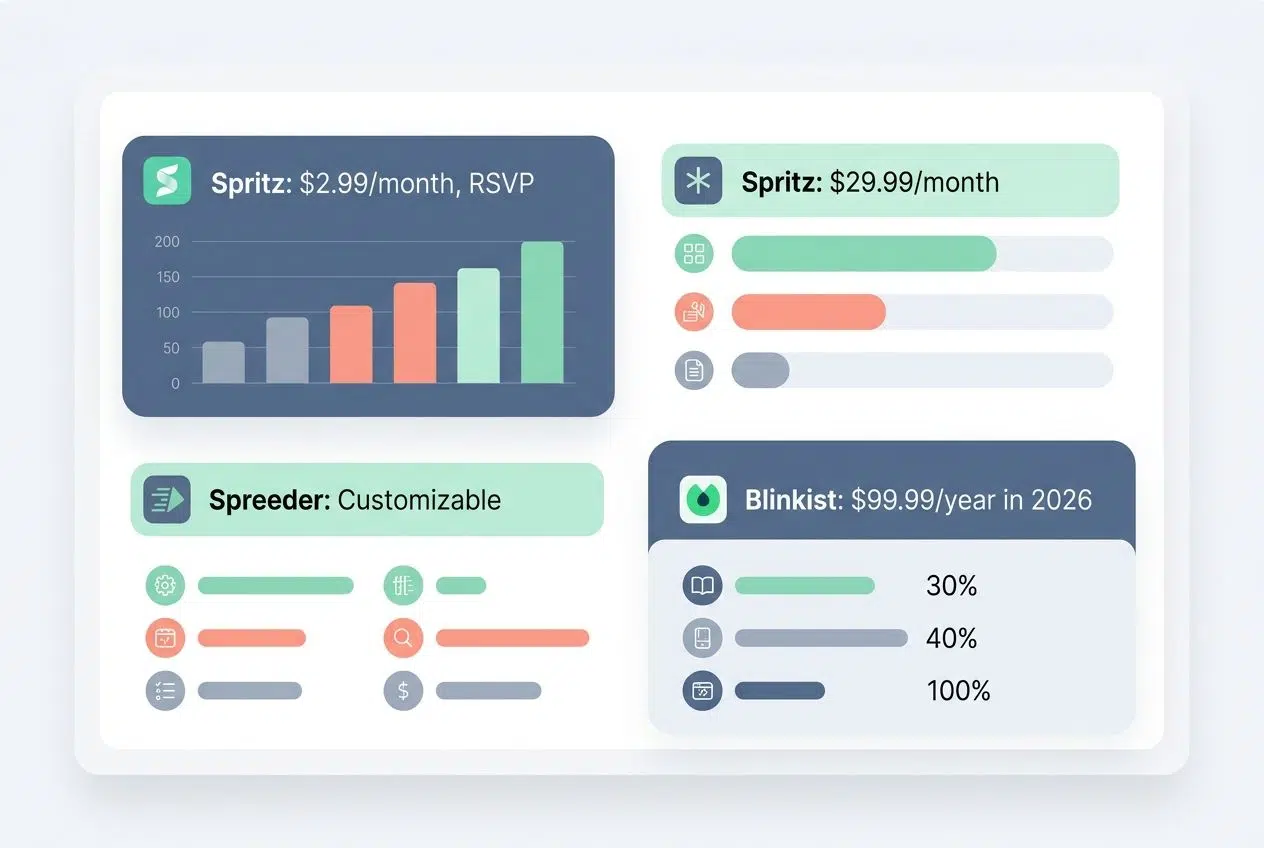
| App Name | Core Features | Pricing & Value |
|---|---|---|
| Spritz | RSVP technology, adjustable word-per-minute rates. | Premium is $2.99/month. Eliminates saccades entirely. |
| Spreeder | Customizable speeds, multiple formats, built-in dictionary. | Great value for pasting your own custom text. |
| Blinkist | Book summaries, audio narration, and topic categorization. | Premium is $99.99/year in 2026. Perfect for rapid learning. |
These tools transform your device into a speed training center. Apps like Spritz push your reading speed into the 1,000 words-per-minute range by flashing single words rapidly.
Enhance Vocabulary with Built-in Tools
Most speed reading apps pack vocabulary builders right into their platforms. These tools flag unfamiliar words as you read. They offer instant definitions without breaking your focus. Checking a physical dictionary ruins your eye fixation rhythm.
Built-in tools lower your cognitive load. Your brain absorbs new terms in context, which sticks far better than memorizing flashcards. The software tracks which words trip you up most. It then reinforces them across future reading sessions.
Monitor Progress with Reading Analytics
Tracking your speed reading progress through analytics gives you real data about your improvement. Most reading apps show your words per minute, comprehension scores, and time spent on different materials. You can see exactly how fast you read fiction versus technical papers. These numbers tell the story of your growth.
Data keeps you honest. If your comprehension drops at 400 words per minute, your analytics will tell you to adjust your pacing.
Your reading analytics act like a personal coach. They point out where you stumble and where you shine.
Practical Exercises for Improved Speed Reading
Your eyes need training just like your muscles do. Grab a book and start working through these drills to transform your reading speed.
Practice Magnetic Eye Fixations
Magnetic eye fixations train your eyes to stop at key words and phrases instead of reading every single word.
- Focus your eyes on the center of each line as you read. Let your peripheral vision catch the words on both sides.
- Place your finger under the words you want to read, moving it smoothly to guide your fixations.
- Start by fixating on every third word. Gradually reduce to every fourth or fifth word.
- Practice this method for ten to fifteen minutes daily to build muscle memory.
- Train your eyes to land on content words like nouns and verbs rather than small filler words.
Engage in Number-Skipping Drills
Number-skipping drills train your eyes to move faster across the page. This exercise builds essential reading speed.
- Start with a page of text that contains many numbers mixed throughout the content.
- Set a timer for two minutes and scan the page from top to bottom.
- Focus only on locating numbers rather than processing other information.
- Circle or highlight each number you find during the drill to keep your focus sharp.
- Repeat this drill three times per week to help your eyes adapt to faster movements.
Strengthen Eye Muscles
Your eyes work hard when you read. Stronger eye muscles help you move faster across pages while keeping your focus steady.
- Perform eye circles by moving your gaze in slow, deliberate circles without moving your head.
- Practice the 20-20-20 rule. Look at something twenty feet away for twenty seconds every twenty minutes.
- Do eye pushups. Focus on a word close to your face, then slowly move it farther away.
- Blink deliberately and fully during reading breaks to refresh your eyes and prevent dryness.
Breaking Poor Reading Habits
Your brain has learned bad reading habits over the years. You need to break them to read faster and retain more information.
Stop Regressive Reading
Regressive reading happens when your eyes jump backward to reread words or sentences. This habit slows you down dramatically. Research shows untrained readers regress 10 to 15 times per 100 words.
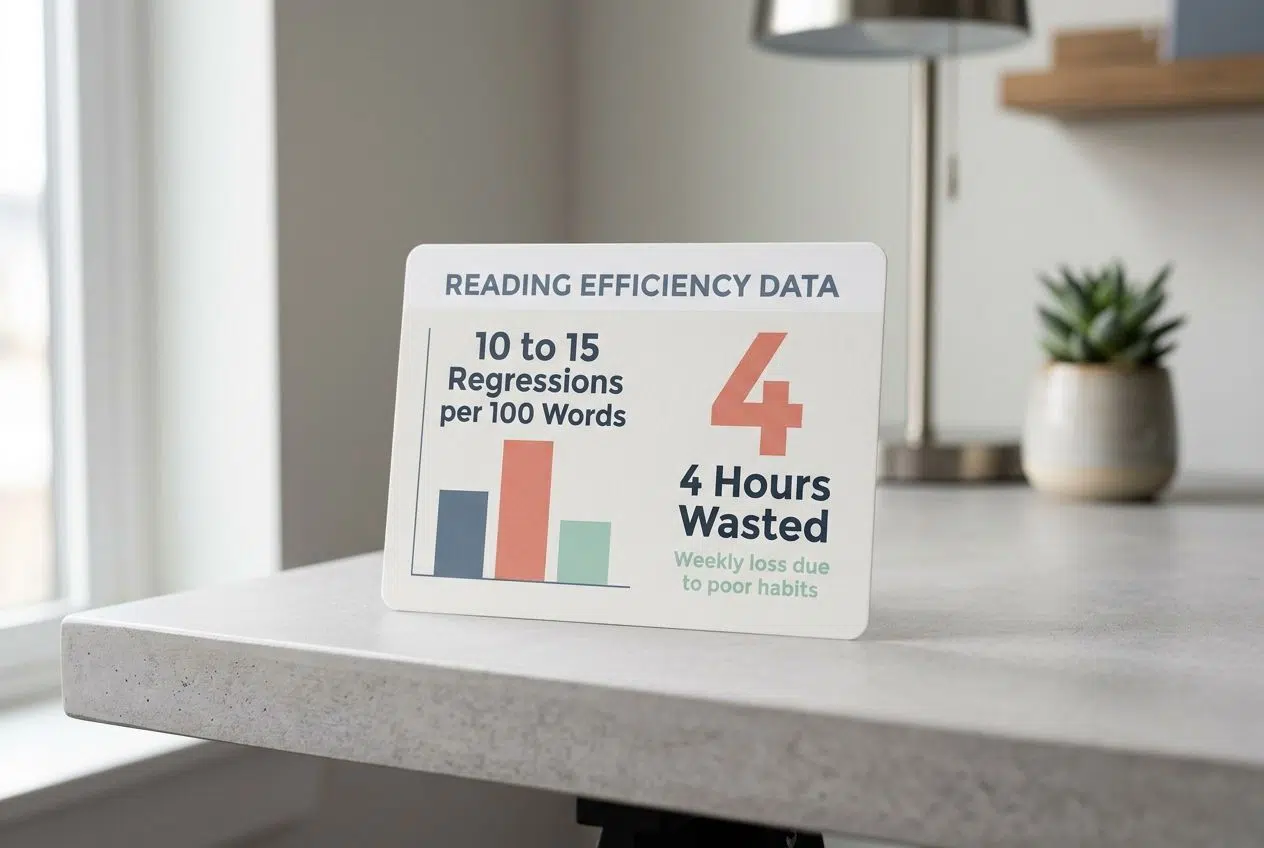
Each regression costs you 200 to 400 milliseconds. Over a 300-page textbook, that adds up to four hours of completely wasted reading time.
Most readers regress out of habit, not necessity. They doubt their comprehension, so they backtrack to check their understanding. Use a pacer tool to guide your eyes forward in one smooth motion. Resist the urge to look back.
Widen Reading Fixation
Your eyes land on one word at a time when you read normally. That habit limits your speed. Widening your reading fixation means training your eyes to take in multiple words in a single glance. Your brain processes information faster than your eyes move across the page. You can grab chunks of text without stopping at each individual word.
Most readers fixate on single words, but you can train your eyes to grab three to five words at once. Consistent practice strengthens your eye muscles over time. Your brain will learn to process larger chunks instantly.
Utilize Full Brain Capacity
Expanding your reading fixation helps you take in more words, but your brain can do even more work. Both sides of your brain hold tremendous power for speed reading success. Engaging both sides transforms how you absorb information.
- The Left Brain: Handles logic, language, and detailed analysis of text.
- The Right Brain: Processes images, patterns, and the big picture of what you read.
- Dual Coding: Combine analytical thinking with visual processing. Picture the concepts you encounter as mental images.
This dual approach strengthens your comprehension while boosting your reading speed.
Memory and Retention Tactics
Your brain holds onto information better when you actively work with it. These tactics transform scattered facts into solid knowledge.
Create Summaries
Summaries act as powerful anchors for your memory. Creating them turns passive reading into active learning. A great approach is the Cornell Note-Taking Method, developed by Walter Pauk in the 1950s. It structures your page perfectly for review.
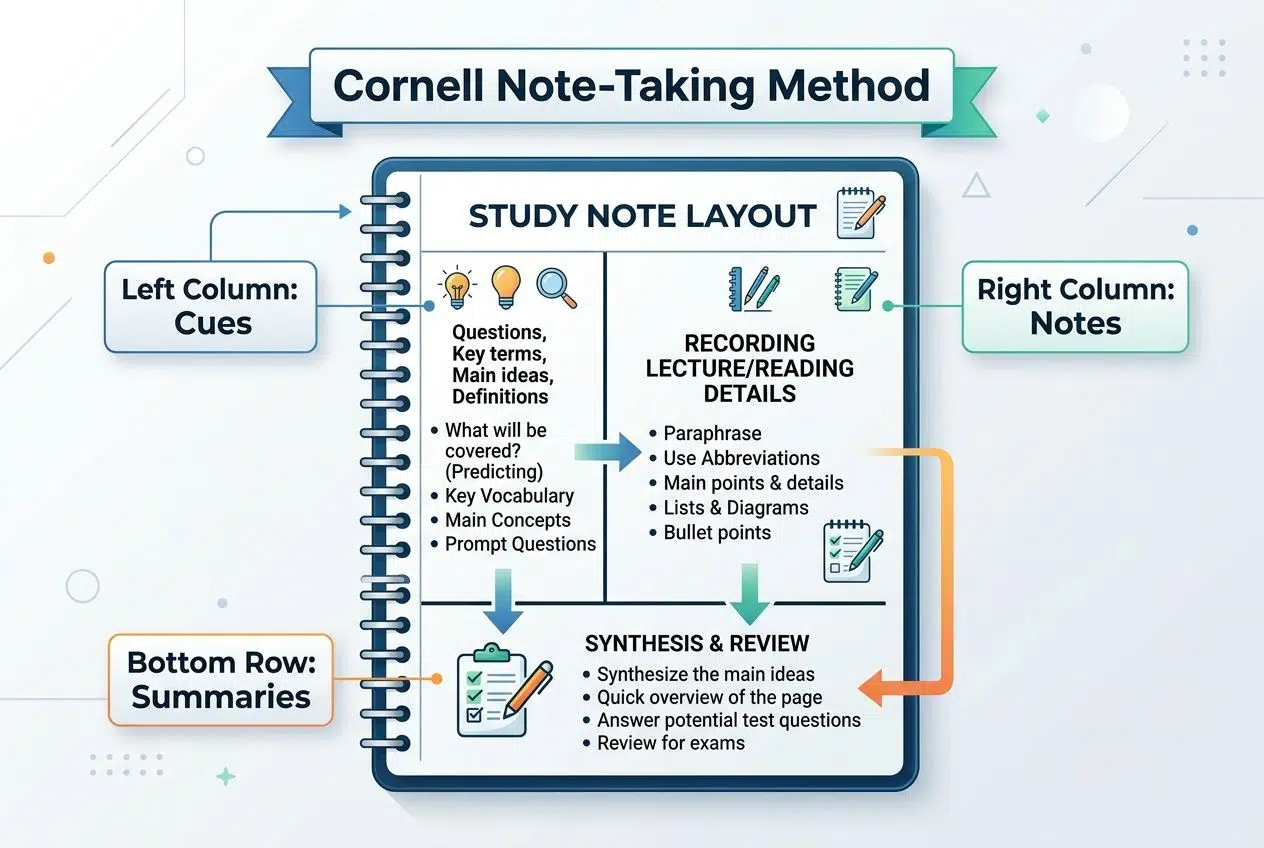
- Divide your page into three sections: a left column for cues, a right column for notes, and a bottom row for summaries.
- Extract the main ideas from each section as you read, capturing only the essential points.
- Write summaries in your own words instead of copying directly from the text.
- Keep summaries brief. Aim for about 25 percent of the original text length.
- Review your summaries immediately after finishing a section to reinforce the information.
Implement the Memory Palace Method
Summaries help you capture key ideas, yet they only record information on paper. The memory palace method, also known as the Method of Loci, elevates your learning by creating mental images you can walk through.
This ancient technique places information inside imaginary rooms in your mind. A 2026 cognitive study showed that memory competitors produce retention rates above 90 percent on large lists after a single session using this spatial memory trick.
Start by choosing a familiar place, like your childhood home. Place one key idea or fact in each room using vivid, strange images. When you need to recall information, you simply take another mental walk through your palace.
Manage Notes Effectively
Good notes transform raw information into tools you can actually use later. Your note-taking system becomes the bridge between fast reading and real comprehension.
- Organize your notes by topic or chapter so you can find information quickly.
- Color-code your notes with highlighters to mark main ideas and supporting details.
- Create abbreviations and shorthand symbols to speed up your note-taking.
- Leave a blank space between your notes to add extra thoughts after you finish reading.
- Review your notes within 24 hours of reading to lock the material into your long-term memory.
Adapting Speed Reading for Various Materials
Different materials demand different approaches. You will need to adjust your strategy based on what you read.
Tackle Scientific Papers
Scientific papers pack dense information into tight spaces. You need a smart reading strategy.
Do not read a research paper like a novel. Start by scanning the abstract, introduction, and conclusion first.
These sections give you the main ideas without forcing you to read every word. Your eyes should move faster through the methods and results sections. Use your peripheral vision skills to catch important numbers, charts, and graphs quickly. Technical terms might slow you down, so build your vocabulary with context clues from surrounding sentences.
Analyze Scholarly Articles
Scholarly articles demand a different reading approach than casual content. Your eye fixations should land on key terms, data points, and topic sentences rather than wandering across every line. Chunking works well here. Group related concepts together as you move through dense paragraphs.
Use visual aids like charts and graphs to grab important information quickly. They often contain the core findings you need. Pacing matters too. Slow down for complex ideas and speed up through familiar material.
Process Long Reports Quickly
Long reports contain data, charts, and sections you can skip entirely. Your eye fixations should land on headers first. This scanning technique lets you grasp the structure before exploring the details.
- Read the executive summary first to understand the main purpose.
- Use visual aids like tables and graphs to extract information faster.
- Break long reports into smaller chunks using the chunking method.
- Practice eye fixations on topic sentences within each paragraph to keep comprehension sharp.
Establishing a Speed Reading Routine
You need to build a speed reading routine that sticks. Your brain learns faster when you practice consistently.
Set Clear Goals
Setting clear goals transforms your journey from a vague hope into a concrete plan.
- Define a specific words-per-minute target, like jumping from 250 to 450 words per minute.
- Establish a baseline by measuring your current reading speed and comprehension level.
- Break your main goal into smaller milestones, such as mastering subvocalization reduction in week one.
- Schedule specific practice times each week. Block out 20 minutes for reading techniques.
Track and Evaluate Progress
Tracking your progress keeps you honest and shows you exactly where you are improving.
- Measure your words per minute weekly to spot real gains in reading speed.
- Record your comprehension scores after each session to catch any drops in understanding.
- Compare your current reading techniques against your baseline scores.
- Note which skimming and scanning strategies produce your best results.
Use Relaxation Techniques
Your reading speed jumps up when you track progress, but tension kills your momentum. Stress tightens your muscles, narrows your focus, and slows down your eye fixations. Relaxation techniques flip this script entirely.
Deep breathing calms your nervous system before you start reading. Try the four-count box breathing method. Inhale for four counts, hold for four, and exhale for four.
This simple practice lowers your heart rate and sharpens your concentration. A calm mind absorbs information faster than a stressed one. Stretching your neck and shoulders prevents fatigue during long reading marathons.
Mastery in Speed Reading
You master speed reading when you adapt your approach to match different authors. Your brain learns to pull meaning from text faster.
Expand Vocabulary Contextually
Your vocabulary grows stronger when you read across different materials and subjects. Speed reading forces you to encounter new words in their natural settings. This helps your brain lock them in place.

Instead of stopping to check a dictionary, grab the meaning from surrounding sentences. This contextual learning sticks with you far longer than memorizing word lists.
Context clues act like breadcrumbs that lead you to word meanings without slowing your pace. Your brain learns faster this way because it connects new vocabulary to concepts you already understand.
Apply Mnemonic Systems
Mnemonic systems act as mental shortcuts that secure information in your long-term memory. These powerful tools change abstract facts into concrete patterns that remain with you for years.
- Form acronyms from the first letters of key concepts to make recall quick and easy.
- Relate numbers to specific shapes or objects that look similar to easily recall statistics.
- Make rhymes or catchy phrases from important terms to turn dry information into something easy to recall.
- Assign colors to different categories of information to help your visual memory retrieve facts.
Adjust to Different Writing Styles
Your reading speed jumps to the next level when you adjust to different writing styles. Fiction reads nothing like a technical manual. A blog post flows differently from a legal document. Your brain needs to shift gears based on what sits in front of you. Dense academic papers demand slower, more careful reading.
Light novels let you move faster through pages. You pick up speed when you recognize these patterns early. Adjust your chunking strategy, too. Group more words together in simple texts, but break them into smaller chunks when technical language appears.
The Benefits of Mastering Speed Reading
Mastering speed reading frees up hours each week. It transforms how you work, learn, and grow in your career.
Time Management and Productivity
Speed reading completely changes how you spend your time. Instead of crawling through pages at a slow pace, you move faster and absorb more information. Most people waste hours reading slowly when they could finish the same material in half the time. Your workday shrinks when you apply reading techniques like chunking.
Productivity skyrockets because you reclaim lost hours for tasks that actually matter. Time management becomes easier when you control your reading pace instead of letting it control you.
Career Advancement and Knowledge Growth
That saved time translates directly into career growth and better opportunities.
- Stand Out at Work: Bosses notice when you digest industry reports faster than your colleagues.
- Become the Expert: You gain knowledge that others miss because you read more material.
- Earn Promotions: Employees who understand complex documents quickly become go-to leaders on their teams.
Knowledge growth compounds over time. The reading efficiency you build today shapes your career trajectory for years ahead.
Manage Information Overload Efficiently
Information floods your screen every single day. Speed reading helps you process massive amounts of data without drowning in it. Your brain can handle more content when you read faster. Skimming and scanning techniques let you filter out noise and grab what matters most.
You control the flow of information rather than letting it control you. This skill transforms how you work through emails and reports. Fast readers manage their time better because they spend less energy on material that does not require deep focus.
Final Words
You have learned practical techniques that actually work. From reducing subvocalization to using visual guides, these methods are simple. They fit right into your daily reading without requiring special equipment.
Mastering how to speed read effectively without losing comprehension will save you hours each week. Your understanding will stay sharp and strong. Start with one technique this week, and track your progress. You will be amazed at what you can achieve. Take action today, and watch your reading speed soar to new heights.
Frequently Asked Questions (FAQs) on How To Speed Read
1. How can I speed-read without losing comprehension?
Start by using your finger or a pen to guide your eyes along each line, a technique that can boost reading speed by up to 25% according to speed-reading studies. Try reading in chunks of 3-4 words at a time instead of word-by-word, and pause every few paragraphs to check if you remember the main ideas.
2. What are some tricks to keep my understanding high while reading fast?
Preview the text first by scanning headings, images, and bold words to give your brain a roadmap of what’s coming. Readers who use this prereading strategy maintain better comprehension at faster speeds compared to those who jump straight in, according to research from Scientific Studies of Reading.
3. Does practicing speed-reading really help me get better?
Yes, practice truly makes a difference! Most people who dedicate 15-20 minutes daily to speed-reading techniques can double their reading speed within about a month while keeping their comprehension steady. Think of it like learning to type without looking at the keyboard, clumsy at first, but it becomes second nature with regular practice.
4. Can anyone learn how to speed-read effectively?
Absolutely! Anyone from middle-schoolers (typically age 11 and up) to adults can pick up these skills with consistent effort, though some people naturally improve faster than others.





















