You spend hours negotiating with vendors, only to walk away wondering if a better deal was possible. It’s frustrating. Leadership demands lower costs. Teams push for better payment terms. Yet every negotiation feels like an uphill battle with little room to win. This challenge is more common than it seems. Many business leaders across the US face the same roadblock when trying to secure stronger supplier agreements.
The turning point comes with a simple shift in strategy: leverage.
When multiple vendor offers are on the table, the balance of power changes. Instead of accepting whatever terms are presented, negotiations become an opportunity to guide outcomes that truly benefit the business.
With the right approach, it becomes possible to stop settling and start negotiating with confidence. Let’s break down the key tactics that help secure better deals and ensure no value is left on the table.
What is Vendor Negotiation?

Vendor negotiation is a back-and-forth conversation between your company and suppliers to reach an agreement on price, terms, and conditions. You talk directly with vendors about what you need, what they offer, and what works best for both sides.
This process covers everything from the cost of goods to delivery schedules, payment terms, and service levels. Smart buyers focus on value creation rather than just cutting costs.
According to a 2025 procurement study by Ardent Partners, US businesses that formalize their vendor negotiation process save an average of 14% on annual spend. That makes a structured approach a direct budget priority.
Here is a quick breakdown of traditional purchasing versus strategic sourcing:
| Approach | Focus | Outcome |
|---|---|---|
| Traditional Purchasing | Lowest immediate price tag | Short-term savings, higher risk |
| Strategic Sourcing | Total cost of ownership | Long-term value, strong partnerships |
Successful vendor negotiation requires the right mindset, thoughtful preparation, and a clear understanding of your objectives from the start. Your goal is to build strong supplier relationships based on trust and open communication.
Importance of Effective Vendor Negotiations
Effective vendor negotiations directly impact your bottom line and working capital. Strong negotiating skills help you lower costs without sacrificing quality or service. Multiple vendor offers on the table give you real power in discussions.
You can compare competitive pricing, terms, and services across different suppliers. This competitive advantage means you make smarter decisions that protect your cash flow.
“Organizations that master fact-based negotiation gain a distinct competitive edge in their industry, improving their financial performance year over year.”
Better rates from suppliers free up money for other business needs. A 2026 Gartner survey of US supply chain leaders shows that 68% prioritize continuous improvement in supplier relationships over simple cost-cutting. Getting bulk discounts and better payment terms reduces your expenses.
Your decision making and problem solving skills grow sharper with each negotiation you complete. Supply chain management becomes easier when vendors trust you and want to work together.
Strategies for Negotiating Better Deals with Vendors
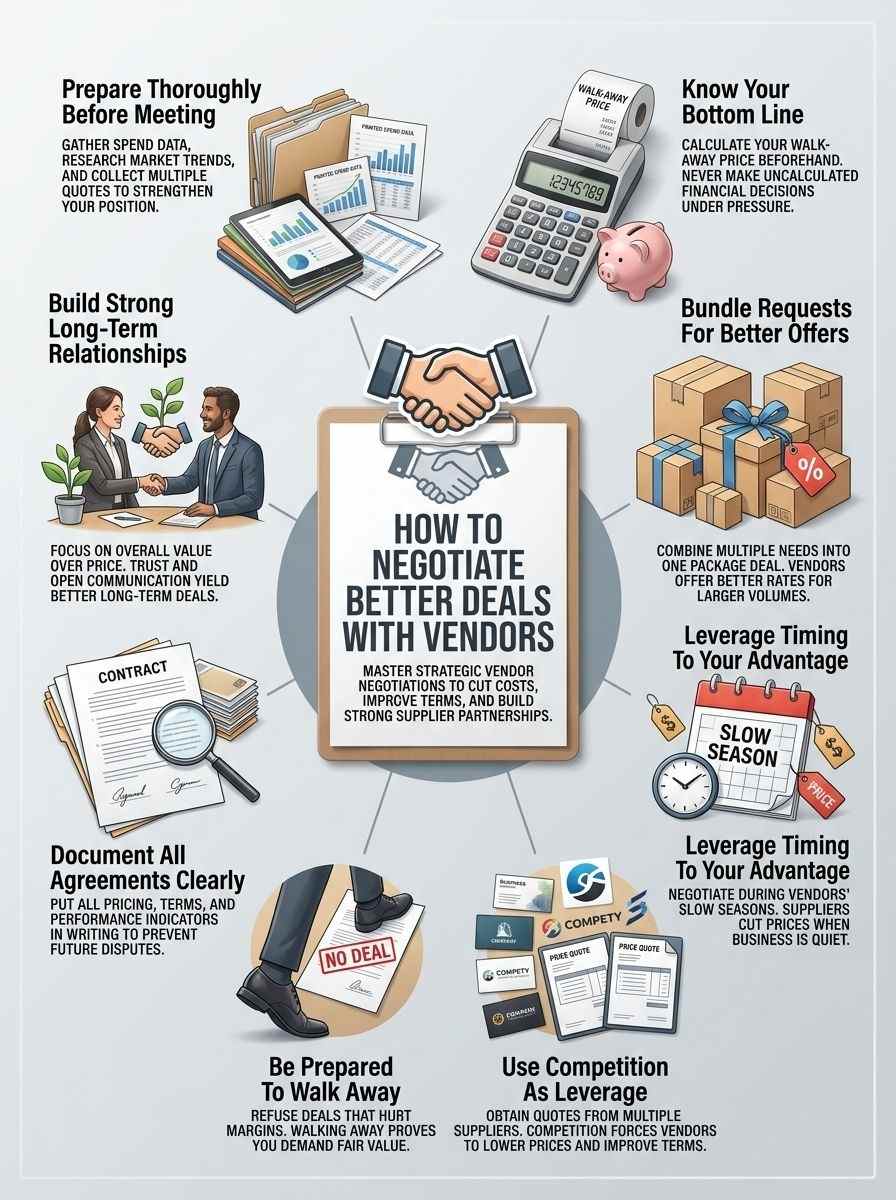
You can turn vendor talks into wins by using smart tactics, building real relationships, and knowing when to push back or walk away.
Prepare Thoroughly
Preparation separates successful buyers from those who leave money on the table. Getting ready ahead of time gives you the confidence and knowledge you need to land better deals. Many top US companies use expense management software like Coupa to track their historical data before talks begin.
- Gather all your current spending data before meeting with any vendor to understand your financial forecast.
- Research market trends in your industry to learn what other US companies pay for similar products or services.
- Collect competitive bids from different vendors simultaneously to increase your leverage.
- Study each vendor’s background, reputation, and performance history.
- List your key performance indicators (KPIs) and specific business goals that matter most to your organization.
- Calculate your bottom line price and walk-away point before any conversation happens.
Know Your Bottom Line
Your bottom line is the lowest price you will accept before walking away from a deal. You must know this number cold before you sit down with any vendor. Calculate your costs, profit margins, and budget constraints first.
Experts in the Harvard Business Review often refer to this as knowing your BATNA, or Best Alternative to a Negotiated Agreement. This gives you a clear boundary that keeps you from making bad decisions under pressure.
Start by doing your homework on market intelligence. Pull multiple quotes from different vendors so you understand what rates actually exist in your industry. You stop being reactive and start being strategic.
Build and Maintain Strong Relationships
Vendors want to work with people they trust. Strong business relationships open doors to better pricing, flexible terms, and priority service.
Trust forms the foundation of integrative negotiation, where both sides win instead of one side crushing the other. Former PepsiCo executive Grace Puma Whiteford often highlights that strategic partnerships require specific actions:
- Treating suppliers as true extensions of your internal team.
- Sharing your long-term business goals openly.
- Providing consistent feedback, not just when things go wrong.
Consolidating your vendor list actually strengthens your position for these long-term relationships. Focus on value creation rather than price alone, and vendors notice the difference.
Bundle Requests for Better Offers
Grouping your requests together gives you real power at the negotiation table. Instead of asking for one small discount here and another small change there, you combine multiple needs into one package deal.
“Smart buyers know that volume is their strongest currency. Bundling transforms a standard purchase into a highly attractive business opportunity for any vendor.”
This bundling strategy works incredibly well in North America retail and manufacturing. Vendors become more willing to drop prices when they know you bring them substantial business.
By consolidating your vendor list and stacking requests, you strengthen your negotiating position significantly.
Be Open to Compromise
Compromise sits at the heart of good vendor talks. You will not get everything you want, and your vendor will not either. This is where the real deal-making happens.
Focus on value rather than price alone, and you will find room to move. Maybe you cannot get the lowest rate, but you can get better payment terms. This is known as compromising negotiation.
Sometimes, an accommodating negotiation style builds goodwill for future deals. A vendor might accept lower profit margins in exchange for a longer contract. The best deals come from conversations where both parties walk away feeling heard.
Leverage Timing to Your Advantage
Timing shapes every negotiation. You gain power when you approach vendors during their slow seasons, when they need sales more than you need their products.
Petros Paranikas, a thought leadership expert from Boston Consulting Group, emphasizes that timing separates good deals from great ones. To maximize your advantage, track these specific market indicators:
- Industry off-seasons when warehouses are full.
- End-of-quarter pushes when vendors need to hit sales quotas.
- Moments when new competitors enter the market.
Your spend analysis reveals the best times to negotiate. Plan major purchases before busy seasons hit.
Use Competition as a Negotiation Tool
Multiple vendor offers give you real power at the negotiating table. Having two or three suppliers competing for your business changes everything.
This competitive pressure pushes them to lower prices, improve terms, and sweeten offers. Distributive negotiation tactics work best when vendors understand you will walk to a competitor if they do not meet your needs.
Compare their pricing, key performance indicators, and service levels side by side. Most vendors will respond by improving their proposal. The competition itself becomes the negotiation strategy.
Be Prepared to Walk Away
Knowing when to step back separates smart buyers from desperate ones. You hold real power when you can walk away from a bad deal. This mindset shifts the entire conversation in your favor.
According to a 2025 US Chamber of Commerce survey, businesses that actively reject poor vendor terms increase their total profitability by 9% annually. Vendors sense desperation and use it against you.
Your profitability depends on refusing deals that increase your financial risk. Walking away teaches vendors that you mean business.
Ensure All Agreements Are Documented
Putting agreements in writing protects both you and your vendors from misunderstandings. Clear documentation forms the backbone of successful vendor contracts.
- Write down every single detail that you and your vendor discussed, including prices and delivery dates.
- Include specific key performance indicators (KPIs) in your vendor contracts so both parties understand exactly what success looks like.
- Specify all payment terms clearly, such as net 30 or net 60 days.
- List all deliverables and services in your documentation with exact quantities and quality standards.
- Record all competitive research and multiple quotes you obtained during your negotiation process.
Addressing Common Challenges in Vendor Negotiations

Vendor negotiations throw curveballs at you, from pushy salespeople to supply chain chaos that makes planning nearly impossible. Knowing how to handle these obstacles is crucial.
Dealing with Aggressive or Difficult Vendors
Aggressive suppliers test your patience and your wallet. Stay calm and professional, no matter what tactics they throw at you. Set clear boundaries from the start.
Alan Weiss, known for his Million Dollar Consulting framework, teaches that successful supplier negotiations require thought and firm boundaries. If a supplier pushes too hard on negotiating fees, pull out your spend analysis.
Coaching & consulting professionals like Jill Tavey stress that you should probe for savings opportunities with vendors directly. Difficult vendors often become your best partners once you prove yourself reliable and reasonable.
Handling Cultural Differences in Global Negotiations
Global negotiations bring teams from different backgrounds to the table. Each culture has its own way of doing business, its own values, and its own communication style.
Bob Tevelson and other experts stress that successful multiparty or team negotiation requires deep cultural awareness. You must learn what matters most to your international vendors:
- Do they value quick decisions or careful, methodical planning?
- Do they prefer written agreements or informal handshake deals?
- Is their communication style direct or highly nuanced?
Business and entrepreneurship leader Dan Belz notes that preparation gives you an edge. You show respect by making the effort, and respect builds trust for better deals.
Managing Negotiations During Supply Chain Disruptions
Supply chain disruptions throw curveballs at vendor talks, and you need to stay sharp. Shortages, delays, and price spikes become the new standard, so your preparation must change.
In what industry experts call the no normal, you must conduct competitive research before chaos hits. Get multiple quotes from different vendors while you still can.
Philip Ideson, a prominent voice in procurement, suggests that consolidating your vendor list sounds backward during disruptions, but it works. You achieve better pricing and terms by putting more volume with fewer trusted partners.
Post-Negotiation Best Practices
Your deal does not end when you shake hands. It starts there. What you do next shapes whether you get real value from that agreement.
Document Agreements Clearly
Clear documentation protects both you and your vendor when disputes arise. Written agreements create a paper trail that holds everyone accountable to what they promised.
- Put everything in writing, even if you discussed terms over the phone or in person.
- Include all pricing details, payment terms, delivery schedules, and quality standards in your written agreement.
- Define quality standards and acceptance criteria so the vendor knows what good enough means for your business needs.
- State the consequences if either party fails to meet their obligations.
- Include contact information for key people at both companies who can answer questions quickly.
Monitor Performance and Compliance
Keeping tabs on your vendors’ performance tells you if they deliver what they promised. You catch problems early and fix them before they hurt your business.
- Track delivery dates closely to see if vendors meet their deadlines.
- Review invoice accuracy regularly to spot billing errors or overcharges before paying.
- Create a scorecard system that rates vendors on speed, quality, price, and communication.
- Verify that vendors comply with all contract terms, industry regulations, and your specific requirements.
- Schedule quarterly business reviews with vendors to discuss performance metrics and address concerns.
Regularly Review and Update Agreements
Your vendor contracts need regular check-ins. Stale agreements leave money on the table and miss new opportunities for better terms.
- Schedule quarterly reviews of all active vendor contracts to catch pricing changes.
- Compare current market pricing against your existing agreement terms to stay competitive.
- Ask your vendor directly about new service options or volume discounts that might have become available.
- Calculate your total cost of ownership with each vendor, not just the per-unit price.
- Update your contract language to reflect current business practices and compliance requirements.
Foster Long-Term Relationships with Vendors
Strong vendor relationships work like a good friendship. They need care, honesty, and regular attention to grow. Trust forms the foundation of these partnerships.
When you treat vendors fairly and pay on time, they notice. They appreciate a partner who values their work. Open communication keeps the business relationship healthy.
Focus on value rather than price alone, and vendors will work with you to lower costs while maintaining the relationship. Regular check-ins show that you care about their success too.
Final Thoughts
You have learned how to prepare thoroughly, know your bottom line, and build strong relationships with vendors who matter to your business. These practical steps work fast. Your negotiating power grows stronger when you gather multiple quotes and understand market pricing.
Taking action today means your company saves money tomorrow, improves supplier terms, and builds partnerships that last for years. Start using these negotiation tactics this week. Watch your bottom line transform as you close better deals than ever before.