
Have you ever lain awake at night worrying about money? Many folks lack access to basic banking services, struggle to get loans, or pay high fees just to manage their cash. The gap between the wealthy and everyone else keeps growing, and it feels unfair. Here is a striking fact. More than 1.7 billion adults worldwide have no bank account, yet most of them own a mobile phone. This simple statistic shows us something powerful. Technology can reach people that brick-and-mortar banks never could.
I am going to show you exactly how artificial intelligence breaks down barriers, cuts costs, and puts financial power in your hands. We will go over real ways technology improves customer service, catches fraud faster, and makes smart money decisions simple.
Grab a cup of coffee, and let’s go through it together. How AI in financial services is more accessible for everyday people.
What is AI in Financial Services?
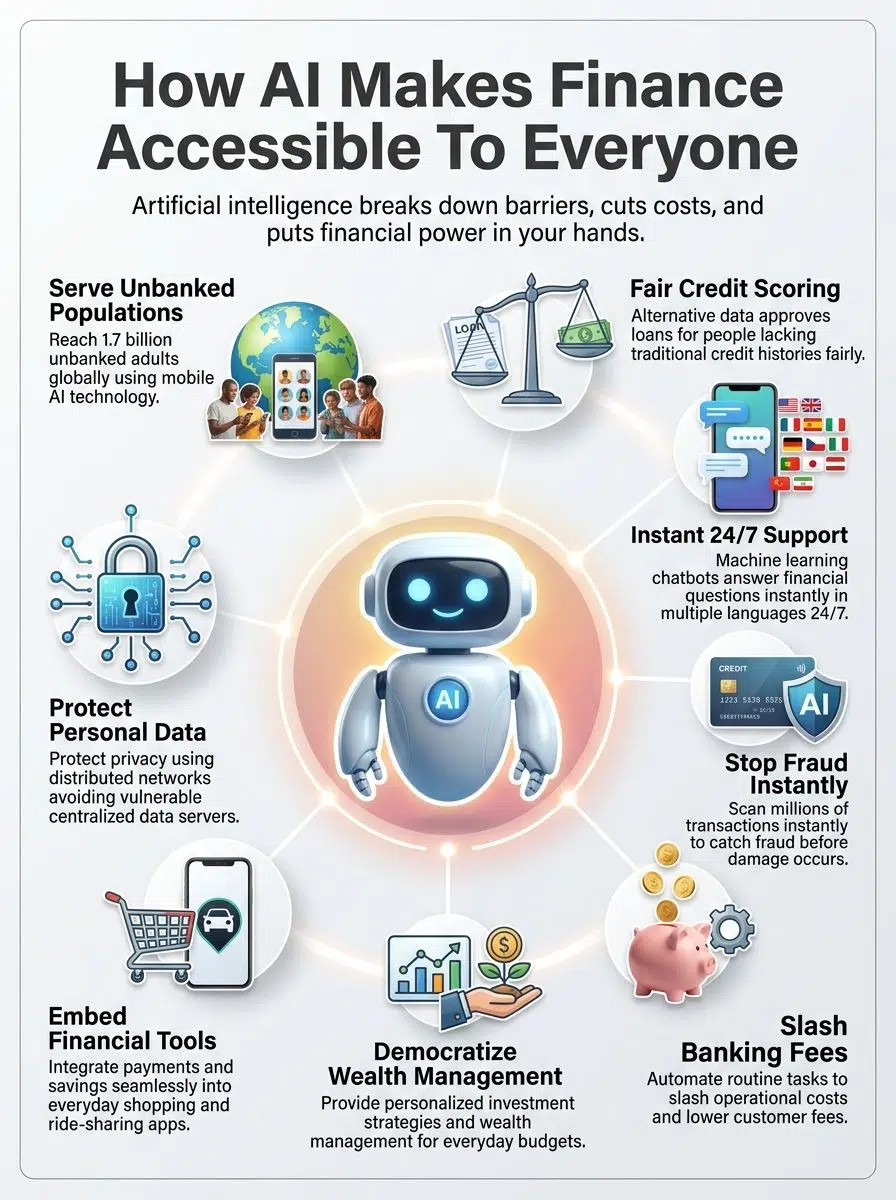
Now that we have set the stage for why financial inclusion matters, let’s look at what artificial intelligence actually does. AI in finance refers to smart computer systems that learn from data and make decisions without constant human input.
To give you an idea of the scale, Bank of America’s AI assistant, Erica, handled an astonishing 169 million interactions in the fourth quarter of 2025 alone. These systems analyze patterns, spot risks, and help banks, insurance companies, and fintech platforms serve customers better.
Financial institutions deploy AI across multiple channels to improve your experience. Here are a few ways they do it:
- Customer Engagement: Natural language processing enables chatbots like Erica to answer your questions instantly, twenty-four hours a day.
- Operations: Computer vision technology reads documents and processes claims faster than any human team could manage.
- Predictive Analytics: AI helps banks forecast market trends and customer behavior with surprising accuracy.
- Risk Management: Systems flag suspicious transactions in real time, protecting your money from fraud.
Automation handles routine tasks like data entry and transaction processing. This frees up staff to focus on complex problems. AI takes mountains of information and transforms it into actionable insights that drive better financial decisions.
Importance of AI in Finance
AI transforms how financial institutions serve people who previously had no access to banking services. Machine learning algorithms make smart decisions fast, turning raw data into actionable insights that drive real results.
Bridging the gap for underserved populations
Millions of people lack access to basic financial services, and artificial intelligence changes this reality. A recent FDIC survey found that 4.2% of US households lack a bank account.
That equals about 5.6 million households. Black and Hispanic adults remain disproportionately unbanked at 10.6% and 9.5%, respectively.
Machine learning algorithms now power digital banking platforms that reach these rural communities, low-income neighborhoods, and developing nations. These systems work around the clock to serve customers whom banks once ignored.
“Mobile apps deliver financial advice to people without traditional bank accounts, making information available to anyone with a smartphone.”
Data analysis tools assess creditworthiness using alternative data sources. This approach opens doors for people with limited financial history. Automation reduces operational costs, so companies pass savings to customers through lower fees and better rates.
Enhancing decision-making with data-driven insights
AI systems analyze massive amounts of financial data in real time, giving decision-makers clear pictures of what is happening right now. These systems spot patterns that humans might miss.
Financial advisors use data-driven insights to recommend better investment strategies. Banks leverage machine learning to assess credit risk more accurately. This shift toward evidence-based assessment opens doors for millions seeking fair financial opportunities.
Lenders approve loans for people with thin credit histories by examining alternative data sources. For example, Upstart’s AI credit model approves 43% more Black borrowers and 46% more Hispanic borrowers than traditional US scoring models.
The benefits of these data-driven insights include:
- Faster Approvals: Upstart reported that 91% of their loans in 2024 were fully automated with no human involvement.
- Fairer Rates: Borrowers often receive significantly lower Annual Percentage Rates (APRs) compared to traditional models.
- Personalized Advice: Underserved populations gain access to tailored financial plans.
The result is faster decisions backed by solid evidence rather than gut feelings alone.
Key Applications of AI in Financial Services
AI transforms how banks, lenders, and investment firms operate every single day. These tools handle everything from spotting fraud in seconds to giving people credit scores they actually deserve.

Customer service and chatbots
Chatbots powered by machine learning handle customer service work around the clock. They answer questions in seconds instead of hours. These digital helpers respond to banking questions, process account requests, and resolve common issues.
For instance, Bank of America clients interacted with their finances digitally a record 30 billion times in 2025. The technology learns from each conversation, getting smarter and better at understanding what you actually want.
Fintech companies use chatbots to bridge gaps for people who lack access to traditional banking services. A customer in a rural area can chat with an AI assistant about loans, savings accounts, or investment options at three in the morning.
These bots communicate in multiple languages, breaking down barriers for immigrant communities. By automating customer engagement, financial institutions reach more people with personalized service.
Fraud detection and prevention
AI systems catch fraud faster than any human team could. These intelligent tools scan millions of transactions every single second, spotting patterns that signal danger.
Mastercard’s Decision Intelligence is a perfect example of this speed. The AI-driven solution evaluates hundreds of data points to flag or approve a transaction in under 50 milliseconds.
Here is why this incredible speed matters for your money:
- Real-time blocks: The system stops the transaction before the funds ever leave your account.
- Massive savings: A recent report found that 42% of card issuers saved over $5 million in fraud attempts between 2023 and 2025 thanks to AI.
- Better experience: It reduces frustrating false declines for honest customers making legitimate purchases.
The system learns what normal looks like for each person, then raises alarms when something feels off. This efficiency improvement makes financial services faster and cheaper for everyone involved.
Credit scoring and risk assessment
Beyond stopping fraud, AI transforms how lenders evaluate creditworthiness and measure financial risk. Traditional credit scoring systems rely on limited data points. This leaves millions of people without credit histories stuck in the shadows.
Machine learning algorithms analyze thousands of data signals, from payment patterns to spending habits. This data analysis approach opens doors for people whom banks previously rejected outright.
Fintech companies now use AI to assess risk in real time, making lending decisions faster and fairer. Upstart’s AI model, for instance, approves borrowers at 38% lower APRs on average compared to traditional underwriting.
These machine learning models catch nuances that human reviewers would overlook. Risk management improves dramatically when AI processes vast amounts of information simultaneously.
Automation of financial workflows
Banks and fintech companies automate financial workflows to save time and money. Robots handle routine tasks like loan processing, payment transfers, and account updates.
The US market for Robotic Process Automation (RPA) in banking is expected to surge from $9.76 billion in 2025 to nearly $75 billion by 2035. This massive investment allows staff members to focus on complex work that needs human judgment.
Customers get faster service, and banks reduce mistakes that come from manual entry. Digital payments move through systems smoothly because automation removes bottlenecks.
Financial inclusion grows when automation makes banking services faster and cheaper to deliver. The technology transforms how banks operate, making customer service better and keeping expenses down.
Portfolio management and investment strategies
AI tools now handle portfolio management in ways that were impossible just years ago. Machine learning algorithms analyze thousands of stocks, bonds, and other investments in seconds.
Robo-advisors use AI to build personalized portfolios for everyday investors. They adjust holdings based on market changes and your financial goals. This automation cuts costs dramatically, so more people can afford professional-level guidance.
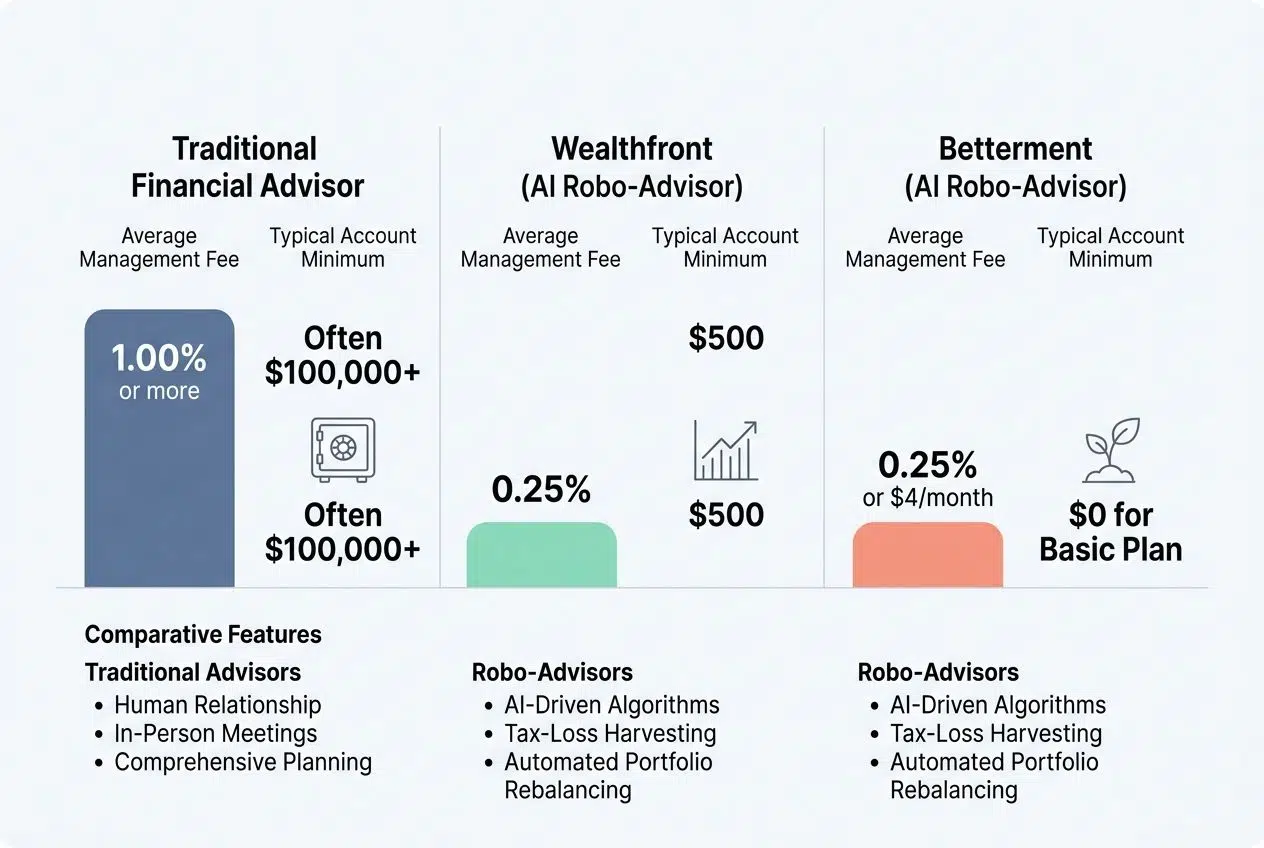
Digital transformation in investing means you get expert-quality management without paying high fees. A quick comparison of popular US robo-advisors versus traditional advisors shows the financial difference:
| Service Type | Average Management Fee | Typical Account Minimum |
|---|---|---|
| Traditional Financial Advisor | 1.00% or more | Often $100,000+ |
| Wealthfront (AI Robo-Advisor) | 0.25% | $500 |
| Betterment (AI Robo-Advisor) | 0.25% or $4/month | $0 for Basic Plan |
Fintech companies leverage machine learning to forecast market trends with greater accuracy. Your investment strategy adapts automatically as conditions shift, protecting your money from unnecessary risks. Real-world results show that AI-driven strategies help ordinary people build wealth steadily.
Insurance underwriting and claims processing
Artificial intelligence transforms insurance underwriting by analyzing massive amounts of customer data in seconds. Insurance companies now use machine learning to assess risk profiles and lifestyle factors with incredible speed.
Traditional underwriting took weeks or months to complete. AI systems finish the same work in hours, sometimes minutes. This acceleration means customers get faster approvals and better rates.
Claims processing represents another area where automation delivers real results. Lemonade’s AI claims bot, known as AI Jim, holds a world record for settling a claim, checking policies, and running anti-fraud algorithms in just two seconds.
Machine learning models spot suspicious patterns that signal potential fraud before money leaves the company’s account. This data analysis protects both insurers and honest customers from losses. The entire process moves faster, so people get their money when they need it most.
How AI is Enhancing Accessibility in Financial Services
AI transforms how people access financial services by personalizing recommendations, catching fraud instantly, predicting market trends, and embedding banking tools directly into everyday apps.
AI-driven personalization for financial inclusion
AI learns your money habits and creates financial plans just for you. Machine learning algorithms study how you spend, save, and invest, then offer advice that fits your life.
The Cleo app is a great example of this. It acts as an AI money coach for Gen Z and Millennials, analyzing nearly 82 million user transactions every day to provide hyper-personalized budgeting advice.
This personalization breaks down barriers that kept many people out of traditional finance. A single parent in a rural area accesses the same quality financial advice as someone in a major city.
Low-income workers get credit scores that reflect their actual payment history. Mobile apps deliver personalized recommendations instantly, without expensive meetings or paperwork.
Real-time fraud detection at scale
Fraud happens fast, and banks need to catch it faster. Machine learning systems scan millions of transactions every single second, spotting patterns that humans would miss.
These AI-powered tools flag suspicious activity the moment it occurs, not days later.
“Real-time fraud detection transforms how banks manage risk and keep data safe. The technology learns from past fraud cases, then applies those lessons to new transactions instantly.”
Financial services companies save millions of dollars by stopping fraudulent charges before they are completed. Customers feel more confident using digital payments when they know their accounts have this protection. Operational efficiency skyrockets because staff members spend less time investigating suspicious activity.
Predictive analytics and forecasting for better decision-making
Predictive analytics transforms how people make financial choices. AI systems analyze massive amounts of data from past transactions, market trends, and customer behavior to spot patterns humans might miss.
These tools forecast future outcomes with impressive accuracy. Financial advisors use these insights to guide clients toward smarter decisions.
Lenders approve loans faster because AI evaluates risk in seconds instead of days. This technology puts financial advice within reach for everyday people. Small fintech companies compete with large institutions because AI levels the playing field.
Embedded finance for seamless user experiences
Embedded finance puts financial tools right where customers shop, work, and spend their time. The US embedded finance market reached an estimated $115.66 billion in 2025, proving how popular these tools have become.
Your favorite shopping app now offers instant payment options through services like Affirm or Apple Pay Later. These experiences happen without jumping between different websites or apps.
AI powers this magic by connecting financial services to everyday moments. The system offers credit options at checkout, insurance during booking, or savings tools while browsing.
Here is how embedded finance improves your daily life:
- Frictionless Checkout: You get what you need fast, without confusion.
- Targeted Offers: AI analyzes user behavior and suggests the right financial product at the exact right time.
- Better Security: Risk management gets stronger as AI spots fraud patterns that humans might miss.
Benefits of AI in Financial Services
AI cuts costs and speeds up operations across the entire financial industry. Better decisions, fewer mistakes, and happier customers follow when companies put AI to work.
Increased efficiency and cost savings
Automation powered by machine learning cuts operational costs significantly. Banks and fintech companies reduce manual work through AI-driven workflows.
Staff members focus on complex tasks instead of repetitive data entry. Customer service chatbots handle thousands of inquiries simultaneously, slashing response times from hours to seconds.
Financial institutions save millions annually by streamlining back-office operations. Digital transformation through automation means fewer errors, faster processing, and happier teams working smarter. Operational efficiency translates into real money staying in your pocket.
Improved decision-making and accuracy
AI tools transform how financial professionals make decisions every single day. These systems analyze massive amounts of data in seconds, spotting patterns that humans would miss.
Banks now use AI to evaluate loan applications with greater precision than ever before. The technology cuts through noise and delivers clear, actionable insights.
Accuracy improves dramatically when AI handles repetitive assessment tasks. Risk management becomes sharper because AI identifies potential problems before they spiral out of control. The bottom line is simple: Smarter choices lead to stronger financial health.
Enhanced customer experience
AI systems transform how customers interact with their banks and financial companies. Chatbots answer questions instantly, 24/7, without making customers wait on hold.
Bank of America reported that 94% of its client interactions were fully digital in 2025. Real people get personalized product suggestions based on their spending habits and financial goals.
These AI systems provide three main benefits for users:
- Instant Answers: Chatbots operate around the clock without frustrating hold times.
- Personalized Suggestions: Users get product recommendations based on their exact goals.
- Faster Processing: Automation handles routine account updates instantly.
Broader financial inclusion
Millions of people lack access to basic banking services, but artificial intelligence changes this reality. Machine learning algorithms evaluate credit histories in new ways, allowing banks to serve customers whom traditional scoring methods reject.
As mentioned earlier, bringing the 5.6 million unbanked US households into the financial system is a massive priority. Fintech companies deploy digital payments and mobile banking through AI, reaching rural communities and low-income populations.
This shift opens doors for underbanked populations to build credit, save money, and invest in their futures. Financial inclusion transforms lives when technology meets opportunity. Innovation in banking means someone in a small town has the exact same tools as someone in a major city.
Challenges and Risks of AI in Finance
AI systems can make mistakes that hurt people’s finances, and companies must work hard to keep customer information safe from hackers. Regulators demand clear rules about how financial companies use these powerful tools.
Data privacy and security concerns
Financial companies collect massive amounts of personal data every single day. Your bank account details, credit history, and spending habits all live in digital systems.
Hackers and criminals constantly target these systems to steal information. In 2025, US data breaches reached a record high of 3,322 incidents, with the financial services sector suffering the most attacks.
Financial institutions must protect this sensitive information with strong security measures. The stakes are incredibly high, as the global average cost of a data breach rose to $4.88 million in 2024.
Companies use encryption, firewalls, and multi-factor authentication to keep data safe. Yet, no system is completely foolproof. Banks and fintech companies must balance innovation with protection, investing billions in cybersecurity infrastructure.
Bias in AI algorithms
AI algorithms can pick up biases from the data they learn from, and this creates real problems for financial inclusion. If training data reflects past discrimination, the machine learning system will repeat those same mistakes.
For example, an AI credit scoring model might deny loans to certain groups simply because those patterns existed before. This perpetuates inequality and keeps underserved populations from accessing financial services.

To combat this, the US Consumer Financial Protection Bureau (CFPB) approved a new rule in 2024.
“The CFPB requires companies using algorithmic appraisal tools for mortgages to put strict safeguards in place to comply with nondiscrimination laws. The phrase ‘the algorithm decided’ is no longer a legal defense.”
Diverse teams building these systems help spot problems that homogeneous groups might miss. Addressing bias is essential for true financial inclusion and customer engagement.
Regulatory compliance and governance issues
Financial institutions face serious pressure to follow strict rules about AI use. Regulators worldwide want companies to explain how their machines make decisions, especially when those decisions affect customers’ money or credit scores.
Banks must prove their AI systems treat all groups fairly, and they need clear records of everything their technology does. This creates a heavy load for compliance teams, who must track data flows and audit algorithms regularly.
Governance issues add another layer of challenge. Companies struggle to decide who owns the AI decisions and who takes responsibility when things go wrong. A single mistake in compliance can cost millions in fines and destroy customer trust.
Future Trends in AI and Financial Accessibility
AI keeps pushing forward with fresh tools that make money management simpler for regular people. Financial services will shift dramatically as machines learn to handle complex tasks, reduce costs, and open doors for millions.
Advanced generative AI applications
Generative AI tools are transforming how financial institutions serve customers. These systems create personalized financial advice at scale, something that was once impossible.
Morgan Stanley rolled out an OpenAI-powered assistant called Debrief to its 16,000 financial advisors in 2024. This tool takes meeting notes, drafts emails, and increases document retrieval efficiency from 20% to 80%.
Customer service teams deploy these applications to answer questions about accounts, loans, and digital payments without human intervention. These advanced applications democratize financial advice, bringing professional-grade analysis to everyday users.
Autonomous AI agents for end-to-end workflows
Autonomous AI agents handle entire financial processes from start to finish without human intervention. These agents work around the clock, processing loan applications, managing digital payments, and handling customer service requests all at once.
They learn from each transaction and improve their performance over time. Financial institutions deploy these agents to cut operational efficiency costs while speeding up service delivery.
The benefits of autonomous agents include:
- Faster Approvals: Customers receive quicker responses across all touchpoints.
- Reduced Human Error: Automation eliminates bottlenecks in data entry.
- Better Resource Management: Banks serve more customers with fewer resources.
Decentralized AI for privacy and security
Decentralized AI systems put power back into your hands, rather than storing sensitive financial data on centralized servers that hackers love to target. These systems spread data across multiple locations, making it far harder for bad actors to access your information all at once.
Your financial details stay protected because no single point of failure exists. Machine learning models run on your device or across distributed networks.
This approach transforms how fintech companies handle customer data, giving you real control over your privacy. Blockchain technology often works alongside decentralized AI, creating additional layers of protection for your transactions.
Green finance with sustainability-focused AI
AI technology now powers green finance solutions that help companies measure and reduce their environmental impact. Machine learning algorithms analyze massive amounts of data to identify carbon emissions and track sustainability metrics.
Financial institutions leverage this innovation to offer investment products that support eco-friendly businesses. Automation streamlines the process of evaluating companies based on their environmental performance, making it easier for investors to align their money with their values.
This digital transformation means that accessibility to sustainable investing reaches everyday people. Risk management tools now assess environmental factors alongside traditional financial metrics.
The Closing Thoughts
Financial services stand at a crossroads, and artificial intelligence holds the keys to opening doors that were previously locked. Machine learning algorithms spot fraud in seconds, chatbots answer questions around the clock, and automation handles paperwork that once buried employees.
Fintech companies leverage these tools to serve people in rural areas, low-income neighborhoods, and developing nations who have never had access to traditional banking. Technology has shifted from a luxury to a necessity. The journey toward true financial accessibility has just begun, and the tools to get there are already here.
Frequently Asked Questions (FAQs)
1. How does AI help people use financial services more easily?
AI speeds up everything from simple account setups to getting instant loan approvals through tools like Upstart, which saw a 41 percent jump in personal loan originations in late 2025. Because of this success, 83 percent of US lenders are boosting their AI budgets in 2026 to make your everyday money management even smoother.
2. Can AI make it safer for everyone to handle their money?
Yes, smart programs actually saved 42 percent of banks over $5 million in fraud attempts recently by spotting odd spending instantly. Right now, 99 percent of US financial organizations use AI to watch your back, so your cash stays much safer from scams.
3. Does AI give advice about saving or investing money?
Absolutely, because these systems act like a brilliant financial guide right in your pocket. Popular US robo-advisors like Wealthfront use AI to instantly analyze your goals, and as of late 2025, over 63 percent of human financial advisors also use AI tools to build you a better plan.
4. Will using AI in finance cost me extra?
Usually, it actually saves you money since traditional human advisors might charge up to 3 percent in fees, while AI-powered robo-advisors typically only charge around 0.25 percent per year, and most everyday banking AI features are completely free.