Most founders hit a revenue ceiling because they treat their business like a demanding freelance job. You bring on more clients, hire a few freelancers, and suddenly you spend your entire weekend fixing mistakes and answering emails. Throwing more people at a broken process just creates a bigger mess. If you want to scale your operations, increase your profit margins, and eventually take a vacation without your phone ringing, you need to completely overhaul your internal workflows.
You have to learn how to systemize an agency so the work gets done perfectly whether you are sitting at your desk or not. This guide breaks down the exact steps to pull the operational knowledge out of your head and build a predictable, scalable machine.
1. Conduct a Comprehensive Operational Audit
Before you change a single workflow or buy new project management software, you need a clear picture of how your team currently operates. Founders often assume they know how work gets delivered, but employees usually build their own hidden shortcuts and side processes. You need to map out the reality of your daily operations to find where time is bleeding out of your company. This operational audit acts as your baseline truth. It highlights the bottlenecks that eat up your profit margins and frustrate your clients. Here is a breakdown of the core areas you need to evaluate immediately.
| Audit Area | What to Look For | Common Bottlenecks |
| Lead Generation | How prospects enter your pipeline | Manual data entry, slow response times |
| Client Onboarding | The first 30 days of the relationship | Missing assets, confusing kickoff calls |
| Service Delivery | Executing the actual creative work | Endless revisions, unclear task delegation |
| Administration | Invoicing, payroll, and reporting | Overdue payments, messy spreadsheets |
Once you understand the broad areas of your business, you have to dig into the microscopic daily tasks that consume your team’s energy.
Documenting Recurring Workflows
You cannot fix a process if you do not know it exists. Ask your entire team to track their time meticulously for two straight weeks. Have them write down exactly what they do, which tools they use, and where they get stuck waiting for approvals. You will likely discover that your highly paid graphic designers spend hours hunting down logos in email threads, or your account managers waste half their day doing data entry. Take this raw data and draw out the actual lifecycle of a client project on a whiteboard. Map it from the moment a contract gets signed to the final deliverable. You will instantly see duplicate efforts and unnecessary steps. Cut the fat immediately. This exercise moves the hidden knowledge out of individual heads and turns it into tangible data you can actually manage.
Best for: Discovering exactly where your team wastes time and loses money on a daily basis.
Why We Chose It: You need hard data to make smart decisions about restructuring your company.
Things to consider: Team members often hate time tracking, so you need to explain that this is about fixing broken systems, not punishing them.
2. Establish Standard Operating Procedures (SOPs)
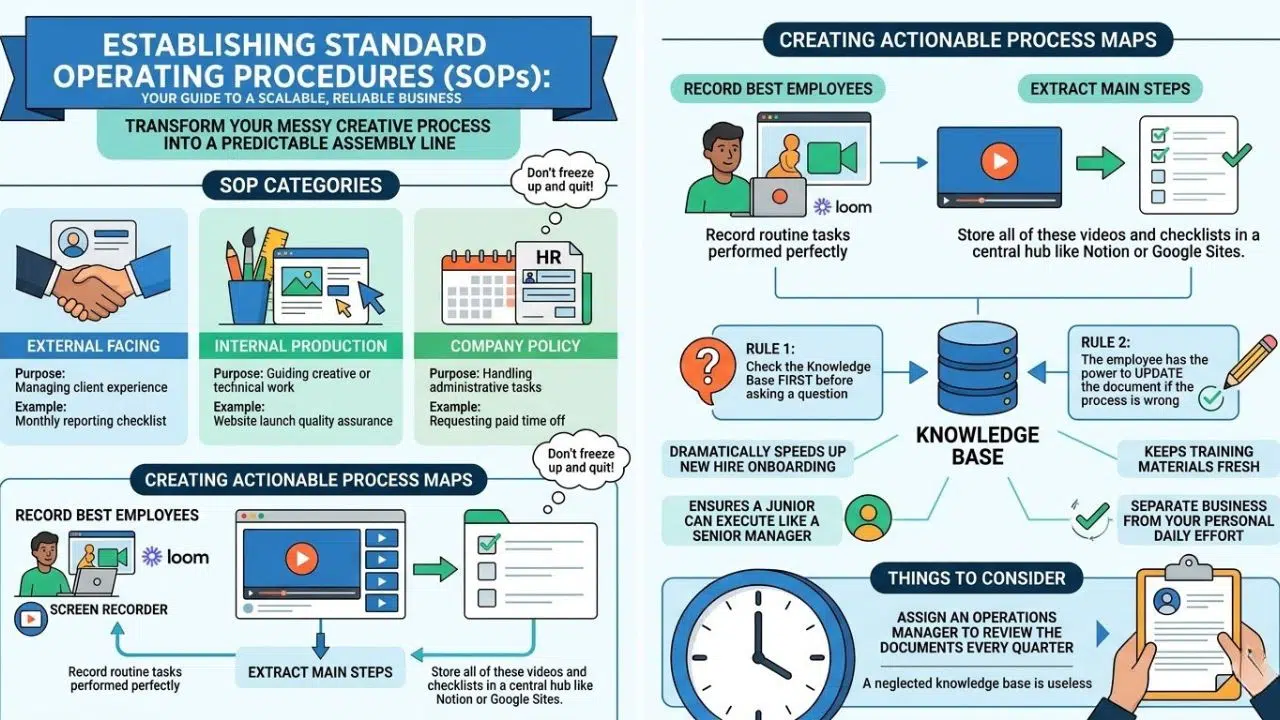
When you know what your team actually does, your next job is to figure out the absolute best way to do it. You cannot scale a company if every single employee handles client work differently. A lack of consistency destroys client trust and creates a nightmare for your quality control. You have to write down the rules for how your company operates. Standard operating procedures turn your messy creative process into a predictable, reliable assembly line. Look at the primary types of documentation you need to create right away.
| SOP Category | Purpose | Example Document |
| External Facing | Managing the client experience | Monthly reporting checklist |
| Internal Production | Guiding the creative or technical work | Website launch quality assurance |
| Company Policy | Handling administrative tasks | Requesting paid time off |
Writing these documents down is where most agency owners freeze up and quit.
Creating Actionable Process Maps
Nobody wants to read a thirty-page text document about how to upload a blog post. If your SOPs look like old corporate manuals, your team will ignore them. You need to make your process maps highly visual and incredibly easy to follow. Tell your best employees to record their screen using a tool like Loom the next time they perform a routine task perfectly. Take that video, pull out the main steps, and turn them into a simple checklist. Store all of these videos and checklists in a central hub like Notion or Google Sites. Make it a company rule that before anyone asks a question, they have to check the knowledge base first. If the process is wrong, the employee has the power to update the document. This keeps your training materials fresh and dramatically speeds up how fast you can onboard new hires.
Best for: Ensuring a junior employee can execute tasks with the same quality as a senior manager.
Why We Chose It: Documented processes are the only way to separate your business from your personal daily effort.
Things to consider: A neglected knowledge base is useless, so assign an operations manager to review the documents every quarter.
3. Implement Project Management and Automation Tools
Writing down your steps is just the foundation. Now you need to enforce those steps using the right technology. Running an agency through messy email chains, instant messaging, and isolated spreadsheets guarantees that things will fall through the cracks. You need one central hub where all work lives and breathes. Once the work is organized in one place, you can use automation to handle the boring, repetitive tasks that drain your team’s energy. Here is how you should categorize your technology stack.
| Software Type | Primary Function | Agency Example |
| Project Management | Task delegation and deadline tracking | Asana, ClickUp, Monday.com |
| Communication | Internal team chat and client updates | Slack, Microsoft Teams |
| Workflow Automation | Connecting tools to remove manual entry | Zapier, Make |
Buying the software is the easy part. Forcing your team to abandon their old habits and actually use the tools correctly is the real challenge.
Centralizing Agency Communication
You have to declare absolute zero tolerance for shadow communication. If a client emails a revision request, it must be moved into your project management software immediately. Every task needs a clear owner, a strict due date, and all the necessary context attached to it. When you achieve this level of centralization, you can start building automations to systemize an agency workflow naturally. Think about the client onboarding process. You can set up a system where the moment a client signs a proposal, the software automatically creates a Google Drive folder, populates an onboarding task list in Asana, and triggers a welcome email. Your team does not have to click a single button. By stripping away the administrative heavy lifting, your team can handle twice as many clients without feeling overwhelmed or missing a deadline.
Best for: Eliminating human error during repetitive handoffs and administrative tasks.
Why We Chose It: Software works 24/7, never complains, and executes processes exactly the same way every time.
Things to consider: Buying too many tools at once will overwhelm your staff and lead to terrible adoption rates.
4. Restructure Your Service Offerings
You cannot build a reliable machine if the parts keep changing. If you say yes to every random, customized request a prospect makes, you will never achieve operational efficiency. Custom work kills your profit margins because your team has to figure out how to deliver the service from scratch every single time. To grow predictably, you need to narrow your focus and sell standardized packages. Here is how custom services compare to a productized model.
| Feature | Custom Services | Productized Services |
| Scoping | Takes hours of back-and-forth negotiation | Predetermined and clearly defined |
| Pricing | Hourly rates or unpredictable project fees | Flat monthly retainers or fixed rates |
| Fulfillment | Requires expensive, senior generalists | Executed by focused, efficient specialists |
Shifting away from custom work requires you to completely change how you position and sell your agency.
Productizing Your Services
Instead of pitching yourself as a full-service agency that can do everything, package your specific expertise into a clear product. Sell a defined outcome for a specific target audience. For example, do not sell general SEO services. Sell a specific content velocity package for SaaS companies. When you lock down exactly what the client gets and exactly what it costs, you instantly streamline your sales cycle. Prospects know what they are buying without needing four pitch meetings. More importantly, standardizing the output allows you to standardize the input. You can hire specialists who only write copy or only run Facebook ads, rather than hunting for expensive unicorns who can do a little bit of everything. Your service delivery becomes faster, your quality goes up, and your margins expand significantly.
Best for: Generating predictable, recurring revenue while making the sales process incredibly simple.
Why We Chose It: You can only scale a process if the deliverables remain identical from client to client.
Things to consider: You will have to say no to prospects who want custom work, which feels scary at first.
5. Build a Leadership Layer to Systemize an Agency
You can build the best SOPs and buy the most expensive software in the world, but your business will still hit a wall if you make every decision. If you are the person approving every design and putting out every client fire, you are the biggest bottleneck in your own company. You have to fire yourself from the daily operations. This requires you to build a team of leaders who can run the systems you just created. Look at the core roles you need to fill so you can finally step back.
| Leadership Role | Area of Responsibility | Founder’s Benefit |
| Operations Manager | Enforcing SOPs and managing the tech stack | Removes you from internal process disputes |
| Account Director | Handling client relationships and upselling | Stops clients from calling your personal cell phone |
| Creative Director | Ensuring the quality of the final deliverables | Removes you from the daily revision cycle |
Handing over the keys to your business requires a massive shift in your mindset.
Empowering Department Heads
Going from a doer to a manager of managers is incredibly uncomfortable. You have to stop delegating individual tasks and start delegating massive outcomes. Tell your operations manager what the profit margin needs to be, and let them figure out how to hit that number. Establish clear key performance indicators for every department. Review these metrics during a weekly leadership meeting. If the numbers are green, stay out of their way. If the numbers are red, step in to help them fix the system, not do the work for them. Your leaders will inevitably make mistakes. You have to let them fail, learn from those failures, and update the SOPs accordingly. When you finally remove yourself from the daily execution, you can focus on what actually matters: closing bigger deals, building strategic partnerships, and steering the long-term vision of the company.
Best for: Removing the founder from the daily chaos so the business can operate independently.
Why We Chose It: A business that requires the founder’s constant attention is essentially worthless to a potential buyer.
Things to consider: Promoting your best designer to a management role does not always work; management is a completely different skill set.
Frequently Asked Questions (FAQs)
How long does it take to implement these processes?
Overhauling your operations is not a weekend project. For a small to mid-sized agency, it usually takes six to twelve months to properly document workflows, train the team on new software, and transition to productized services. You have to do this while still delivering client work, so expect the transition to happen in phases.
Do I need to hire an expensive operations consultant?
You do not need an outside consultant to start tracking your time and writing down your checklists. Start by assigning an organized, detail-oriented person on your current team to act as the internal champion for process documentation. You only need a consultant when you hit a major revenue plateau and cannot figure out why your current tech stack is failing.
Will my team hate using strict standard operating procedures?
Creative teams often resist systems at first because they feel it limits their freedom. You have to show them that systems actually reduce their stress. When the administrative work and client onboarding are handled by software and checklists, your creatives get more uninterrupted time to actually focus on doing great work.
Final Thoughts
Growth does not have to equal pain. You do not have to sacrifice your health, your weekends, or your sanity just to add more clients to your roster. When you take the time to systemize an agency, you transform your stressful freelance job into a highly valuable, independent asset. Start with the operational audit today.
Find out exactly where your team wastes time, write down the best way to fix it, and enforce that new rule with simple project management tools. As you move away from custom chaos and toward productized, predictable services, your profit margins will soar. Most importantly, you will finally build a business that serves your life, rather than a business that consumes it.