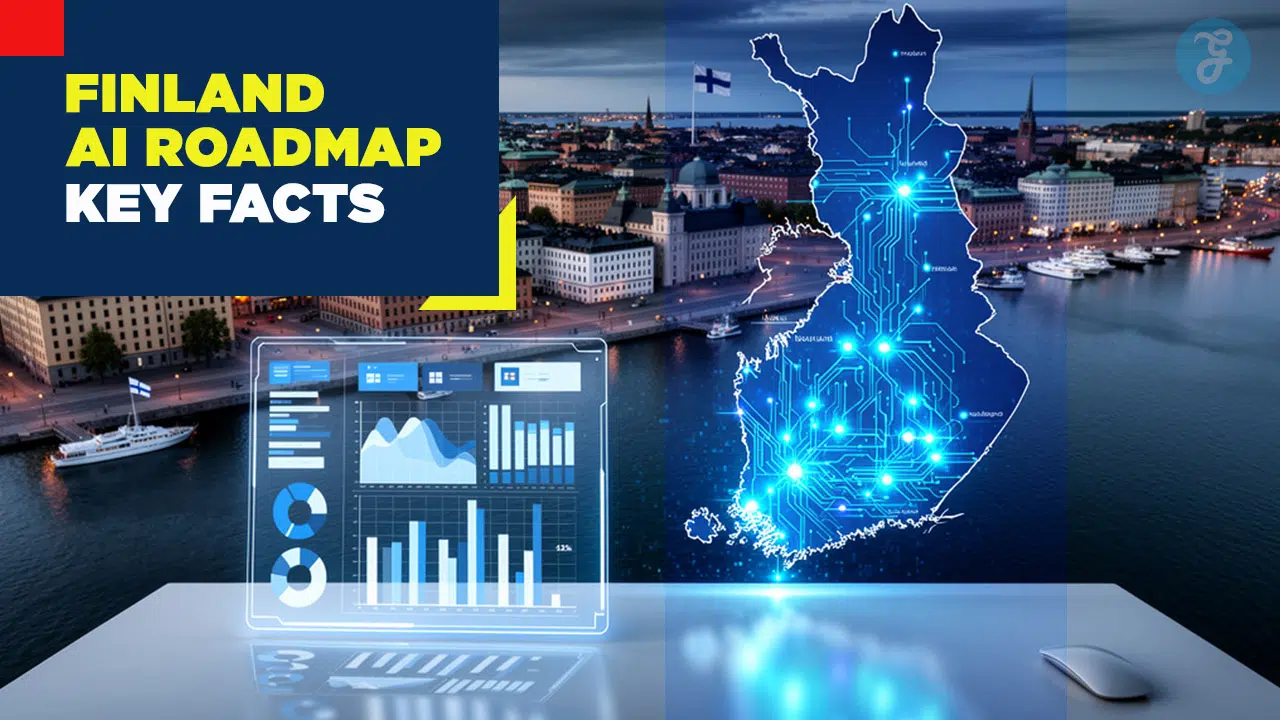
Finland has consistently punched above its weight in the global technology arena, having been the first European Union member to launch a national AI strategy. As we move into 2026, the nation is not just maintaining its lead but is actively pivoting its Finland AI roadmap toward “Agentic AI” and the “Twin Transition.” This strategic shift aims to combine aggressive digitalisation with ambitious carbon neutrality goals, positioning Finland as the primary gateway for industrial AI innovation in Europe.
Whether you are a business leader looking to scale or a policymaker studying ethical frameworks, these ten facts define the Finnish approach to a machine-intelligent future.
How We Selected Our 10 Finland AI Roadmap Facts
To bring you the most relevant updates for 2026, we analysed the final reports of the Artificial Intelligence 4.0 programme and the latest Digital Decade progress metrics. We focused our selection on three core pillars: economic impact (specifically GenAI adoption rates), legislative readiness (EU AI Act compliance), and the new institutional support structures like the Finnish AI Region (FAIR). We prioritised information that demonstrates how Finland is moving from “pilot” projects to “at-scale” industrial applications.
10 Critical Facts About Finland’s AI Roadmap
The Finnish strategy is unique because it treats AI not as an isolated software category, but as a foundational layer for a sustainable, high-productivity society. Here are the ten most important developments for the 2026 landscape.
1. The AI 4.0 Programme Is the North Star
Launched by the Ministry of Economic Affairs and Employment, the Artificial Intelligence 4.0 programme is the official long-term roadmap guiding Finland through 2030. Its primary mission is to ensure that Finnish industry—particularly SMEs—remains globally competitive through the rapid adoption of AI and other digital technologies. It sets a clear path for moving beyond simple automation toward “augmented intelligence,” where human expertise and machine capability work in tandem to solve complex industrial problems.
Best for:
-
SME owners and industrial leaders seeking a strategic framework for growth.
Why We Chose It:
-
It is the overarching policy document that dictates funding and research priorities.
-
It bridges the gap between high-level EU goals and local business needs.
-
It establishes the 2030 vision for a “clean, efficient, and digital” Finnish industry.
Things to consider:
-
Success depends heavily on the speed of digital skills updates across the workforce.
2. FAIR Secures a Second Term for 2026
The Finnish AI Region (FAIR), a European Digital Innovation Hub (EDIH), has officially secured its second term starting in 2026 with top marks from the EU. FAIR serves as a one-stop-shop for companies looking to integrate AI into their operations. This extension ensures that businesses have continued access to world-class expertise from Aalto University, the University of Helsinki, and VTT (Technical Research Centre of Finland) without the massive upfront costs of private consultancy.
Best for:
-
Start-ups and SMEs needing technical proof-of-concepts (PoC) and expert advice.
Why We Chose It:
-
FAIR is the primary “gateway” to the entire EU AI infrastructure for Finnish firms.
-
It provides a low-risk environment for experimenting with high-performance computing.
-
The 2026 term includes expanded services for augmented reality and cybersecurity.
Things to consider:
-
Services are primarily aimed at SMEs and public sector organisations rather than large enterprises.
3. The AI Helpdesk Launches in Early 2026
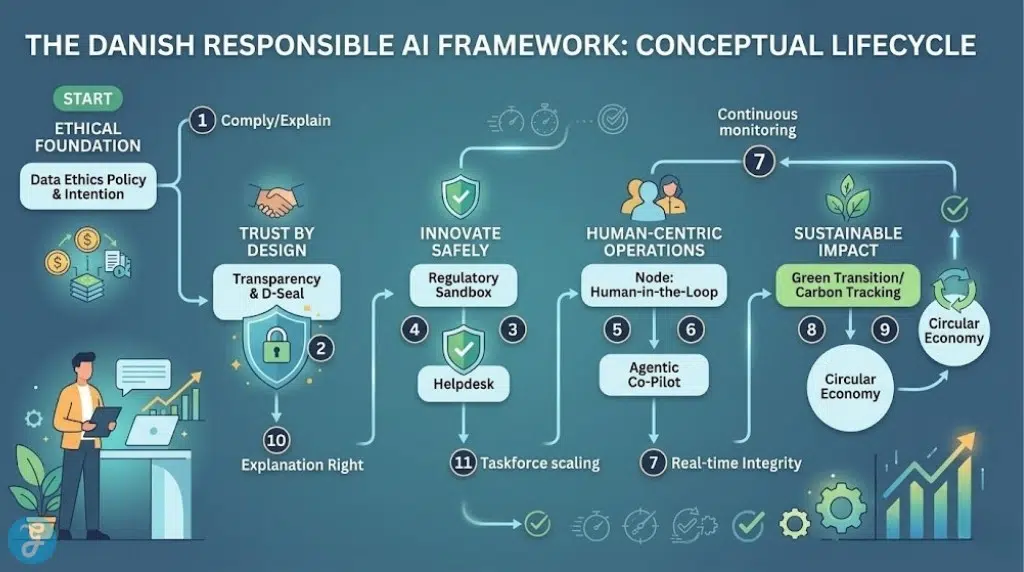
One of the most practical additions to the Finland AI roadmap this year is the launch of the FAIR AI Helpdesk. This function is designed to be an open-access resource for any organisation requiring guidance on AI adoption. It simplifies the often-confusing landscape of service providers, testing platforms, and funding opportunities, directing users to the right partners in Finland or elsewhere in Europe.
Best for:
-
Business leaders who are unsure where to start their AI journey.
Why We Chose It:
-
It removes the “knowledge barrier” that often prevents smaller firms from starting.
-
It acts as a concierge service for navigating complex EU AI factories and labs.
-
It provides immediate, actionable advice on technology selection and scaling.
Things to consider:
-
While advice is free, implementing the suggested solutions will still require budget.
4. Finland Leads the EU in Generative AI Adoption
As of late 2025, a staggering 66% of Finnish firms report using generative AI tools like ChatGPT or Copilot in their daily operations. This is nearly double the EU average and makes Finland the most advanced adopter of GenAI in the bloc. This high adoption rate is a direct result of the nation’s high digital literacy and the “experiment-first” culture encouraged by the government’s roadmap.
Best for:
-
International investors looking for the most “AI-ready” market in Europe.
Why We Chose It:
-
It proves that the roadmap’s focus on digital skills is yielding measurable results.
-
High adoption levels create a “virtuous cycle” of local expertise and innovation.
-
It shifts Finland from a consumer of AI technology to a global testing ground.
Things to consider:
-
Rapid adoption requires vigilant internal governance to manage data privacy risks.
5. The “Triple Victory” Sustainable Goal for 2035
The roadmap is intrinsically linked to Finland’s climate targets. The goal is a “Triple Victory” by 2035: using AI to achieve sustainable development, economic growth, and societal well-being simultaneously. This involves deploying AI to optimise energy grids, reduce waste in manufacturing, and create “circular economy” business models that are more profitable than traditional linear ones.
Best for:
-
Companies with strong ESG (Environmental, Social, and Governance) mandates.
Why We Chose It:
-
It differentiates the Finnish roadmap from purely “profit-driven” strategies.
-
It aligns AI development with the massive global demand for green technology.
-
It provides a unique selling point for Finnish exports in the global market.
Things to consider:
-
Measuring the “carbon handprint” of AI can be complex and requires new standards.
6. 2026 Is the Year of Agentic AI in Business
AI Finland, the national network, has declared Agentic AI as its primary theme for 2026. Unlike previous years which focused on “assistants” (chatbots), the focus now is on “agents”—autonomous systems that can plan, execute, and adapt workflows with minimal human oversight. This shift is designed to help Finnish businesses move from fragmented pilots to truly intelligent, automated operations.
Best for:
-
Enterprise architects and CTOs planning the next phase of automation.
Why We Chose It:
-
It represents the “next frontier” of AI capability in the industrial sector.
-
It addresses the workforce shortages in Finland by delegating routine tasks to agents.
-
It focuses on measurable business outcomes rather than just conversational hype.
Things to consider:
-
Agentic systems require much more robust governance and “human-in-the-loop” safeguards.
7. Dedicated AI Act Compliance Support for SMEs
With the EU AI Act now in full effect, the Finland AI roadmap has introduced a specific compliance assessment service. Facilitated by FAIR, this service provides an AI-powered evaluation to help companies determine if their technology solutions meet current and future EU requirements. It is a critical “shield” for Finnish innovators, ensuring they don’t get stuck in regulatory limbo while trying to scale.
Best for:
-
Tech developers and software-as-a-service (SaaS) providers.
Why We Chose It:
-
It reduces the legal costs associated with high-risk AI classification.
-
It builds “trust by design,” making Finnish AI products more attractive to EU buyers.
-
It prevents small companies from being overwhelmed by complex EU bureaucracy.
Things to consider:
-
Self-assessment is a great start, but high-risk applications still require formal audits.
8. The “Twin Transition” Integration
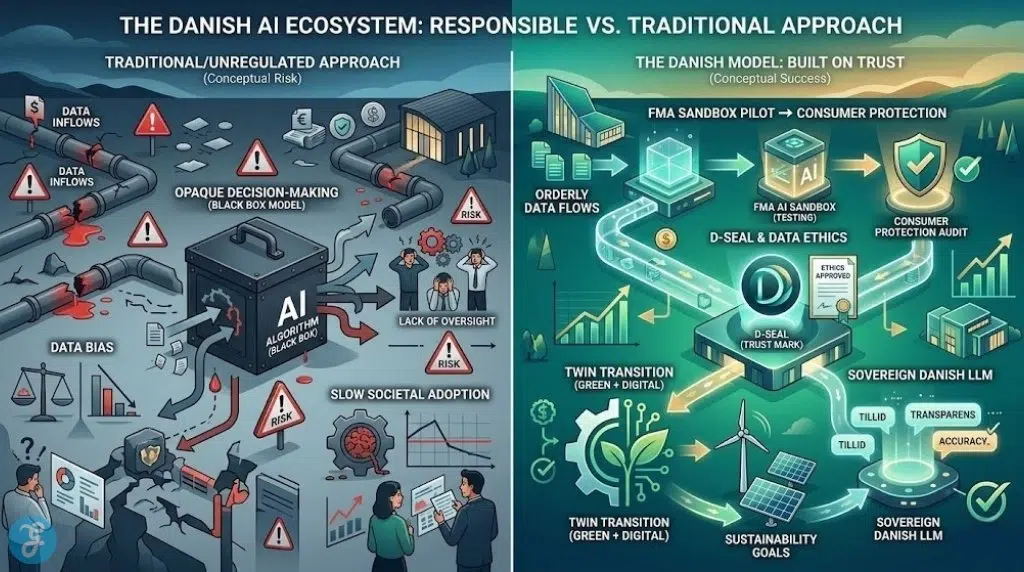
Finland is the global leader in the “Twin Transition”—the idea that the digital and green transitions must happen at the same time. The roadmap specifically allocates public funding to AI projects that increase the “carbon handprint” (the positive impact a product has on the climate). This means that a Finnish AI start-up focusing on forest management or renewable energy is far more likely to receive government support than a generic ad-tech firm.
Best for:
-
Start-ups in the CleanTech and AgriTech sectors.
Why We Chose It:
-
It mirrors the funding priorities of the European Investment Bank (EIB).
-
It creates a “future-proof” industrial base that is resilient to carbon taxes.
-
It leverages Finland’s natural resource expertise with high-tech software.
Things to consider:
-
The “Twin Transition” requires a multidisciplinary workforce that understands both bits and biology.
9. Digital Compass 2030: The Skills Target
Finland’s Digital Compass strategy sets an ambitious target: 80% of the population must possess basic digital skills by 2030. Finland has already reached 79%, making it one of the most digitally literate societies on earth. The 2026 roadmap focuses on the “last mile”—ensuring that older generations and those in non-tech sectors can effectively work alongside AI tools without being displaced.
Best for:
-
HR managers and educational institutions.
Why We Chose It:
-
High digital literacy is the “unfair advantage” that makes the Finnish AI roadmap work.
-
It ensures social cohesion by preventing a “digital divide” in the labour market.
-
It supports the “continuous learning” model where workers update skills throughout their careers.
Things to consider:
-
Basic skills are no longer enough; the focus is shifting toward “AI prompting” and “data literacy.”
10. An 11-Action Strategic Framework
The Finland AI roadmap isn’t just a list of hopes; it is structured around 11 key actions designed to build a world-class ecosystem. These include fostering enterprise-driven ecosystems, simplifying AI adoption for traditional industries, and making bold investments in research. This framework ensures that there is a clear “chain of command” and accountability across different ministries and public bodies.
Best for:
-
Policy researchers and international government observers.
Why We Chose It:
-
It provides a structured “playbook” that other nations often try to replicate.
-
It emphasises “strategic leadership” at the highest levels of government.
-
It ensures that investments in research are actually translated into business value.
Things to consider:
-
Coordination between multiple agencies can sometimes slow down the implementation of individual actions.
An Overview Of Finland AI Roadmap
The Finnish strategy is a balanced blend of aggressive adoption and ethical caution. Here is how the key components compare.
Overview Comparison Table
| Component | 2026 Focus | Impact Level | Primary Beneficiary |
| FAIR EDIH | Second Term Expansion | High | Industrial SMEs |
| AI Helpdesk | Concierge Guidance | Moderate | First-time Adopters |
| GenAI Usage | At-scale Production | Critical | Finnish Economy |
| AI Act Support | Compliance Assessment | High | SaaS Developers |
| Twin Transition | Green + Digital synergy | High | CleanTech Sector |
Our Top 3 Picks and Why?
-
FAIR EDIH Second Term: This is our top pick because it provides the physical and intellectual infrastructure that makes everything else possible. Without FAIR, SMEs would struggle to access the compute power needed for modern AI.
-
GenAI Adoption Leadership: We chose this as the runner-up because it proves Finland’s “Digital Compass” strategy is working. A 66% adoption rate is a powerful indicator of a future-proof economy.
-
The AI Act Compliance Service: This takes the third spot because regulatory certainty is the biggest hurdle for tech firms in 2026. This service turns a “compliance burden” into a competitive advantage.
Buyer’s Guide: How to Align with the Finland AI Roadmap?
If you are operating in the Finnish market, you shouldn’t just build AI; you should build “Finnish-style” AI—which means it must be ethical, secure, and sustainable.
-
The Sustainability Test: Does your AI solution contribute to the “Twin Transition”? If it helps reduce emissions or waste, it will be much easier to secure Finnish and EU funding.
-
The Transparency Test: Are your models “explainable”? Finland’s roadmap prioritises human-centric AI where the machine’s reasoning is transparent to the user.
-
The Interoperability Test: Can your system talk to the existing Finnish data ecosystem? Use the FAIR helpdesk to ensure your tools align with national standards.
| Choose this path… | If your primary business goal is… |
| Partner with FAIR if… | You need to test a technical AI pilot using high-performance computing. |
| Focus on Agentic AI if… | You want to solve workforce shortages through autonomous workflow automation. |
| Utilise the AI Helpdesk if… | You are a traditional SME looking for a low-cost “entry point” into digitalisation. |
| Seek AI Act Assessment if… | You are developing software that might be classified as “high-risk” under EU law. |
The Final Checklist:
-
Review the AI 4.0 Final Report to see where your industry fits in the national priorities.
-
Contact the FAIR AI Helpdesk for a baseline assessment of your current digital maturity.
-
Audit your data sets to ensure they are high-quality and ethically sourced.
-
Conduct a preliminary EU AI Act risk classification for all internal and external tools.
-
Develop a “Twin Transition” plan that links your AI adoption to your carbon reduction targets.
Leading the Next Industrial Revolution
Finland’s Finland AI roadmap is a testament to what a small, highly educated nation can achieve with clear strategic intent. By 2026, the shift toward Agentic AI and the Twin Transition is no longer a theory; it is the practical engine of the Finnish economy. For businesses, the message is clear: the most successful firms will be those that embrace these tools not just for efficiency, but as a way to solve the greatest challenge of our time—the sustainable transformation of global industry.