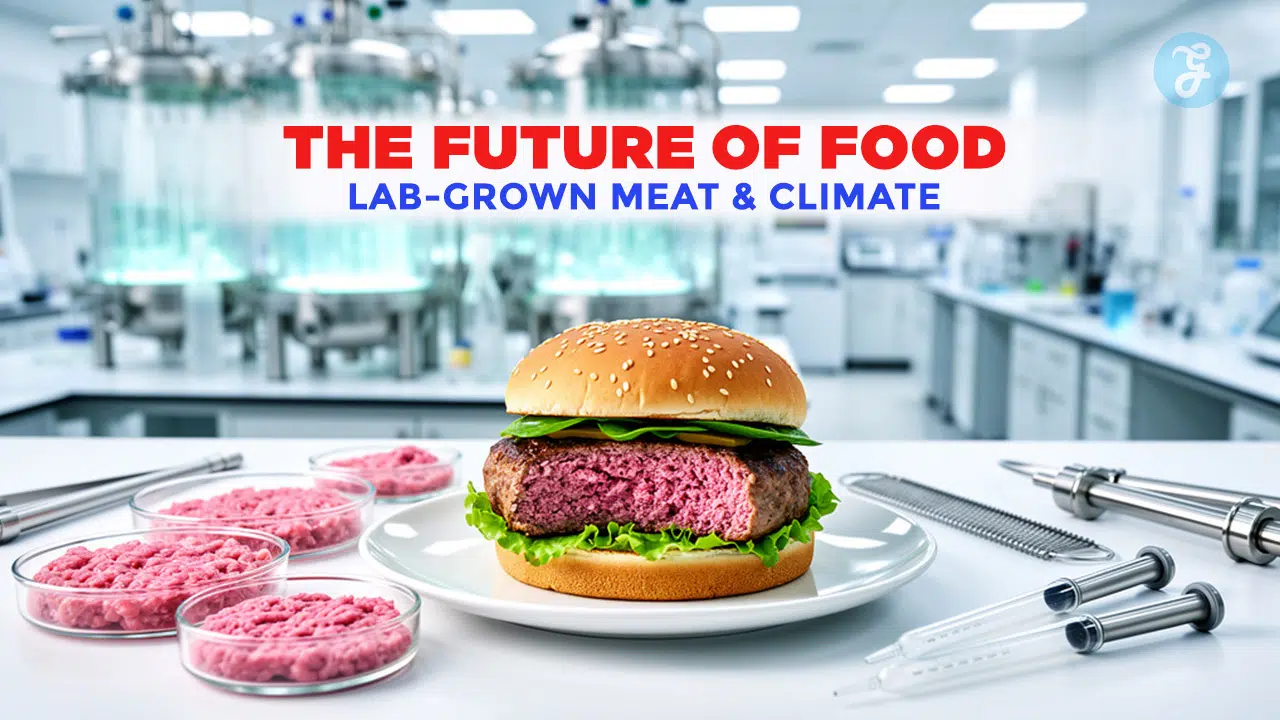
Have you ever felt that nagging guilt after biting into a burger, wondering what your meal is really costing the planet? You’re not alone in that thought. Here’s something worth knowing: livestock farming is responsible for roughly 14% to 18% of global greenhouse gas emissions. That’s a massive chunk of our climate problem coming from our dinner plates.
That’s exactly why lab-grown meat, also known as cultivated meat, is one of the most talked-about breakthroughs in food production right now. It’s real meat, made from real animal cells, without the farms, the land, or the methane.
This guide breaks down what cultivated meat actually is, how it’s made, what it means for climate change, and whether it can truly deliver on its promise of a more sustainable food system. Let’s get into it.
What is Lab-Grown Meat?
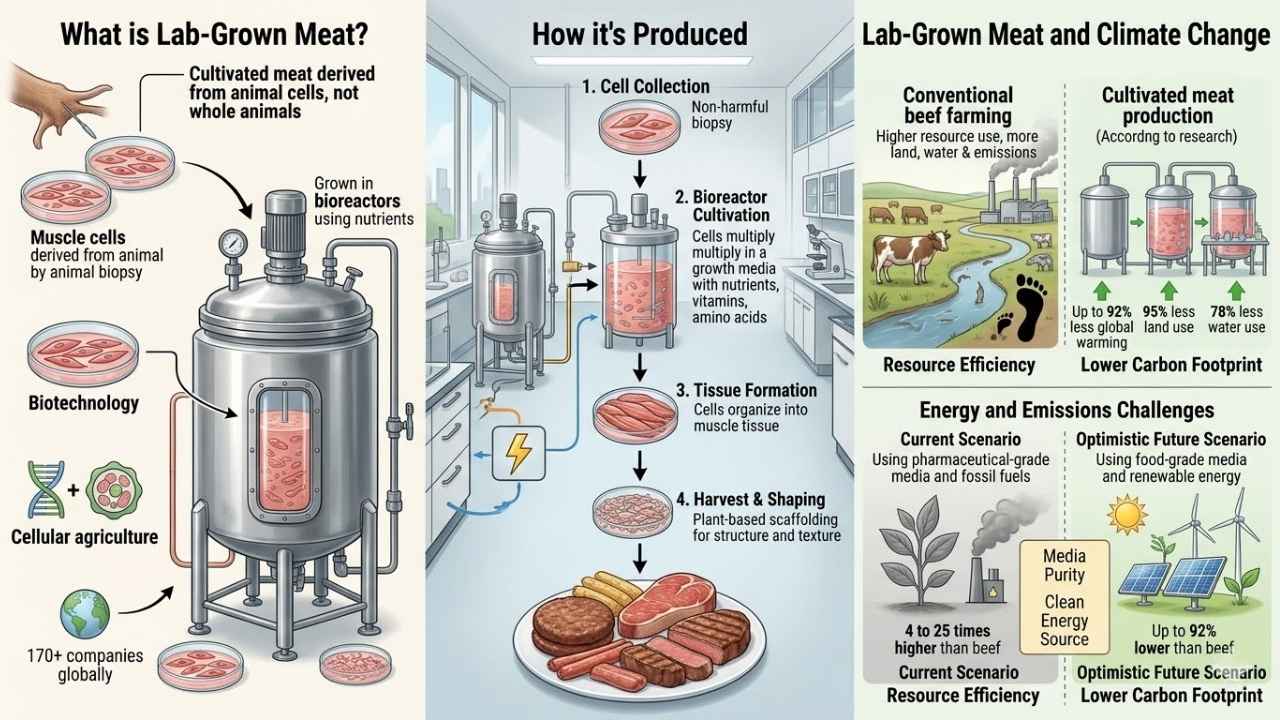
Lab-grown meat starts with living animal cells, then grows into real meat using biotechnology. This new kind of food production could change how we think about climate impact and resource efficiency.
Definition and concept
Cultivated meat, also called lab-grown or cell-based meat, comes from animal cells instead of whole animals. Scientists take a small sample of cells and grow them in bioreactors using nutrients, not fields or barns.
According to a 2025 review published in Comprehensive Reviews in Food Science and Food Safety, there are now over 170 companies in the cultured meat space, and they have attracted more than $3 billion in investments since 2019.
This type of alternative protein aims to cut the environmental impact tied to traditional livestock. Livestock contributes 14% to 18% of global greenhouse gas emissions today, so this shift could reshape food production worldwide.
Cultivated meat offers a way to boost sustainability and tackle climate change while still meeting demand for real meat products through biotechnology and cellular agriculture.
How lab-grown meat is produced
Lab-grown meat starts with real animal cells, but it is made in a food technology lab using biotechnology. The process uses cell culture and energy in special reactors, making alternative protein without raising livestock.
- Scientists take a small sample of animal cells, usually from muscle tissue, without harming the animal. In fact, a single biopsy extracts roughly 0.5 grams of tissue, which is then processed to yield about 40,000 stem cells.
- These cells are placed in a warm tank called a bioreactor, which acts like a high-tech farm for growing meat.
- The cells are fed with nutrients, including amino acids and vitamins, often mixed in serum-free growth media developed to boost sustainability.
- The environment inside the bioreactor has to be kept just right, think Goldilocks conditions, so the cells grow efficiently.
- As the cells multiply, they form muscle tissue that looks and feels like traditional meat found on your dinner plate.
- Some companies use plant-based scaffolds to give structure and texture to the growing protein so it holds its shape better. Scientists at University College London recently developed a method to convert brewing yeast waste into an edible scaffold material, which could significantly lower costs.
- Energy still powers this setup. Current systems consume a lot of electricity to keep everything running smoothly.
- Over 170 companies worldwide now back this method of food production with more than $3 billion invested since 2019, aiming for resource efficiency and lower climate impact across six continents.
- While emissions from these labs exist due to energy needs, research from the Good Food Institute points to potential greenhouse gas drops of up to 92% compared to beef farming when clean energy is used.
- This process does not need vast stretches of land or large amounts of water like traditional livestock farms. This shift could help cut deforestation rates and habitat loss worldwide.
No cows required. Just science doing some serious work for a greener plate.
Lab-Grown Meat and Climate Change
Lab-grown meat could change how we think about food production and its climate impact. People keep asking: can this new alternative protein actually cut greenhouse gas emissions for a more sustainable future?
Environmental benefits over traditional meat production
Swapping meat from animals with cultivated protein could shrink the climate impact of food production in a big way. Livestock farming pumps out 14% to 18% of global greenhouse gases, which is more than most people realize.
A study commissioned by the Good Food Institute and conducted by independent research firm CE Delft found that, compared with conventional beef, cultivated meat may cause up to 92% less global warming, 93% less air pollution, and use up to 95% less land and 78% less water. Those are the kinds of numbers that make you stop and think.
Farms need huge stretches of land and enormous amounts of water to raise cattle. In fact, conventional meat uses up to 19 times more land than cultivated beef, according to the same CE Delft research. Growing cells in vats skips all of that.
Research from Oxford University and the University of Amsterdam estimated that cultured meat could involve 99% lower land use and 82% to 96% lower water use compared to conventional beef, depending on the production method.
Forests get destroyed for grazing, and that destruction is one of the biggest drivers of biodiversity loss. A shift toward cultivated meat could mean lower deforestation rates and more wild habitat left intact.
Energy consumption and emissions challenges
Lab-grown meat still needs a lot of energy to make. The reactors that house the growing cells run day and night, pulling power from grids often tied to fossil fuels.
This is where the honest conversation gets a bit complicated. A peer-reviewed 2025 study from the University of California, Davis, published in ACS Food Science & Technology, found that under current production methods using highly purified growth media, cultivated meat could generate 4 to 25 times the greenhouse gas emissions of conventional beef. The key variable? The purity level of the growth media used.
A different picture emerges when you factor in food-grade ingredients and cleaner energy. Using food-grade media instead of pharmaceutical-grade inputs, the Good Food Institute projects cultivated meat could cut emissions by up to 92% compared to beef. A separate analysis by researcher Elliot Swartz and his co-authors found that with food-grade ingredients, cultivated meat would generate up to 70% fewer greenhouse gas emissions than traditional beef by 2030.
- Worst-case scenario (pharmaceutical-grade media, fossil fuels): Emissions 4 to 25 times higher than retail beef.
- Optimistic scenario (food-grade media, mixed energy): Emissions up to 70% lower than beef.
- Best-case scenario (food-grade media, renewable energy): Emissions up to 92% lower than beef.
The bottom line is this: the climate math on lab-grown meat depends almost entirely on two things, what you use to feed the cells, and where the electricity comes from. Get those right, and cultivated meat becomes a genuine climate tool.
Benefits of Lab-Grown Meat
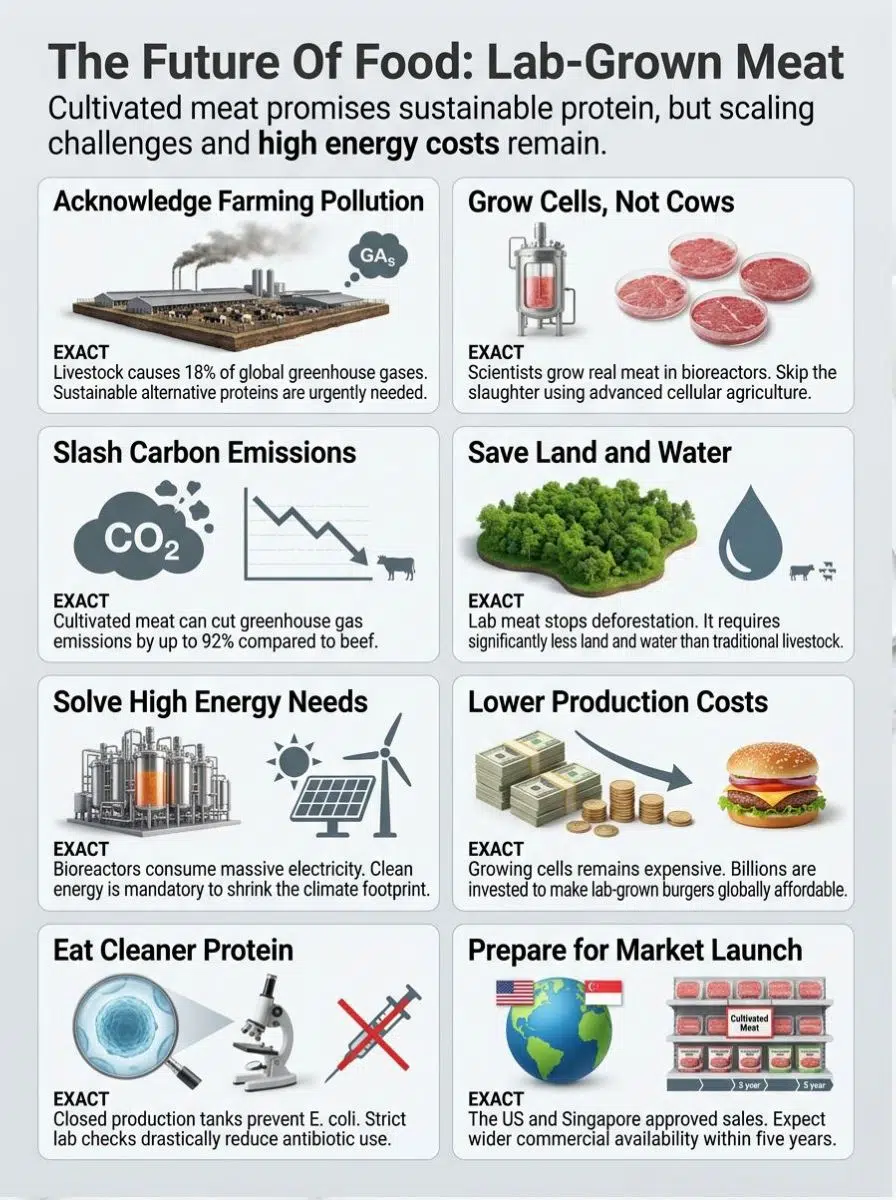
Lab-grown meat makes food production smarter. It offers a fresh way to boost sustainability and cut climate impact, so it’s worth taking a closer look at what it actually delivers.
Reduced land and water use
Traditional livestock farming swallows up huge stretches of land and drinks loads of water. Livestock production takes up nearly 80% of the world’s farmland yet provides less than 20% of our calories. That math doesn’t add up for a planet with a growing population.
Cultivated meat changes this picture completely by growing cells in tanks instead of fields or barns. Research from Oxford University shows that cultivated meat facilities can operate on 95% less land while using 78% less water than traditional livestock operations.
Water savings are one of the most exciting benefits here. Several analyses suggest cultivated meat could reduce water consumption by roughly 70% to 80%, depending on production methods and energy sources. Because cell cultivation happens in closed systems, water can be precisely controlled and even recycled.
The Good Food Institute’s CE Delft study highlights that lab-grown beef could cause up to 92% less global warming and use up to 95% less land than conventional beef. Using biotechnology and improved resource efficiency means saving forests, cutting pollution, and freeing land for nature or more sustainable uses in future food production.
Lower deforestation and habitat destruction
Raising cattle and other livestock uses a staggering amount of land. Forests get cleared, homes for wild animals disappear, and ecosystems take a serious hit. Livestock farming is a key driver of deforestation, and that land-use change is a major source of greenhouse gas emissions.
Lab-grown or cultivated meat skips these steps entirely. It lets us produce alternative protein without converting forests into pastures.
According to the CE Delft research commissioned by the Good Food Institute, conventional meat uses up to 19 times more land than cultivated beef. A large-scale shift toward cultivated protein could free up that land for reforestation or carbon sequestration, acting as an additional climate multiplier.
With over 170 companies now working on lab-grown meat using biotechnology instead of farmland, that shift is starting to look more real than theoretical.
Potential for safer and cleaner meat
Lab-grown meat skips many of the problems seen with traditional livestock. These cell culture products avoid common sources of foodborne illness, like E. coli and salmonella, which often enter the food supply from unsanitary farm conditions or processing plants.
Scientists grow cultivated meat in closed bioreactors, so there is far less chance for pathogens to get inside. Biotechnology allows precise control over every step of production.
Strict lab conditions also mean far fewer antibiotics are used compared to conventional animal farming. That’s a meaningful win for public health, since antibiotic overuse in livestock farming is one of the main drivers of antibiotic-resistant “superbugs.”
The process can also remove harmful fats or add beneficial nutrients, making this alternative protein potentially safer and healthier than regular beef or chicken. A pro-tip that food scientists often share: because the cellular environment is so controlled, producers can actually tune the nutritional profile, something impossible with conventional meat.
Challenges in Scaling Lab-Grown Meat
Building lab-grown meat for everyone is a tough challenge, mostly because it costs a lot and runs on significant amounts of energy. Regulations add extra twists and turns, keeping this alternative protein from landing on dinner tables everywhere just yet.
High production costs
High production costs keep cultivated meat out of most stores and kitchens today. The cost has dropped dramatically since 2013, when scientist Mark Post unveiled the first cultured beef burger at a production cost of $2.3 million per kilogram. By the most recent estimates, that cost has come down to around $63 per kilogram, though it still remains far above conventional meat prices.
According to a 2025 review in Comprehensive Reviews in Food Science and Food Safety, consumer acceptance of cultivated meat could increase by 27% if prices matched conventional meat, and by 55% if cultivated meat were cheaper.
Most of the expense comes from growing cells in special reactors and, most significantly, from the growth media. Research shows that growth media can represent up to 80% of total production costs. Removing animal serum from cell culture also remains expensive because biotech alternatives are not yet cheap or easy to produce at scale.
Here’s an encouraging data point: Israeli startup Believer Meats published a serum-free formulation in August 2024 that brought growth media costs down to just $0.63 per liter. That kind of progress is exactly what the industry needs to bring prices closer to conventional meat.
Energy-intensive processes
Cultivated meat still needs a lot of energy to grow. Factories use large bioreactors that run day and night, with tight climate control systems and steady power. This makes the process energy-intensive and pushes greenhouse gas emissions upward.
As noted earlier, current studies show lab-grown meat’s climate impact ranges widely, from 80% lower to potentially 25 times higher than regular beef production, depending on energy sources and media purity. The key takeaway from the Good Food Institute: with clean energy powering these facilities, the climate benefits become real and substantial.
Most facilities today operate with bioreactors around 1,000 liters in capacity, while commercial viability is estimated to require systems larger than 50,000 liters. That scale-up is a massive engineering challenge. Without decarbonized electricity, these food technology systems could have long-term effects on climate change, making the shift to green energy a true priority for the entire industry.
Regulatory hurdles
Regulations for lab-grown meat in the U.S. are strict and can slow progress. Both the FDA and the U.S. Department of Agriculture share oversight of cultivated meat products. Under a formal agreement established in 2019, the FDA handles the early stages, including cell collection, banking, and growth. The USDA’s Food Safety and Inspection Service takes over at the harvesting stage, overseeing processing, packaging, and labeling.
As of mid-2025, regulatory approvals in the U.S. have been granted to companies including Upside Foods, Good Meat, Wildtype, and Believer Meats for products like cultivated chicken and salmon. That’s real progress. At the same time, several states have pushed back. Florida and Alabama enacted bans on cultivated meat sales in 2024, and by mid-2025 at least seven states, including Texas, had passed legislation restricting or banning the products.
This creates a genuinely complicated patchwork for companies trying to scale. Federal regulators are moving toward approval while some state governments are pulling in the opposite direction. It’s a balance that lawmakers are still working through.
Innovations in Lab-Grown Meat Production
Scientists keep breaking new ground in food technology, making it possible to grow tasty meat with fewer greenhouse gas emissions and more resource efficiency. The pace of innovation here is genuinely exciting.
Advancements in bioreactor technology
Bioreactor technology keeps getting better, pushing lab-grown meat closer to the dinner table. New bioreactors use smarter controls and less energy while keeping cells in safe, steady conditions.
A notable recent development: in February 2025, Stämm and Super Meat announced a partnership to enhance cultivated chicken production using Stämm’s bubble-free continuous Bioprocessor, which has demonstrated a 15-fold increase in volumetric productivity in biopharmaceutical applications. That kind of efficiency leap matters enormously for bringing costs down.
Bioreactor design has also shifted from static cultures to AI-controlled perfusion systems that can dynamically regulate pH, oxygen, and shear stress for high-density cell expansion, according to a 2025 review of the field. Better bioreactors, combined with cleaner energy sources, could unlock the massive emissions reductions the Good Food Institute has projected.
Development of serum-free growth media
Growing cultivated meat used to require fetal bovine serum, which made the process both costly and ethically complicated. Early production relied on serum priced at $200 to $500 per liter.
That’s changing fast. Companies like Upside Foods (formerly Memphis Meats) introduced serum-free media as far back as 2015, tailored for bovine muscle satellite cells. In August 2024, Believer Meats published a serum-free formulation costing just $0.63 per liter, a jaw-dropping reduction that signals real commercial momentum.
Researchers at Tokyo Women’s Medical University have also developed a media approach using microalgae instead of glucose derived from corn or sugarcane. This switch achieves a 90% reduction in emissions related to growth media. Microalgae thrive in saltwater or wastewater, require no fertilizers, and can detoxify spent media for reuse.
By finding new ways to feed cells without relying on animals or resource-intensive crops, producers are pushing lab-grown meat closer to being both climate-friendly and more affordable.
Use of plant-based scaffolds
Scientists use plant-based scaffolds to give lab-grown meat its shape and structure. These scaffolds come from materials like spinach leaves or soy fibers. They act as tiny frameworks, helping animal cells grow into the right form, much like vines climbing a trellis.
Using plant materials cuts down on costly animal products and supports resource efficiency in food production. A 2025 breakthrough from scientists at University College London took this further by demonstrating how waste yeast from brewing can be converted into an edible scaffold material. This approach could reduce the cost of building muscle tissue in bioreactors and make larger-scale production far more economically viable.
As more than 170 companies race ahead with billions in investment, expect fresh ideas using nature’s building blocks showing up on our plates sooner than you might expect.
The Future of Lab-Grown Meat in the Market
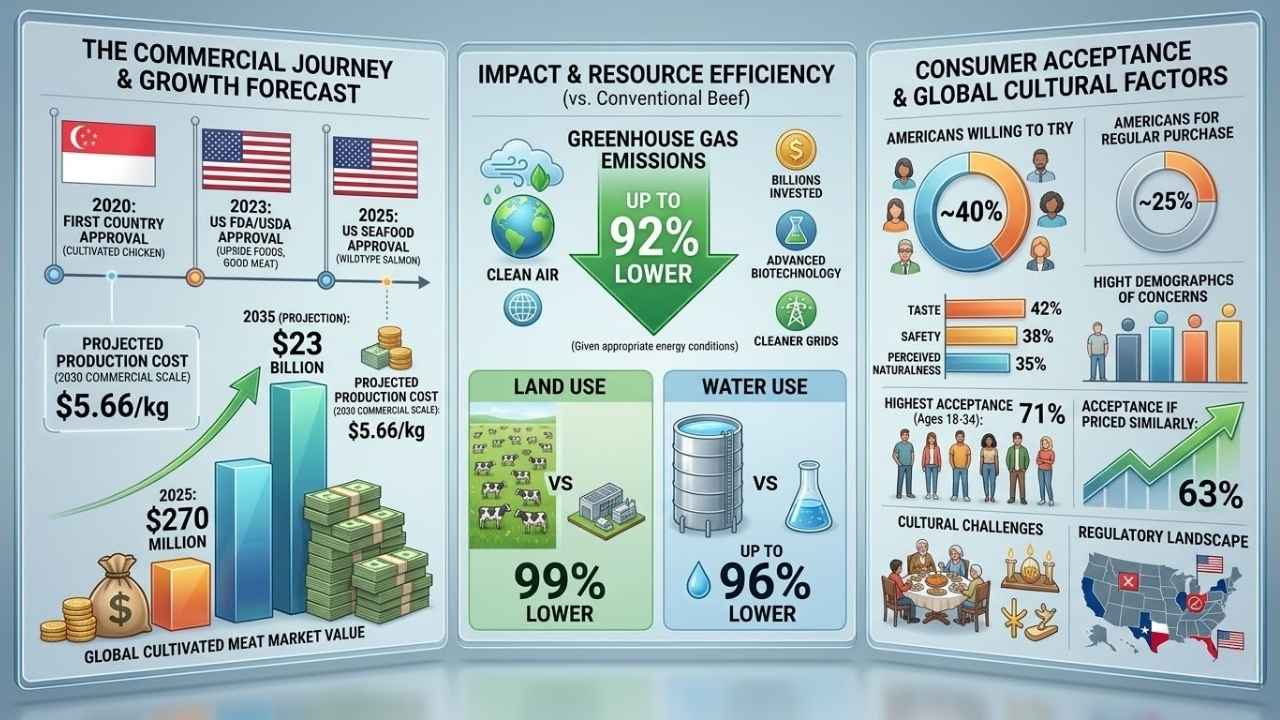
Cultivated meat is already moving beyond the lab. As food technology advances, people will face real new choices in protein with meaningfully lower climate impact.
Forecast for commercial availability
The commercial story of lab-grown meat is already underway. Singapore approved cultivated chicken for consumption in 2020, the first country in the world to do so. In June 2023, both Upside Foods and Good Meat received full FDA and USDA approval to sell cultivated chicken in the United States. In May 2025, Wildtype became the first startup cleared to sell cultivated seafood in the U.S. after the FDA approved its cultivated coho salmon.
The global cultivated meat market is currently valued at around $270 million in 2025, according to market research firm Roots Analysis, and is projected to reach $23 billion by 2035.
The Good Food Institute’s CE Delft research suggests that by 2030, production costs at commercial scale could come down to as low as $5.66 per kilogram. That would put cultivated meat in range of competing with multiple forms of conventional protein. Whether that timeline holds depends on how fast the energy and regulatory landscapes evolve.
Potential to replace traditional meat
Cultivated meat could take a serious role in future food production. Investors have poured billions into this space, and the Good Food Institute projects that alternative protein could cut greenhouse gas emissions by as much as 92% compared to conventional beef, given the right energy conditions.
For land use and water, the advantages are clear regardless of energy source. Cultivated meat will never require the billions of hectares of grazing land that conventional beef does, and it won’t drive the deforestation that continues to push species toward extinction.
Lab-grown meats use less land and water because they skip raising whole animals. Research from Oxford University estimated 99% lower land use and up to 96% lower water use compared to conventional beef. With new advances in biotechnology and cleaner power grids, these products have a real shot at becoming a mainstream source of protein in the coming decades.
Culture, taste preferences, and cost will shape how fast this shift unfolds among consumers hungry for sustainability.
Consumer acceptance and cultural considerations
Some people feel genuinely excited about lab-grown meat, while others feel uncertain. Many like the promise of sustainable and clean food from biotechnology, but old habits run deep.
Consumer surveys show that about 40% of Americans say they would try lab-grown meat, but only 25% would make it a regular purchase. The primary concerns are taste (42%), safety (38%), and perceived naturalness (35%), according to survey data. Young adults aged 18 to 34 show the highest acceptance rate at 71%, while consumers over 55 express more skepticism.
| Consumer Factor | Key Stat |
|---|---|
| Would try lab-grown meat | ~40% of Americans |
| Would make it a regular purchase | ~25% of Americans |
| Would try it if priced similarly to conventional meat | ~63% of consumers |
| Highest acceptance group | Ages 18-34 (71%) |
Price matters enormously here. If lab-grown meat were priced similarly to conventional meat, acceptance jumps to 63%, and if it were cheaper, that number could climb even higher. In some places, eating traditional beef or chicken is deeply tied to family, faith, or local identity, and a burger made from cell culture might raise eyebrows at the dinner table. Building trust takes time.
The regulatory landscape adds another layer of complexity. At least seven U.S. states, including Texas and Florida, have passed legislation restricting or banning cultivated meat sales, reflecting a sharp political divide over this technology. The Good Food Institute’s projections suggest that if global demand grows and clean energy scales up in parallel, cultivated meat could slash greenhouse gas emissions by as much as 92%. Getting there requires both open minds and favorable policy.
Final Thoughts
Lab-grown meat brings a fresh approach to food production and takes on climate change directly. It saves land and water, can slash emissions, and uses smart biotechnology to deliver real meat without the environmental cost of conventional livestock farming.
The path forward is not simple. High costs and energy demands are real challenges, and the science is still evolving. But progress is steady, from serum-free media costing under a dollar per liter to AI-controlled bioreactors and breakthrough scaffold materials.
Curious to learn more? The Good Food Institute publishes free, detailed reports on cultivated meat’s science, economics, and climate impact, and they’re a great next read. Every bite of cultivated meat on a future plate could help shape a food system that’s better for the planet, and that’s a future worth thinking about.