Have you ever looked at a map of Canada and thought, “Living there would be amazing,” only to feel overwhelmed when trying to figure out how the immigration process actually works? Many people experience the same frustration. The immigration system can seem like a maze of forms, regulations, and unfamiliar acronyms that quickly become confusing.
However, the Provincial Nominee Program (PNP) was created to simplify that path. It is one of the most direct immigration routes for skilled workers, graduates, and entrepreneurs who want to build a future in Canada.
The timing is especially promising. Canada’s 2026 Immigration Levels Plan expanded PNP allocations by 66%, increasing from 55,000 spots in 2025 to 91,500 in 2026. According to Canada’s federal immigration authority, this marks the largest single-year increase in the program’s history.
The following guide explains how the program works, which provinces offer strong opportunities, and what applicants can do to strengthen their chances of success.
What is the Provincial Nominee Program (PNP)?
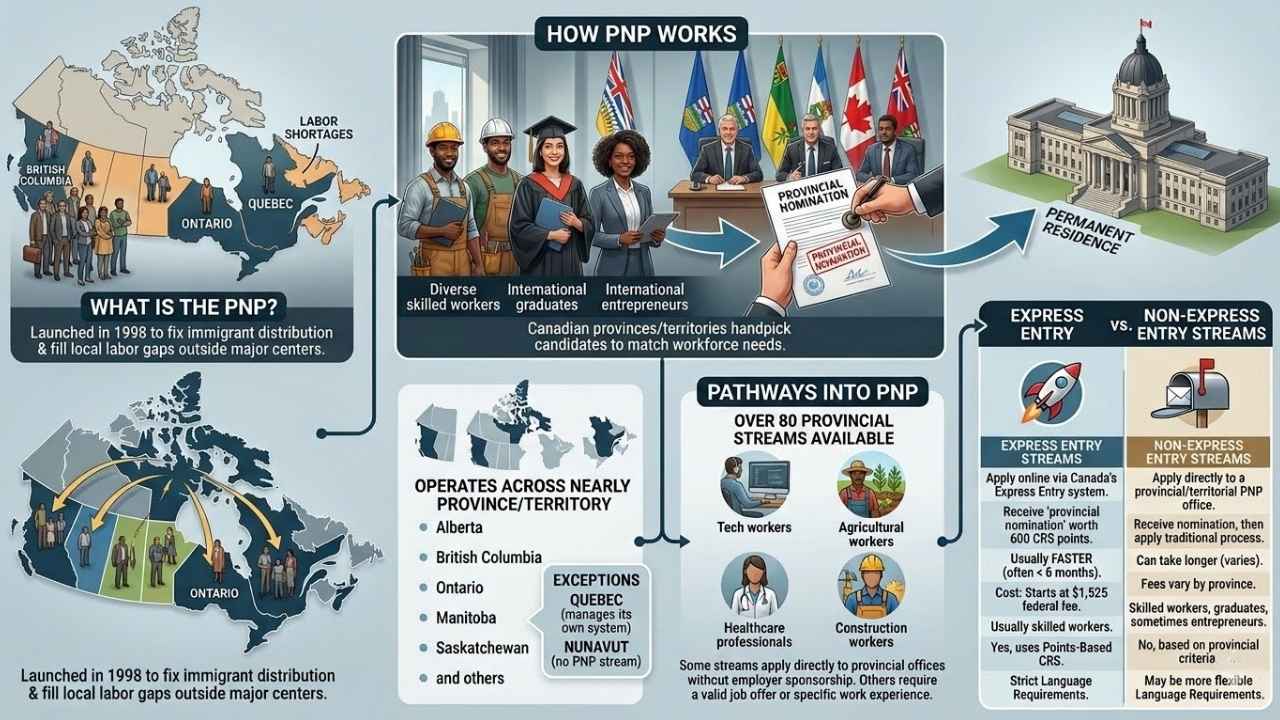
The Provincial Nominee Program (PNP) launched in 1998 to solve a specific problem: most immigrants were settling in Ontario, Quebec, and British Columbia, leaving smaller provinces struggling to fill local labor gaps. The federal government and the provinces agreed to fix that by sharing immigration authority.
Under this arrangement, each province can nominate skilled workers, international graduates, or entrepreneurs for permanent residence. Provinces like Alberta, British Columbia, Manitoba, and Saskatchewan use their own PNP streams to bring foreign nationals into their communities, targeting the specific jobs and industries that need people the most.
Today, the program operates across nearly every province and territory. Quebec and Nunavut are the two exceptions: Quebec manages its own immigration selection system, and Nunavut does not have a PNP stream.
With more than 80 provincial immigration streams available, the PNP gives you the ability to match your specific skills, background, and career goals to a province that genuinely wants you. Some streams let you apply directly to a province’s immigration office without needing an employer to sponsor you. Others do require a valid job offer or specific work experience.
The Express Entry stream is one pathway into the PNP, with federal processing fees starting at $1,525 per application. Provinces design their own requirements so that newcomers fit local economic priorities and boost growth where it matters most.
How the PNP Works
Each province or territory selects foreign nationals using their own provincial streams. These programs give people a pathway to permanent residency through sponsorship and nomination, making it easier for skilled workers to settle and work in Canada.
Nomination by Provinces or Territories
Canadian provinces and territories handpick skilled workers, graduates, or entrepreneurs for permanent residency. The PNP makes this possible by giving provinces the authority to identify the candidates who best match their local workforce needs.
Provinces like Alberta and British Columbia select applicants based on their job market needs and economic development goals. The BC Provincial Nominee Program, for example, helps fill gaps in British Columbia’s labor force while focusing on settlement priorities unique to that region.
Not every PNP category requires employer sponsorship. Some streams let foreign nationals apply straight to a province’s immigration office. With over 80 provincial streams available across Canada, you can choose where you want to settle by matching your skills to each area’s demands.
The Express Entry pathway into the PNP charges a $1,525 starting fee but often offers a faster track to permanent residence. Each nomination also gives you greater provincial support during the application process.
Express Entry vs. Non-Express Entry Streams
There are two main ways to apply for a provincial nomination. One connects to Canada’s federal Express Entry system; the other goes directly to the province. Here’s a clear side-by-side look at how these two pathways compare.
| Feature | Express Entry Streams | Non-Express Entry Streams |
|---|---|---|
| Application Method | Apply online through Canada’s federal Express Entry system | Apply directly to a provincial or territorial PNP office |
| Processing Time | Usually faster, often under 6 months | Can take longer, varies by province |
| Nomination | Receive a “provincial nomination” worth 600 points for Express Entry | Receive a nomination, then apply for permanent residence through traditional process |
| Cost | Starts at $1,525 for federal processing | Fees vary by province, may be lower or higher |
| Who Can Apply | Usually skilled workers meeting criteria for Express Entry programs | Skilled workers, graduates, and sometimes entrepreneurs |
| Points-Based? | Yes, uses the Comprehensive Ranking System (CRS) | No, selection based on provincial criteria |
| Provinces Involved | Alberta, British Columbia, Ontario, Manitoba, Saskatchewan, and more | Same provinces and territories offer both streams |
| Job Offer Requirement | Sometimes required, not always | Often required but some streams do not need a job offer |
| Language Requirements | Strict, set by federal government | May be more flexible, depending on the province |
| Flexibility in Province Choice | Applicant selects province of interest during Express Entry profile creation | Applicant applies directly to their chosen province or territory |
| Year Introduced | Express Entry system launched in 2015 | PNP started in 1998 |
| Benefit Highlight | Faster way to permanent residency for skilled workers | Different options for workers, students, and entrepreneurs |
Benefits of the PNP
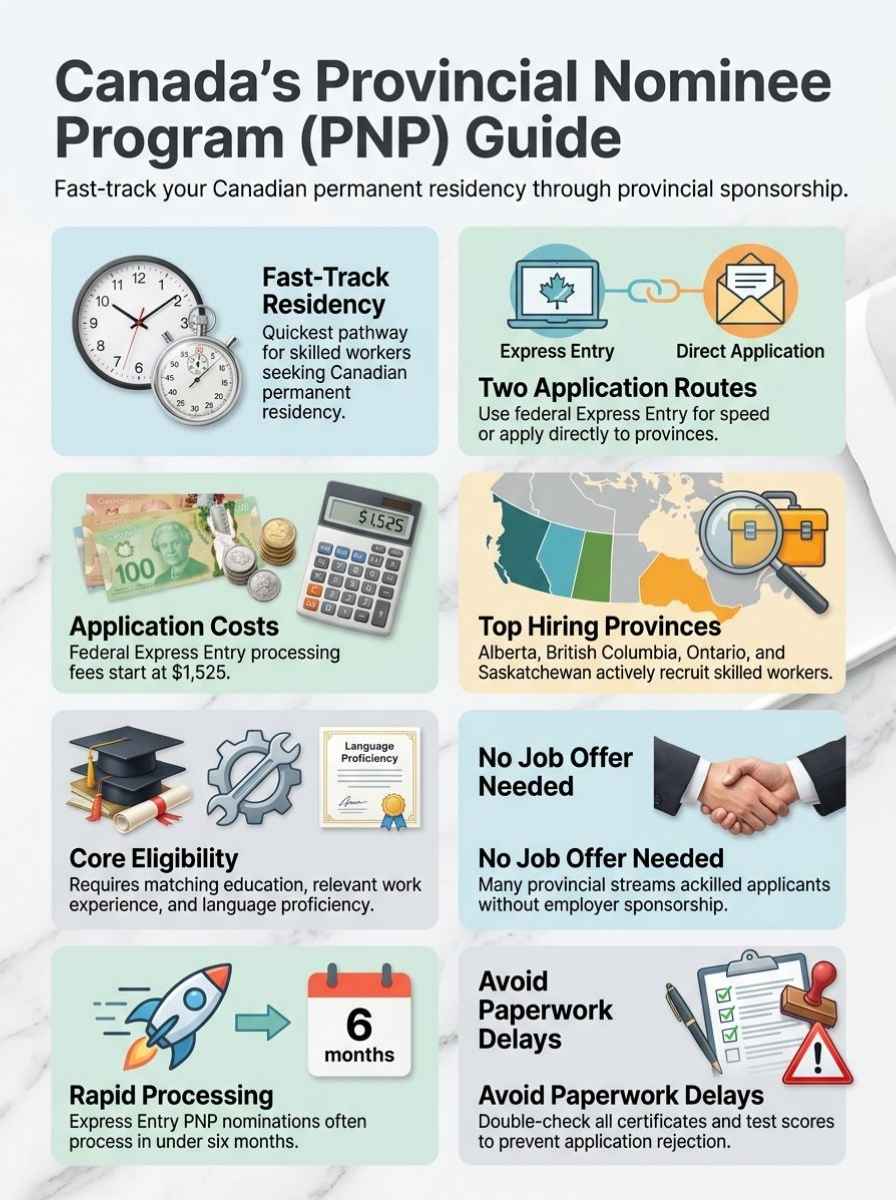
The Provincial Nominee Program opens doors to fresh opportunities for foreign nationals and their families. Many people see it as one of the smoothest pathways to permanent residency through provincial nomination and sponsorship.
Faster Pathway to Permanent Residency
Many skilled workers choose the PNP because it leads to permanent residency faster than most other Canadian immigration options. Since its launch in 1998, the PNP has become a leading pathway for foreign workers and graduates seeking sponsorship for Canada.
The Express Entry process through the PNP can speed up your application significantly. According to Immigration, Refugees and Citizenship Canada (IRCC), Express Entry-linked PNP streams can have processing times as low as three months in 2026, sometimes allowing people to move to Canada in under a year.
Here’s why the CRS boost matters so much: a candidate with a base CRS score of 400 who secures a provincial nomination enters the Express Entry pool with an effective score of 1,000. The highest score ever recorded in a general Express Entry draw has been below 700, meaning a nomination makes your Invitation to Apply (ITA) virtually guaranteed in the next draw.
Provinces like British Columbia and Alberta use their own nominee streams to fill local jobs quickly. These provincial streams respond fast to labor market needs, making them a more direct route for those with skills in demand.
Applicants pay an Express Entry processing fee starting at $1,525 but receive priority processing if nominated by a province or territory. This helps bring in new residents who are ready to support economic development without facing long waits.
Tailored Opportunities for Skilled Workers
Canadian provinces shape their PNP streams around real labor market needs. The British Columbia Provincial Nominee Program (BC PNP), for example, helps fill gaps in B.C.’s workforce across sectors like technology, healthcare, and skilled trades.
Skilled workers, including computer programmers, engineers, and nurses, may find pathways built specifically for their experience. Some streams require a job offer; others welcome applicants with strong work histories or in-demand credentials.
Research by Immigration, Refugees and Citizenship Canada (IRCC) shows that PNP immigrants tend to earn high wages, have high rates of labor force participation, and have low rates of unemployment. That’s because the whole point of the program is to match people to places where their skills are genuinely needed.
The process also gives skilled workers the flexibility to pick a province that fits both their background and their vision for life in Canada.
Greater Provincial Support for Immigrants
Provinces play a big part in helping newcomers settle. The PNP lets each province or territory pick skilled workers, graduates, and entrepreneurs who can contribute to local jobs and long-term economic growth.
Many provinces offer dedicated support services for immigrants. These typically include:
- Language classes in English or French
- Job search assistance and career guidance
- Help finding housing and schools for children
- Community settlement programs for faster integration
Some programs welcome foreign nationals without needing employer sponsorship. Applicants can apply straight through the provincial PNP office in those cases. Since 1998, these supports have grown stronger as more provinces look to fill labor gaps while helping people build lasting lives in Canada.
Eligibility Criteria for the PNP
The PNP’s eligibility criteria can open doors to permanent residence in Canada. Here’s a look at what most streams actually require, so you can see where you stand.
Education and Skills Requirements
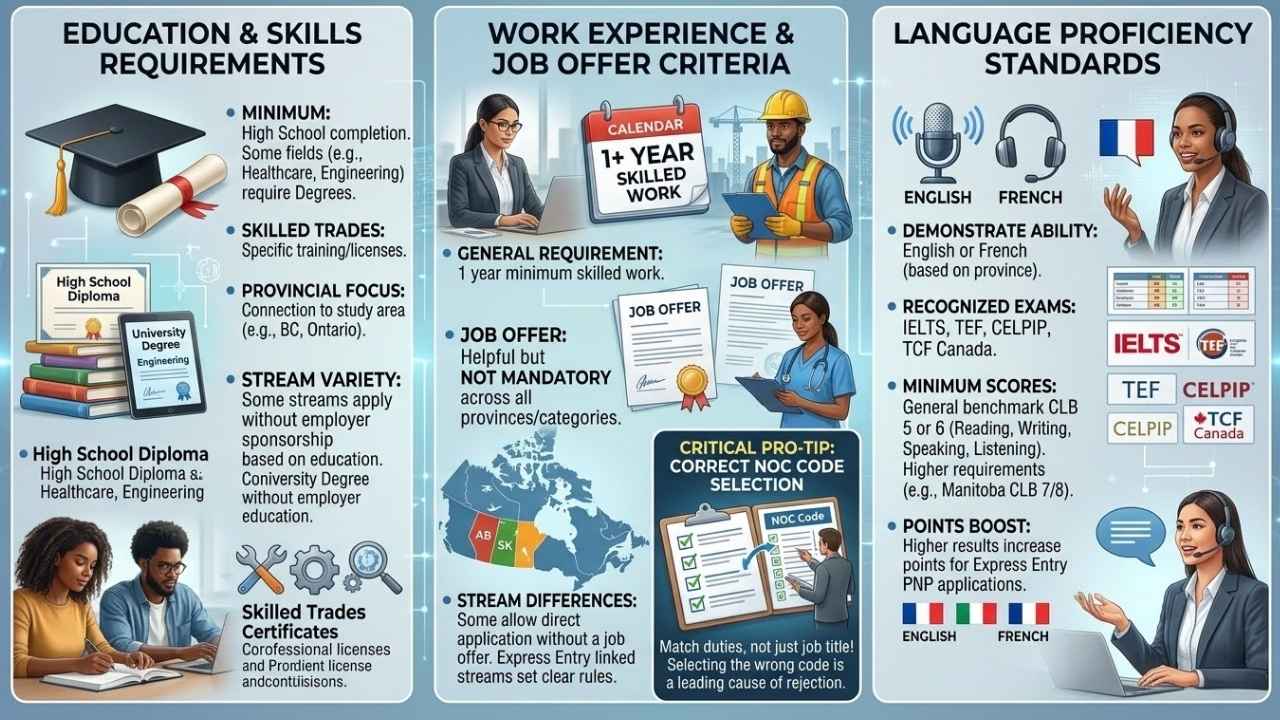
Most PNP streams look for candidates with enough education and work skills to match local labor needs. Many provinces require foreign nationals to complete at least high school, but some occupations, like healthcare or engineering, will ask for a college or university degree.
Workers in skilled trades might need specific training certificates or licenses recognized in Canada. Provinces such as British Columbia and Ontario often favor candidates whose studies connect directly to their job offer or target occupation.
Some PNP categories do not need employer sponsorship, so skilled applicants can apply based on their education alone through the province’s PNP office. The right combination of schooling and professional experience opens more doors under each provincial program.
Work Experience and Job Offer Criteria
Provinces pick candidates based on work experience. Each PNP stream asks for different skills and job backgrounds. British Columbia’s BC PNP, for example, uses work history to support its labor market and economic development goals.
Most streams require at least one year of skilled work in a related field or industry. Some will want proof of past full-time employment, while others accept recent graduates who already hold Canadian job offers.
A few important things to know about job offers and nominations:
- Not every applicant needs employer sponsorship or a job offer to qualify for the PNP.
- Some streams allow you to apply directly to a province’s office without a job offer.
- Express Entry-linked streams set clear rules about work experience, favoring those with steady careers in fields that provinces like Alberta and Saskatchewan currently need.
- A job offer from a local employer helps your application, but it’s not mandatory across all provinces and all categories.
One pro-tip worth knowing: one of the most common reasons for PNP rejection is selecting the wrong National Occupation Classification (NOC) code, according to Regulated Canadian Immigration Consultants (RCICs). Many applicants choose their NOC based on their job title alone, but the code must match the actual duties they performed. Getting this right before you apply is critical.
Language Proficiency Standards
Applicants must show their ability to speak English or French, based on the province’s requirements. Most PNP streams ask for test results from recognized exams like the IELTS for English or the TEF for French.
Scores need to meet the minimum set by each provincial program. Most programs look for a Canadian Language Benchmark (CLB) of at least 5 or 6 in reading, writing, speaking, and listening. In provinces like Manitoba, a higher score of CLB 7 or 8 may be required, depending on the stream.
Higher test results also boost your points under Express Entry applications for permanent residence through the PNP. Other accepted tests include CELPIP for English and TCF Canada for French, so you have options if one test format suits you better.
PNP Streams by Province and Territory
Each province and territory in Canada offers its own streams for the PNP, drawing skilled foreign nationals with specific expertise. This creates a wide variety of immigration pathways for those seeking permanent residence through a provincial nomination.
Alberta Advantage Immigration Program (AAIP)
The Alberta Advantage Immigration Program (AAIP) helps skilled workers, graduates, and entrepreneurs settle in Alberta. It’s a top choice for those who want a fast track to permanent residency through provincial streams, and it works with both Express Entry and direct applications.
The AAIP focuses on workers in the energy sector, healthcare, construction, and technology. Alberta received 6,403 nomination spaces for 2026. Notably, Alberta is one of the few major provinces that consistently invites overseas applicants in specific sectors, even without a Canadian job offer.
Foreign nationals can apply if they meet education, work experience, and language standards set by Alberta. Fees start at $1,525 through Express Entry pathways. One key update for 2026: Alberta’s Rural Renewal Stream tightened its rules as of January 1, 2026, now requiring in-Canada applicants to hold a valid work permit at the time of both application and assessment.
British Columbia Provincial Nominee Program (BC PNP)
The British Columbia Provincial Nominee Program (BC PNP) gives skilled workers, graduates, and entrepreneurs a clear pathway to permanent residency. Since its start in 1998, this program has helped fill B.C.’s labor market needs while boosting economic development for the region.
BC PNP is widely recognized for its transparency. It maintains a clear points-based scoring grid, publishes weekly draw results with cut-off scores, and has among the fastest processing times in the country. B.C.’s 2026 focus continues to favor workers in technology, healthcare, and skilled trades.
Applicants can use Express Entry or apply directly through B.C.’s own process, depending on their skills and work experience. Some streams allow foreign nationals to secure a nomination without needing an employer sponsorship letter. Fees start at $1,525 for those applying via Express Entry. B.C.’s 2026 nomination allocation is 5,254 spaces, a figure the province has described as lower than its actual labor market needs.
Ontario Immigrant Nominee Program (OINP)
The Ontario Immigrant Nominee Program (OINP) stands as one of the largest provincial programs for skilled worker immigration. Ontario holds the largest provincial PNP allocation in 2026, projected at approximately 14,119 nominations. That’s a 31% increase from the 10,750 nominations issued in 2025, according to a February 2026 report from ICC Immigration.
The OINP is undergoing a significant redesign in 2026. Ontario is merging its three separate Employer Job Offer streams into one unified stream and replacing several existing pathways with three new targeted routes: Priority Healthcare, Exceptional Talent, and a revamped Entrepreneur stream. If you currently qualify under older OINP rules, applying sooner rather than later is a smart move.
English or French language tests are required. Application fees start at $1,525 under Express Entry routes, just like other provinces.
Saskatchewan Immigrant Nominee Program (SINP)
The Saskatchewan Immigrant Nominee Program (SINP) helps skilled workers and graduates move to the province. It started in 1998 and acts as a major pathway for newcomers seeking permanent residence.
For 2026, Saskatchewan announced one of the most comprehensive redesigns of the SINP in its history. The province has 4,761 nomination spaces for 2026. At least 50% of those spots are reserved for candidates in seven priority sectors: Healthcare, Agriculture, Skilled Trades, Mining, Manufacturing, Energy, and Technology.
Here’s the key breakdown for 2026 SINP applicants:
- Priority sectors (Healthcare, Agriculture, Skilled Trades, Mining, Manufacturing, Energy, Technology): Applicants can apply at any time, including from overseas, with no work permit timing restrictions.
- Capped sectors (Accommodation and Food Services, Trucking, Retail Trade): Applications are only accepted during six specific intake windows throughout 2026 (January, March, May, July, September, November).
- International students: Starting in 2026, only graduates of Saskatchewan Designated Learning Institutions (DLIs) qualify under the Student category.
Fees start from $1,525 if you use Express Entry for your application. Every applicant must meet specific eligibility conditions set by the province before applying for residency under this stream.
How to Apply for the PNP
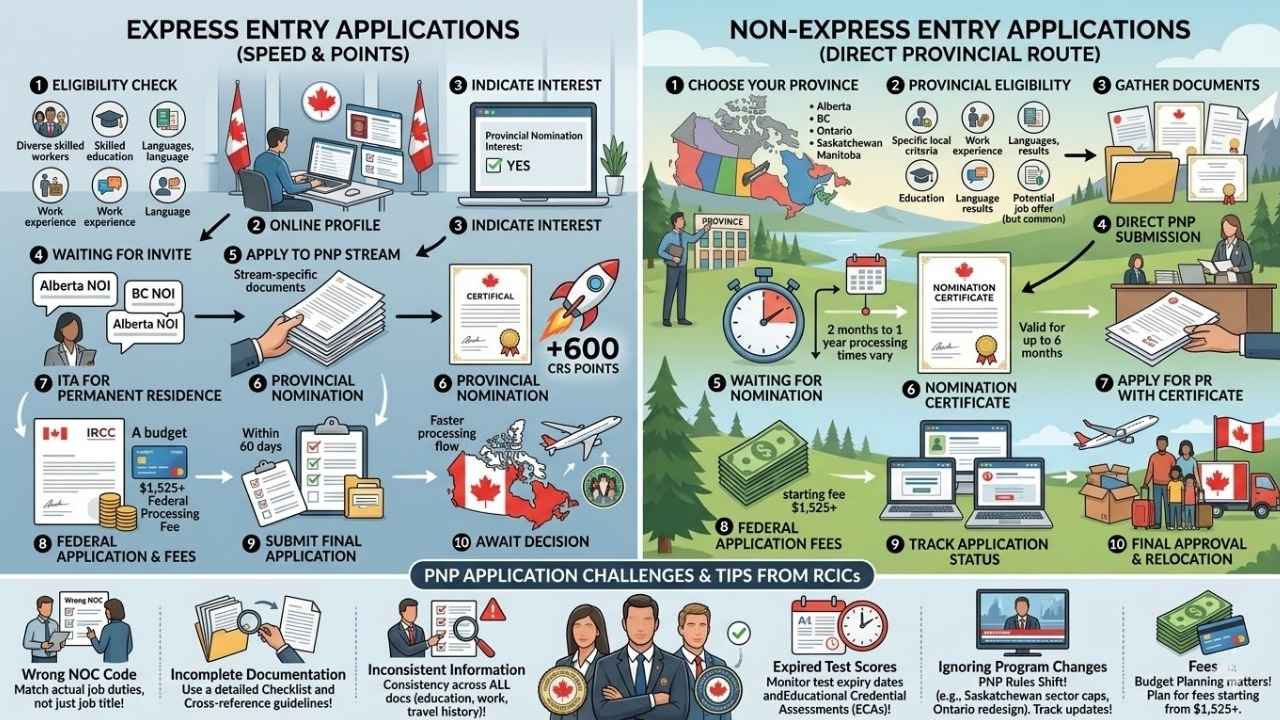
Applying for the Provincial Nominee Program can open a real pathway to permanent residency in Canada. Here’s a practical look at both application routes, so you can pick the one that fits your situation.
Steps for Express Entry Applications
Express Entry speeds up the application for many Canadian immigration programs. The PNP uses Express Entry to give skilled workers a faster shot at permanent residence.
- Check if you meet the province’s PNP eligibility, including work experience, education, and language scores.
- Create an online Express Entry profile using your details, such as your passport, test results, and job history.
- Select “Yes” to show interest in provincial nomination under Express Entry streams.
- Wait for a province’s invitation. Provinces like Alberta or British Columbia may send you a Notification of Interest.
- Apply to the specific PNP stream with accurate documents once invited.
- Receive a provincial nomination if approved. Your profile gets 600 extra points added to your Comprehensive Ranking System (CRS) score.
- Get an Invitation to Apply (ITA) for permanent residence from Immigration, Refugees and Citizenship Canada (IRCC).
- Pay the federal application fee, which starts at $1,525 for Express Entry processing.
- Submit your final application with all proof and medical tests within 60 days after your ITA.
- Await a decision on your permanent residency. PNP streams often move faster than other immigration pathways since each province manages its own economic migration needs.
A practical tip from immigration professionals: when you create your Express Entry profile, indicate your interest in multiple provinces. This increases your chances of receiving a nomination from a province that matches your skills and experience.
Steps for Non-Express Entry Applications
Non-Express Entry PNP applications offer a solid path for those who want to go directly through a province. These steps help skilled workers and foreign nationals seek permanent residence without the federal Express Entry system.
- Choose the province or territory that fits your skills, work history, or job offer. Every region has its own PNP and pathways.
- Review eligibility criteria set by the province. Requirements often include education, work experience, language ability, and sometimes a provincial job offer.
- Gather all needed documents, such as proof of work experience, diplomas, language test results, and identification. Missing paperwork can slow down your sponsorship application significantly.
- Submit your application directly to the chosen province’s PNP office instead of IRCC.
- Wait for a nomination decision from the provincial government. Some streams see high demand, so processing times may vary from two months up to a year.
- If nominated by the province, you receive a nomination certificate. This is the key step for moving ahead with permanent residence. Note that nomination certificates are typically valid for up to six months, so you’ll need to complete the federal application within that window.
- Apply to IRCC for permanent resident status using your nomination certificate. Federal authorities will check medical records and criminal background before issuing residency.
- Pay all required fees, including the $1,525 starting fee commonly seen across most provinces.
- Track your application using both provincial and federal online systems. Contact officials promptly if you spot delays or errors during review stages.
- Wait for final approval before making relocation plans. Only after getting permanent resident status does your new life in Canada officially begin.
Common Challenges and Tips for Success
Paperwork piles up fast. Many PNP applicants find it tricky to gather certificates, language test scores, and work records. Streams in provinces like Alberta or British Columbia each have their own checklist, and mix-ups cause delays or even rejection. Double-check every detail before you hit submit.
Meeting eligibility standards can trip people up, too. Some think they need employer sponsorship, but several PNP categories let skilled workers apply straight through the province’s office without a job offer needed. Language tests and education proof are a must-have for most streams, so don’t cut corners there.
Here are the most common mistakes to avoid, based on guidance from Regulated Canadian Immigration Consultants (RCICs):
- Wrong NOC code: Many applicants choose their National Occupation Classification code based on their job title, not their actual duties. This is one of the most common reasons for a returned application.
- Incomplete documentation: Submitting missing documents significantly increases your processing time. Build a detailed checklist and cross-reference it with the province’s official guidelines.
- Inconsistent information: Immigration officers cross-check your employment, education, and travel history. Any inconsistency between documents can trigger a delay or refusal.
- Expired test scores: Language test results and Educational Credential Assessments (ECAs) have expiry dates. Many applicants miss this and submit outdated scores.
- Ignoring program changes: PNP rules shift frequently. Failing to monitor provincial updates, like Saskatchewan’s 2026 sector cap changes or Ontario’s OINP redesign, can mean missing an intake window or applying under rules that no longer apply to you.
Fees start at $1,525 if you use Express Entry, so budget planning matters as much as your paperwork does. If your resume aligns with a province’s in-demand occupations and all documents line up correctly, you boost your chances of securing that nomination for permanent residence.
Final Thoughts
The Provincial Nominee Program stands as a strong pathway for immigration to Canada. It gives skilled workers, foreign nationals, and entrepreneurs faster routes to permanent residency, with local support from the provinces every step of the way.
You can pick your province, check its streams, meet the requirements, and start your journey with a clear plan. The fees are clear and the steps are straightforward. Many people have already walked this road successfully.
If you want more details or need help, each province’s PNP website offers guides and contact information for every step of your application. Your future in Canada could be one smart decision away.