In 2026, the decision for a British small-to-medium enterprise (SME) to adopt either Gemini or GPT has shifted from a matter of cool features to one of hard operational economics. While roughly 35% of UK firms have now operationalised AI, the choice between Google’s multimodal ecosystem and OpenAI’s reasoning powerhouse often comes down to the cost per million tokens and existing software integrations. British business leaders must now look beyond the chatbot interface and evaluate these tools as core infrastructure that dictates the speed of digital transformation.
How We Selected Our 7 Best AI Strategy for British SMEs Insights
To provide an accurate roadmap for UK firms, we analyzed the latest March 2026 pricing sheets for both OpenAI and Google Cloud (Vertex AI). Our selection was based on the specific operational hurdles British SMEs face such as GDPR compliance, integration with UK-centric accounting software, and the need for high-volume data processing on a limited budget. We filtered our insights through the following criteria:
- Token Economy: We compared the API costs of the Gemini 3.1 family against GPT-5.2 to find the lowest entry point for automation.
- Local Infrastructure: We looked at the availability of UK-based data centers and sovereignty features.
- Productivity Integration: We evaluated how each tool syncs with standard British business stacks like Sage, Xero, and Microsoft 365.
- UK SME Maturity: We adapted the strategy to reflect the 2026 reality where efficiency is valued over experimental usage.
7 Strategic Pillars of AI Strategy for British SMEs: Explaining the Gemini and GPT Gap
The move toward operational AI requires a clear understanding of where your money is going and what level of reasoning your business actually needs. These seven pillars define the current competitive landscape for firms operating within the UK.
1. The Token Price War and API Efficiency
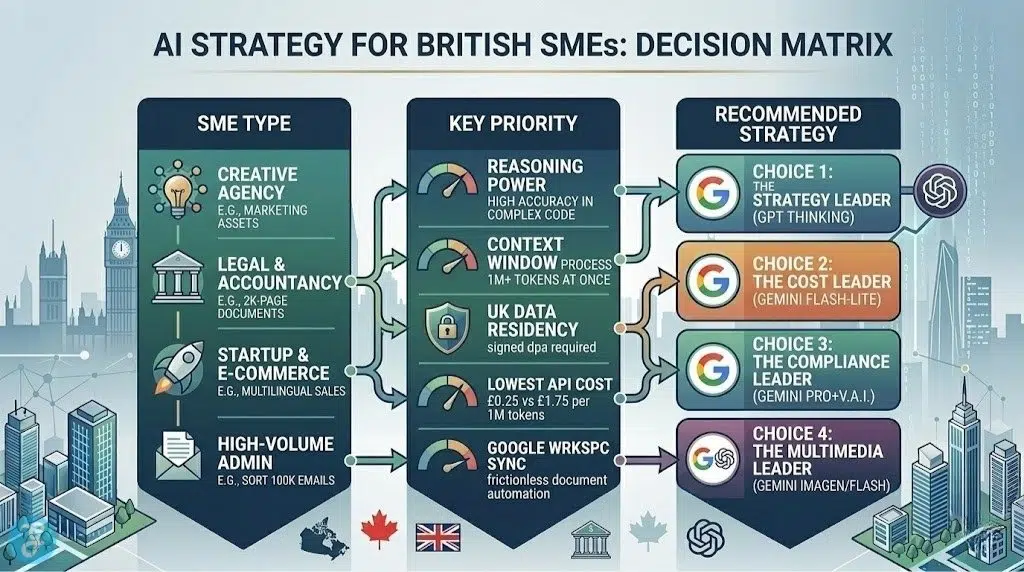
For businesses building custom internal apps, the cost difference is now a primary driver of strategy. Google’s Gemini 3.1 Flash-Lite currently costs approximately $0.25 per million input tokens while OpenAI’s GPT-5.2 is priced closer to $1.75 per million. This allows British SMEs to run heavy automations like sorting thousands of customer emails or processing UK VAT receipts without the fear of a ballooning monthly bill.
Best for: Developers and tech-heavy UK startups
Pros:
- Significant reduction in overhead for high-volume tasks
- Accessible entry point for custom-built internal tools
Things to consider: The cheaper Flash models may require more detailed prompt engineering to match the reasoning of flagship models.
2. The Context Window Advantage for Document Analysis
Gemini 3 offers a context window of up to 1 million tokens as standard with some tiers reaching much higher. This allows a business to upload their entire year’s worth of UK financial records or a 2,000-page regulatory document in one go. GPT-5.2 maintains a 400k context limit which is substantial but requires more frequent file splitting for large-scale legal or financial audits.
Best for: Legal firms, accountancy practices, and research-heavy teams
Pros:
- Eliminates the need for complex database indexing
- Allows for holistic analysis of entire project folders in one prompt
Things to consider: Processing a full 1-million-token prompt can still be slower than a smaller GPT query.
3. Local Software Ecosystem Integration
British SMEs rely heavily on platforms like Sage and Xero. Google’s Gemini Pro ($20/mo) integrates directly into Google Workspace, allowing users to pull data from spreadsheets into Docs seamlessly. OpenAI’s GPT-5.2 focuses more on Custom GPTs and the GPT Store, which requires the SME to build their own bridges via Zapier or Make.com to sync their British accounting data effectively.
Best for: Non-technical business owners using Google Workspace
Pros:
- Near-zero setup time for document and email automation
- Consistent experience across Sheets, Docs, and Gmail
Things to consider: GPT’s store offers highly specialized niche tools that Google currently lacks.
4. Data Residency and UK GDPR Compliance
As of early 2026, Google has expanded its Vertex AI regions specifically to support UK data residency requirements in the europe-west2 (London) region. While OpenAI offers enterprise-grade security, British firms often find it easier to meet local compliance standards using Google’s established UK data centers. This is a critical factor for firms handling sensitive public sector data or healthcare records under NHS contracts.
Best for: Healthcare providers and government contractors
Pros:
- Easier path to meeting UK hosting requirements
- Robust audit logs for compliance officers
Things to consider: GDPR compliance still requires the SME to sign a formal Data Processing Agreement regardless of the provider.
5. Reasoning Power vs. Creative Speed
GPT-5.2 remains the market leader in Thinking modes which provide the complex reasoning required for strategic planning or high-level coding. Gemini 3 has focused on speed and multimodal Live interaction. For a British SME, this means choosing between a tool that can plan a 5-year business strategy or a tool that can provide real-time voice translation for international clients.
Best for: Strategic planners and international exporters
Pros:
- GPT-5.2 provides higher accuracy for complex logic
- Gemini offers superior real-time multimodal performance
Things to consider: Using GPT’s high-reasoning modes is significantly more expensive per query.
6. Subscription Tier Value for Teams
ChatGPT Team ($25/user/month) is designed for collaborative workspaces with shared custom tools and a higher usage cap. Google’s AI Pro ($20/mo) is an individual powerhouse that includes 2 TB of cloud storage and deep Workspace integration. For a small UK creative agency, the storage bundle from Google often offsets the subscription cost while the collaborative Team features of GPT are better for firms with multiple departments.
Best for: Creative agencies and collaborative marketing teams
Pros:
- Google provides better individual value with storage bundles
- OpenAI offers superior team collaboration and bot-sharing
Things to consider: Scaling to 10+ users on either platform requires a significant monthly investment.
7. Multimedia Generation for Digital Marketing
UK SMEs spend thousands on stock imagery and designers. Google’s Gemini 3.1 Flash Image model is priced aggressively for high-volume generation. For a small e-commerce brand on Shopify UK, generating hundreds of product lifestyles via Gemini can save nearly 60% in creative costs compared to the more expensive DALL-E 3 integration in GPT.
Best for: E-commerce brands and social media managers
Pros:
- Massive savings on high-volume marketing assets
- Integrated image editing directly in the chat interface
Things to consider: OpenAI’s DALL-E remains slightly more intuitive for following complex artistic style prompts.
Quick Overview
Comparison Table
| Feature | Google Gemini (2026) | OpenAI GPT (2026) |
| API Entry Cost | $0.25 / 1M tokens (Flash-Lite) | $1.75 / 1M tokens (GPT-5.2) |
| Context Window | 1,000,000 Tokens | 400,000 Tokens |
| SaaS Price | ~£16.00 / mo | ~£20.00 / mo |
| Best Asset | 2TB Storage & Workspace Sync | GPT Store & High-Level Reasoning |
Our Top 3 Picks
- The Cost Leader: Gemini 3.1 Flash-Lite is the clear winner for SMEs looking to automate high-volume admin tasks.
- The Strategy Leader: GPT-5.2 remains the best choice for founders needing deep reasoning and strategic planning.
- The Creative Leader: Gemini (Imagen 4) offers the best ROI for marketing-heavy firms generating digital assets.
Buyer’s Guide: How to Choose the Right AI Strategy for British SMEs
Selecting the right provider in 2026 requires looking at your existing technical debt and future growth plans.
The Selection Framework:
- Technical Stack: If you are already on Google Workspace, Gemini is the frictionless choice.
- Workload Volume: If you process millions of tokens a day, the price difference makes Gemini the only viable financial option.
- Security Needs: Check if your industry requires UK-only data hosting which may favor Google’s local regions.
Decision Matrix (Table):
| Choose Gemini If… | Choose GPT If… |
| You need to analyze 50+ files at once. | You need the highest accuracy in complex code. |
| You want to generate marketing images cheaply. | You want to use specialized bots from the GPT Store. |
| You already pay for Google Workspace. | You need collaborative team workspaces. |
The Final Checklist
Ask yourself the following questions to help you decide:
- Have you audited your average monthly token usage to calculate API costs?
- Does your provider offer a signed DPA for UK GDPR compliance?
- Have you tested the reasoning accuracy of the Flash models vs. the Pro models?
- Are you utilizing the 2 TB storage or workspace integrations included in your fee?
- Have you set up usage limits on your API account to prevent cost overruns?
Final Thoughts
The shift toward operational AI represents a turning point for the British digital economy. By investing in a structured AI Strategy for British SMEs, firms can secure their competitive edge while keeping overheads predictable. Whether you choose the massive context of Gemini or the elite reasoning of GPT, the priority is to move from ad-hoc experimentation to a systemic integration that drives measurable productivity.