Do you ever look up at the night sky and feel small—in the best possible way? Finding great documentaries about space can be challenging. With so many options available, it’s easy to get lost in the choices. There’s also the concern of ending up with something filled only with plain facts and dry scientific explanations. But the right documentary can completely change that experience.
One example is Cosmos: A Spacetime Odyssey, widely considered one of the greatest shows ever made about the universe. It combines breathtaking visuals with big, thought-provoking questions, making the mysteries of space feel closer and more fascinating than ever.
Below is a list of seven top space documentaries designed to make choosing easier. Each one explores incredible scientific discoveries and strange, distant planets. They introduce courageous astronauts, reveal the mysteries of black holes, and showcase the vast beauty of the cosmos.
The following guide walks through the recommended shows step by step—and some of them may be more gripping than expected.
So grab a cup of coffee and dive into the journey through the universe.
Cosmos: A Spacetime Odyssey
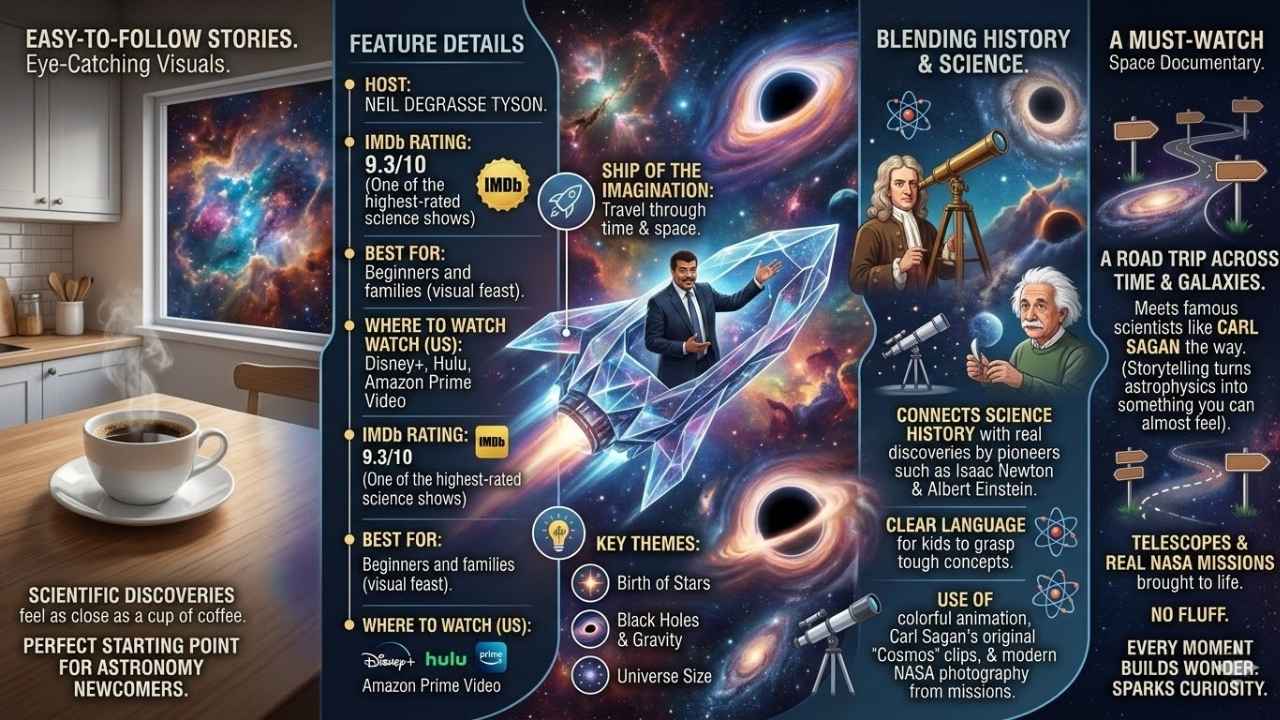
Cosmos: A Spacetime Odyssey sweeps you off your feet. It guides you through space with easy-to-follow stories and eye-catching visuals. It makes scientific discoveries about the universe feel as close as a cup of coffee on your kitchen table. Found this series to be the perfect starting point for anyone new to astronomy.
| Feature | Details |
|---|---|
| Host | Neil deGrasse Tyson |
| IMDb Rating | 9.3/10 (One of the highest-rated science shows) |
| Best For | Beginners and families who want a visual feast |
| Where to Watch (US) | Disney+, Hulu, Amazon Prime Video |
Overview and Key Themes (Cosmos)
Astrophysicist Neil deGrasse Tyson guides viewers through the wonders of space in “Cosmos: A Spacetime Odyssey.” This series helps people understand giant ideas like the birth of stars, black holes, gravity, and the size of our universe.
The show uses a device called the “Ship of the Imagination” to travel through time and space. Each episode connects science history with real discoveries by pioneers such as Isaac Newton and Albert Einstein.
The show uses clear language so even kids can grasp tough concepts. With colorful animation, old clips from Carl Sagan’s 1980 original “Cosmos: A Personal Voyage,” and modern photography from NASA missions, the series brings astronomy to life.
Scientific discoveries about galaxies, telescopes, planetary science, and how tiny atoms build everything are explained step by step. Myths meet facts as stories blend science with curiosity about Earth and far-off galaxies. People leave each episode a little more curious about what else lies out there beyond our blue planet.
Why It’s a Must-Watch
Neil deGrasse Tyson guides viewers through wonders that stretch beyond the stars. Stunning visuals mix with clear facts to make science fun. Each episode explores questions about astronomy, scientific discoveries, and the universe’s biggest mysteries.
“Cosmos: A Spacetime Odyssey” stands out as one of the best space documentaries from the last decade. Think of it like a road trip across time and galaxies.
You even make stops to meet famous scientists like Carl Sagan along the way. This documentary uses storytelling to turn astrophysics into something you can almost feel in your bones.
Kids and adults see how telescopes changed our understanding of space. The show also brings real NASA missions to life with animation and news clips. No fluff here. Every moment builds wonder. It sparks curiosity or teaches a key fact about exploration or planetary science.
The Planets
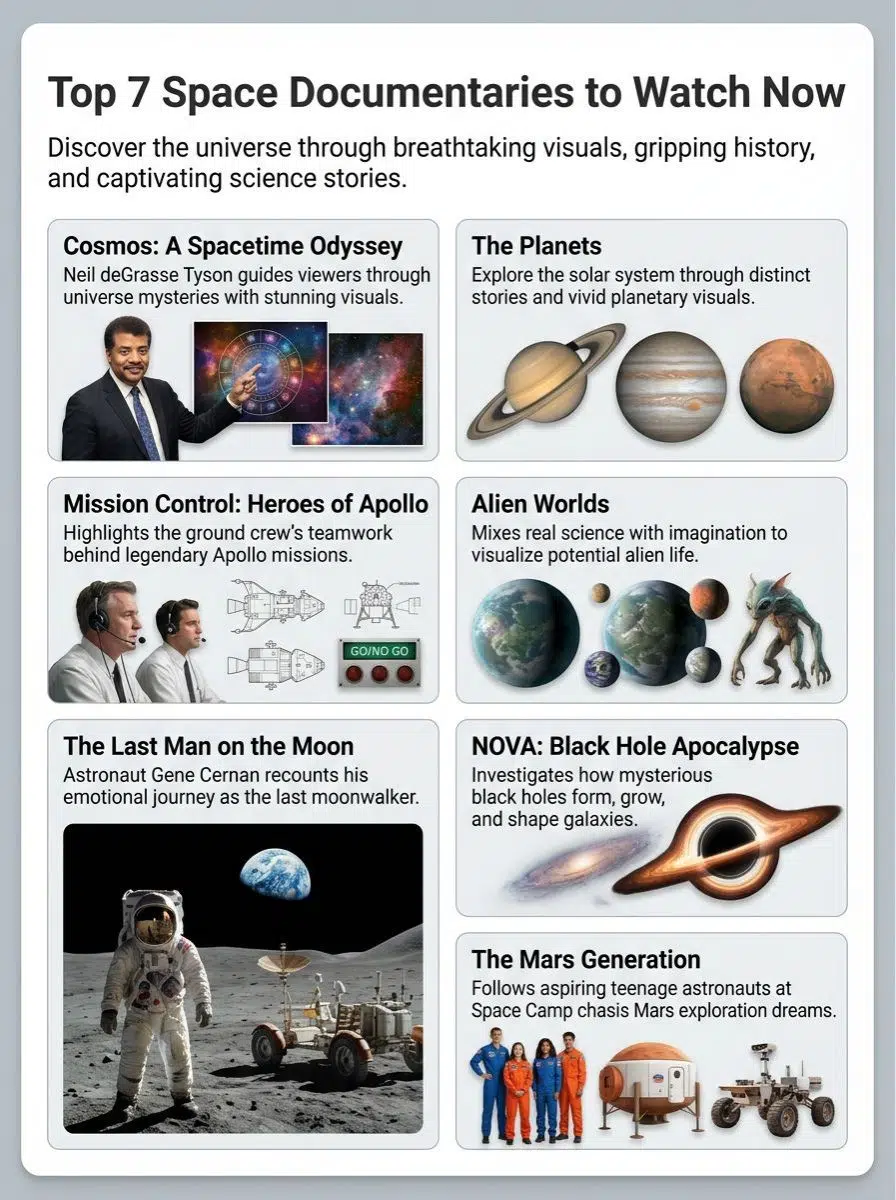
The Planets sweeps you across our solar system. It shows each planet’s wild and distinct personality. It is like hopping on a spaceship with a scientist who tells stories that stick in your memory. In the US version on PBS, you often hear the voice of Zachary Quinto, while Brian Cox narrates the UK version. Both versions use the same stunning imagery.
Overview and Key Themes (The Planets)
Planets, moons, and their secrets come alive in this colorful series. Each episode explores a different planet using new discoveries from telescopes and space probes. Thrilling facts jump out at you. You see volcanoes on Venus or giant storms raging on Jupiter.
Scientists explain how these worlds formed over billions of years. This makes the solar system feel close to home.
“The visual effects team, who also worked on the movie Gravity, used actual data from space missions to create the landscapes. You are seeing the most accurate recreation of these worlds possible without actually going there.”
Vivid visuals show wild landscapes no human has walked. Viewers see everything from icy rings circling Saturn to Mars’s red canyons.
You even see Pluto’s surprising heart shape spotted by the New Horizons mission in 2015. Historic missions get spotlighted too.
For example, scientists recall NASA’s Voyager journey past Uranus and Neptune. This documentary packs fresh research with jaw-dropping images.
It makes astronomy fun for everyone who is curious about planetary science or the cosmos as a whole.
Notable Episodes to Check Out
Science fans get a real treat with this series.
Each episode highlights a different planet using sharp visuals and recent discoveries.
- “A Moment in the Sun – The Terrestrial Planets” shows Mercury, Venus, Earth, and Mars. New NASA images bring fresh views of their surfaces.
- “Saturn: Lord of the Rings” features Saturn’s rings with never-before-seen telescope footage from Cassini.
- “Jupiter: Bringer of Jollity” explores the gas giant’s storms and changes caught by Juno in 2018.
- “Life Beyond the Sun: Saturn’s Moons” looks at Titan and Enceladus, which might have hidden oceans under ice.
- “Into the Darkness: Ice Worlds” focuses on Uranus and Neptune with close-ups from Voyager 2 since no other spacecraft has visited.
- Each story makes astronomy simple but detailed for curious minds of all ages.
- The entire series uses easy-to-understand science communication mixed with jaw-dropping visuals to spark joy and awe in both new explorers and seasoned experts alike.
Mission Control: The Unsung Heroes of Apollo
This film shines a light on the men and women who worked behind the scenes at NASA. They made every Apollo mission possible. Their calm voices and sharp minds turn chaos into triumph. They did it one button press at a time.
Overview and Key Themes (Mission Control)
Mission Control: The Unsung Heroes of Apollo pulls back the curtain on NASA’s ground crew during the legendary Apollo missions.
The film spotlights engineers, mathematicians, and flight controllers. These people kept cool as cucumbers even when things went haywire 240,000 miles from home.
What makes Mission Control stand out is its focus on teamwork and science under pressure. Interviews with real-life mission control veterans bring heart to every story told.
Viewers learn that without these tireless experts, historic achievements like landing on the Moon in 1969 would have ended very differently.
- The “Trench” Dynamics: Learn about the dynamics of the FIDO (Flight Dynamics Officer) and GUIDO (Guidance Officer).
- The Average Age: You might be shocked to learn the average age of the team during the Apollo 11 mission was only 28.
- The Culture: It highlights the cigarettes, the coffee, and the absolute dedication to the mission.
Their commitment helped shape not just space history but also inspired generations across the universe to reach for the stars.
How It Highlights NASA’s Ground Crew
Mission Control: The Unsung Heroes of Apollo shines a spotlight on NASA’s ground crew during the space race. These are the people behind each Apollo mission. You meet flight director Gene Kranz and his team of engineers.
The film uses rare photos, old footage from 1969 to 1972, and real radio chatter. These elements show their tense moments as they guide astronauts through space travel.
The documentary shares stories that rarely make headlines. For example, it covers how fast-thinking helped save Apollo 13 after its explosion in 1970.
Expect plenty of technical drama mixed with human emotion as ground teams work around the clock. Their teamwork is what turned “Houston” into a household word across America.
Alien Worlds
Alien Worlds flips the script. It mixes real science with imaginative alien life. It makes you wonder what could be out there waiting behind the stars. It is a great pick if you want something that feels like a mix of “Planet Earth” and “Star Wars“.
Overview and Key Themes (Alien Worlds)
Scientists imagine what life might look like on other planets. Using real data from astronomy and planetary science, the show builds new worlds that could exist in our universe. Astronomers draw inspiration from creatures here on Earth. They blend biology with astrophysics to make alien habitats feel possible.
Each episode takes viewers to a different planet. You explore how living things might adapt to strange climates or odd atmospheres.
| Earth Concept | Alien Application |
|---|---|
| Gravity | How high-gravity worlds might create powerful, flying “Sky Grazers.” |
| Atmosphere | How thick atmospheres allow seeds to float like balloons. |
| Symbiosis | How alien species might work together to survive two suns. |
Netflix released “Alien Worlds” as one of the 7 Best Documentaries About Space And The Universe for those curious about extraterrestrial life. The series leans into scientific discoveries and creative thinking. Biologists and physicists work together to explain how gravity, light, or weather would shape animals far beyond home.
Animations let people see these imagined creatures move and hunt as if they were real parts of another cosmos.
Exploring the Concept of Extraterrestrial Life
Alien Worlds takes viewers on a journey beyond Earth. It uses real science to imagine life on distant planets. The series shows how creatures might survive in harsh places using what we know about astronomy and planetary science. In each episode, things like gravity, atmosphere, and energy shape possible alien animals and plants.
The documentary stands out for its creative use of computer graphics along with clear facts from experts in astrobiology and exploration.
Alien Worlds brings up big ideas about where life could exist outside our solar system. With so many exoplanets discovered by new telescopes since 2015, the chances of finding other forms of life feel closer than ever before.
The Last Man on the Moon
This film shares the story of an astronaut’s final steps on the lunar surface. He left footprints and memories behind. It shows how reaching for the stars can spark hope, courage, and wonder in each of us. This is less about the rocket science and more about the human heart.
Overview and Key Themes (The Last Man on the Moon)
Gene Cernan’s story in The Last Man on the Moon brings Apollo’s final journey to life. His voice is calm but full of feeling. He leads viewers through both his training days and emotional moments with NASA. The film shows rare footage from the Apollo 17 mission. It puts a human face on American space history. Every shot tells how it felt to stand alone with Earth shining above.
“I stood on the blue lawn of my home and looked at the moon, and I thought, ‘I’ve been there.'” – Gene Cernan
The documentary highlights sacrifice and bravery in space travel like few others do. Family photos, journal entries, and interviews add layers that simple facts cannot give. Viewers see what astronauts leave behind every time they launch into the cosmos.
History buffs and astronomy fans will spot real NASA records alongside stories about friendship. These are the bonds between crew members who shaped planetary science forever.
An Emotional Journey Through Space History
Twelve men have walked on the Moon. But only Gene Cernan was the last to leave his footprints behind. “The Last Man on the Moon” tells his story with raw emotion and honesty. The film uses real NASA footage, interviews with astronauts, gritty mission control scenes, and personal stories from families back home.
Pain, joy, and hope all come alive through these tales. During Apollo missions like Apollo 17 in 1972, people watched history unfold live on TV screens across America. Viewers see what it meant for engineers at Mission Control to risk sleep and safety for a shot at greatness.
This story is more than space travel. It is about courage and loss too. Friends never came home from some flights. Through every triumph or heartbreak shown here, space history feels close enough to touch.
NOVA: Black Hole Apocalypse
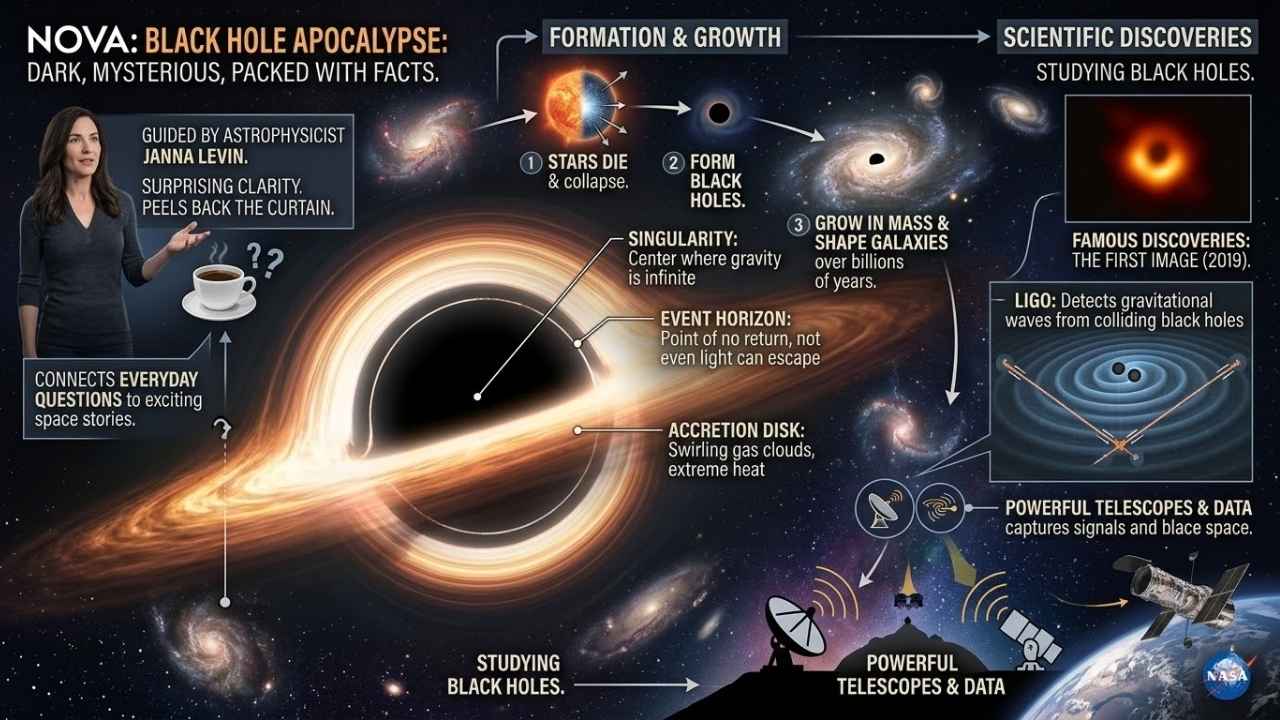
Dark, mysterious, and packed with mind-bending facts. This film peels back the curtain on black holes. You might find yourself questioning everything you thought you knew about space itself. It tackles the heaviest topic in the universe with surprising clarity.
Overview and Key Themes (NOVA: Black Hole Apocalypse)
NOVA: Black Hole Apocalypse takes viewers on a journey through the mysteries of black holes. Astrophysicist Janna Levin guides you with clear explanations and stunning visuals. The documentary shows how black holes form from dying stars.
It explains how they grow in mass and shape galaxies over billions of years. Scientists use powerful telescopes to capture signals and data from these strange objects. Some key scenes explore famous discoveries like the first image of a black hole in 2019.
- Singularity: The center of a black hole where gravity is infinite.
- Event Horizon: The point of no return where not even light can escape.
- LIGO: The observatory that detects gravitational waves from colliding black holes.
The film breaks down big ideas. It explains how gravity pulls everything into these cosmic giants.
Even light cannot escape their grasp. Experts share results from groundbreaking research in astronomy and astrophysics. NOVA ties everyday science questions to exciting space exploration stories. This makes the universe’s most mysterious objects feel more familiar yet still awe-inspiring for any astronomy enthusiast or curious viewer at home.
Delving Into the Mysteries of Black Holes
Black holes are the universe’s biggest show-offs. Their gravity is so strong that nothing can escape. Scientists use powerful telescopes and clever tricks to spot these cosmic giants.
NOVA: Black Hole Apocalypse breaks down what happens when stars die and collapse into black holes. Astrophysicist Janna Levin joins in with easy explanations.
She shows what makes black holes both scary and exciting for astronomers. The documentary uses real images from NASA missions to reveal swirling gas clouds, event horizons, and strange signals from space. This film proves that studying black holes pushes science far beyond old ideas about astronomy. It brings out questions humans have had for centuries.
The Mars Generation
Watch young dreamers chase their chance to touch the stars. Their passion for space travel makes even grown-ups want to reach out and grab a telescope. This is a Netflix Original that hits different because it focuses on the future, not just the past.
Overview and Key Themes (The Mars Generation)
The Mars Generation gives kids and teens a front-row seat to space travel dreams. It follows young people at NASA’s Space Camp in Huntsville, Alabama. They are chasing a future on Mars. The film features astronaut hopefuls, scientists, and experts who talk about the steps needed for humans to reach the Red Planet. Interviews with real NASA engineers shine light on what it takes to launch new missions.
| The Dreamers | The Experts |
|---|---|
| Teenagers at Space Camp (“The Aurora Generation”) | Bill Nye “The Science Guy” |
| Future Astronauts | Neil deGrasse Tyson |
| Passionate Students | Elon Musk |
Key themes include science education, curiosity about exploration, and how youth today could lead tomorrow’s discoveries. The story highlights both past heroes from Apollo missions and new thinkers who love astrophysics. Facts, passion, and humor are all here. This documentary has them packed tighter than an astronaut glove.
Inspiring the Next Generation of Space Explorers
Kids today watch real astronauts like Neil Armstrong and Buzz Aldrin walk on the moon in films such as “Apollo 11.” Future scientists can see how NASA’s ground crew kept missions safe by watching “Mission Control: The Unsung Heroes of Apollo.” Documentaries from the last few years, including “Alien Worlds,” use science fiction to spark big dreams about life across galaxies.
Space documentaries often show teens training with space gear or learning from space veterans. Viewers spot advanced telescopes, heroic teams, and groundbreaking scientific discoveries. Young explorers pick up facts about planets, black holes, and cosmic wonders through hits like “Cosmos: A Spacetime Odyssey.” These stories fuel curiosity in astronomy, astrophysics, planetary science, and space travel for kids at home everywhere.
Final Thoughts
Space documentaries make astronomy, science, and exploration easy for everyone to enjoy at home. These seven films share new discoveries, stunning visuals, and rich stories about the universe. Each one offers clear facts that light up our curiosity. Watching them is simple fun that feeds hungry minds. You do not even need a telescope. Which film will spark your wonder first?
Maybe you will start thinking about what else is out there. Chase those big questions further by checking out more space shows or visiting a local planetarium. After all, every great journey begins with just a bit of curiosity. The right film can launch it.