
Working hard toward a goal while the finish line still feels miles away can be incredibly frustrating. Many people have experienced that moment — staring at an objective that seems just out of reach. But what if success could be trained for before any physical action is taken? It may sound like a secret shortcut, yet it is firmly grounded in scientific research.
A powerful concept known as mental imagery has been used by everyone from Olympic gold medalists to top CEOs. This technique involves mentally rehearsing success in vivid detail, strengthening the brain’s pathways associated with performance and achievement. Understanding how it works — and how to apply it effectively — can reshape the way goals are pursued. Let’s explore the science of mental imagery or visualizing success and how it can influence real-world results.
Understanding Mental Imagery
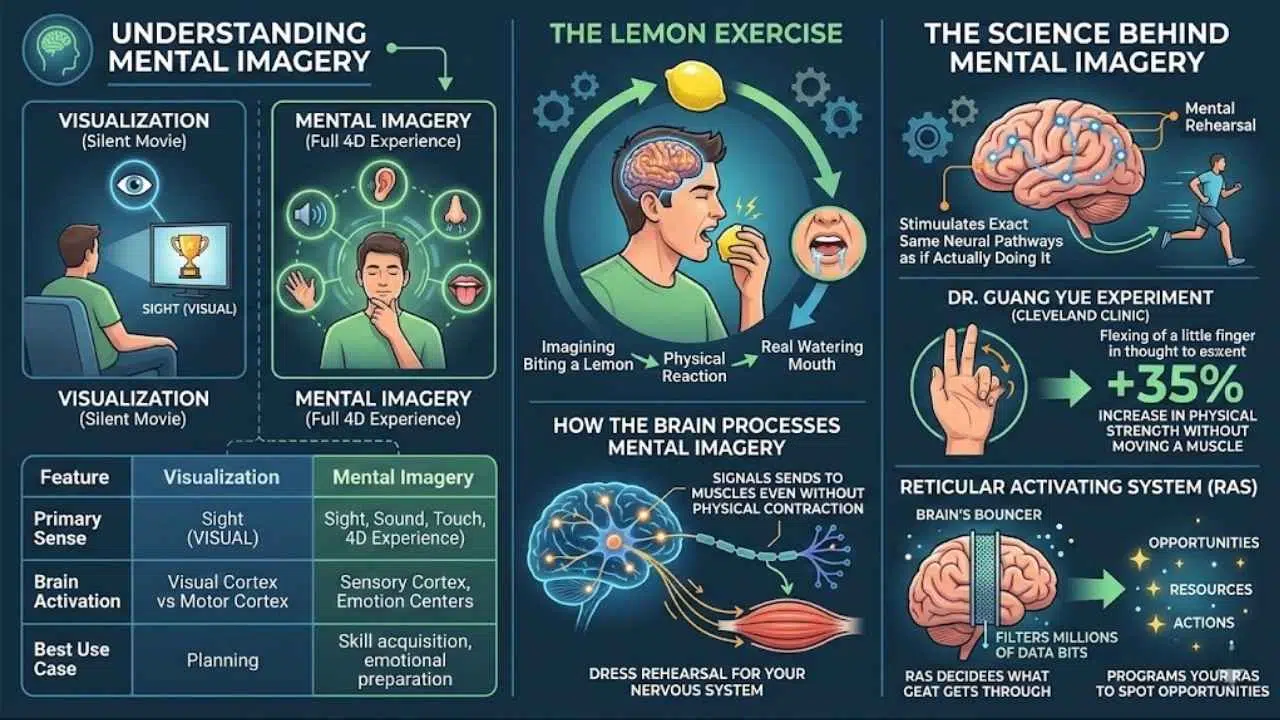
Mental imagery is often confused with simple visualization, but there is a distinct difference. Think of visualization as a silent movie, while mental imagery is the full 4D experience with surround sound and smell-o-vision.
What is Mental Imagery?
Mental imagery involves using all your senses to create a realistic experience in your mind. It is not just about “seeing” a trophy. It is about feeling the cool metal in your hands, hearing the roar of the crowd, and even smelling the freshly cut grass on the field.
When you engage all your senses, your brain has a hard time distinguishing between what is real and what is imagined. A classic way to test this is the “Lemon Exercise.” If you vividly imagine biting into a sour, yellow lemon—feeling the juice squirt, tasting the acidity—your mouth will likely start to water for real. That physical reaction is the power of mental imagery at work.
The Difference Between Visualization and Imagery
While visualization focuses primarily on the visual sense, mental imagery is a multi-sensory event. Here is a simple breakdown of how they compare:
| Feature | Visualization | Mental Imagery |
|---|---|---|
| Primary Sense | Sight (Visual) | Sight, Sound, Touch, Smell, Taste |
| Brain Activation | Visual Cortex | Motor Cortex, Sensory Cortex, Emotion Centers |
| Best Use Case | Planning a route or layout | Skill acquisition and emotional preparation |
The Science Behind Mental Imagery
You might be wondering how sitting still can actually improve your performance. The answer lies in your brain’s complex wiring, specifically a system that acts like a filter for your reality.
How the Brain Processes Mental Imagery
When you vividly imagine performing an action, your brain stimulates the exact same neural pathways as if you were actually doing it. This was famously demonstrated by Dr. Guang Yue at the Cleveland Clinic. His team found that people who simply imagined flexing their little finger muscle for 15 minutes a day saw a 35% increase in physical strength without ever moving a muscle.
This happens because your brain sends signals to your muscles during imagery, strengthening the neural connection even without physical contraction. It is essentially a dress rehearsal for your nervous system.
The Reticular Activating System (RAS)
One of the most powerful players in this process is the Reticular Activating System, or RAS. Think of the RAS as a bouncer for your brain. It filters out millions of bits of data to let in only what it thinks is important.
“Your RAS is the reason you suddenly see red cars everywhere after you decide to buy one. When you visualize success, you are programming your RAS to spot opportunities that help you achieve that goal.”
By regularly feeding your mind detailed images of success, you are telling your RAS, “This is important.” Your brain then starts working overtime to find the resources, people, and actions needed to make that image a reality.
Benefits of Visualizing Success
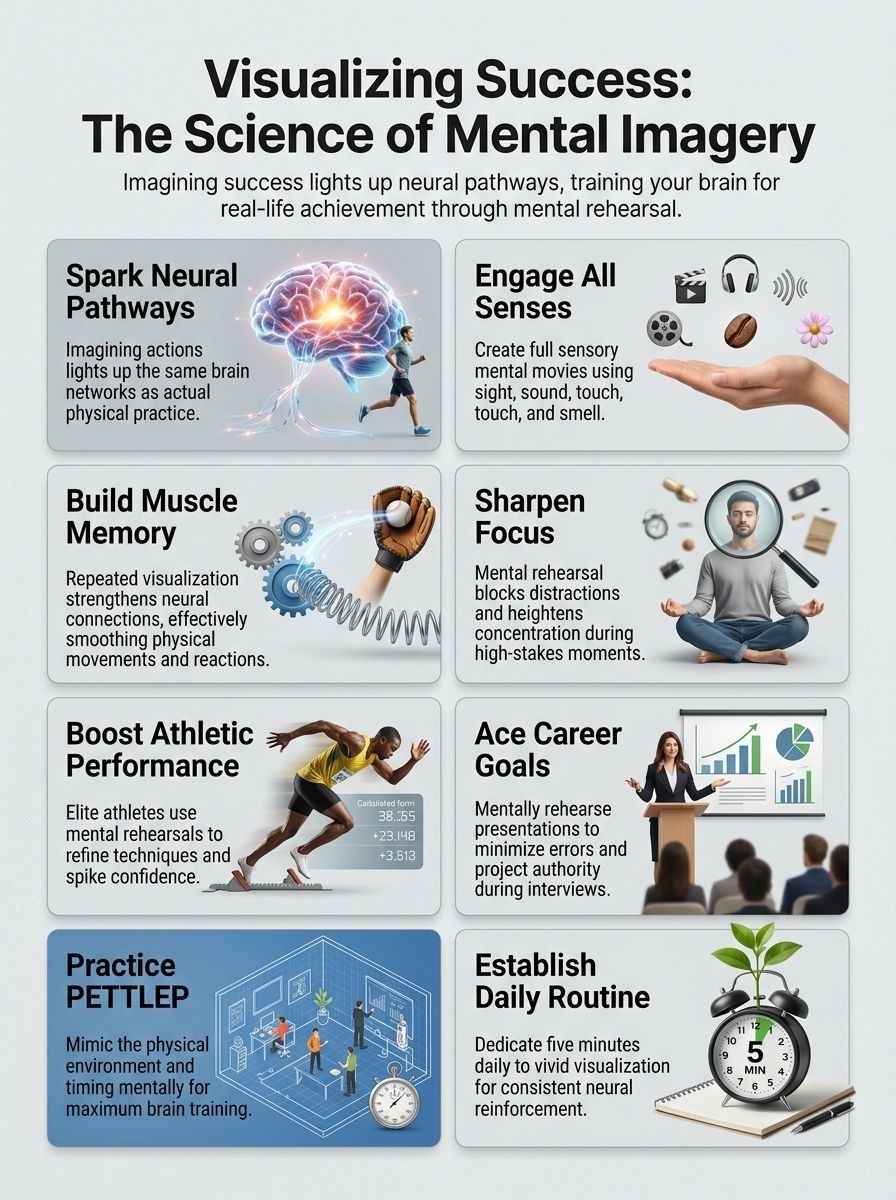
The benefits of this practice go far beyond just “feeling positive.” The data shows that consistent mental practice can lead to measurable improvements in performance and well-being.
Strengthening Self-Efficacy
Self-efficacy is the unwavering belief in your ability to succeed. A 2025 study from the University of Colorado Boulder found that imagining a positive interaction can actually change how your brain stores information about people and situations. This means you can rewire your brain to expect success rather than failure, which significantly lowers anxiety.
Enhancing Focus and Motivation
In a world full of distractions, mental imagery acts like a laser focus for your mind. When you have a clear, multi-sensory picture of your goal, you are less likely to get sidetracked.
- Clearer Priorities: Your brain knows exactly what target to hit.
- Reduced Anxiety: Familiarity breeds comfort. If you have “lived” the speech in your mind fifty times, the real thing feels like just another practice run.
- Higher Persistence: You are more likely to push through setbacks because you have already “seen” the payoff at the end.
Accelerating Skill Development
Mental rehearsal is a shortcut to mastery. In a famous experiment often cited in sports psychology by Australian researcher Alan Richardson, three groups of students practiced free throws. One group practiced physically, one did nothing, and one only visualized.
The visualizers improved their shooting percentage by 23%, almost matching the 24% improvement of the physical practice group. This proves that mental reps are nearly as valuable as physical ones when it comes to training your brain.
Practical Applications of Mental Imagery
So, how do we take this out of the lab and into the real world? Whether you are trying to make the varsity team or nail a quarterly review, the application is surprisingly similar.
Athletic Performance and Sports Training
Athletes are the power users of mental imagery. They do not just “hope” to win; they live the win before the game starts. US Olympic luminaries like Lindsey Vonn and Michael Phelps are famous for visualizing every turn and stroke of their races.
For the best results, athletes use a specific framework called the PETTLEP Model. This approach ensures you are covering all the bases:
- Physical: Adopt the stance and wear the clothes you would for the event.
- Environment: Imagine the specific location where you will perform.
- Task: Focus on the same thoughts and feelings as the real task.
- Timing: Visualize in real-time, not slow motion (unless you are learning a new skill).
- Learning: Update your imagery as your skills improve.
- Emotion: Feel the excitement or nerves you expect to feel.
- Perspective: See it through your own eyes (internal) rather than like a TV camera (external).
Academic and Career Success
You can apply these same athlete-level strategies to your career. Public speaking is a prime example. With Glossophobia (the fear of public speaking) affecting roughly 77% of the population, visualization is a potent cure.
Before a big presentation, do not just read your notes. Close your eyes and picture the conference room. See the faces of your colleagues. Hear your voice projecting clearly and confidently. A 2024 report on workplace anxiety suggests that this kind of “cognitive rehearsal” can reduce cortisol levels, helping you stay calm when the spotlight hits you.
Overcoming Challenges and Building Resilience
Life rarely goes exactly to plan. You can use imagery to prepare for the bumps in the road, too. This is often called “coping imagery.”
Instead of only imagining the perfect outcome, imagine something going wrong—like a projector failing or a difficult question—and then vividly imagine yourself handling it with grace and calm. This builds a “mental armor” that keeps you from freezing up when real-world problems arise.
Tips to Enhance Your Visualization Practice
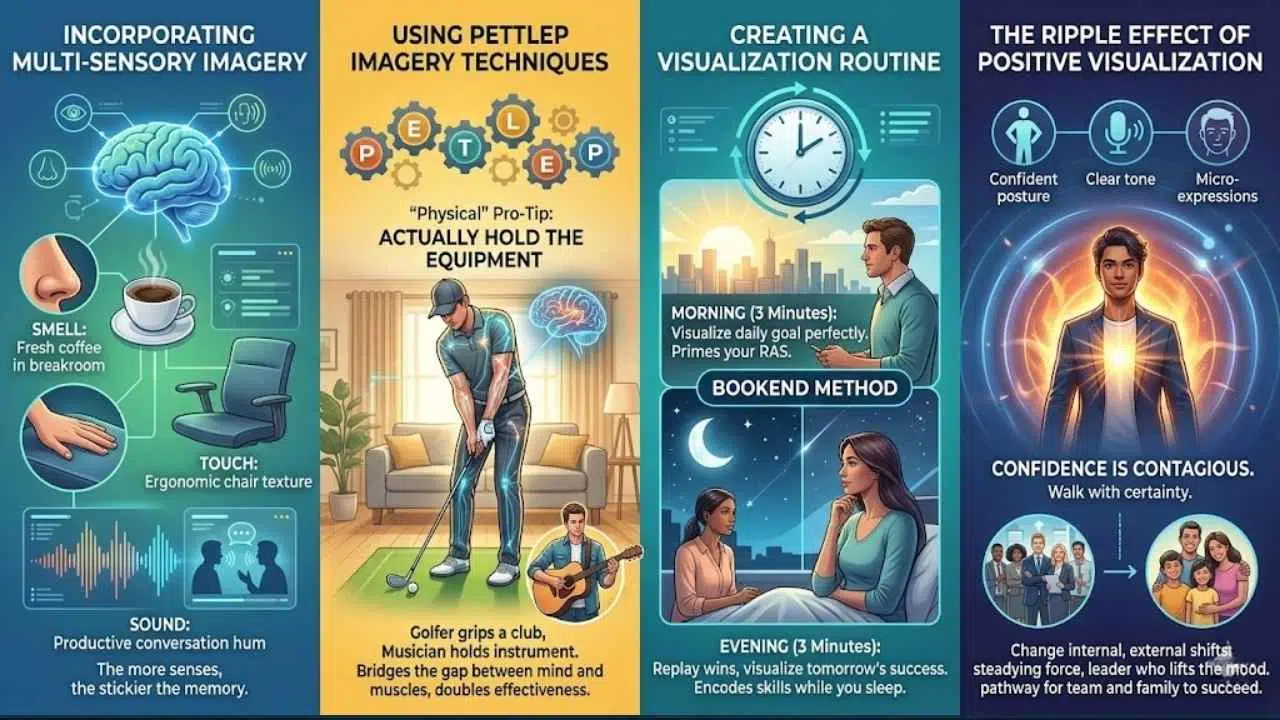
Ready to start? You do not need a meditation cushion or an hour of free time. You just need a smarter approach.
Incorporating Multi-Sensory Imagery
The more senses you use, the “stickier” the memory becomes for your brain. If you are visualizing a new office, do not just see the desk.
- Smell: The scent of fresh coffee in the breakroom.
- Touch: The texture of the ergonomic chair.
- Sound: The low hum of productive conversation.
Using PETTLEP Imagery Techniques
We touched on this earlier, but here is a pro-tip for the “Physical” aspect of PETTLEP that many people miss. Actually hold the equipment.
“If you are a golfer visualizing a swing, stand in your living room and grip a club. If you are a musician, hold your instrument. The physical sensation of the object in your hands bridges the gap between your mind and your muscles, making the visualization twice as effective.”
Creating a Visualization Routine
Consistency is key. You cannot do this once and expect a miracle. Try the “Bookend Method” to build a habit:
- Morning (3 Minutes): Visualize your main goal for the day going perfectly. This primes your RAS immediately.
- Evening (3 Minutes): Replay the day’s wins and visualize tomorrow’s success. This helps encode the skills while you sleep.
The Ripple Effect of Positive Visualization
When you change your internal world, your external world shifts to match it. This isn’t just about you reaching a goal; it’s about the energy you bring to those around you.
Confidence is contagious. When you walk into a room having already “seen” a successful outcome, your body language, tone, and micro-expressions reflect that certainty. People respond to that. You become a steadying force, a leader who lifts the collective mood. By visualizing your own success, you often inadvertently create a pathway for your team or family to succeed alongside you.
Final Thoughts
Mental imagery is a skill, just like learning to ride a bike or type on a keyboard. It might feel a little awkward at first, but the science is undeniable. By training your brain to see success, you are physically altering your neural pathways to make that success more likely.
Start small today. Pick one upcoming challenge—a meeting, a workout, or a difficult conversation—and spend three minutes running through it in your mind with full sensory detail. You might just find that when the moment arrives, it feels like you have done it a thousand times before. You have the tools. Now it is time to close your eyes and get to work.