
You know that feeling of being completely overwhelmed by software that tries to do everything? In my work analyzing executive wellness and work trends, I have noticed a shift. Professionals are tired of bloat. They want tools that do one thing perfectly. That is the role of Micro-SaaS in 2026.
We are seeing a move away from giant platforms toward specific, lean solutions. It is changing how we handle our gigs and our downtime. Let’s look at the data behind this shift and how you can use it to reclaim your schedule.
What is Micro-SaaS?
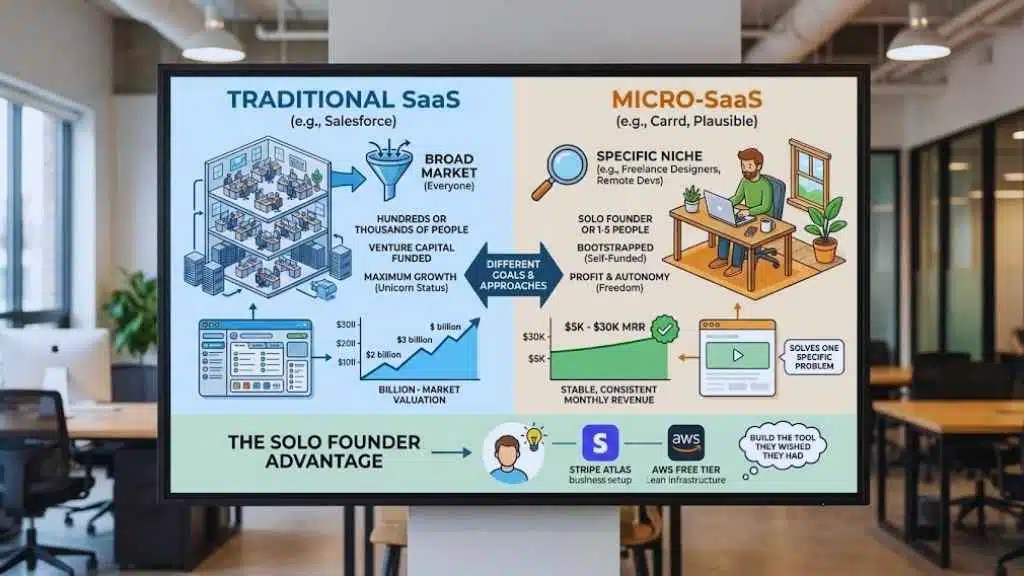
Micro-SaaS is a software business that solves one specific problem for a clearly defined group of people. These companies are often run by a solo founder or a very small team. They prioritize profit and sanity over endless growth.
Definition and key characteristics
A Micro-SaaS business runs on the Software-as-a-Service model but operates with a tiny footprint. Unlike massive tech companies that need to please everyone, a Micro-SaaS product serves a narrow niche. Think of Carrd, a tool built by a solo founder that just makes simple one-page websites, or Plausible Analytics, which offers a privacy-focused alternative to Google Analytics.
These products have low operating costs and high margins. In 2026, successful Micro-SaaS companies often generate between $5,000 and $30,000 in monthly revenue. They reach this level without venture capital or board meetings. The focus is on simple features that work reliably for groups like freelance designers, remote developers, or digital creators.
How it differs from traditional SaaS
The difference lies in the goal. Traditional SaaS chases “unicorn” status with billion-dollar valuations. Micro-SaaS chases freedom and profitability. Here is how they compare:
| Feature | Traditional SaaS (e.g., Salesforce) | Micro-SaaS (e.g., Carrd) |
|---|---|---|
| Target Audience | Everyone (Broad Market) | Specific Niche (e.g., Tutors, Plumbers) |
| Team Size | Hundreds or Thousands | 1 to 5 People |
| Funding | Venture Capital | Bootstrapped (Self-Funded) |
| Goal | Maximum Growth | Maximum Profit & Autonomy |
The role of solo founders and small teams
Solo founders lead this movement. They move fast because they do not have to wait for approval. A founder can spot a new trend in the gig economy, like a need for AI-generated invoices, and build a solution in weeks.
They rely on powerful infrastructure tools like Stripe Atlas for business setup and AWS Free Tier to keep hosting costs near zero. This lean approach allows them to compete in areas big companies ignore. In my experience, the most successful founders are those who solve a problem they faced themselves. They build the tool they wished they had.
Why Micro-SaaS is Thriving in the Gig Economy
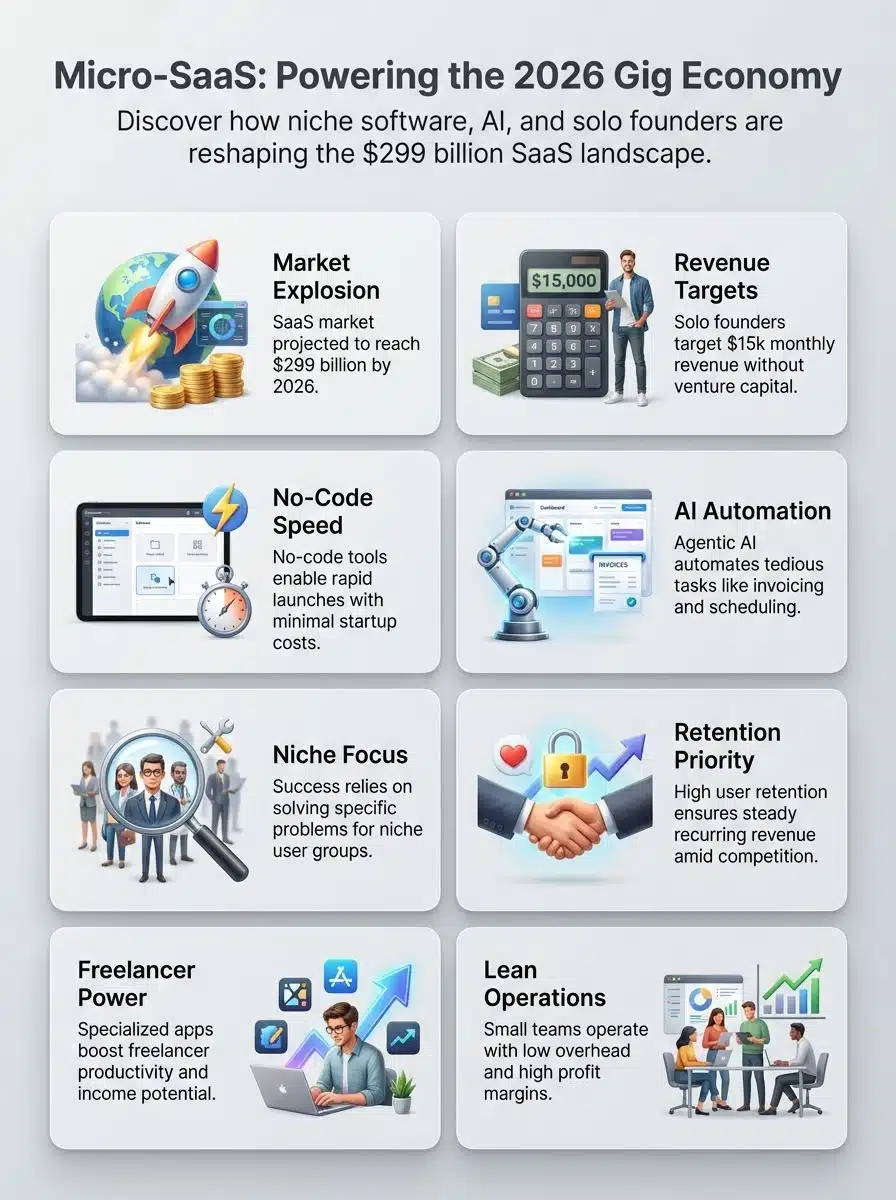
The US gig economy is massive. Recent data shows there are over 76 million freelancers in the United States as of 2026. This huge workforce needs specialized tools to manage their independent businesses, and Micro-SaaS is filling that gap.
Lower start-up costs and faster development
Starting a software company used to cost a fortune. Now, the barrier to entry is almost non-existent. Founders use platforms like Vercel or Supabase to launch applications with little to no upfront cost. This financial freedom changes everything.
It means a developer can experiment with an idea for a “weekend project” without risking their life savings. If the tool gains traction, they scale it. If not, they move on. This speed allows for rapid innovation that big corporations simply cannot match.
Niche targeting and high user engagement
General tools are often frustrating because they are too complex. Micro-SaaS wins by being simple. A freelance photographer does not need a complex CRM like HubSpot. They need a simple tool to book mini-sessions and send galleries.
When a product fits a user’s workflow perfectly, engagement skyrockets. Users feel heard because the founder often handles support tickets personally. This direct connection builds a loyal community that big brands struggle to replicate.
Recurring revenue with low overhead
The subscription model is the engine of Micro-SaaS. A tool charging $29 per month needs only 300 customers to hit $100,000 in annual revenue. Because the team is small and automation handles the billing, most of that revenue is profit.
This efficiency creates a stable income stream. It allows founders to step back and focus on life outside of work, which aligns perfectly with the “work to live” mindset many gig workers value.
The rise of no-code and low-code tools
You no longer need to be a master coder to build a business. Platforms like Bubble and FlutterFlow let non-technical founders build complex apps visually. This democratization means the people who understand the problems—like accountants or teachers—can now build the solutions.
By 2026, we see thousands of “citizen developers” launching tools that serve their specific industries. It is shifting power from Silicon Valley engineers to subject-matter experts across the country.
Key Factors Driving Micro-SaaS Growth in 2026
Technology moves fast. In 2026, we are seeing a shift from simple automation to intelligent action. This evolution is what keeps Micro-SaaS relevant and necessary.
Automation and AI advancements
We have moved beyond basic chatbots. The trend in 2026 is “Agentic AI”—systems that can plan and execute tasks on their own. Tools built on frameworks like Microsoft AutoGen or CrewAI can now act as virtual employees.
For example, an agentic tool might not just tell you that you have an email. It could draft a reply, schedule a follow-up meeting, and update your CRM without you clicking a button. This level of help is priceless for a solo freelancer trying to juggle ten clients at once.
Demand for hyper-specialized solutions
Generic software is out. Specific software is in. We see this with tools like Kit (formerly ConvertKit), which focuses entirely on creators, ignoring other sectors. Gig workers are willing to pay for tools that speak their language.
A graphic designer will choose a file-sharing tool made for visual assets over a generic Dropbox link every time. This demand for “custom-fit” software drives the entire Micro-SaaS market forward.
Increased focus on customer retention
Acquiring new customers is expensive. Smart Micro-SaaS founders know that keeping existing users is the key to survival. They use automated onboarding and personal check-ins to ensure customers get value immediately.
“The most successful founders I know don’t obsess over growth charts. They obsess over churn. They know that keeping a customer for five years is better than finding five new ones.”
By focusing on retention, these small businesses build a solid foundation that can weather economic downturns. They become indispensable partners to their users rather than just another monthly expense.
Applications of Micro-SaaS in the Gig Economy
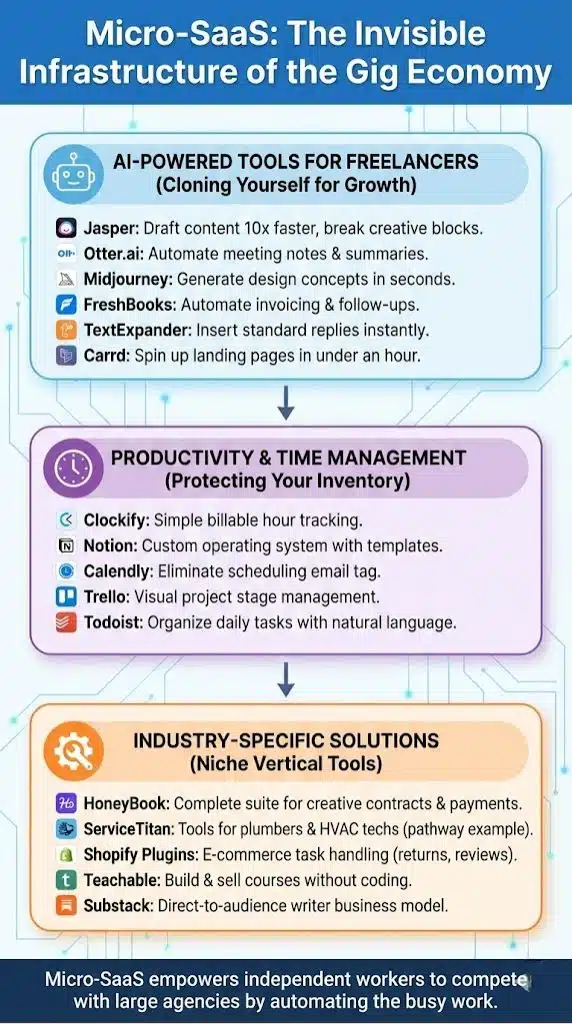
Micro-SaaS tools are the invisible infrastructure of the gig economy. They help independent workers compete with large agencies by automating the busy work.
AI-powered tools for freelancers
Freelancers use these tools to clone themselves. They let software handle the repetitive tasks so they can focus on the creative work that pays the bills.
- Jasper helps writers break through creative blocks and draft content ten times faster.
- Otter.ai joins meetings to take notes and summarize action items so the freelancer can stay focused on the conversation.
- Midjourney allows designers to generate concepts and mood boards in seconds rather than days.
- FreshBooks automates invoicing and follow-ups so freelancers never have to have that awkward “where is my money” conversation.
- TextExpander saves hours of typing by instantly inserting standard email replies or code snippets.
- Carrd lets professionals spin up landing pages for new service offerings in under an hour.
Productivity and time management apps
Time is the only inventory a gig worker has. Protecting it is crucial. Micro-SaaS apps help professionals track where their time goes and ensure they are billing for every minute.
- Clockify offers a simple way to track billable hours across different projects and clients.
- Notion has spawned an entire economy of templates that turn it into a custom operating system for any business.
- Calendly eliminates the endless email tag of scheduling by letting clients book open slots directly.
- Trello provides a visual way to manage project stages without the complexity of enterprise project management software.
- Todoist keeps daily tasks organized with natural language input that feels like talking to an assistant.
Industry-specific solutions for gig workers
The best Micro-SaaS tools are those you have never heard of because they are built for a job you don’t do. These vertical solutions are highly profitable because they have no real competition.
- HoneyBook gives creative freelancers a complete suite to manage contracts and payments in one branded portal.
- ServiceTitan (originally a smaller player, now huge) showed the path for tools serving plumbers and HVAC technicians.
- Shopify plugins act as micro-SaaS businesses that help e-commerce store owners handle specific tasks like returns or reviews.
- Teachable allows educators to build and sell courses without needing to be web developers.
- Substack gave writers a business model that bypasses traditional media gatekeepers entirely.
Challenges Facing Micro-SaaS Businesses
It is not all passive income and beach vacations. Running a Micro-SaaS business is hard work. Founders face specific hurdles that can kill a project before it starts.
Market saturation and competition
The low barrier to entry is a double-edged sword. Because it is easy to start, everyone is doing it. A search for “AI writing tool” returns hundreds of results. Standing out is the hardest part.
A sobering statistic from 2025 shows that while the top tier of Micro-SaaS generates healthy profits, nearly 70% of these businesses earn less than $1,000 a month. Founders must be realistic. Success requires finding a “micro-niche” that is too small for big players but big enough to support a small team.
Balancing product development and marketing
Most Micro-SaaS founders are builders. They love coding. They often hate marketing. But in 2026, the code is the easy part. Getting attention is the work.
Founders have to wear every hat. One hour they are fixing a database bug, and the next they are writing a LinkedIn post or recording a demo video. Burnout is a real risk. The most successful founders learn to automate their marketing just like they automate their code.
Retaining users in small niches
In a small market, every customer counts. You cannot afford to lose them. If a user finds a bug, they need a fix today, not next week. This pressure can be intense for a solo founder.
Insider Tip:
Many experienced founders on Indie Hackers suggest avoiding the “feature trap.” Do not just add features to keep people. Instead, improve the reliability and speed of what you already have. Users leave slow, buggy tools faster than they leave simple ones.
The Future of Micro-SaaS in the Gig Economy

As we look ahead, the line between “gig worker” and “software company” will blur. Freelancers will build their own tools, and tools will enable new types of freelancing.
Opportunities in emerging technologies
We are moving toward “composable” software. Instead of buying one giant suite, businesses will stack five or six Micro-SaaS tools together. This trend favors small, specialized players.
We will also see more tools built on “API-first” principles. This means a Micro-SaaS might not even have a user interface. It might just be a powerful engine that connects two other tools, like linking a payment gateway to a Discord server. This invisible software is a huge growth area.
Predictions for scalability and innovation
By 2026, the definition of a “tech company” has changed. You don’t need a headquarters in San Francisco. You just need a laptop and a problem to solve.
The SaaS market is projected to reach nearly $375 billion this year. Micro-SaaS will capture a significant slice of that by serving the edges—the small, weird, specific problems that big companies ignore. For the gig economy, this means better tools, more autonomy, and a future where work fits around life, not the other way around.
Final Thoughts
Micro-SaaS is reshaping the gig economy by proving that small can be powerful. It offers a path for solo founders to build meaningful businesses and gives freelancers the specific tools they need to succeed.
These solutions are growing because they respect our time and intelligence. They don’t try to take over our entire workflow; they just fix the one thing that is broken. With the rise of no-code platforms and AI agents, the ability to build these solutions is now in everyone’s hands.
Staying open to these tools means you can automate the boring stuff and focus on the work that actually lights you up. From what I have seen, the right Micro-SaaS tool doesn’t just save you money—it saves your sanity.