

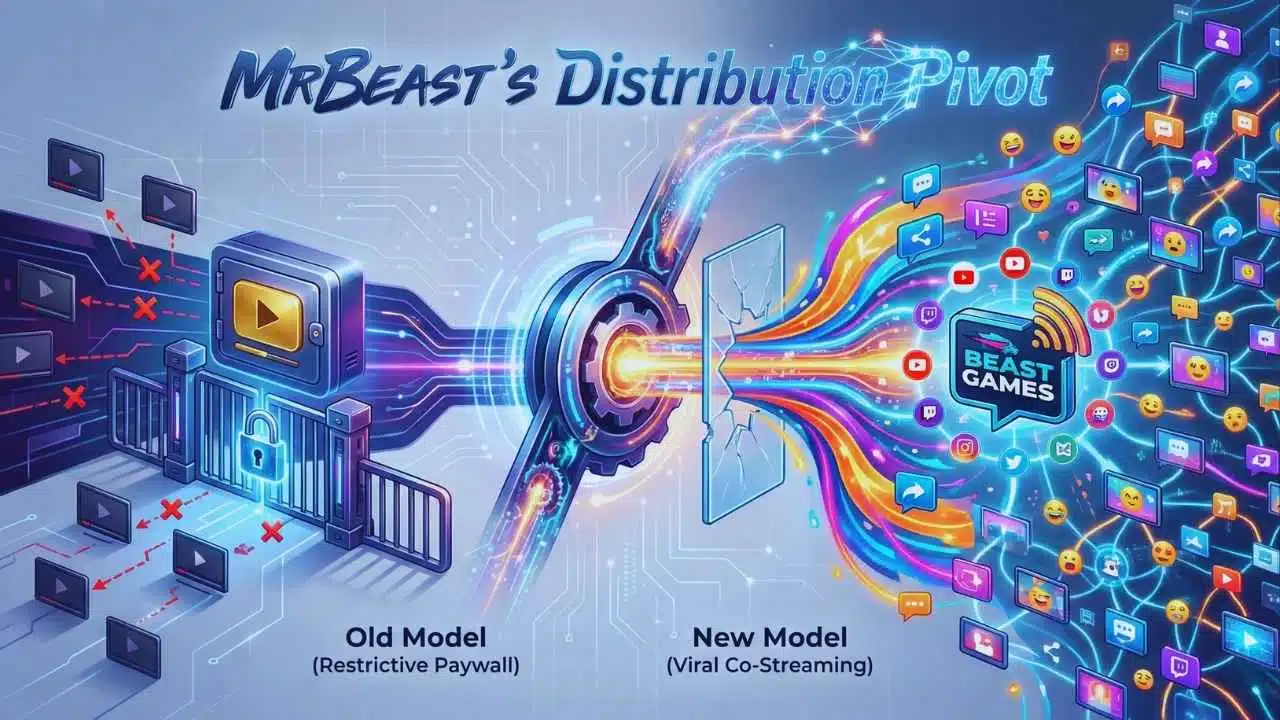
MrBeast’s Copyright Gambit matters right now because it turns copyright from a “stop sign” into a growth tool: by allowing streamers to use Episode 1 of Beast Games Season 2 without fear of claims, he makes a paywalled TV launch behave like internet-native culture, and forces platforms to rethink who gets to “distribute” premium video in 2026.
How A Paywalled Show Tries To Stay Internet-Native?
MrBeast built his empire in an environment where distribution is social, not scheduled. On YouTube, the “launch” is rarely just the upload. It is the reaction wave, clip farming, memes, commentary, and follow-on videos that keep the content alive for weeks. Subscription streaming flips that model. A paywall increases revenue per viewer, but it reduces the frictionless sharing that creators rely on to keep their audiences feeling involved.
That tension is the backdrop for Beast Games. Season 1 proved the upside of crossing over. Amazon said the show became Prime Video’s most-watched unscripted series ever, reaching 50 million viewers within 25 days of its December 19, 2024 premiere, and it was renewed for additional seasons. Season 2 launches January 7, 2026, and Amazon’s materials frame it as “Strong vs. Smart,” with 200 contestants and a $5 million top prize, releasing three episodes at launch and then weekly.
MrBeast’s strategic problem is simple: he cannot afford to “lose the internet” while gaining Hollywood-scale production. That is why the copyright waiver is not a gimmick. It is an attempt to merge two incompatible launch systems: the paywalled premiere and the viral co-stream.
| What Creator-Led Launches Need | What Subscription Streaming Optimizes For | The Friction Point |
| Fast remixing (reactions, clips, commentary) | Controlled access and exclusivity | Sharing often triggers automated enforcement |
| Community participation and live chat momentum | Big opening week and subscriber conversion | Paywalls reduce casual sampling |
| Cross-platform virality | Platform-contained viewing | Each platform resists “leaking” attention |
| Always-on engagement after release | Drop schedule and retention curves | Internet culture moves faster than weekly rolls |
What “Copyright-Free” Really Means In Practice?
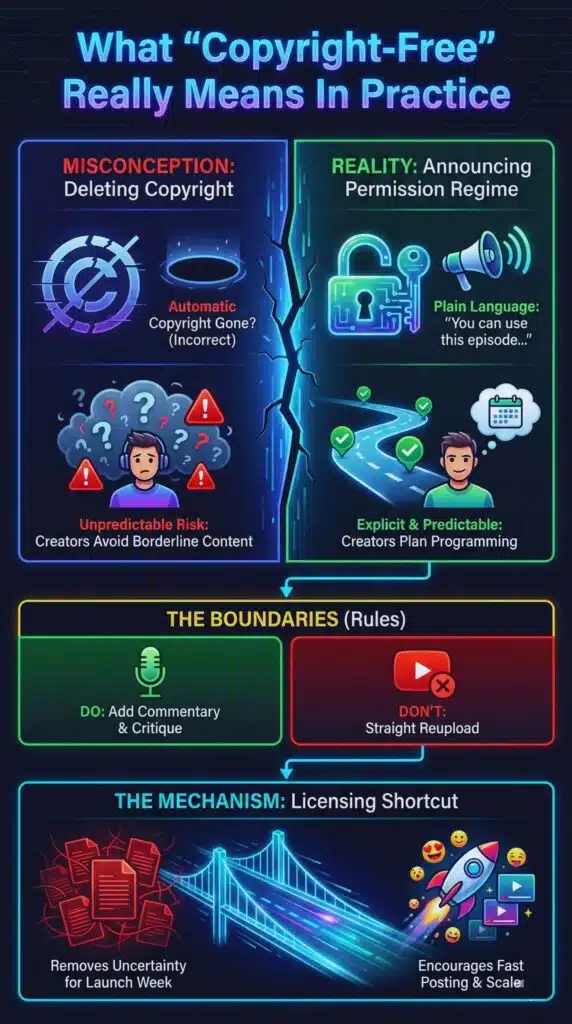
“Copyright-free” is easy to misread. MrBeast is not deleting copyright, because copyright is automatic. What he is doing is announcing a permission regime that tells streamers, in plain language, “you can use this episode for reaction content without fear of enforcement,” with boundaries like adding commentary and avoiding straight reuploads.
That clarity matters because creator behavior is shaped less by legal theory and more by platform risk. When enforcement is unpredictable, creators avoid borderline content. When permission is explicit, creators plan programming around it. A waiver also changes incentives. It encourages creators to post quickly, which is exactly what a premiere needs.
The best way to understand the move is as a licensing shortcut that removes uncertainty for one specific moment: launch week.
| Permission Model | What The Creator Can Do | What The Rightsholder Gains | The Hidden Tradeoff |
| Unclear fair use (case-by-case) | React, critique, clip, but at risk | None guaranteed | Disputes, demonetization, takedowns |
| Platform claims (automated matching) | Sometimes keep video up, often lose revenue | Monetize or block at scale | Creator trust erodes |
| Explicit waiver or license (MrBeast approach) | React and clip within stated rules | Viral reach with controlled boundaries | Sets audience expectations for future releases |
| Allowlisted co-streaming (platform feature) | Rebroadcast with permission, add commentary | Measurable amplification and control | Requires setup, rules, and monitoring |
A key nuance is that this waiver is targeted. It is about Episode 1, not the entire season. That suggests a funnel strategy: open the first door wide, then rely on curiosity and social proof to drive viewers to Prime Video for later episodes.
The Platform Shift: From Takedowns To Allowlists
MrBeast’s move lines up with a broader platform trend: rights are turning into product features.
On YouTube, Content ID allows rightsholders to choose what happens when a match is detected, including blocking, monetizing, or tracking. That system is powerful, but blunt. It is built for scale, not nuance. For creators, that means even high-effort commentary can be caught in automated claims.
Twitch is moving in the opposite direction for certain events. In late 2025, Twitch described co-streaming as a system where a “Main Broadcaster” can allowlist streamers to rebroadcast a live event while adding their own perspective, and it emphasized aggregated analytics across approved co-streams. That is a major signal. Platforms are realizing that “unauthorized sharing” is not just a policy problem. It is a product gap.
MrBeast’s waiver works as a cultural bridge. It effectively says: if platforms cannot reliably distinguish infringement from commentary at internet speed, then creators and rightsholders will build their own permission layer on top.
| Platform Approach | What It’s Designed For | Strength | Weakness For Reaction Culture |
| Automated matching systems (like Content ID) | Mass detection and scalable enforcement | Efficient control for rightsholders | Over-enforcement risk, creator uncertainty |
| Notice-and-takedown (legal baseline) | Fast removal after a claim | Works for clear infringement | Slow, adversarial, easy to abuse or misfire |
| Allowlisted co-streaming | “Approved rebroadcasting” with measurement | Clear permission + analytics | Best for events and organized launches, not casual remixing |
| Creator-declared waivers | Rapid permission without platform rebuild | Immediate behavior change | Harder to standardize, depends on trust |
The bigger story is this: the internet has normalized “watching together” as a primary viewing mode. Live reactions are not a side dish anymore. They are, for many viewers, the main meal.
The Economics: Turning Attention Into Subscriptions And Ad Value
Copyright policy is not only about law. It is also about unit economics.
Streaming platforms fight churn. They need launches that feel like events. Creators fight discoverability. They need content that is timely, culturally relevant, and safe to publish. MrBeast’s waiver aligns both sides by converting creator labor into a marketing multiplier.
There is also a macro trend: advertising money is moving toward creator-led distribution. WPP Media forecasted that user-generated content would surpass professionally produced content in ad revenue share, and Reuters summarized WPP’s view that global ad revenue would still grow into 2026, with digital advertising dominating. Separately, Goldman Sachs has projected the creator economy could approach $480 billion by 2027. Meanwhile, IAB has reported that digital video is expected to take nearly 60% of U.S. TV and video ad spend in 2025, showing how quickly budgets follow attention.
Those numbers matter because they explain why premium streamers are increasingly willing to partner with creators rather than compete head-on with them. The creator economy is not a marketing channel anymore. It is becoming a parallel distribution system.
| Metric Or Forecast | What It Signals | Why It Matters For Beast Games |
| 50M viewers in 25 days (Season 1) | Creator-led IP can perform at streamer scale | Makes renewal and bigger launches rational |
| Global reach across 240+ countries and territories (Season 1 distribution) | Streaming turns a creator into a global franchise fast | Raises stakes for launch execution |
| $5M top prize (Season 2) and “over $10M in prizes” reported | Spectacle budgets are used as growth assets | High spend increases need for wide reach |
| Digital video nearing 60% of U.S. TV/video ad spend in 2025 | Video ad money is consolidating around digital ecosystems | Co-streaming and clips become monetizable attention |
| Creator economy projected toward ~$480B by 2027 | Creators are becoming studio-like operators | Streamers must adapt to creator-native behavior |
This is why “copyright-free Episode 1” is not just generosity. It is a calculated CAC move, using creators as a scalable acquisition layer.
The Legal Pressure: Fair Use, Warhol, And Platform Liability
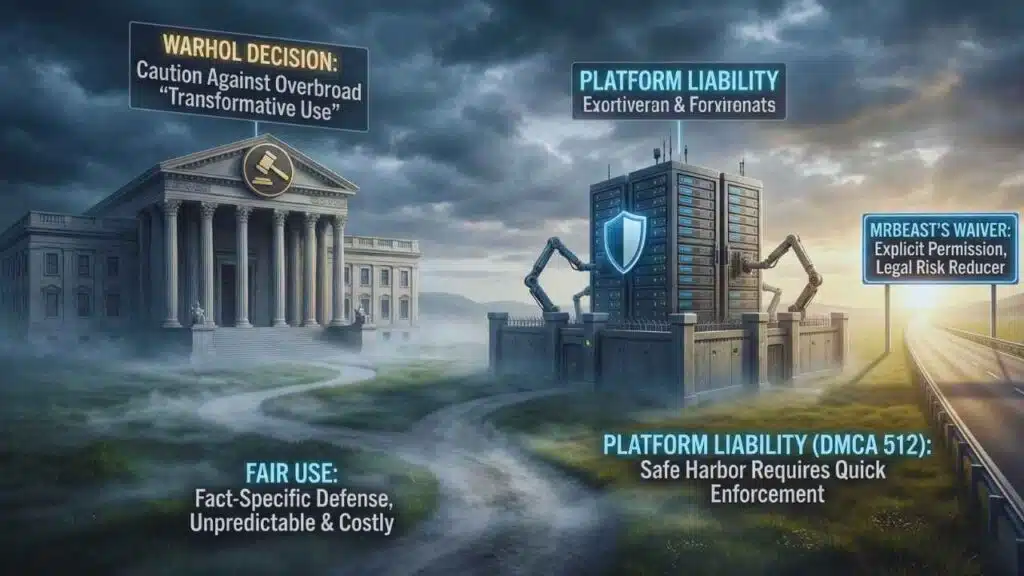
The legal environment is part of what makes the waiver valuable.
Reaction content often relies on fair use, but fair use is not a blanket permission slip. It is a fact-specific defense. It can be expensive to argue, slow to resolve, and inconsistent across contexts. The Supreme Court’s Warhol v. Goldsmith decision in 2023 is widely read as a caution against overbroad “transformative use” arguments, especially when the secondary use competes in a similar commercial market.
At the same time, reaction-style critique has won in court under certain facts. The U.S. Copyright Office’s Fair Use Index summarizes cases like Hosseinzadeh v. Klein (2017) where critique and commentary were treated favorably. The practical point is not that reactions are “safe.” The point is that creators cannot run their businesses on case law uncertainty.
Platforms also sit under legal frameworks that push them toward quick enforcement. Section 512 of the DMCA creates safe harbors for online service providers if they meet conditions and cooperate with takedown processes. The Copyright Office’s Section 512 study highlights how high-stakes and complex the notice-and-takedown ecosystem has become in the modern internet.
So MrBeast’s waiver is partly a legal risk reducer. It replaces “maybe fair use” with “explicit permission,” which is easier for platforms, creators, and sponsors to live with.
| Legal Concept | What It Means In Plain English | Why Creators Care |
| Fair use | A flexible defense that depends on purpose, amount used, and market effect | Hard to predict, costly to fight |
| “Transformative use” after Warhol | New meaning alone is not always enough if the use serves a similar market purpose | Reaction formats that feel substitutive face more scrutiny |
| DMCA safe harbor (Section 512) | Platforms reduce liability by responding to notices and meeting requirements | Encourages fast action over nuanced interpretation |
| Licensing or waiver | Permission granted upfront for specific uses | Predictability, easier monetization, fewer disputes |
In short, the copyright gambit is also a compliance gambit. It makes the launch legally cleaner and easier to scale across thousands of creators.
Programmable Rights And The Coming Contract Reset
The most forward-looking implication is that digital ownership is shifting from “control everything” to “control the rules.”
In 2026, the strategic question is not whether content will be clipped. It will be clipped. The question is whether rightsholders can define the terms of clipping in a way that grows the brand without destroying the business model. MrBeast’s waiver is an early example of “programmable rights,” where a show sets conditions that shape creator behavior.
Business reporting around Season 2 suggests the ambition is to go bigger while tightening operations. One Business Insider interview with the showrunner described the push to balance creativity with efficiency after Season 1’s logistics and cost challenges. It also reported production details like filming in Greenville, North Carolina, supported by a $15 million state grant. That matters because it shows how creator-led TV is becoming industrial, with regional incentives, bigger crews, and more traditional production economics.
As creator-led franchises scale, contracts will likely evolve to include clauses that used to be rare in TV deals, such as co-streaming windows, creator clip allowances, and platform-specific permissions.
| Contract Terms Likely To Become Standard | Why They Are Emerging | What They Change |
| “Reaction window” for premiere episodes | Launch needs creator amplification | Makes premieres feel like cultural events |
| Allowlisted co-streaming lists | Brands want control and brand safety | Moves reuse from informal to structured |
| Monetization rules for clips | Creators need revenue predictability | Reduces disputes and negotiation overhead |
| VOD retention limits | Rightsholders fear substitution | Sets boundaries on “free viewing” |
| Analytics sharing across co-streams | Platforms want measurable reach | Makes co-streaming a performance channel |
This is also where neutrality matters. There is a real counterargument permission-based ecosystems can become gatekept. If only certain creators are “allowed,” then power concentrates, and criticism can be chilled. The best versions of programmable rights will protect commentary while defining limits on pure reuploads.
Winners, Losers, And The Second-Order Effects
The most immediate winners are obvious: MrBeast, Amazon, and the streamer community that gets safe, high-interest content. The more interesting outcomes are second-order.
If this model works, it pressures other streamers and studios to loosen control at the top of the funnel. That could be good for audiences and creators, but it could also accelerate a world where viewers increasingly consume premium shows through reactions rather than direct viewing, weakening subscription value for all but the biggest franchises.
It may also change how audiences interpret paywalls. If Episode 1 is widely available through reactions, some viewers will treat that as an acceptable substitute. Others will treat it as a teaser that increases urgency to subscribe. Which effect dominates will be the KPI that determines whether this approach spreads.
| Stakeholder | First-Order Outcome | Second-Order Risk |
| MrBeast | Keeps internet-native engagement while scaling TV | Fans may expect every release to be “free to react” |
| Prime Video | Gains creator-driven amplification for a major launch | If reactions substitute viewing, conversion may soften |
| Streamers and reactors | Get permission clarity and timely content | Rules may tighten, or access may become selective |
| Traditional studios | Learn a repeatable launch tactic | May lose leverage if audiences prefer creator-guided viewing |
| Platforms | Add rights features like allowlists and analytics | Must balance control with open culture expectations |
This is why the gambit is bigger than one show. It is a test case for how the next generation of premium video will circulate.
What Happens Next And What To Watch In 2026?
Predictions should be labeled, so here is the clean version.
Analysts are likely to watch three categories of signals measurement, repetition, and regulation.
Measurement signals to watch
- Whether co-streaming and reaction coverage correlates with Prime Video ranking strength and subscriber momentum.
- Whether engagement stays high after the premiere window, since weekly episodes need sustained attention.
Repetition signals to watch
- Whether Amazon repeats the “copyright-free premiere” approach for later episodes or for other creator-led series.
- Whether other streamers begin to copy the template, even in limited form, such as official “reaction packs” or licensed clip bundles.
Regulation signals to watch
- Whether platforms and policymakers push for updates around notice-and-takedown, standard technical measures, or other reforms referenced in Copyright Office work.
| 2026 Milestone To Track | Why It Matters | What It Would Confirm |
| Post-premiere creator participation levels | Shows whether permission changed behavior at scale | If the waiver meaningfully expands launch reach |
| Any official co-stream analytics disclosures | Validates co-streaming as measurable marketing | If rights become a performance channel |
| Copycat moves by other streamers | Indicates industry adoption | If this becomes a standard launch tool |
| Contract language leaks or reporting about “reaction windows” | Reveals whether rights are becoming programmable by default | If the business model is shifting, not just one show |
| Any new policy moves on Section 512 or platform liability | Could reshape enforcement incentives | If legal pressure pushes more structured permissions |
The simplest long-term implication is this: premium video is drifting toward a hybrid model where exclusivity and openness are not opposites. They are stages in the funnel. MrBeast’s Copyright Gambit is an early, high-profile attempt to formalize that hybrid.
MrBeast did not just waive enforcement for a premiere episode. He made a statement about how attention works in 2026: people do not merely watch premium content, they watch people watching premium content. When a creator with massive reach formalizes that behavior, it nudges the entire industry toward rights systems that are clearer, more measurable, and more creator-compatible. The next era of digital content ownership is less about locking the door and more about deciding who gets a key, for how long, and under what rules.






















