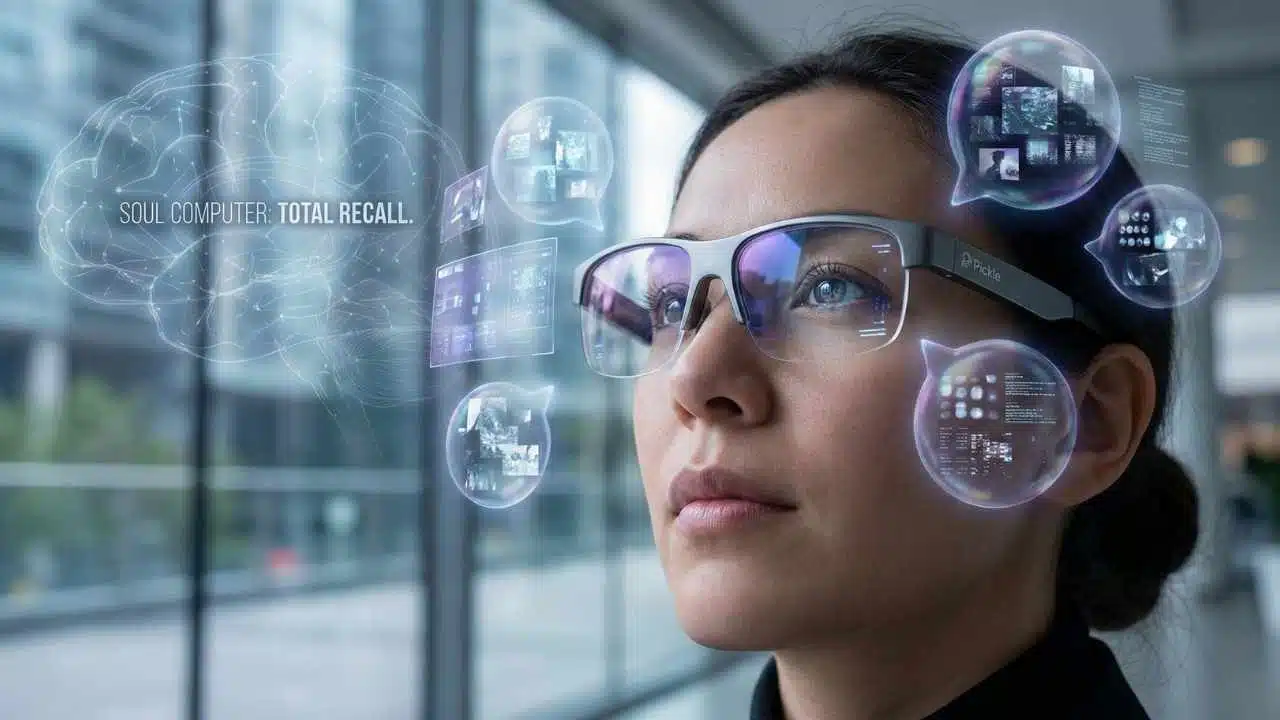
Pickle 1 AI glasses are taking pre-orders with a refundable $200 deposit, promising always-on “life memory” and real-time help through a companion system called Pickle OS, with U.S. deliveries targeted for Q2 2026.
What Pickle 1 AI Glasses Are And What’s Been Announced?
Pickle 1 AI glasses are being marketed as a new kind of wearable computer—one designed less like a phone replacement and more like a “memory layer” you wear on your face. The company’s central idea is that the glasses can continuously capture parts of your day, organize them into searchable “moments,” and then surface useful context right when you need it.
In practical terms Pickle says the device is built around two promises:
- Always-on context: The glasses use sensors to observe surroundings so the system can understand what you are doing.
- Instant recall: The system stores and organizes captured information so it can be retrieved later—either proactively or when you ask.
Pickle is positioning this as a jump from today’s voice assistants (which respond to commands) to something more like an ambient helper (which anticipates needs). That is a big claim, and it places Pickle 1 AI glasses in the most sensitive corner of wearable tech: products that can record what other people say and do nearby.
The company is also using the language of a platform, not just a gadget. Pickle OS is presented as the layer where users manage what gets captured, how memories are organized, and what kind of “assistant personality” appears inside the experience. This matters because the success of smart glasses often depends as much on the software experience as on the hardware itself.
Pickle 1 Pre-Order Snapshot
| Item | What’s Listed | What It Means For Buyers |
| Deposit | $200 (refundable) | Reserves a place in the first batch |
| Pricing shown | $799 and $1,300 | Likely configuration-based pricing |
| Delivery target (U.S.) | Q2 2026 | Early shipments expected in that window |
| International | 1–2 quarters later | Non-U.S. buyers may wait longer |
| Prescription flow | After checkout | Suggests prescription options are supported |
How The Glasses Work In Daily Use?
Pickle’s pitch centers on “ambient computing,” meaning the glasses do not wait for you to open an app. They are supposed to run in the background, collecting signals and turning them into a usable personal record. That record is then used to power on-the-spot assistance.
The company describes a few core pieces of the experience:
- Continuous capture: The glasses use cameras and microphones for what Pickle describes as “real-time ambient capturing.” The point is to gather enough context to understand events, people, tasks, and conversations.
- Memory organization: Captured information is grouped into structured entries (the company uses terms like “memory bubbles”). The goal is to let users retrieve moments later—such as what was discussed, where something happened, or when a task was assigned.
- In-view suggestions: Pickle says relevant prompts can appear “before your eyes,” so you can act without pulling out a phone. This could include reminders, context, or quick summaries.
Pickle also emphasizes personalization. It promotes an “interactive avatar” concept, where users can select a look, voice, and personality style for the assistant layer. This is not just cosmetic. If the system is proactive, how it interrupts you—and how often—can decide whether it feels helpful or annoying.
On the hardware side, Pickle lists a lightweight build and long battery goals. It highlights an aluminum body with a listed weight around 68 grams (noting that it can vary by configuration). Battery life is stated as up to 12 hours of mixed use, and the company notes support accessories like a charging case and stand.
Pickle also advertises a binocular, full-color display experience and ties performance to Snapdragon hardware, describing work to reduce latency for AI and AR interactions. In plain language, the company is trying to convince buyers that this will not feel sluggish. For smart glasses, that is critical: delays between what you see and what the system shows you can break the experience.
Key Claimed Specs And Experience (As Marketed)
| Category | What Pickle Emphasizes | Why It Matters |
| Wearability | Lightweight aluminum frame | Comfort decides whether people wear it daily |
| Battery | Up to 12 hours mixed use | Always-on features drain power quickly |
| Display | Full-color binocular AR view | Determines usefulness for guidance and recall |
| Processing | Snapdragon platform | Impacts speed, heat, and responsiveness |
| Software | Pickle OS memory + avatar | Controls privacy, retrieval, and daily workflow |
Privacy, Consent, And The Central Risk Of Always-On Glasses
Pickle 1 AI glasses are not entering a neutral environment. Camera-equipped glasses have a long history of privacy backlash. The difference now is that AI makes captured media more searchable and more powerful. Recording is one issue; indexing, summarizing, and recalling is another.
The key concern is consent in shared spaces. If glasses are always watching and listening, people nearby may not know they are being recorded. That changes expectations in places like:
- Offices and meeting rooms
- Cafés and public transit
- Schools and campuses
- Private homes and social gatherings
Even if a user intends to capture only their own life, the device can inevitably capture others. That creates social friction and potential legal risk depending on local recording and privacy rules.
Pickle responds by positioning security and user control as central features. The company describes a privacy approach that includes secure processing and controls inside its companion app. It claims users can manage capture settings with category-level controls so certain types of content can be limited or excluded.
Pickle also promotes security language around protected processing environments and cryptographic safeguards. Those claims will matter to privacy-conscious buyers, but they do not automatically solve the human problem: people need to recognize when they are being recorded and understand what is happening.
This is where the category faces a broader trust challenge. If smart glasses look like normal eyewear, the default social cue is that nothing is being captured. Many privacy advocates argue that wearables should include clear indicators—visible recording lights, audible alerts, and strong default restrictions—because social consent is otherwise hard to maintain.
Pickle’s challenge is to prove that its approach is not only technically secure but also socially responsible. That is a higher bar than “we store data safely.” It means building features that discourage misuse and making it easy for users to behave ethically in public.
Practical Privacy Questions Buyers Will Ask
| Question | Why It’s Important |
| Can I limit what is captured? | Always-on capture needs meaningful user control |
| Can others tell when it’s recording? | Social consent depends on visible indicators |
| How long is data kept? | Longer retention increases exposure risk |
| Can I delete everything easily? | “Memory” products must support clean removal |
| Who can access captured content? | Access policies matter more than marketing language |
Where Pickle 1 AI Glasses Fit In The Smart Glasses Race?
The smart glasses market is shifting quickly from “camera glasses” to “assistant glasses.” Several trends are pushing this transition:
- Better on-device chips that can run AI tasks faster
- Improved microphones and audio that make voice interaction reliable
- Rising comfort with AI assistants for search, summarization, and planning
- Growing interest in wearables that reduce phone screen time
Pickle is taking an aggressive stance by leaning into memory as the primary feature. Many competing devices focus on capture and quick sharing, or on lightweight assistance like translations, navigation prompts, and voice-based summaries. Pickle is effectively saying: “We will build a personal timeline of your life and make it instantly useful.”
That approach has upside. If it works, it could help with real problems people face every day:
- Forgetting details from conversations
- Losing track of tasks, names, and commitments
- Struggling to recall what was said in meetings
- Managing personal schedules without constant phone checking
But it also increases risk. A “memory-first” device creates a bigger data footprint than a device that records only when a user taps a button.
From a product strategy perspective, Pickle’s real competition is not just other glasses. It is also the smartphone itself, plus AI apps that already offer summaries, reminders, and retrieval—without putting cameras on your face. The glasses must feel genuinely more convenient and more valuable than pulling out a phone.
Market Positioning Comparison (High-Level)
| Approach | What It Prioritizes | Strength | Weakness |
| Memory-first glasses (Pickle-style) | Always-on capture + recall | Powerful retrieval, hands-free context | Privacy and consent concerns |
| Lifestyle smart glasses | Quick capture + audio features | Familiar use cases, lower friction | Less “intelligence” and proactive help |
| Assistant-first glasses | Translation, navigation, summaries | Clear daily utility | Depends heavily on software quality |
| Phone-based AI apps | Searchable notes + reminders | No wearable stigma, easy adoption | Not hands-free, less ambient context |
Pickle 1 AI glasses are making one of the boldest promises in consumer wearables: not just to record moments, but to build a usable “memory system” that actively helps you in real time. The deposit-based ordering and Q2 2026 shipping target suggest the company is aiming for an early adopter audience first, with broader expansion later.
What will decide whether Pickle becomes a breakthrough product or a niche experiment comes down to three tests.
First, the hardware test: comfort, heat, battery life, and display usability must hold up in daily wear. Second, the software test: memory retrieval has to be accurate, fast, and genuinely helpful without overwhelming the user. Third, the trust test: always-on capture must be paired with strong controls and clear social cues so people nearby are not unknowingly recorded.
If Pickle can prove that “always-on memory” can be delivered responsibly—without normalizing covert recording—it could push smart glasses into a new mainstream category. If it cannot, the same feature that makes the product stand out could also become the reason many people avoid it.