

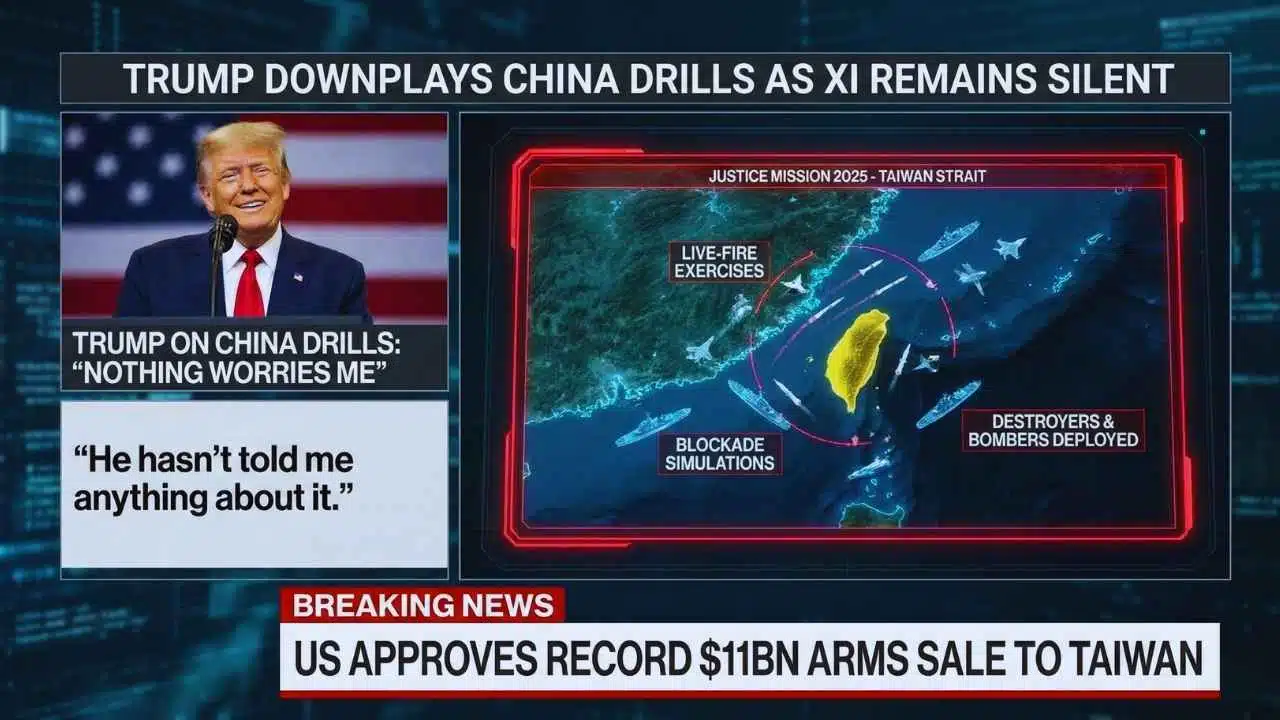
Trump Downplays China Drills as Beijing’s “Justice Mission 2025” live-fire operation encircles Taiwan, disrupting flights after a record U.S. arms package for Taipei.
What Happened And What Trump Said?
China’s military launched a large, multi-day set of live-fire exercises around Taiwan at the end of December 2025, and U.S. President Donald Trump publicly played down the significance.
Speaking to reporters as the drills entered a second day, Trump said he was “not worried” and suggested the activity fit a long-running pattern of Chinese military pressure in the region. He also indicated he had not been briefed beforehand about China’s plans and said Chinese President Xi Jinping had not raised the drills with him. The comments signaled a calm public posture from the White House at a moment when regional governments were tracking heightened military activity in busy air and sea corridors.
The drills mattered not only because they were large, but because they were staged in ways that put Taiwan’s air routes, nearby shipping lanes, and crisis-response systems under stress. Taiwan’s government condemned the operation, calling it destabilizing and harmful to regional peace. Taiwan’s defense authorities reported significant numbers of Chinese aircraft and vessels operating near the island during the peak of the activity.
At the center of the political debate is a familiar question: how the U.S. should respond when China ramps up military signaling around Taiwan—especially when those actions overlap with U.S. arms support for Taipei and rising competition between Washington and Beijing.
What China’s Drills Included And Why They Disrupted Flights?
China’s operation was identified by the People’s Liberation Army (PLA) as “Justice Mission 2025,” and it involved coordinated activity across multiple services. Taiwan and international reporting described joint air-sea operations with live-fire elements, as well as warnings establishing temporary “danger zones” that pushed civilian aircraft away from parts of the airspace during drill windows.
Key Features Reported During The Drill Window
| Reported Element | What It Means In Practice | Why It Matters |
| Live-fire activity across multiple zones | Exercises involving real munitions and restricted air/sea areas | Increases disruption risk in crowded routes and raises accident concerns |
| Large air and naval presence near Taiwan | High volumes of aircraft and ships operating around the island | Tests Taiwan’s monitoring, response times, and readiness posture |
| “Encirclement-style” geography | Activity reported north, east, south, and southwest of Taiwan | Signals potential ability to pressure Taiwan’s ports and approaches |
| Civil aviation re-routes and cancellations | Airlines avoid drill zones and shift flight paths | Creates wide spillover effects for passengers and airline schedules |
A major immediate consequence was the impact on travel. Taiwan’s civil aviation authorities warned that live-fire drill restrictions could affect more than 100,000 international passengers during the heaviest disruption period, with airlines forced to adjust routes, delay departures, or cancel certain flights. Officials also described knock-on effects for domestic flights as routes were reconfigured to avoid restricted areas.
Taiwan’s defense reporting during the drill window described a surge of PLA activity near the island, including high counts of aircraft and vessels. In practical terms, these surges force Taiwan’s military and coast guard to raise readiness, reposition assets, and sustain extended tracking operations—actions that can be demanding even if no shots are exchanged.
It also highlighted how modern crises can escalate without direct combat. When large militaries create temporary exclusion zones and move ships and aircraft at high volume, civilian traffic still needs to flow. That overlap—military maneuvers near major commercial routes—creates risk even when both sides say they are acting with restraint.
Why Tensions Spiked Now: The $11.1 Billion U.S. Arms Package And Beijing’s Pushback?
The late-December escalation came days after the United States moved forward with a major tranche of potential arms sales to Taiwan through the Foreign Military Sales (FMS) process. U.S. notifications posted on Dec. 17, 2025, outlined eight cases totaling about $11.1 billion in estimated value—described in multiple reports as the largest single set of Taiwan-related arms cases in recent years.
The package included long-range rocket artillery, self-propelled howitzers, loitering munitions and drones, anti-armor missiles, communications and networking support, and sustainment or follow-on support for systems already in Taiwan’s inventory. While FMS notifications do not automatically mean immediate delivery, they are a major political signal because they formalize U.S. intent to support Taiwan’s defense modernization.
Major Items Listed In The December 2025 U.S. Notifications
| System / Support Area | Why It’s Notable For Taiwan |
| HIMARS rocket artillery | Mobile long-range fires that can target ships or staging areas from dispersed positions |
| M109A7 self-propelled howitzers | Modernizes ground artillery with protected mobility and sustained fire capability |
| ALTIUS-700M / ALTIUS-600 systems | Expands reconnaissance and precision-strike options with unmanned systems |
| Javelin and TOW anti-armor missiles | Strengthens ground defenses against armored formations and landing forces |
| Tactical mission network support | Improves command, control, and coordination—critical in fast-moving crises |
| Harpoon repair follow-on support | Enhances sustainment of anti-ship capability already central to Taiwan’s deterrence |
| AH-1W helicopter parts and repair | Maintains readiness for existing aviation platforms |
Beijing objected sharply. Chinese authorities framed the U.S. moves as “external interference” and argued the package encouraged pro-independence forces in Taiwan. Chinese messaging around “Justice Mission 2025” emphasized deterrence and punishment themes, and described the drills as aimed at countering “separatism” and foreign involvement.
In addition, reporting during the same period described Chinese countermeasures that included announcing restrictions tied to U.S. defense firms and individuals—part of a broader pattern of mixing military signaling with political and economic pressure.
Regional And Global Stakes: What The Drills Signal Beyond Taiwan?
Even when shots are not exchanged across the Taiwan Strait, large PLA exercises around Taiwan are closely watched because they show what a coercive campaign could look like in real time: positioning forces, restricting airspace, pressuring ports, and testing how quickly Taiwan and partners can respond.
A key concept often discussed in cross-strait security is “blockade pressure.” A blockade scenario does not require an immediate amphibious landing. Instead, it tries to control the approaches to the island—air corridors, shipping lanes, and port access—creating economic stress and political pressure while staying below the threshold of invasion. Exercises that simulate operations around key approaches and ports are widely interpreted through that lens.
Taiwan’s government has consistently argued that these drills threaten not only Taiwan but broader regional stability and global commerce. The Taiwan Strait is one of the world’s most important waterways for trade and container shipping. Any prolonged disruption can affect supply chains, shipping insurance costs, airline routing, and regional investor confidence.
Japan’s security debate has also been intertwined with Taiwan scenarios, including public discussions by senior Japanese leaders in 2025 about the regional consequences of a Taiwan crisis. These discussions matter because geography links the Ryukyu island chain and sea lanes near Japan to any major contingency around Taiwan.
For Washington, the challenge is balancing deterrence and stability. U.S. policy has long combined support for Taiwan’s self-defense with an official “one China” framework and a preference for peaceful resolution. China’s drills, Taiwan’s responses, and U.S. arms support all interact—and each round creates new political pressure on leaders to show resolve without triggering escalation.
What Comes Next After “Justice Mission 2025”?
The biggest immediate question is whether “Justice Mission 2025” was designed as a short, sharp demonstration—or the beginning of a longer cycle of intensified operations around Taiwan into early 2026.
Several indicators will shape what happens next:
- Frequency: If similar large-scale drills become routine rather than episodic, Taiwan and airlines may face persistent disruption.
- Geography: More activity east of Taiwan and around southern approaches increases the strain on shipping and aviation corridors.
- Policy decisions: U.S. congressional review steps on the arms cases—and any follow-on support—could trigger additional Chinese responses.
- Crisis management: Both sides will watch for accidents, near-misses, or miscommunication at sea and in the air, which can quickly escalate tensions.
Trump’s public posture—downplaying the drills and emphasizing confidence—creates a clear contrast with the visible operational reality around Taiwan: heightened readiness, disrupted travel, and regional anxiety whenever live-fire activity is announced near heavily traveled routes.
For readers watching the region, the takeaway is that cross-strait pressure is no longer only a military story. It is also an aviation story, a shipping story, a diplomatic story, and a political story—one that can hit daily life quickly, even when no conflict formally begins.






















