

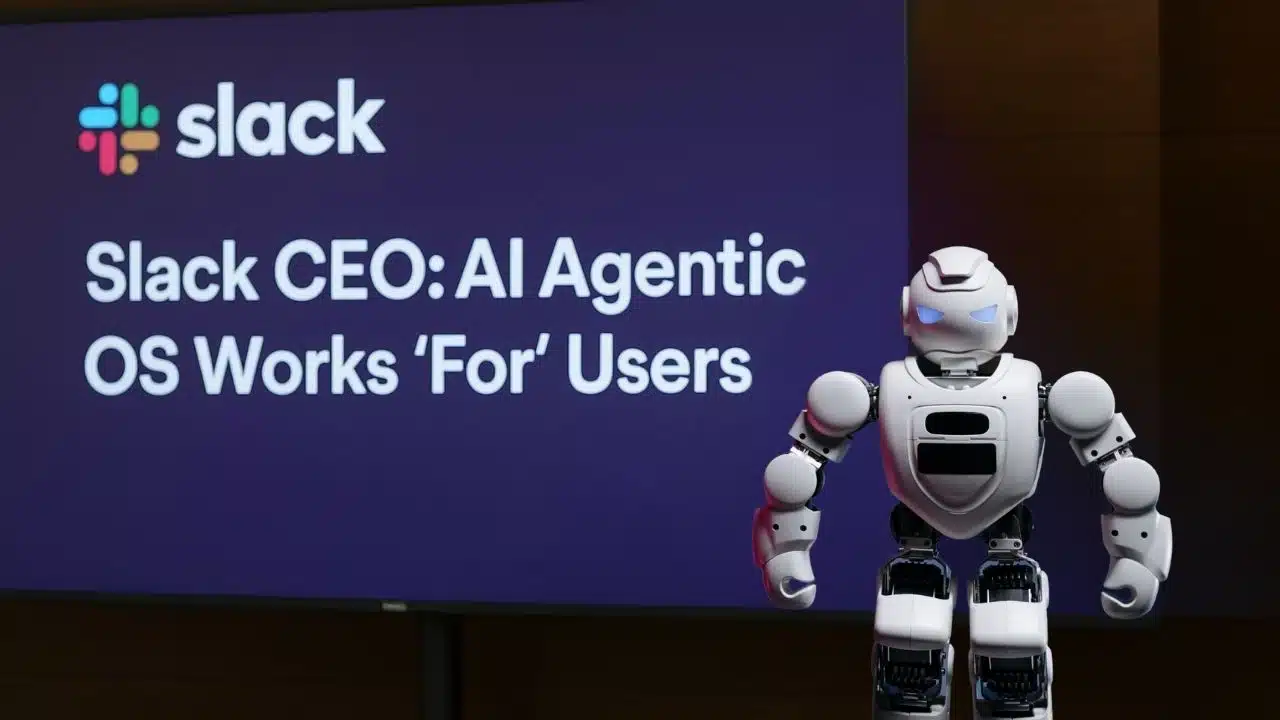
Slack is entering a new phase—one where the platform doesn’t just help people communicate, but actively participates in getting work done. This shift became clearer during Slack CEO Denis Dresser’s visit to Seoul, where he shared how the company is responding to rapid changes in the AI-driven workplace and addressed comments made by OpenAI CEO Sam Altman, who claimed that “Slack is increasing fake work.” Rather than dismissing the critique, Slack is using the moment to highlight its evolution into something far more advanced than a messaging tool.
Slack has long served as the world’s top business messenger, connecting email, file drives, and dozens of productivity apps within a single workspace. But now the company is pushing further by declaring the era of the Agentic Operating System (Agentic OS)—a system designed not only for communication, but for execution. This concept marks Slack’s ambition to become a platform where work is completed for users through AI, instead of users manually navigating apps, tools, and channels themselves.
According to Dresser, the goal is simple yet transformative: “It is not that we work ‘in’ Slack, but that Slack works ‘for’ us.” Through AI-powered agents, Slack wants to act as a central brain for the workplace—one that understands workflows, accesses organizational context, and supports teams by automatically managing tasks.
During his Seoul visit, Dresser provided a live demonstration using his own Slack workspace. When he asked Slackbot—a feature that once served as a simple helper—about the company’s “AI Era Human Resource Strategy” document, the system didn’t just search chat logs. It pulled together insights across channels, shared documents, Google Drive files, and other authorized sources. Everything surfaced instantly, showing how deeply AI has been woven into the platform’s infrastructure. The idea is to give workers the ability to find answers without switching between tools or opening separate AI services like ChatGPT.
What makes Slack’s AI offering so notable, Dresser explained, is context. Workspaces contain billions of messages, project channels, files, workflow logs, and shared links. All of this information forms a rich knowledge base that Slack’s AI can analyze. Instead of being a generic assistant, Slack’s AI understands how a particular organization works—its processes, its communication styles, and the relationships between its teams. This allows it to provide more accurate, meaningful, and actionable guidance than standalone AI tools that lack integrated workplace history.
One of Slack’s standout features is “Recap”, a tool that automatically summarizes missed messages and ongoing conversations. Whether a team member was out on vacation or simply away from their desk for a few hours, Recap provides comprehensive updates so they can catch up quickly without scrolling through long message threads. It turns what used to be a time-consuming catch-up routine into a streamlined moment.
Dresser also shared a variety of practical tips for maximizing workplace efficiency through Slack’s intelligent features. One example was designating certain employees as “VIPs.” By tagging key colleagues this way, users can prioritize their updates, ensuring they never miss important discussions or urgent decisions. Another tip was using the priority section—a customizable part of Slack where users can centralize essential channels, tasks, and meetings so critical work is always front and center.
One of the most powerful capabilities Dresser emphasized is Slack’s one-click approval system. This feature lets employees complete administrative processes—such as approving budgets, travel requests, or internal documentation—without leaving Slack or logging into other platforms. Dresser pointed out that companies using this function saw internal approval times accelerate by more than 90 percent, demonstrating the practical impact of automating repetitive, bureaucratic steps.
But Slack’s ambitions extend far beyond speeding up daily tasks. The company envisions a future where workplaces operate with significantly less friction. Instead of employees being bogged down by administrative duties, switching between countless apps, or hunting for information, Slack’s AI agents will manage much of the operational burden automatically. This frees workers to focus on creativity, decision-making, and strategic thinking—areas in which human talent delivers the greatest value.
Dresser emphasized that the future of work is not just about increasing speed; it’s about restoring meaning. He argues that AI should help people reconnect with the enjoyable parts of their job by removing the monotonous, repetitive, or easily automated tasks that often create frustration. Slack’s long-term vision, he said, is a workplace culture where employees can “love the process of work again,” because AI will take on the heavy lifting behind the scenes.
Slack’s transition to an Agentic OS reflects broader changes in the digital collaboration landscape. As organizations adopt more tools and datasets, the need for a unified system that can coordinate them becomes essential. Generative AI has blurred the boundaries between messaging apps, productivity suites, and information search engines. Instead of acting as a communication silo, Slack is attempting to integrate everything—from documents to workflows—into a single interface enriched by AI understanding.
Dresser’s comments also serve as a response to competitive pressure. With companies like OpenAI introducing group chat features designed to support teamwork and collaboration, Slack is emphasizing its advantage: workplace-embedded context. Slack’s rich network of channels, files, and interactions gives it a level of organizational intelligence that standalone AI tools cannot replicate.
Even as new AI-based tools emerge, Slack is betting on the strength of its ecosystem and the depth of its user data. The company believes this relevance—combined with AI that truly understands organizational structure—will keep it at the forefront of business communication and productivity.
In a world where digital collaboration is only becoming more complex, Slack’s Agentic OS signals a shift toward AI-driven workplaces where software becomes more than a tool. It becomes a partner—one that supports, understands, and anticipates the needs of people. For Slack, this marks a clear evolution from a messaging platform into a dynamic, intelligent work assistant designed to transform not just efficiency, but the entire experience of work itself.





















