

U.S. President Donald Trump abruptly terminated all Trump Canada trade negotiations in a late-night social media post, citing “egregious behavior” over an Ontario government-funded anti-tariff advertisement. The move, which threatens to derail the C$3.6 billion in daily cross-border trade, prompted an immediate reversal from Ontario Premier Doug Ford, who pledged Friday to pull the controversial ad campaign.
Key Facts: The State of Play
- White House Action: President Trump announced late Thursday (Oct. 23) via social media that “ALL TRADE NEGOTIATIONS WITH CANADA ARE HEREBY TERMINATED.
- The Trigger: A $53 million+ ad campaign by the Ontario government using a 1987 audio clip of former President Ronald Reagan criticizing protectionism. Trump labeled the ad “FAKE.”
- Canada’s Concession: Ontario Premier Doug Ford announced Friday (Oct. 24) he will “pause” the ad campaign effective Monday to allow trade talks to resume.
- Official Response: Canadian Prime Minister Mark Carney said Friday that Ottawa is “ready to resume” talks whenever Washington is prepared.
- Economic Impact: The spat deepens an 8-month-old trade war. The U.S. goods trade deficit with Canada hit $70.26 billion in the first seven months of 2025, already exceeding the total deficit for all of 2024.
The Ad That Broke the Deal
The diplomatic crisis was ignited by a $53 million (C$73 million) television and online ad campaign launched by Ontario Premier Doug Ford. The ad, which began airing in key U.S. border states, featured archival audio from a 1987 radio address by former U.S. President Ronald Reagan.
In the clip, Reagan warns against protectionism, stating that tariffs “start trade wars” and lead to higher consumer prices and American job losses.
The ad drew a furious response from President Trump, who is preparing for a trip to Asia. In a series of posts on his Truth Social platform late Thursday, the president accused Canada of misrepresenting the Republican icon.
“The Ronald Reagan Foundation has just announced that Canada has fraudulently used an advertisement, which is FAKE, featuring Ronald Reagan speaking negatively about Tariffs,” Trump wrote.
The Reagan Foundation confirmed this, stating, “The ad misrepresents the Presidential Radio Address, and the Government of Ontario did not seek nor receive permission to use and edit the remarks.
Trump, who has argued his tariffs are essential for U.S. national security, accused Canada of attempting to interfere with an upcoming U.S. Supreme Court hearing on the legality of the levies.
He concluded: “Based on their egregious behavior, ALL TRADE NEGOTIATIONS WITH CANADA ARE HEREBY TERMINATED.”
Ford’s Reversal, Carney’s Cautious Wait
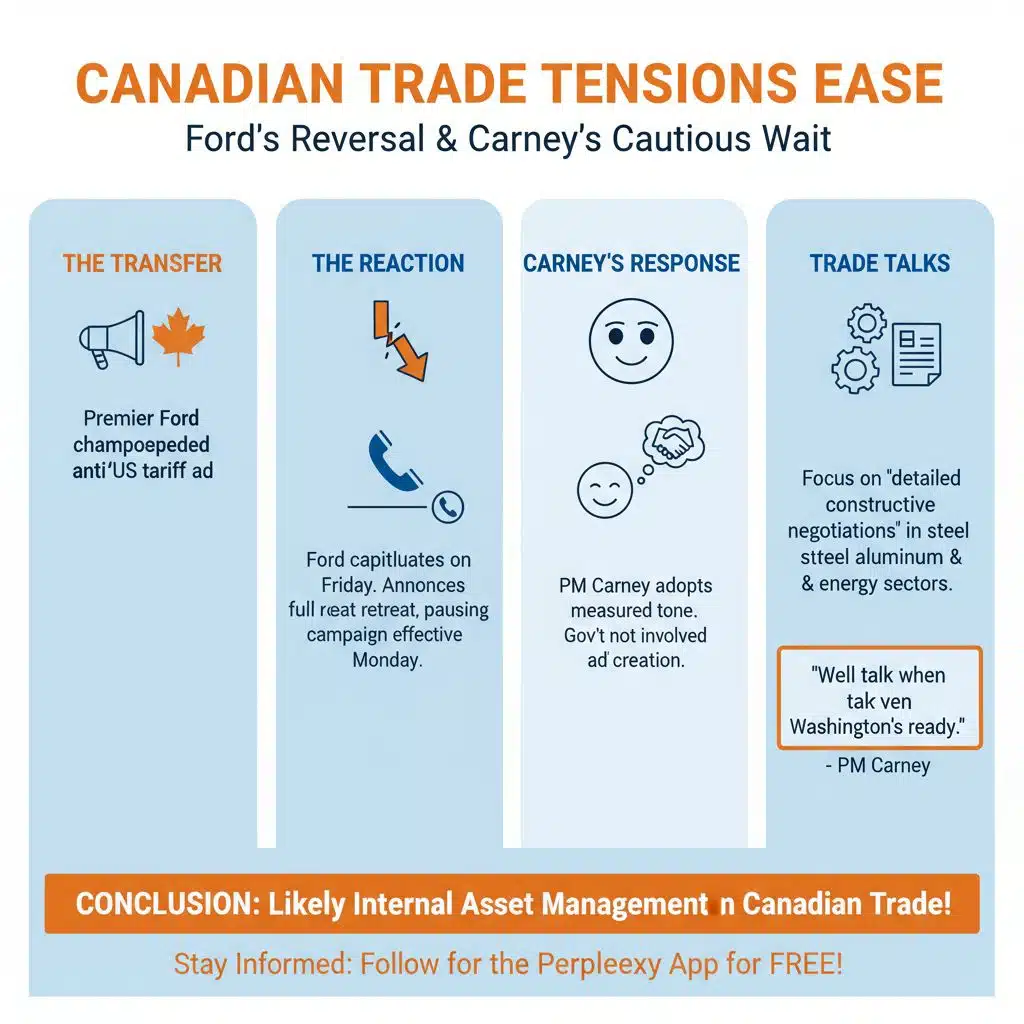
The move sent shockwaves through Ottawa and the provincial government in Toronto. By Friday afternoon, Premier Ford had capitulated.
In a statement, Ford, who had previously championed the ad as “using every tool we have” to fight U.S. tariffs, announced a full retreat. He confirmed that after speaking with Prime Minister Mark Carney, he “decided to pause the advertising campaign effective Monday so that trade talks can resume.
Prime Minister Carney, who is scheduled to travel to Malaysia for the Asia-Pacific Economic Cooperation (APEC) summit, adopted a measured tone. Speaking to reporters Friday, Carney stressed that his government was not involved in the ad’s creation but was focused on a resolution.
“My colleagues have been working with their American colleagues on detailed constructive negotiations… on specific sectors — steel, aluminum and energy,” Carney said. “We stand ready to pick up on that progress. We’ll talk when Washington’s ready.”
The 2025 U.S.-Canada Trade War
The ad controversy is only the latest flashpoint in a bruising trade war that has defined cross-border relations throughout 2025.
The conflict began in earnest on February 1, 2025, when the Trump administration announced its intent to impose a 25% tariff on most Canadian goods and a 10% tariff on energy products, justifying the move by citing a need “to Address the Flow of Illicit Drugs Across Our Northern Border.
Despite a brief 30-day pause, the tariffs took effect on March 4, 2025. The U.S. later escalated the dispute, adding 25% tariffs on Canadian steel and aluminum (March 12) and autos (April 3). On August 1, the administration increased the general tariff rate to 35%.
Canada responded with tit-for-tat retaliatory tariffs, primarily targeting U.S. steel, aluminum, and auto imports.
A partial truce was reached on September 1, 2025. The U.S. clarified that its new general tariffs would not apply to goods that were compliant with the Canada-United States-Mexico Agreement (CUSMA). In response, Canada dropped most of its retaliatory measures, but critically, both sides left their punitive tariffs on steel, aluminum, and autos in place.
It was these remaining tariffs, which are strangling Ontario’s auto and manufacturing sectors, that the Reagan-themed ad campaign sought to fight.
The Damage by the Numbers
The economic fallout from the 2025 trade war has been stark, reversing recent trends and inflicting measurable damage on the $1 trillion-plus bilateral trade relationship.
- Massive Deficit Spike (2025): The U.S. goods trade deficit with Canada reached $70.26 billion in the first seven months of 2025 (January–July) alone.
- Surpassing 2024 Total: That seven-month figure already eclipses the entire 2024 U.S. goods deficit with Canada, which totaled $53.92 billion for the full 12-month period.
- Daily Trade at Risk: The dispute places the entirety of the bilateral relationship at risk. More than 75% of all Canadian exports are destined for the U.S., with nearly C$3.6 billion (US$2.7 billion) in goods and services crossing the border daily.
U.S. Goods Trade Deficit with Canada (2022–2025)
| Year | U.S. Goods Deficit with Canada (USD) | Source |
| 2022 (Full Year) | -$44.47 Billion | U.S. Census Bureau |
| 2023 (Full Year) | -$54.59 Billion | U.S. Census Bureau |
| 2024 (Full Year) | -$53.92 Billion | U.S. Census Bureau |
| 2025 (Jan–July) | -$70.26 Billion | U.S. Census Bureau |
Analysis: Carney’s Pivot as CUSMA Review Looms
The trade war and President Trump’s “America First” posture have forced a fundamental rethink in Ottawa.
Prime Minister Carney, who took office earlier this year, has signaled a historic pivot in Canadian foreign and trade policy. In a national address just this week, Carney warned that Canada could no longer depend on its southern neighbor.
“We have to take care of ourselves because we can’t rely on one foreign partner,” Carney said Wednesday. “The U.S. has fundamentally changed its approach to trade, raising its tariffs to levels last seen during the Great Depression.”
Carney has set a new national goal: to double Canada’s non-U.S. exports within the next decade, explicitly naming India and China as markets for “re-engagement.
This entire dispute is unfolding under the shadow of the 2026 CUSMA (USMCA) joint review. The trade pact, which replaced NAFTA, is subject to a “sunset clause” review every six years. The first of these reviews is now just months away.
The Canadian government is actively preparing for what will likely be contentious negotiations. Global Affairs Canada is currently holding public consultations (running from September 20 to November 3, 2025) to gather input from businesses and the public on the “operation of CUSMA” and “potential areas for improvement.
What to Watch Next
With Premier Ford’s ad campaign now shelved, all eyes are on the White House to see if President Trump will accept the concession and formally restart negotiations.
The immediate volatility may have subsided, but the core issues remain:
- U.S. tariffs on Canadian steel, aluminum, and autos are still in effect.
- Canadian retaliatory tariffs on U.S. steel, aluminum, and autos are still in effect.
- The CUSMA review in 2026 looms as a major point of leverage for both sides.
As PM Carney heads to Asia, his team will be left to manage the fallout, hoping to salvage the world’s largest bilateral trade relationship from its most profound crisis in decades.