Ever feel overwhelmed by all the climate change news?
I get it. But here’s something that might give you hope: Israeli Renewable Energy Innovations are changing the game for clean energy worldwide.
Small teams in Israel are creating smart solar tech, green hydrogen breakthroughs, and battery designs that could power your home, your car, and even your city. According to Startup Nation Central, Israel’s energy tech sector now includes more than 350 companies, up nearly 60% over the past decade.
Let me walk you through 15 innovations that are actually making a difference right now.
Key Takeaways
- Solargik’s AI-powered solar trackers can boost energy yield by 20-25% compared to fixed panels, even on steep slopes up to 30%, making solar work in challenging terrains.
- Apollo Power builds floating solar systems on water reservoirs that generate clean electricity while reducing water evaporation, addressing two problems at once.
- H2Pro’s E-TAC technology achieves 95% efficiency in green hydrogen production by splitting water in two steps instead of one, potentially delivering hydrogen at under $1 per kilogram before 2030.
- Addionics uses 3D metal structures in batteries to enable faster EV charging, longer lifespan, and better heat management without increasing manufacturing costs.
- HomeBiogas turns kitchen scraps and farm waste into cooking gas for your stove, with each kilogram of waste producing 200 liters of biogas.
Israeli Solar Energy Innovations Transforming Sustainability
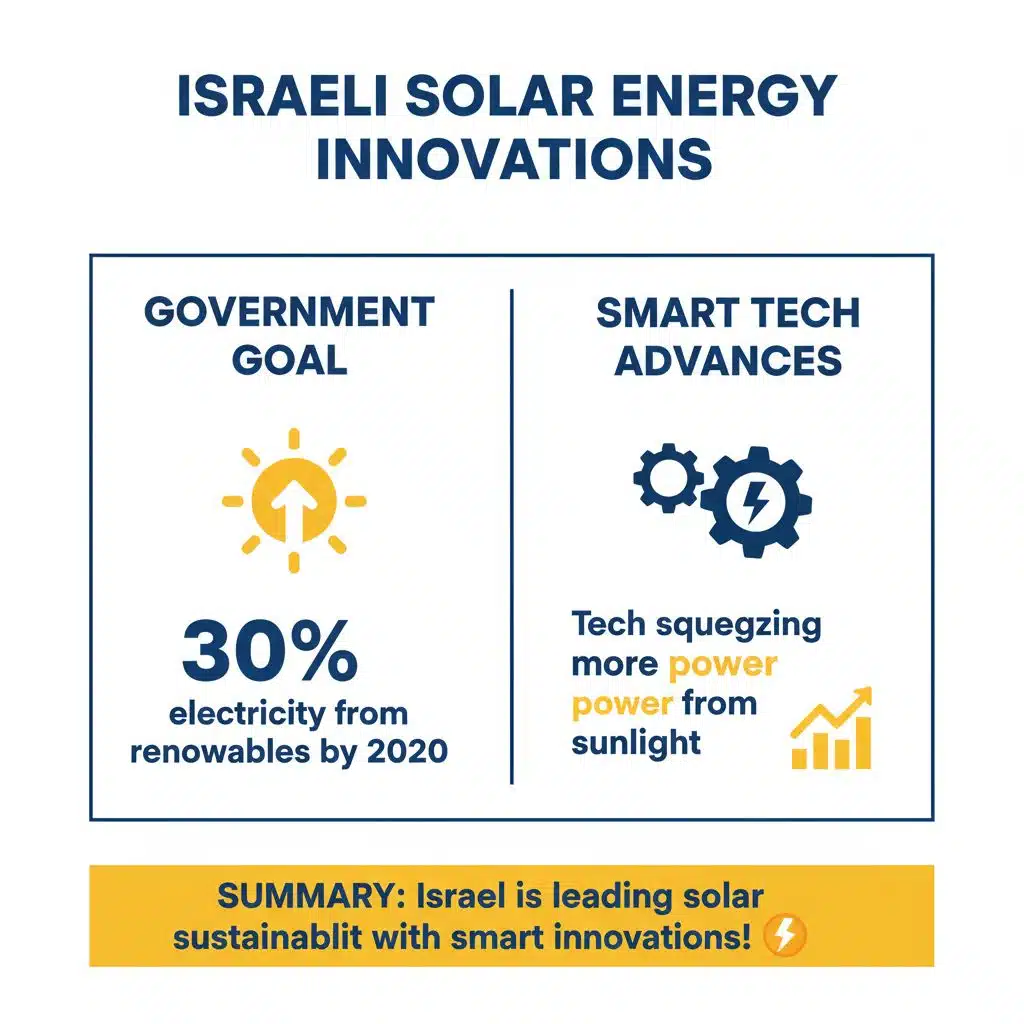
Israel is betting big on solar. The government aims to generate 30% of electricity from renewables by 2030.
Right now, companies are making that goal realistic with smart tech that squeezes more power from every ray of sunshine.
How does AI optimize solar panel performance in Israel?
Solargik makes solar tracking systems smarter with artificial intelligence.
Their technology uses AI to adjust panel angles throughout the day, tracking the sun’s movement while accounting for clouds, dust, and weather changes in real time. According to the company, their systems deliver 20-25% more energy production than fixed-tilt panels.
What makes this different? Solargik’s trackers use short table sizes of just 6-24 panels, compared to the industry standard of 60-360 panels. This allows more precise tracking and better performance optimization.
The system works on challenging terrain too. You can install these trackers on slopes up to 30% without expensive grading work.
That’s huge for countries where flat land is scarce. Energy companies like EDF Renewables get higher output for lower cost per watt, and farmers can use land that would otherwise sit empty.
What are floating solar farms and how are they used on reservoirs?
Picture solar panels floating on water instead of taking up valuable farmland.
Apollo Power pioneered flexible solar films that can sit on reservoirs, lakes, and even ocean surfaces. In August 2021, they established Israel’s first grid-connected floating solar site at 110 kW.
Here’s why this matters:
- Water keeps panels cooler, which increases power output compared to rooftop systems baking in the sun
- The panels reduce water evaporation, critical in dry regions like Israel
- You preserve precious land for agriculture or housing
Apollo’s flexible solar film weighs only 3 kilograms per square meter, compared to 2,000 kilograms for traditional glass panels. Their factory in Yokneam can produce 1.5 million square meters annually, enough to power 35,000-40,000 households.
Major companies are taking notice. Volkswagen signed a 33 million euro deal for Apollo’s panels to charge electric vans, and Amazon installed their solar pavement at a French logistics center to charge employee e-bikes.
Advances in Israeli Green Hydrogen and Energy Storage Technologies
Green hydrogen could replace fossil fuels in trucks, ships, and factories.
The challenge? Making it cheaply enough to compete with natural gas. Israeli startups are cracking that problem with smarter chemistry and better batteries.
How does E-TAC technology improve hydrogen production efficiency?
H2Pro developed a breakthrough called E-TAC that splits water into hydrogen and oxygen more efficiently than standard electrolysis.
Traditional electrolysis does everything in one step, wasting about 25% of the power on generating oxygen electrochemically. H2Pro’s technology uses electricity to produce hydrogen in the first step, then applies heat in a separate step to make oxygen.
The results speak for themselves. E-TAC achieves over 95% efficiency at the system level, compared to 60-70% for alternative methods.
| Technology | Efficiency | Key Advantage |
|---|---|---|
| H2Pro E-TAC | 95% | No membrane needed, lower costs |
| Standard Electrolysis | 60-70% | Proven but energy-intensive |
H2Pro claims this technology could deliver green hydrogen at less than $1 per kilogram before 2030. That would represent a 60-80% drop in prices, making green hydrogen cheaper per unit of energy than gasoline in the United States.
The company has raised over $100 million from investors including Bill Gates’ Breakthrough Energy, Sumitomo Corporation, and Yara. They’re planning commercial production at hundreds of megawatts scale for green ammonia projects.
In what ways does 3D metal fabrication enhance rechargeable batteries?
Addionics is rethinking how batteries are built from the inside out.
Instead of flat, 2D electrodes, they create 3D metal structures that look like tiny scaffolding inside the battery. This approach increases the surface area for chemical reactions without making the battery bigger or heavier.
The benefits for electric vehicles are significant:
- Faster charging: 50% reduction in charging time
- Better performance: Two times higher accessible capacity
- Longer life: 150% longer lifetime for high-performance products
- Improved safety: Better heat dissipation reduces fire risk
In July 2024, Addionics raised $39 million in Series B funding led by GM Ventures. The investment will help build a U.S.-based factory for their 3D Current Collectors.
This matters because battery costs are the biggest barrier to affordable electric vehicles. By improving performance without increasing costs, Addionics helps make EVs accessible to more people while supporting the global shift to renewable energy.
Israeli Innovations in Wind and Waste-to-Energy Solutions
Wind and waste might not sound glamorous, but they’re key pieces of the clean energy puzzle.
Israeli engineers are finding clever ways to boost wind power output and turn your garbage into cooking fuel.
How are wind turbines upgraded for better efficiency in Israel?
Israel has limited wind resources compared to its solar potential, but companies are making every breeze count.
Enlight Renewable Energy operates Genesis Wind, Israel’s largest wind farm with 39 General Electric turbines in northern Golan Heights. At full capacity, it provides clean energy equivalent to the yearly consumption of 70,000 households and saves 180,000 tons of CO2 emissions annually.
The challenge with wind power is maximizing output from existing infrastructure. Upgrading turbine blades, control systems, and tower designs can significantly increase energy capture without building entirely new wind farms.
Smart sensors and AI analytics now enable turbines to adjust to changing wind speeds and directions in real time, optimizing performance continuously. According to the U.S. Department of Energy, modern wind turbine capacity factors have increased from 22% before 1998 to nearly 35% today.
What small-scale biodigester technologies convert waste to biogas?
HomeBiogas created a simple system that fits in your backyard and turns kitchen scraps into cooking fuel.
Here’s how it works: You feed up to 6 liters of food waste or 15 liters of animal manure into the digester each day. Bacteria inside break down the organic matter without oxygen, producing biogas and liquid fertilizer.
The output is impressive. Every kilogram of food waste produces about 200 liters of biogas, enough to cook for one hour over a high flame. That means 2-3 hours of cooking gas daily for an average household.
| System | Daily Input | Gas Output | Fertilizer Output |
|---|---|---|---|
| HomeBiogas 2 | 6L food waste | 2-3 hours cooking | 5-10 liters/day |
| HomeBiogas 4 | 12L food waste | 4-6 hours cooking | 10-20 liters/day |
HomeBiogas is expanding rapidly. In 2025, they’re targeting 10,000 family installations in Kenya alone, with 420 units installed in February. The Dominican Republic government purchased 500 units to reduce citizen dependence on wood for heating.
This technology tackles multiple problems at once. You reduce landfill waste, cut methane emissions from decomposing garbage, eliminate the need for firewood or propane, and create organic fertilizer for your garden.
The system takes about 2 hours to install and starts producing gas within 2-4 weeks. It works best when average temperatures stay above 17°C (63°F), making it ideal for warm climates worldwide.
Takeaways
Israeli startups are proving that renewable energy isn’t just about grand visions.
It’s about smart solar trackers that work on hillsides, flexible panels that float on water, hydrogen systems that waste less energy, batteries that charge faster, and backyard digesters that turn trash into fuel. These aren’t concepts for 2050. They’re working today.
As Israel pushes toward its 30% renewable energy goal by 2030, these innovations are showing the rest of the world what’s possible. The renewable energy transition needs more than ambition. It needs practical solutions that make clean power cheaper and easier to use.
That’s exactly what these 15 Israeli companies are delivering.
FAQs on Israeli Renewable Energy Innovations
1. What makes Israeli renewable energy innovations stand out in the global market?
Israeli companies stand out through unique technologies, like Apollo Power’s flexible solar panels that can cover any surface and Eco Wave Power’s systems that generate energy from sea waves. Supported by organizations like Startup Nation Central, these firms are leaders in the global renewable energy transition. Their innovations in smart grids and solar tracking systems demonstrate how a small nation can drive significant environmental change.
2. How is Israel contributing to energy storage solutions?
Companies like Brenmiller Energy and StoreDot Ltd are pioneering thermal and electricity storage solutions. For instance, StoreDot is developing ‘100in5’ battery technology that aims to add 100 miles of range to an electric vehicle in just five minutes of charging. These advancements are critical for ensuring clean power is available 24/7, solving a major challenge for renewable energy adoption.
3. What role does hydrogen play in Israel’s clean energy push?
Israel is advancing a hydrogen economy with leaders like the Bazan Group and H2Pro, a company that developed a breakthrough method for producing green hydrogen with 95% efficiency. These projects focus on hydrogen generation and storage to help decarbonise sectors like heavy industry and shipping. This push positions hydrogen power as a key alternative energy source for the future.
4. Are Israeli companies working on solar power improvements?
Yes, companies like Arava Power, which recently launched the 270 MW SUNRAY solar plant in Texas, are scaling up solar energy projects globally. Others, such as SolarEdge, are global leaders in smart solar inverters that maximize power generation from photovoltaic systems by up to 25%. These advancements continue to make solar power more efficient and reduce the cost per watt for consumers.
5. How do these innovations help limit global warming?
By creating practical tools for sustainable development, like Driivz’s EV charging management platform, these innovations help countries meet climate change mitigation goals by optimizing the grid and reducing emissions.
6. What impact has the Inflation Reduction Act had on Israeli energy companies?
The Inflation Reduction Act has created significant opportunities, prompting companies like Brenmiller Energy to establish production facilities and expand its project pipeline in the United States to over $210 million. This policy helps Israeli firms partner with US independent system operators to deploy their energy technology. This accelerates the American energy industry’s move from fossil fuels.