I worked as a freelancer and remote worker for almost seven years before I joined Editorialge. In that time, nearly every client payment landed in a digital wallet first. That wallet was my paycheck, my savings, and my business account at once. So I take digital wallet security tips to follow very seriously, and I have tested every habit below on my own money.
These are the 10 rules I still follow, checked against the latest data. They work for payment apps like PayPal or Wise and for crypto wallets. If you are new to crypto, start with our guide on how to set up your first Web3 wallet.
Why Digital Wallet Security Tips to Follow Matter More in 2026
The numbers got worse last year:
- Americans reported losing $15.9 billion to fraud in 2025, up from $12.5 billion in 2024, according to FTC testimony to Congress.
- The FBI logged $11.4 billion in crypto-related fraud losses in 2025. That is more than half of all internet crime losses it recorded.
- Chainalysis counted 158,000 personal wallet compromises in 2025, hitting at least 80,000 people.
Attackers now go after many small wallets instead of a few big ones. That puts regular users like me in the target zone.
The 10 Digital Wallet Security Tips to Follow
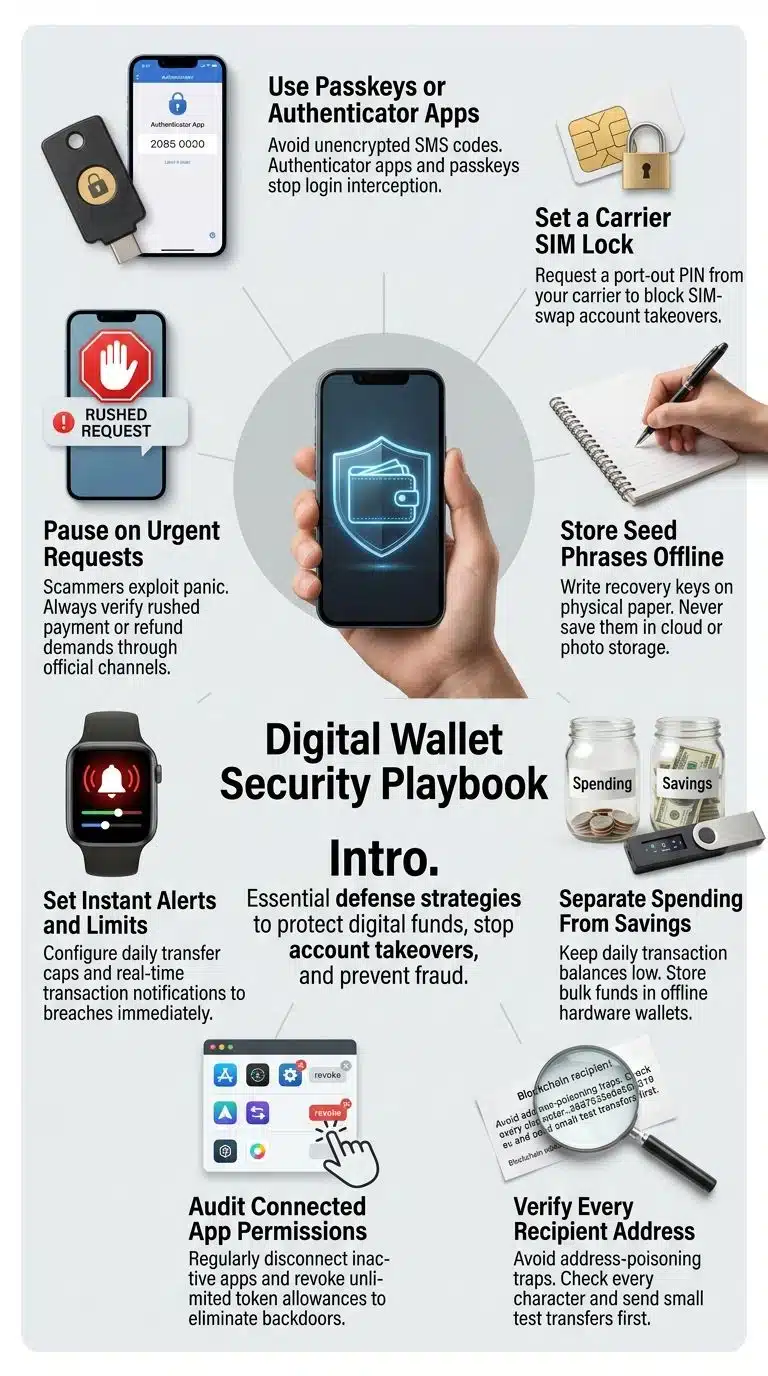
1. Use Passkeys or an Authenticator App
Text message codes are the weakest login guard. In December 2024, CISA advised moving away from SMS codes because texts are not encrypted and can be intercepted. It called FIDO passkeys a strong option.
I use passkeys wherever my wallet or payment app offers them. Where it does not, I use an authenticator app instead of text codes. Every wallet also gets its own long password, stored in a password manager.
2. Lock Your Phone Number
A SIM swap lets a scammer move your number to their phone and catch your login codes. In November 2023, the FCC adopted rules that make US carriers verify customers before moving a number and alert them to SIM changes.
I still ask my carrier for a SIM lock or port-out PIN. It takes five minutes and closes an easy door.
3. Keep Your Seed Phrase Offline
Your recovery phrase is the master key to a crypto wallet. Anyone who has it owns your funds. I write mine on paper and store it somewhere safe. It never goes into photos, notes apps, email, or cloud storage. No real support agent will ever ask for it.
4. Split Spending Money From Savings
I keep only a small balance in my daily wallet. For crypto, my savings sit in a hardware wallet. For shared or business funds, a multi-signature setup needs more than one approval to move money. Our guide to multi-signature wallets and their security benefits explains how it works.
For regular money, I move freelance income from the payment app to my bank on a set schedule. If you are still choosing how to get paid, see our list of fintech tools for freelancers to get payments.
5. Check Every Address Before You Send
Address poisoning is a nasty trick. A scammer sends you a tiny transaction from an address that looks like one you use. Later, you copy the fake one from your history. In 2025, one victim lost $50 million in USDT this way.
I now save trusted addresses in an address book and never copy from my transaction history. I check the full address, not just the first and last few characters. For large amounts, I send a small test first.
6. Review App Approvals Every Month
When you connect a wallet to an app, you often give it unlimited access to a token. MetaMask suggests reviewing and revoking unneeded approvals, ideally every month. Tools like Revoke.cash and the Etherscan approval checker make this easy, though each revoke costs a small gas fee.
I do the same with payment apps. I remove old linked apps and logged-in devices I no longer use.
7. Download Wallets Only From Official Sources
Fake wallet apps and lookalike websites copy real brands. I install apps only through the link on the company’s own website. I also bookmark the real login page and never click search ads to reach it.
8. Keep Everything Updated
Updates fix security holes that attackers already know about. I turn on automatic updates for my phone, browser, and wallet apps. I also never sign in to a wallet on a shared or public computer.
9. Turn On Alerts and Limits
Instant alerts for every login, payment, and withdrawal help me catch problems within minutes. I set daily transfer limits where the app allows it. On exchanges that offer it, I turn on a withdrawal allowlist so money can only go to addresses I approved.
10. Treat Urgency as a Red Flag
Most losses start with a message, not a hack. The FBI says Americans lost $1.4 billion to recovery scams in 2025, where fake helpers promise to get stolen money back.
As a freelancer, I learned to distrust “clients” who send odd payment links, overpay and ask for a refund, or request “account verification.” If a message rushes me, I stop. Then I contact the company through its official app.
If Something Goes Wrong: Digital Wallet Security Tips to Follow After a Breach
Speed matters. This is my checklist:
- Move any remaining crypto to a new wallet with a new seed phrase. For a payment app, freeze the account through official support.
- Change your password, sign out of all devices, and reset two-factor login.
- Revoke all token approvals on the old wallet.
- Report it to your wallet provider and bank. In the US, also file at ReportFraud.ftc.gov and ic3.gov.
- Ignore anyone who offers to recover your funds for a fee.
FAQs on Digital Wallet Security Tips to Follow
Are digital wallets safe to use?
Yes, when you protect them well. Passkeys, a locked phone number, and alerts stop most common attacks on regular users.
Is a hardware wallet worth it?
If you hold crypto savings you cannot afford to lose, yes. It keeps your private keys off your phone and computer.
Is SMS two-factor better than nothing?
Yes. But switch to passkeys or an authenticator app as soon as your wallet supports them.
Final Words
After seven years of freelancing, my view is simple. These digital wallet security tips to follow are not extra work. They are part of getting paid. Start with passkeys and a SIM lock today. Both take about ten minutes and protect the money you worked hard to earn.