

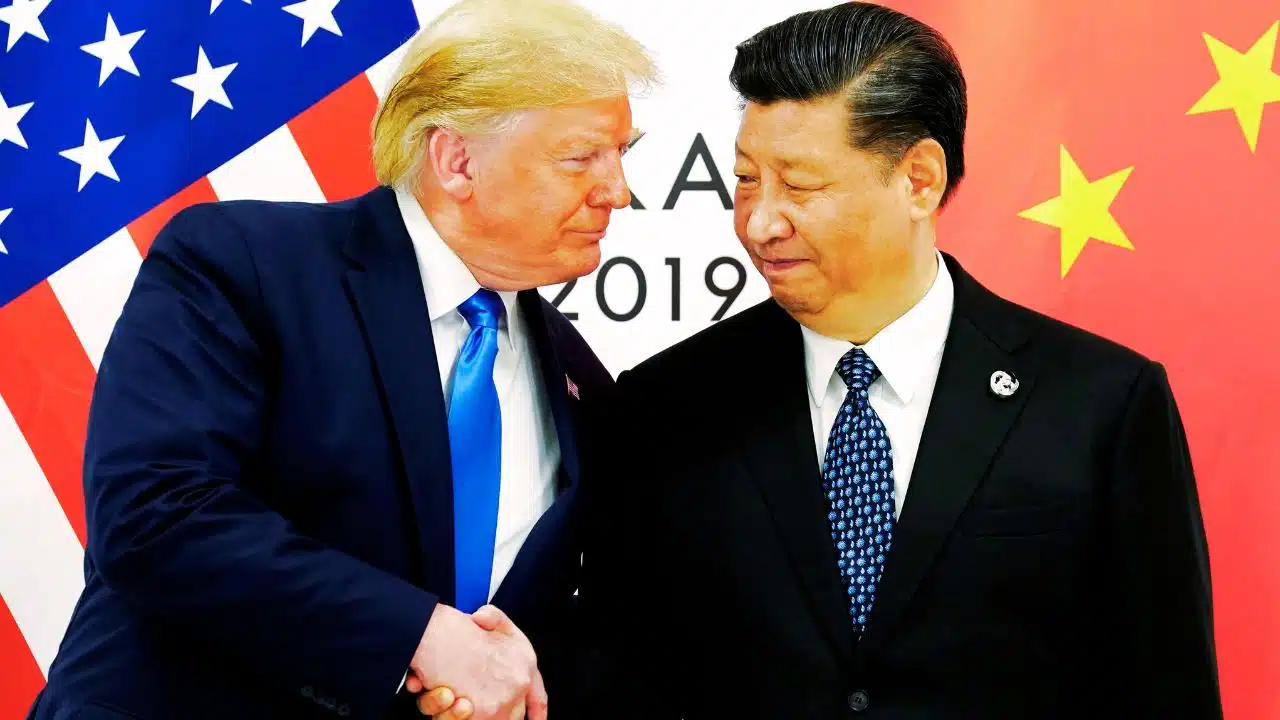
U.S. President Donald Trump and Chinese President Xi Jinping are set for a critical Trump Xi meeting on October 30 in a last-ditch effort to contain a rapidly escalating trade war. The talks, scheduled to occur in Busan, South Korea, come just 48 hours before a U.S.-imposed deadline that could see tariffs on Chinese goods skyrocket to an unprecedented 155%.
President Trump, who departed Washington on Friday (Oct 24) for a three-nation Asia tour, arrives in Malaysia today (Oct 26) against a backdrop of two major crises: a bruising trade conflict that threatens the global economy and a paralytic government shutdown back home.
“We have a lot to talk about with President Xi, and he has a lot to talk about with us,” Mr. Trump told reporters Friday night as he left the White House. “I think we’ll have a good meeting.”
The president’s optimism is being tested in real-time. This weekend, his top economic advisors—Treasury Secretary Scott Bessent and U.S. Trade Representative Jamieson Greer—are in Kuala Lumpur for emergency negotiations with Chinese Vice Premier He Lifeng, attempting to find an off-ramp before the two leaders meet.
The Brink of a New Trade War
The upcoming meeting is the first face-to-face interaction between the two leaders since President Trump began his second term in January. It was intended to stabilize relations, but the situation has deteriorated sharply in recent weeks.
The November 1 Deadline
The global economy is bracing for November 1, the date President Trump has set to impose what he calls a “potential 155% tariff” on Chinese goods if a “fair trade deal” is not reached.
This new 100% duty would be applied on top of the existing tariffs, which were reduced to approximately 55% as part of a temporary truce forged in May 2025. That truce, which also saw Chinese tariffs drop to around 30%, is set to expire on November 10.
How the Truce Unraveled
The delicate agreement frayed at the end of September 2025 when the U.S. Commerce Department significantly expanded its “entity list,” a move that blacklisted thousands of additional Chinese firms from accessing U.S. technology and exports.
Beijing’s response was swift and targeted. On October 10, 2025, China’s government announced new global export controls on rare earth magnets and minerals, a sector it dominates. The controls, which China states are to prevent military use, were seen in Washington as a direct economic attack.
In response, President Trump announced the new 100% tariff threat, leading to the current standoff.
Washington’s Core Demands
President Trump has been public about his demands for a deal. Speaking to reporters earlier this week, he listed three key concessions he expects from Beijing:
- Resumption of U.S. Soybean Purchases: “Our farmers have been boycotted by China as a negotiating point. I don’t want that,” Trump said.
- Curbing Fentanyl: The president has repeatedly insisted that China must stop the flow of the synthetic opioid and its precursor chemicals into the United States.
- Ending the ‘Rare Earth Game’: A clear demand for China to roll back its new export controls on the critical minerals.
“We can lower that [tariff], but they have to do things for us, too,” Trump stated on October 20. “It’s no longer a one-way street.”
Diplomacy Under Pressure
While the trade war dominates the agenda, the president’s trip is complicated by domestic and international factors.
Shutdown Criticism
President Trump’s decision to embark on a five-day foreign trip during a government shutdown has drawn scathing criticism from Democrats. With federal workers set to miss paychecks and services disrupted, opponents have labeled the trip an abdication of responsibility.
“America is shut down and the President is skipping town,” Senate Democratic Leader Chuck Schumer said in a statement on Saturday.
Allied Agendas in Malaysia and Japan
Before the APEC summit, President Trump’s first stop is Kuala Lumpur for the annual Association of Southeast Asian Nations (ASEAN) summit, a meeting he attended only once during his first term. He is scheduled to meet Malaysian Prime Minister Anwar Ibrahim and oversee the signing of a peace accord between Thailand and Cambodia.
From there, he travels to Tokyo to meet Japan’s newly elected leader and first female Prime Minister, Sanae Takaichi. Observers note Takaichi, a protégé of the late Shinzo Abe, will be seeking assurances on the U.S.-Japan security alliance while navigating Trump’s “America First” trade policies.
In a potential diplomatic wildcard, President Trump also told reporters he remains “open to” meeting North Korean leader Kim Jong Un, though officials have stated no such meeting is planned for this trip.
Expert Analysis: ‘Things to Get Much Nastier’
The preparatory talks in Kuala Lumpur this weekend are now the single most important focus for the global economy. A U.S. Treasury spokesperson described the first day of talks on Saturday as “very constructive,” but experts remain cautious.
Analysts warn that the two sides are further apart than they have been in years. The dispute is no longer just about tariffs but has spiraled into a conflict over technology access and critical supply chains.
Scott Kennedy, a China economics expert at the Center for Strategic and International Studies (CSIS), framed the stakes starkly in a recent analysis.
“We won’t know if Beijing has successfully counterbalanced the U.S.’s export controls with restrictions of their own or if they’ve induced a continuation of an escalatory spiral until Trump and Xi meet,” Kennedy noted. “If they make a deal, their gambit will have paid off. If there’s no deal, then everyone will need to prepare for things to get much nastier.”
What to Watch Next
All eyes are on the outcome of the weekend talks in Malaysia. A positive joint statement from Vice Premier He, Secretary Bessent, and USTR Greer would signal that the October 30 Trump Xi meeting has a strong chance of success.
Failure in Kuala Lumpur, however, would mean the two presidents will meet in Busan with the 155% tariff “gun” already on the table, making a last-minute breakthrough incredibly difficult. The outcome of that meeting on Thursday will likely determine the direction of the global economy for the foreseeable future.






















