

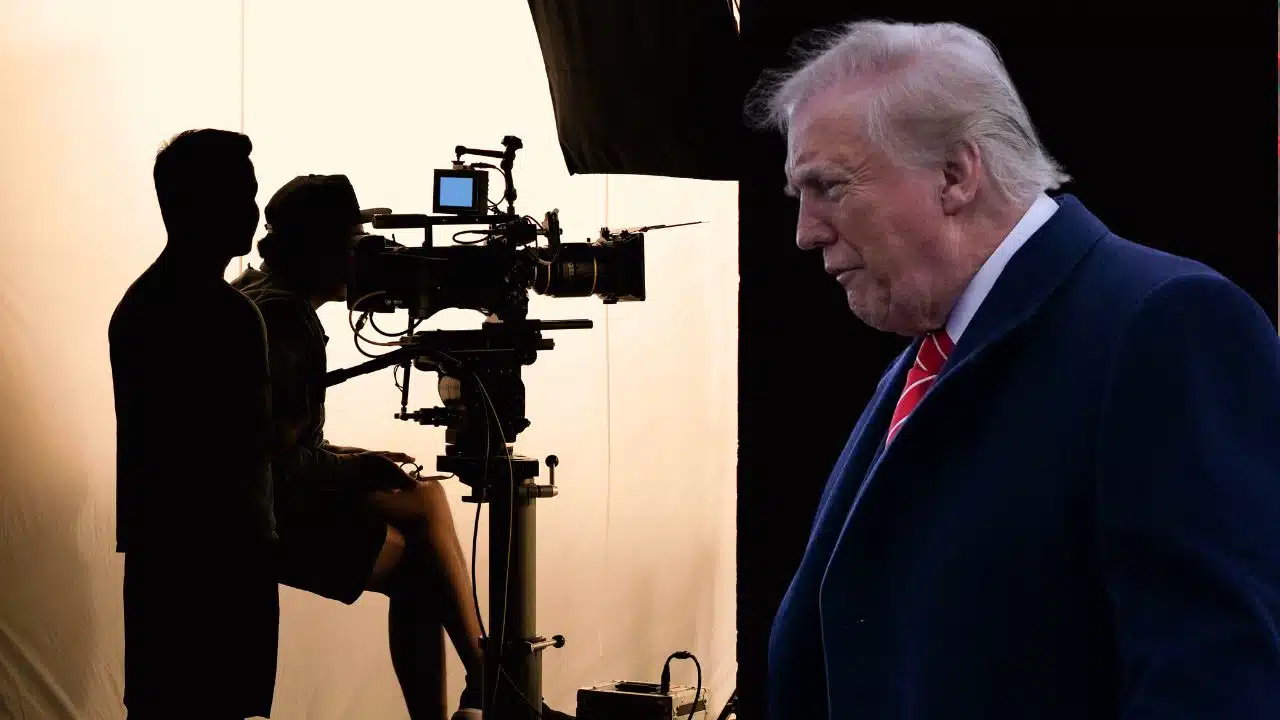
On Monday, September 29, 2025, U.S. President Donald Trump made a striking announcement that immediately sent ripples through the global film industry. In a post on his social media platform Truth Social, Trump declared that his administration would impose a 100% tariff on all films produced outside the United States.
This means that every movie made in countries like India, the United Kingdom, France, South Korea, Japan, China, and beyond would face double the cost to enter the U.S. market. Trump did not release any formal White House statement alongside the post, leaving industry leaders scrambling to interpret what this decision could mean for global cinema and international trade.
Trump’s Exact Words
In his Truth Social post, the President wrote:
“I will be imposing a 100% tariff on any and all movies that are made outside of the United States.”
The language was sweeping and categorical, with no exceptions noted. However, Trump did not clarify when this tariff would take effect, how it would be enforced, or whether it requires congressional approval.
A First of Its Kind: Tariff on Services, Not Goods
Historically, U.S. tariffs have mostly targeted physical goods like steel, aluminum, cars, or electronics. This would be the first time a U.S. administration has tried to impose such a measure on a cultural service or intellectual product like films.
This raises major questions:
- How will U.S. customs define a “foreign film”?
- Will films with partial production overseas—such as Hollywood blockbusters that outsource visual effects to Canada or India—be taxed?
- Could streaming releases (which never physically cross borders) fall under this tariff?
Experts note that applying tariffs to digital goods or services is extremely complicated under World Trade Organization (WTO) rules.
Impact on India and Bollywood

One of the biggest industries that could be hit is India’s Bollywood, which produces more films annually than any other country in the world. Indian films have been gaining popularity across U.S. streaming platforms and in select theaters. A 100% tariff could make it financially unfeasible for distributors to bring Indian films into U.S. theaters, hurting both cultural exchange and box office revenue.
Analysts warn that such a move could also affect Tollywood (Telugu cinema), Kollywood (Tamil cinema), and other regional industries, which have increasingly found audiences abroad.
Global Backlash Likely
The tariff proposal has the potential to spark trade disputes with major economies.
- European Union: France, Germany, and the U.K. have long invested heavily in film exports. These countries may see the move as a violation of trade rules and could retaliate with tariffs on U.S. films or other cultural goods.
- Asia: South Korea, which has recently grown into a global cultural powerhouse thanks to K-dramas and films like Parasite, would view this as a direct hit to its entertainment exports.
- Latin America and Africa: Independent cinema from these regions, already operating on tight margins, could lose its access to the U.S. market entirely.
Hollywood in a Dilemma
Ironically, the tariff may also disrupt Hollywood itself. U.S. studios often outsource post-production, visual effects, and even on-location filming to other countries to save costs.
- Marvel films, for example, have shot scenes in Canada, Australia, and the U.K.
- Many U.S. blockbusters rely on foreign studios for CGI and animation.
If tariffs apply to any part of a movie made abroad, even Hollywood blockbusters could end up being taxed. This could raise production costs, discourage international collaboration, and even lead to higher ticket prices for U.S. audiences.
Economic Stakes
The U.S. film industry currently enjoys a trade surplus. According to U.S. government trade data, film and television exports generated $22.6 billion in 2023. Imposing tariffs risks retaliation from trading partners, which could damage Hollywood’s stronghold as the world’s largest cultural exporter.
Film trade is not just about money. It’s also about soft power—the ability of American films and TV shows to shape global culture and spread U.S. influence. Restricting cultural exchange could undercut one of America’s greatest strengths.
Legal and Practical Challenges
Legal experts are skeptical about whether such a tariff could withstand challenges:
- WTO rules: International trade law prohibits unfair restrictions on services without due process. A sudden 100% tariff on films may be contested.
- Domestic law: The U.S. Constitution gives Congress power over tariffs. If Trump acts unilaterally, it could face legal battles.
- Digital loopholes: With streaming services like Netflix, Amazon Prime Video, and Disney+ distributing films globally, it’s unclear how the government could even collect such tariffs.
Industry and Political Reactions
As of now, Hollywood studios, trade associations, and lawmakers have not issued detailed responses. However, film analysts expect:
- Strong lobbying from both U.S. and international studios to block or water down the proposal.
- Criticism from free-trade advocates, who see this as cultural protectionism.
- Support from nationalist groups, who may view this as a way to strengthen American cultural dominance.
Meanwhile, international governments are expected to demand clarifications through diplomatic channels in the coming days.
What Happens Next
At this stage, the tariff exists only as a proposal announced on social media. No official policy, executive order, or legislation has been published.
- If Trump moves forward, he may need congressional backing or risk lengthy court challenges.
- Other countries may preemptively prepare retaliatory measures against U.S. film exports.
- Film distributors worldwide are waiting for clarity on timing, scope, and enforcement.
For now, the announcement has created uncertainty and anxiety across the global entertainment sector. Whether this becomes enforceable law—or remains a political statement—will depend on how the administration proceeds in the weeks ahead.
The Information is Collected from BBC and CNN.























