
Classrooms are open, but too many seats at the front are empty. The teacher shortage 2025 is no longer a headline—it’s a daily reality for principals, parents, and students from big cities to remote towns.
Math and science classes rotate through substitutes. Special education teams are spread thin. New teachers arrive full of hope, then burn out before year three. Behind each vacancy is the same mix of pressures: pay that can’t beat living costs, admin work that eats planning time, complex licensing rules, and rising stress in and out of the classroom.
This article is a plain-English guide to what’s broken—and how to fix it fast. We’ll map the shortage across regions, unpack root causes, and show what it’s costing learners and communities. The goal is practical: stabilize staffing, protect learning, and make teaching a sustainable, collaborative profession again. If you can move on pay, time, and pipelines—in that order—you can turn this crisis into capacity.
The State of the Teacher Shortage in 2025 (At a Glance)
The teacher shortage 2025 is visible in almost every region—but it doesn’t look the same everywhere. Some systems struggle to hire STEM and special education teachers; others can’t fill rural and high-cost city posts. Turnover is highest where pay trails living costs and planning time is thin. Use the quick snapshots and table below to compare patterns across regions, then layer in your local vacancy and retention data to see where the gaps are sharpest—and which fixes should come first.
Global Overview
-
Who is the hardest to hire? STEM, special education, and early-career teachers in high-cost cities and remote areas.
-
Where are gaps most visible? Rural schools, low-income urban neighborhoods, and fast-growing suburbs.
-
What complicates it? Retirements, career switching out of teaching, higher living costs, and complex licensing routes.
Regional Snapshots (Qualitative)
-
North America: Shortages cluster in special ed, math, and science; high turnover in high-needs schools.
-
Europe: Uneven picture; rural posts and STEM remain hard to fill; workload/time pressure is a top complaint.
-
South Asia: Rapid enrollment growth stresses supply; rural placements need housing and career pathways.
-
Sub-Saharan Africa: Large class sizes; need for training pipelines and mentorship at scale.
-
MENA: Demand outpaces supply in fast-growing urban centers; there is a need for local training and recognition of prior learning.
-
LATAM: Retention challenges in low-income zones; rising interest in alternate pathways and coaching.
-
Oceania: Regional/rural vacancies; housing and travel stipends make a difference.
Root Causes of Teacher Shortage: What’s Actually Broken
The teacher shortage 2025 isn’t driven by one problem—it’s a knot of issues that pull on each other. Pay often can’t compete with similar professions, while admin tasks and large classes swallow planning time. Burnout grows as behavior and safety concerns rise, and many promising candidates stall in credentialing bottlenecks or leak out of the pipeline before year three.
In high-cost areas, housing makes recruitment even harder. And too many “solutions” in edtech add clicks instead of saving minutes. In this section, we unpack each broken link—so you can choose fixes that relieve pressure fast without lowering standards.
1) Compensation & Benefits
Teaching often loses the salary race to comparable professions that require similar degrees. In high-cost areas, housing eats pay raises, and benefits may not offset the gap. Fixes that work: competitive starting pay, differential pay for shortage subjects/locations, and transparent progression.
2) Workload & Planning Time
Teachers spend a lot of time on non-teaching tasks—data entry, admin, duplicated paperwork—while still managing large classes and parent communication. The biggest morale boost is simple: protected planning time and admin offloading.
3) Burnout, Safety & Wellbeing
Behavior issues, classroom safety, and constant pressure thin resilience. Schools that reduce burnout invest in behavior response teams, counseling access, and de-escalation training, and they normalize help-seeking.
4) Training & Credentialing Bottlenecks
Licensing can be slow and costly. Many mid-career candidates want to teach but cannot pause income for a year-long pathway. Paid residencies, school-based apprenticeships, alternate certification, and recognition of prior learning widen the gate while keeping standards high.
5) Pipeline Leak Points
We lose many new teachers before year three. Why? Weak induction, thin mentorship, and no time to plan or improve. Structured mentor-buddy systems and light-touch coaching improve survival and satisfaction.
6) Housing & Cost of Living
In high-cost cities and remote areas, housing blocks are hiring. District-backed rentals, rent stipends, and relocation packages remove a major barrier.
7) Tech Burden vs. Tech Relief
Edtech should save time. But too many tools add clicks. The rule: if a tool doesn’t save 90 minutes per week, it’s not helping the teacher shortage 2025.
Teacher Shortage in 2025: Region Specific Data
| Region | Scenario | Hardest-Hit Subjects/Levels | Main Drivers | Fast Wins (30–90 days) |
|---|---|---|---|---|
| North America | 411,500 positions unfilled or filled by not-fully-certified teachers in USA. Large districts reporting 20–25% uncertified in some schools.† | Special education, STEM, bilingual/ELL; rural & high-poverty urban | Pay vs. living costs; turnover/attrition; certification bottlenecks; behavior/safety; housing in cities | Targeted stipends; protected planning time; mentor-buddy onboarding; upgrade substitute pool |
| Europe | Non-fully-qualified teachers in primary/secondary: Sweden 16–22%, Denmark and Estonia >15% in some levels. EU VET tracks face acute shortages and low perceived status. | STEM, special needs, VET; rural placements; some high-cost metros | Ageing workforce; workload/admin; status/attractiveness; regional pay gaps | Reduce admin load; PLC/collab time; fast-track returners; VET industry partnerships |
| South Asia | India: media/analyst estimates 1 million teacher vacancies, especially rural (late-2024 reporting). Rapid enrolment growth across region | Primary (large classes), STEM; remote districts | Pay/security; infrastructure/housing; recruitment delays; multigrade loads | Rural housing/relocation stipends; accelerated hiring windows; para-to-teacher pathways |
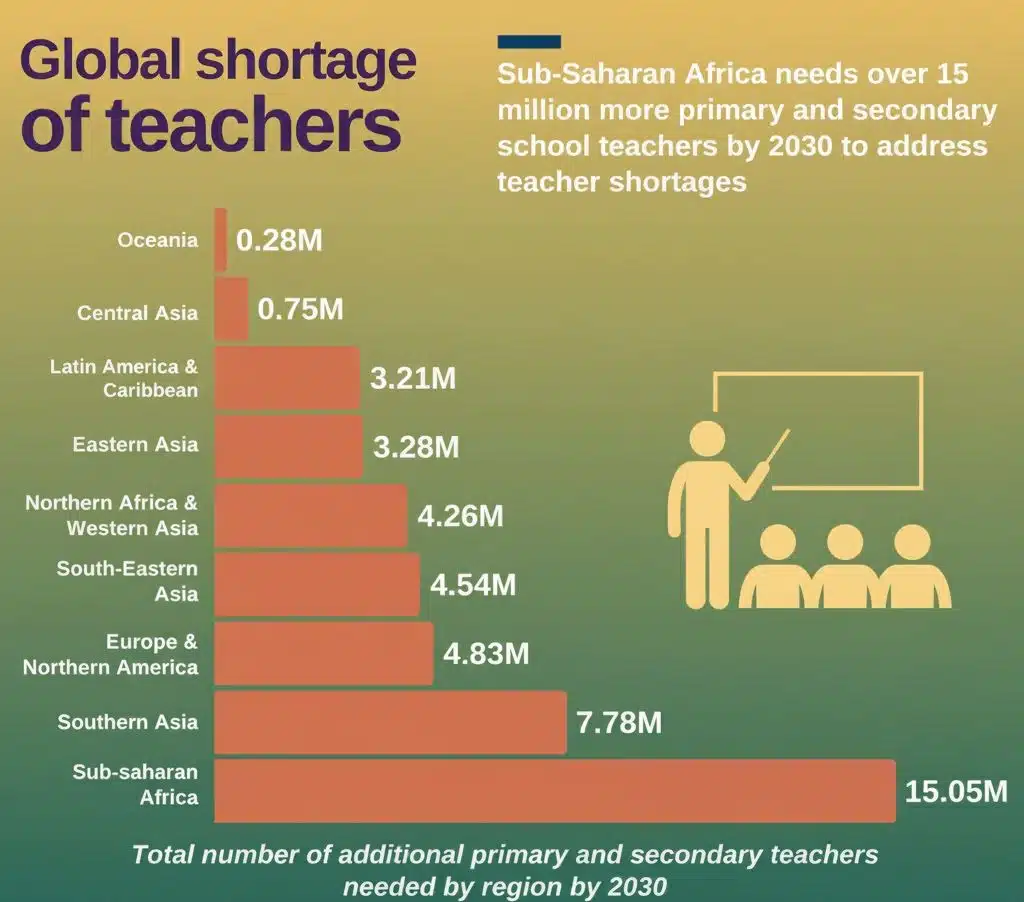
| Sub-Saharan Africa | Region needs ~15 million new teachers by 2030 (part of global 44M gap). | Primary (early literacy/numeracy), STEM; rural/remote | Training capacity; class sizes; resources; retention; geographic distribution | Paid residencies; coaching at scale; community-anchored “grow-your-own” pipelines |
| MENA | Shortages reported in fast-growing cities; reliance on international hires in some systems | STEM, languages; urban public schools | Cost of living/housing; pipeline reliance on migration; credential recognition | Housing support; recognition of prior learning; alternate licensure with mentoring |
| Latin America (LATAM) | Retention issues in low-income zones; uneven rural coverage (country-specific) | STEM, special education; rural | Pay progression; workload; safety; travel time | Differential pay; behavior-support teams; returner programs |
| Oceania | Persistent rural vacancies; housing/relocation barriers noted in AUS/NZ | STEM; remote communities | Housing/costs; travel; limited local pipelines | Rural housing; relocation stipends; local scholarships + service bonds |
| Global Overview | World needs 44 million primary & secondary teachers by 2030 to meet SDG4, replacement + growth. | Secondary teachers (7 in 10 needed globally by 2030); primary in low-income settings | Attrition > retirements; pipeline throughput; profession status; training capacity | Pay + protected time; alternate routes with coaching; data-driven retention KPIs |
region-wise 2025 teacher-shortage table
What It’s Costing Us: Learning, Equity, and Budgets
Every vacant classroom has a price tag—and students pay first. Learning slows when substitutes rotate and courses are taught outside a teacher’s specialty, widening equity gaps for low-income and rural learners. Schools then spend more on recruitment, agency cover, and emergency fixes, draining budgets that should fund coaching, materials, and well-being.
Communities feel it too: lower trust, disrupted routines, and a weaker talent pipeline. In short, the teacher shortage 2025 doesn’t just strain staff—it taxes outcomes and finances across the whole system.
Student Outcomes & Equity
Vacant or rotating posts hit learning. Underqualified placements and short-term substitutes reduce continuity, which widens achievement gaps for low-income and rural students.
Budget Waste & Opportunity Cost
High turnover means constant recruitment and induction spending, agency staffing fees, and lost momentum in curriculum and culture. Money spent plugging holes could be funding coaching, residencies, or housing stipends.
Community Impacts
Teacher churn hurts parent trust, local economies, and the future talent pipeline. Stable schools attract families and investment.
Final Words
The teacher shortage 2025 is real, but it’s not immovable. When schools act on the three biggest levers—pay, time, and pipelines—vacancies shrink, burnout eases, and students regain continuity. None of this requires perfect conditions or endless committees. It requires clear priorities, quick sprints, and steady follow-through.
Start where impact is fastest:
-
Pay what matters: competitive starting salaries and targeted stipends for shortage subjects/locations.
-
Protect time: guaranteed weekly planning blocks and trimmed admin so teachers can teach.
-
Build the pipeline: mentor-buddy onboarding, returner programs, and alternate certification with real coaching.
FAQs on the Teacher Shortage 2025
Q1. What is driving the teacher shortage 2025 in my region?
A mix of pay, workload, credentialing hurdles, and housing costs. Map your local data to each driver, then target fixes.
Q2. Which interventions show the fastest results?
Within one term: admin offloading, protected planning time, behavior support, stipends for shortage roles, and a mentor buddy for every new hire.
Q3. How can schools use AI without increasing workload?
Start small: lesson outlines, quick feedback summaries, and basic communication templates. Use privacy-safe settings and human review.
Q4. What pay reforms deliver the best retention per dollar?
Competitive starting pay and differential pay for shortage areas, plus predictable progression. Pair with time and support—money alone won’t fix workload stress.
Q5. How do we build an alternate certification pathway safely?
Use screened candidates, paid residency, mentor coaching, and performance assessments before full licensure.