Achieving a state of net-zero emissions is a monumental task that requires a complete restructuring of a nation’s energy, industrial, and transportation sectors. Sweden has positioned itself at the forefront of this global transition by enshrining its environmental targets into law, ensuring that climate action remains a priority regardless of political cycles. As we move through 2026, the specific strategies and hurdles of this ambitious roadmap have become clearer, offering a blueprint for other nations to follow.
How We Selected Our 7 Best Sweden’s Carbon Neutral Plan 2045 Facts
To provide the most accurate assessment of the Swedish climate roadmap, we analyzed current legislative updates and independent oversight reports released in 2026. Our selection process prioritized factors that represent the most significant shifts in national policy and those that carry the highest impact on international emission standards.
The benchmarks provided below define the technical and political categories used to evaluate the effectiveness of the 2045 plan.
| Evaluation Metric | Description of Focus Area | Priority Level |
| Legislative Binding | Status of the Climate Act and mandatory reporting | Critical |
| Sectoral Targets | Specific milestones for transport and industry | Very High |
| Technological Feasibility | Scalability of Bio-CCS and green hydrogen | High |
| Independent Oversight | Impact of the Climate Policy Council’s 2026 findings | High |
By utilizing these metrics, we have identified the core pillars that currently define the Swedish approach to a fossil-free future.
The Strategic Roadmap for Sweden’s Carbon Neutral Plan 2045
Successfully transforming a national economy requires more than just a distant target; it requires a sequence of actionable milestones and massive infrastructure investment. These seven facts detail the current state of Sweden’s journey toward its 2045 goal and the specific mechanisms being used to drive change.
1. The 85% Absolute Reduction Mandate
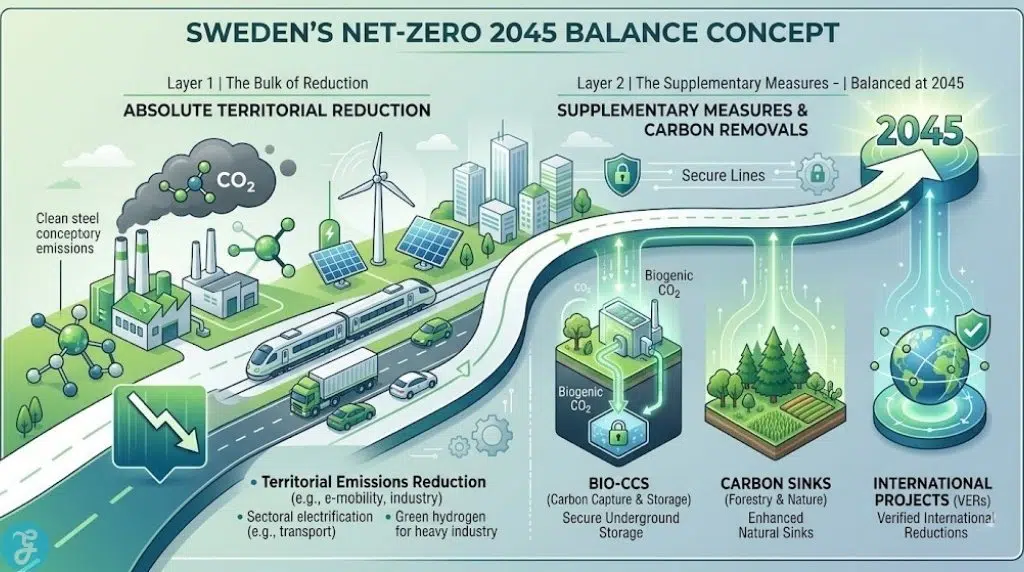
The core of the 2045 target is not just about offsetting emissions but about a radical reduction in actual greenhouse gas output. The Swedish Climate Act stipulates that territorial emissions must be at least 85% lower than 1990 levels by the deadline. This ensures that the bulk of the work is done through direct decarbonization of industry and transport rather than relying solely on carbon sinks.
Best for:
-
Understanding the rigorous mathematical foundation of the Swedish climate law.
Why We Chose It:
-
It prevents the “greenwashing” of targets through excessive carbon credit usage.
-
It forces a structural shift in the heavy industry and manufacturing sectors.
-
It sets a high global standard for what “Net Zero” actually means in practice.
Things to consider:
-
The remaining 15% is expected to be managed through negative emission technologies.
While the reduction targets are the primary focus, the plan also includes a specific vision for what happens after the goal is reached.
2. Transitioning to Negative Emissions Post-2045
Sweden’s climate framework does not stop at zero. After the 2045 deadline, the national goal shifts to achieving negative net emissions, meaning the country will remove more carbon from the atmosphere than it produces. This long-term perspective is designed to help reverse historical climate impacts and contribute to global cooling efforts.
Best for:
-
Long-term climate strategists looking at the era beyond neutrality.
Why We Chose It:
-
It acknowledges that neutrality is a milestone, not the final destination.
-
It incentivizes the early development of removal technologies like Bio-CCS.
-
It provides a clear signal to the forestry sector regarding its role as a carbon sink.
Things to consider:
-
Negative emissions depend heavily on the maturity of unproven large-scale storage technologies.
Reaching these targets requires a complete overhaul of the national grid to ensure power remains abundant and clean.
3. The Pivot to “100% Fossil-Free” Electricity
In a significant policy shift highlighted in recent 2026 energy calls, Sweden has moved from a “100% renewable” target to a “100% fossil-free” electricity target for 2040. This change in terminology specifically allows for the expansion of nuclear power alongside wind and solar to meet the massive surge in demand driven by industrial electrification.
Best for:
-
Energy planners balancing grid stability with decarbonization.
Why We Chose It:
-
It reflects a pragmatic approach to the 2026 energy security landscape.
-
It supports the building of new large-scale and small modular reactors (SMRs).
-
It provides the reliable “baseload” power required for green steel production.
Things to consider:
-
The Swedish Energy Agency has allocated over SEK 170 million for nuclear research in 2026.
The electrification of the grid is essential for decarbonizing the most difficult part of the Swedish economy.
4. Aggressive 70% Transport Emission Cuts by 2030
The transportation sector is the target of a specific interim goal to reduce emissions by 70% compared to 2010 levels by the year 2030. To support this, the government has introduced new electric vehicle premiums in 2026, specifically targeting low-income households in rural areas where public transit is limited.
Best for:
-
Commuters and logistics companies transitioning to electric fleets.
Why We Chose It:
-
Transport remains one of Sweden’s top three highest-emitting sectors.
-
It includes a heavy focus on the electrification of heavy trucks and shipping.
-
The 2026 premiums make the transition more equitable for non-urban residents.
Things to consider:
-
Domestic flights are currently excluded from this specific 70% reduction target.
Achieving such deep cuts in transport and industry requires a way to capture the carbon that cannot be avoided.
5. Bio-CCS and the SEK 36 Billion Reverse Auction
Sweden is betting heavily on Bioenergy with Carbon Capture and Storage (Bio-CCS) to handle its “supplementary” emission removals. Starting in 2026, the government has launched a series of reverse auctions where companies compete for subsidies by offering to capture and store biogenic carbon at the lowest possible cost.
Best for:
-
Industrial players in the bioenergy and waste-to-energy sectors.
Why We Chose It:
-
It utilizes Sweden’s massive existing biomass industry to create negative emissions.
-
The 2026-2046 funding pool provides long-term certainty for investors.
-
It positions Sweden as a global hub for carbon removal technology and expertise.
Things to consider:
-
The first major wave of funding for these projects begins in 2026.
Despite these technological advances, the plan is subject to intense scrutiny from independent experts.
6. Oversight by the Independent Climate Policy Council
Sweden’s progress is monitored by an independent Climate Policy Council, which evaluates the government’s overall policy alignment with the 2045 goals. In its March 2026 report, the Council voiced significant criticism, stating that current policies—such as fuel tax cuts—have made the 2030 and 2040 milestones harder to reach.
Best for:
-
Voters and international observers tracking political accountability.
Why We Chose It:
-
It ensures that climate policy is not solely defined by the government of the day.
-
The 2026 report serves as a “reality check” for the pace of the transition.
-
It highlights the friction between immediate economic relief and long-term climate goals.
Things to consider:
-
The council is tasked with assessing every policy area, not just environmental ones.
One area where the Council’s feedback is particularly relevant is the transformation of heavy industry.
7. The “Industrial Leap” and Fossil-Free Steel
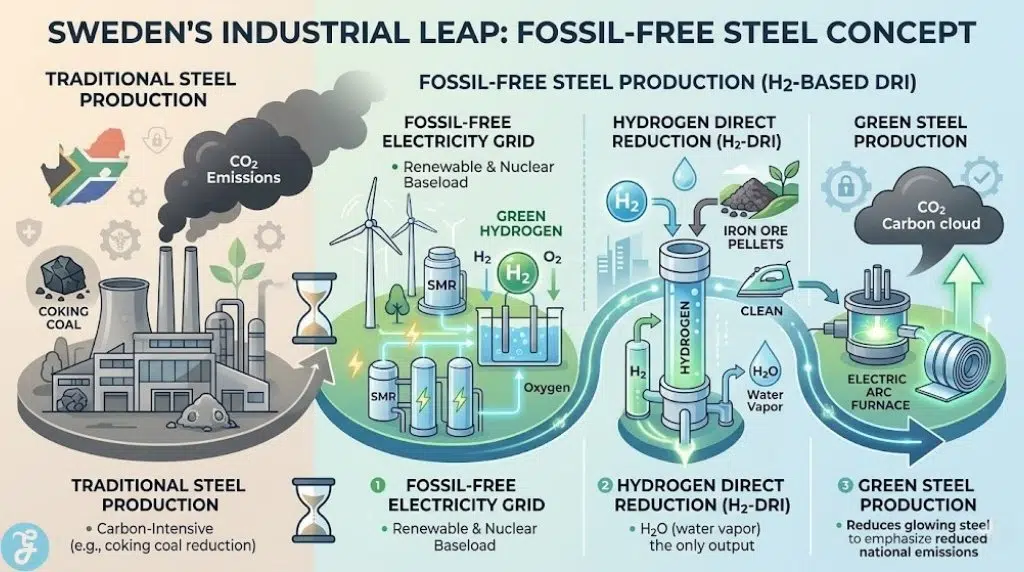
The “Industrial Leap” (Industriklivet) is a major government initiative funding the transition of heavy industry toward zero emissions. This program is the primary driver behind projects like HYBRIT, which aims to produce fossil-free steel using green hydrogen instead of coking coal, potentially removing 10% of Sweden’s total emissions.
Best for:
-
Manufacturers and engineers looking for breakthroughs in heavy decarbonization.
Why We Chose It:
-
It targets the “hard-to-abate” sectors that often stall climate plans.
-
It demonstrates the commercial viability of hydrogen at an industrial scale.
-
Funding for this initiative has been extended with billions allocated through 2030.
Things to consider:
-
Successful scaling depends on the 2026 expansion of the national electricity grid.
An Overview of Sweden Carbon Neutral 2045 Progress
Assessing a national climate plan requires a look at both the ambitious targets and the current operational realities. The following breakdown provides a quick reference for the primary milestones and the current trajectory of the Swedish transition as of 2026.
The categories below summarize the different layers of the national strategy and their current status.
| Target Category | Deadline | Reduction Goal | Current 2026 Status |
| First Milestone | 2020 | 40% (from 1990) | Successfully Met |
| Second Milestone | 2030 | 63% (from 1990) | Under Scrutiny/Lagging |
| Transport Target | 2030 | 70% (from 2010) | Needs Acceleration |
| Third Milestone | 2040 | 75% (from 1990) | Policy Alignment Required |
| Final Net Zero | 2045 | 100% (85% + 15%) | Legally Enshrined |
Our Top 3 Picks and Why?
While all facets of the plan are important, three elements stand out as the most critical for the long-term success of the Swedish model.
-
The Climate Act: This is the legal “anchor” that makes the 2045 goal independent of changing political administrations.
-
Fossil-Free Electricity Pivot: This pragmatic shift ensures the energy supply is actually capable of supporting industrial growth.
-
Bio-CCS Reverse Auctions: This is a world-first financial mechanism that creates a real market for carbon removal.
How to Choose the Right Strategy for a Fossil-Free Future?
Developing a framework for a national or corporate climate transition requires a balance between aggressive targets and technological reality. By following a structured approach to decarbonization, organizations and nations can ensure their path is both sustainable and economically viable.
-
Prioritize Direct Reductions: Focus first on removing fossil fuels from the supply chain before looking at offsets or capture.
-
Incentivize Infrastructure: Ensure that energy grids and storage solutions are built ahead of the demand for electrification.
-
Implement Independent Oversight: Create a non-partisan body to provide honest assessments of progress and policy failures.
-
Leverage Regional Strengths: Utilize existing natural resources, such as Sweden’s forestry or Norway’s hydro-power, to drive specific technologies.
The choice of specific climate measures often depends on the current technological maturity and the urgency of the sector being addressed.
| Choose Direct Electrification if… | Choose Negative Emissions if… |
| The technology for EV or heat pumps is mature. | You are dealing with “unavoidable” industrial CO2. |
| You have access to a clean, stable electricity grid. | You have the geological capacity for carbon storage. |
| You are targeting consumer and light transport sectors. | You are looking for negative balance post-2045. |
The Final Checklist
-
[ ] Verify the current percentage of fossil-free energy in your regional mix.
-
[ ] Identify the specific 2030 and 2040 interim targets for your sector.
-
[ ] Review the latest 2026 Climate Policy Council report for current policy risks.
-
[ ] Check for available government premiums or subsidies for industrial electrification.
-
[ ] Ensure all climate reporting aligns with the 85% absolute reduction requirement.
Securing a Sustainable Swedish Legacy
The 2045 plan is more than a list of numbers; it is a vision for a society that remains prosperous while operating within planetary boundaries. By integrating legislative strength with industrial innovation, Sweden is demonstrating that the path to net-zero is not just a burden, but an opportunity to lead the next global industrial revolution. As we move closer to the 2030 milestone, the ability to adapt to new energy realities while maintaining the core Climate Act will be the ultimate test of this national experiment.
Frequently Asked Questions About Sweden‘s Carbon Neutral Plan 2045
Is Sweden actually on track to meet the 2045 goal?
Answer: While the long-term 2045 goal is legally enshrined and the 2020 target was met, the 2026 report from the Climate Policy Council warns that current policies have put the 2030 and 2040 interim targets at high risk.
Why did Sweden change the 2040 target to “fossil-free”?
Answer: The shift from “100% renewable” to “100% fossil-free” was made to allow nuclear power to play a permanent role in the grid, ensuring enough stable energy is available for the massive electrification of industry.
What are “supplementary measures” in the Swedish plan?
Answer: These are actions used to reach the final 15% of the net-zero goal, including bioenergy with carbon capture (Bio-CCS), carbon sequestration in forests, and verified emission reduction projects in other countries.
How does the plan affect the average Swedish citizen?
Answer: Citizens see the plan through higher carbon taxes on fuels, but also through subsidies for electric vehicles, improved public transit, and the growth of new “green” jobs in the fossil-free steel and battery industries.
Can the 2045 plan be canceled by a new government?
Answer: Because the Climate Act was passed with a broad parliamentary majority, it is designed to be very difficult to repeal. Any government must by law present a climate report and an action plan every four years.