
Samsung has officially confirmed that its upcoming mobile chipset, the Exynos 2600, will be the first smartphone processor manufactured using a 2nm fabrication process. This significant development gives the South Korean tech giant a decisive lead in semiconductor technology over rivals like Apple, Qualcomm, and MediaTek, who are all still relying on TSMC’s 3nm process for their next-generation chips.
The announcement came during Samsung’s Q2 2025 earnings call, where the company highlighted both breakthroughs and ongoing challenges in its semiconductor division. While chip profits have been under pressure in recent quarters, the confirmation of the Exynos 2600’s 2nm status marks a major win—and possibly a turning point—for Samsung’s mobile and foundry businesses.
Samsung’s 2nm Breakthrough: What It Means
The Exynos 2600 will be fabricated using Samsung Foundry’s 2nm Gate-All-Around (GAA) process. This architecture offers several benefits over previous nodes, including:
-
Better power efficiency
-
Improved performance-per-watt
-
Reduced chip size
With this move, Samsung becomes the first company globally to bring a 2nm chip to market, ahead of major competitors. Apple is expected to continue using TSMC’s N3E 3nm process for its upcoming A18 Pro chip in the iPhone 17 Pro, while Qualcomm’s Snapdragon 8 Elite Gen 2 is also being built on TSMC’s 3nm platform.
Samsung’s early lead is not just about being first—it could also help rebuild confidence in its in-house Exynos brand, which has suffered in recent years due to thermal inefficiencies and lower GPU performance compared to Snapdragon alternatives.
Exynos 2600 May Power the Galaxy S26 in Some Markets
Samsung is likely to debut the Exynos 2600 in its Galaxy S26 lineup, expected to launch globally in early 2026. Following recent patterns, the chip may be used in select markets like Europe, the Middle East, and parts of Asia, while regions like North America and South Korea may receive Snapdragon variants of the S26 series.
This hybrid chipset strategy follows Samsung’s move in 2024 to use Qualcomm chips exclusively in the Galaxy S25 lineup, after manufacturing and performance issues with the Exynos 2500 delayed its rollout. The decision to return to Exynos with the 2600 shows renewed confidence in the platform’s capabilities, now backed by next-gen fabrication technology.
Performance Leaks Show Strong Potential
Preliminary leaks and internal testing suggest that the Exynos 2600 will be competitive—if not superior—to its Snapdragon rival in certain benchmarks.
The chip reportedly features a 10-core CPU, arranged in the following configuration:
-
1 high-performance Prime core
-
3 large performance cores
-
6 power-efficient small cores
This structure is designed to balance peak performance with battery optimization, a key demand for flagship mobile devices. The GPU—branded as the Xclipse 960—is a custom solution built in collaboration with AMD. Early benchmarks indicate that this GPU could deliver around 15% better graphics performance than the Adreno 830 GPU found in Qualcomm’s Snapdragon 8 Elite.
In 3DMark’s Steel Nomad Light benchmark, the Xclipse 960 reportedly achieved around 3,135 points at 23 fps, compared to Adreno 830’s 2,681 points at 19.9 fps. These figures are based on pre-production testing with optimized cooling and firmware, so final smartphone results may vary. Nevertheless, the early results are promising for Samsung.
A Critical Moment for Samsung’s Semiconductor Strategy
The launch of the Exynos 2600 isn’t just about mobile performance—it’s also about Samsung proving that its foundry arm can compete with TSMC, the dominant player in advanced chip production. Samsung Foundry has faced challenges with yield rates, power efficiency, and client retention over the past few years. TSMC continues to manufacture most of Apple and Qualcomm’s chips, with nearly a monopoly on leading-edge nodes like 5nm and 3nm.
The Exynos 2600, fabricated on Samsung’s own 2nm GAA node, is seen as a high-stakes internal project. Reports suggest that trial production began in mid-2025 with initial yields of 30–40%. The company aims to improve those yields to 60–70% by the time mass production begins later in the year.
Samsung’s goal is to regain credibility as a viable alternative to TSMC—not only for internal use but also for external clients in automotive, AI, and consumer electronics.
$16.5 Billion Chip Deal with Tesla Could Boost Confidence
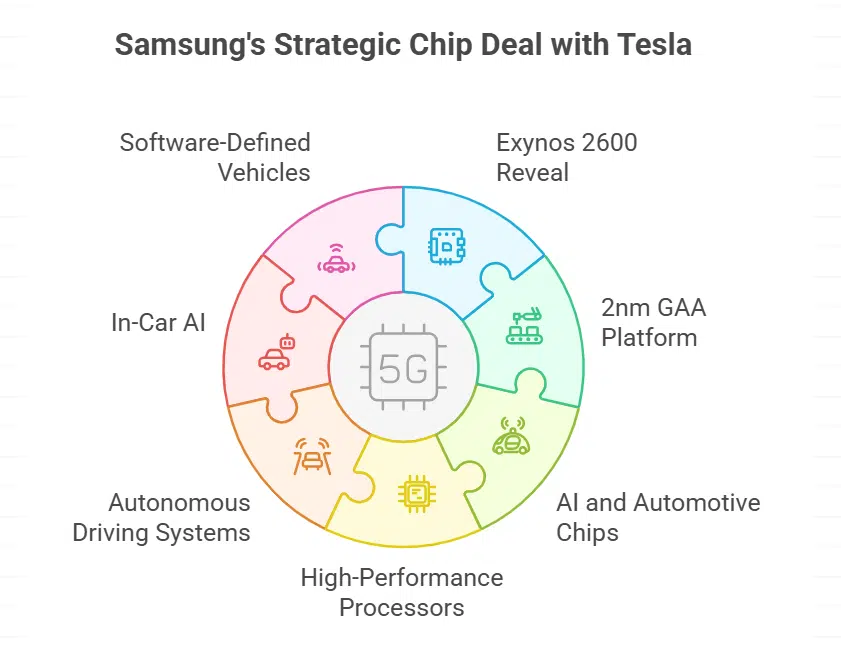
Alongside the Exynos 2600 reveal, Samsung has reportedly signed a $16.5 billion agreement with Tesla, likely for AI and automotive chips manufactured on the same 2nm GAA platform. This is one of the largest semiconductor contracts in Samsung’s history, and it suggests that large-scale clients are beginning to trust Samsung Foundry for cutting-edge production.
The Tesla deal is expected to involve high-performance processors for next-generation autonomous driving systems and in-car AI, aligning with Tesla’s roadmap for software-defined vehicles. The fact that Samsung is willing to use the same 2nm node for both its mobile and AI customers indicates a strong internal validation of its capabilities.
What to Expect Leading Up to Launch
As the Exynos 2600 gets closer to public release, the tech community can expect:
-
More detailed benchmarks, including real-world gaming and AI workloads
-
Thermal performance tests in actual smartphone chassis
-
Power efficiency comparisons against Apple’s A18 Pro and Snapdragon 8 Elite Gen 2
-
Confirmation of exact regional chip variants in the Galaxy S26 lineup
-
Improvements in Galaxy AI, which Samsung plans to expand in its 2026 flagship series
The chip is expected to debut in January or February 2026, aligning with Samsung’s usual Galaxy S-series release window. Depending on yields and production readiness, we could also see the Exynos 2600 in high-end Galaxy tablets or AI-focused smartphones later in the year.
The Bigger Picture: Samsung’s 2025–2026 Outlook Looks Bright
Despite ongoing challenges in the memory and logic chip markets, Samsung’s mobile division is thriving, largely due to the success of the Galaxy Z Fold 7 and strong early reviews of upcoming devices. With the Exynos 2600 breaking ground in 2nm tech, and a massive external contract in place with Tesla, Samsung appears to be entering a renewed growth phase.
The company’s focus on integrating its foundry, mobile, and AI efforts could help it reclaim its position as a semiconductor leader, not just a mobile hardware giant.
Samsung’s Exynos 2600 is shaping up to be a major milestone—not just for the company’s mobile chipset ambitions, but for the entire semiconductor industry. With the potential to be the first 2nm chip to reach consumers, this launch could reshape the competitive landscape and help Samsung reassert itself as a leader in both performance and fabrication.