The era of “spray and pray” marketing is rapidly fading. In the noisy digital landscape of 2026, where attention is the scarcest commodity, podcast advertising has emerged as the ultimate sanctuary for deep engagement. Unlike radio, which broadcasts to a geographical area, podcasting narrowcasts to a specific interest.
It doesn’t shout at a crowd; it whispers directly into the ears of an engaged listener. For brands, this medium has graduated from an experimental channel to a cornerstone of modern digital strategy.
The Shift from Broad Reach to Relevance
The data support this massive shift in advertising spend. As the industry matures, the global market for podcast ads is projected to eclipse the $5 billion mark by the end of 2026. With over 580 million monthly listeners worldwide choosing exactly what they want to hear, the potential is undeniable.
However, the real opportunity in 2026 isn’t just the sheer volume of listeners; it is the fragmentation of that audience into passionate micro-communities. Savvy advertisers now realize that reaching 5,000 dedicated listeners of a niche show, like a podcast dedicated to “Sustainable Supply Chain Management,” is often far more valuable than reaching 50,000 casual listeners of a general news program. This guide explores the strategies, technologies, and psychological drivers that make reaching these high-intent audiences the most effective play in digital marketing today.
Why Niche Podcast Advertising Dominates in 2026
The effectiveness of advertising on podcasts hinges on the unique relationship between the listener, the host, and the content. This isn’t passive consumption like scrolling through a social media feed with the sound off; it is active, intentional listening.
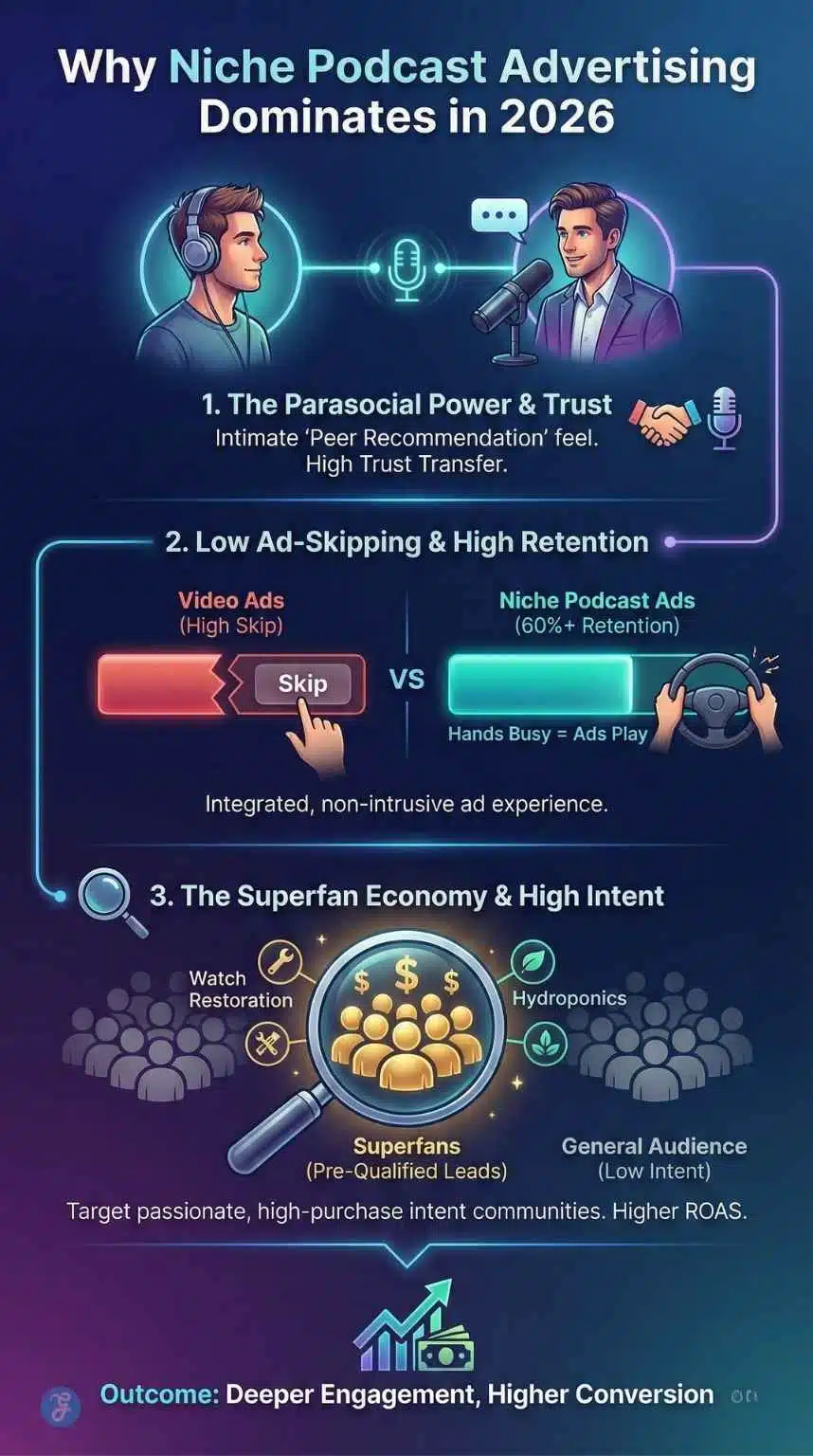
The cornerstone of podcasting’s advertising success is the “parasocial relationship.” This is a psychological phenomenon where listeners develop a one-sided sense of intimacy and friendship with the podcast hosts. Because the audio is consumed directly through headphones, literally inside the listener’s head, it creates a feeling of proximity that video or text cannot replicate.
In 2026, consumer skepticism toward traditional corporate advertising is at an all-time high. However, when a trusted podcast host, someone the listener invites into their life weekly during their commute, workout, or chores, recommends a product, it doesn’t feel like a traditional interruption. It feels like a peer recommendation from a knowledgeable friend. This transferred trust is the primary reason why podcast advertising consistently outperforms other digital media in terms of brand affinity and purchase intent.
Ad-Skipping Behavior and Retention
We live in an era of professional ad-avoiders. Viewers instinctively reach for the “Skip Ad” button on YouTube after five seconds, and television viewers fast-forward through commercials on their DVRs. Podcast advertising, particularly when integrated into the content, bucks this trend significantly.
Recent data indicates that listeners of niche podcasts have retention rates of over 60% during ad breaks, vastly outperforming video platforms. Why? Firstly, their hands are often busy, driving, cooking, or running, making it physically inconvenient to skip. Secondly, and more importantly, if the ad is read by the host and is relevant to the niche topic of the show, listeners often view the commercial message as part of the valuable content they signed up for. They don’t want to miss what their “friend” (the host) has to say, even if it’s about a sponsor.
The “Superfan” Economy and High Intent
Niche podcasts are engines for gathering “superfans.” A general entertainment podcast might have millions of casual listeners, but a podcast focused on a specific vertical—such as “Vintage Mechanical Watch Restoration” or “Regulatory Compliance for FinTech”—attracts a highly qualified audience.
These listeners are not there by accident. They actively sought out content on a specific subject because they are deeply invested in it, either professionally or personally. For advertisers, this means the audience is pre-qualified. They possess “high intent.” A company selling specialized accounting software doesn’t need to waste impressions on a general audience when they can sponsor a podcast dedicated to small business finance, knowing that nearly every pair of ears belongs to a potential decision-maker. In 2026, the efficiency of reaching these concentrated pools of superfans is driving higher Return on Ad Spend (ROAS) than broad-brush campaigns.
The Two Pillars: Host-Read vs. Programmatic Audio
The technical landscape of podcast advertising in 2026 is defined by two primary delivery mechanisms. Understanding the distinction between host-read sponsorships and programmatic audio is crucial for developing the right strategy for your brand goals.
Host-Read Sponsorships [The Premium Choice]
Host-read ads remain the gold standard of the medium. This is where the podcast host personally delivers the ad copy, often in their own voice and style. These ads are typically “baked-in,” meaning they are part of the permanent audio file of the episode. If someone downloads that episode five years from now, the ad will still be there.
The power of the host-read lies in the endorsement effect mentioned earlier. It allows for flexibility; hosts can share personal anecdotes about using the product, “riff” on the script, and integrate it seamlessly into the show’s flow. While this format commands higher Cost Per Mille (CPM) rates, often ranging from $25 to over $50 depending on the show’s niche authority, it delivers the highest levels of engagement and conversion for complex products or brands seeking to build long-term trust.
Programmatic Advertising & Dynamic Ad Insertion [DAI]
While host-reads offer depth, they can be difficult to scale. Negotiating individual deals with hundreds of small niche podcasters is operationally heavy. Enter programmatic audio, powered by Dynamic Ad Insertion (DAI).
DAI technology allows advertisers to insert ads into podcasts at the moment of download. This means the ad is not permanent; it can be swapped out based on who is listening and when. In 2026, Demand-Side Platforms (DSPs) allow brands to buy audio impressions across thousands of podcasts simultaneously based on data layers, similar to how display ads are bought across the web.
This allows for incredible precision. An advertiser can target “Females, aged 25-34, located in Chicago, interested in wellness,” and serve an audio ad to that exact demographic across 500 different small podcasts in the Spotify Audience Network or other exchanges. While these ads are usually pre-produced “announcer reads” rather than host endorsements, they offer scale, lower CPMs ($10-$25), and the ability to geo-target for local businesses.
To clarify the strategic differences, here is a breakdown of the two primary formats:
Table 1: Host-Read vs. Programmatic Audio in 2026
| Feature | Host-Read Sponsorships (Baked-In) | Programmatic Audio (DAI) |
| Ad Delivery Mechanism | Read by the host, permanently recorded into the episode file. | Pre-produced audio is inserted dynamically at the time of download/stream. |
| Primary Benefit | High trust, endorsement effect, and deep listener engagement. | Scalability, precise targeting (geo/demo), and efficiency. |
| Targeting Method | Contextual (based on the show’s specific topic/genre). | Audience-based (using data layers like age, location, interests across many shows). |
| Flexibility | Low. Once it’s live, it stays there forever. | High. Campaigns can be paused, swapped, or optimized in real-time. |
| Typical Cost (CPM) | Premium ($25 – $60+) | Efficient ($10 – $25) |
| Best Use Case | Brand building, complex value propositions, and launching new products require trust. | Direct response, localized campaigns, retargeting, and broad reach across niches. |
Strategic Targeting: How to Find Your Niche
In 2026, finding your audience isn’t just about picking the right category on Apple Podcasts. It requires a multi-layered approach that combines contextual relevance with sophisticated data targeting.
Contextual Targeting and Ethos Alignment
The most direct way to reach a niche is contextual targeting, aligning your brand with specific subject matter experts. However, modern strategies go beyond obvious category matches. Advertisers are now looking for “ethos alignment.”
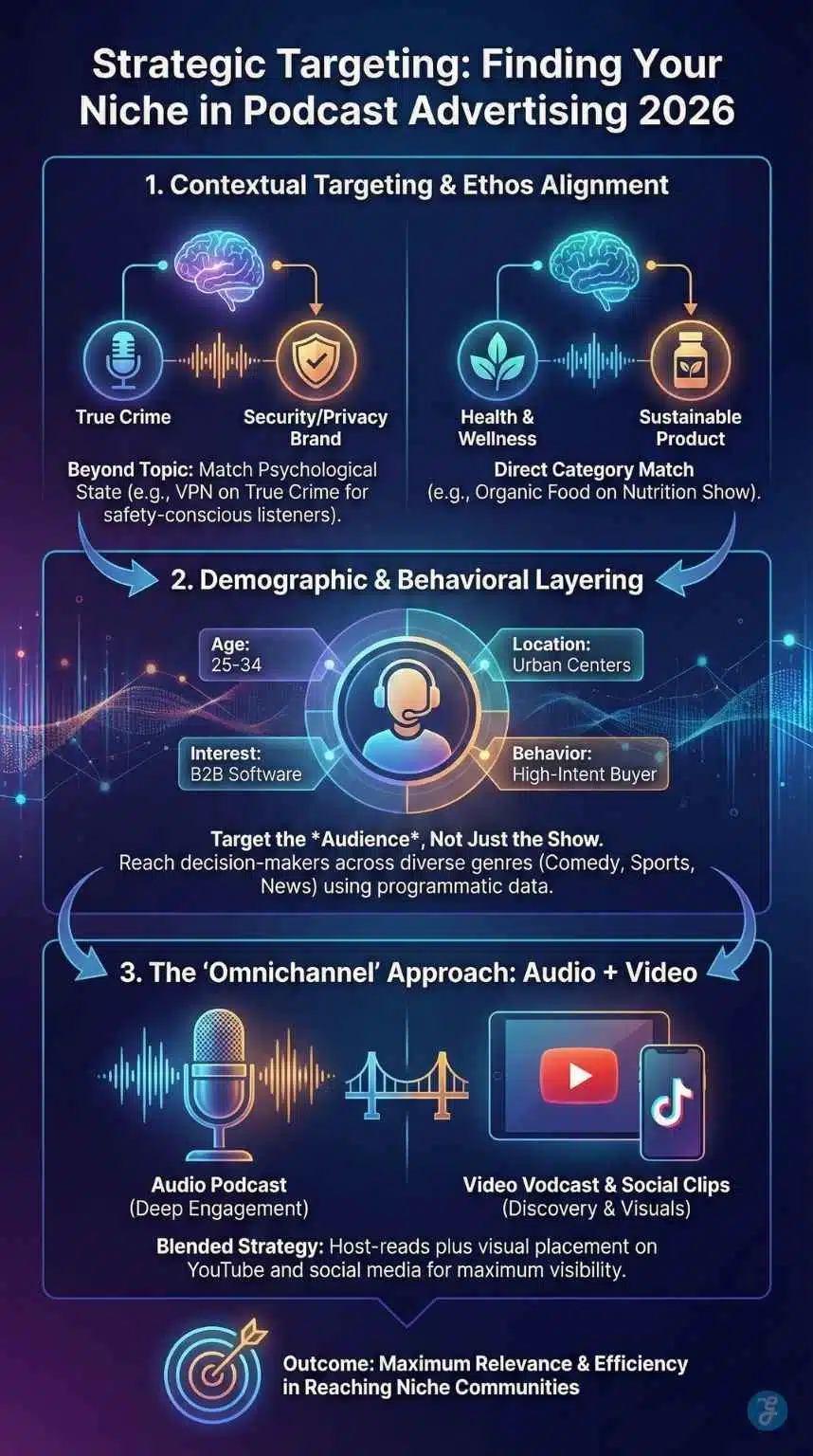
For example, a Direct-to-Consumer (DTC) mattress brand might obviously target “Health & Wellness” podcasts. But a deeper contextual strategy might involve sponsoring a “True Crime” podcast. Why? The audience of true crime podcasts often listens to decompress from anxiety and highly values safety, comfort, and a good night’s sleep behind locked doors. The contextual link isn’t the topic; it’s the psychological state of the listener. Finding these adjacent niches where competitors aren’t advertising is a key strategy for 2026.
Demographic and Behavioral Layering
Thanks to the maturity of platforms like the Spotify Audience Network and various data partners, advertisers can now layer behavioral data on top of audio inventory.
This is crucial for reaching niche audiences that may not listen to niche shows. You may want to reach “B2B software decision-makers.” Instead of only buying ads on expensive “Business Leadership” podcasts, you can use programmatic behavioral targeting to find those same individuals when they are listening to a comedy podcast on the weekend or a sports show during their commute. You are buying the audience, not just the show. This technique allows brands to reach niche demographics at a more efficient frequency across a wider array of content.
The “Omnichannel” Approach: Video Podcasting
A critical evolution in the 2026 landscape is the blurring line between audio and video. YouTube has firmly established itself as the number one discovery platform for podcasts globally. Many niche podcasts are now “vodcasts,” filming their episodes for visual consumption.
A robust podcast advertising strategy now must be omnichannel. Niche advertisers are securing packages that include the audio host-read and visual elements on the video version. This could include product placement on the desk during the interview, a visual “lower third” graphic displayed during the ad read, or sponsoring “clippable moments” that the podcast shares on TikTok, Instagram Reels, or YouTube Shorts. This approach ensures you capture the audience, whether they are listening with their phone in their pocket or watching on their desktop.
The Creative Strategy: Writing for the Ear
Reaching the right niche is only half the battle; the message must resonate. Audio is a unique medium that requires a different creative approach than visual advertising.
The “Theatre of the Mind”
Audio advertising relies on the “theatre of the mind.” Without visuals, the script, sound design, and voice must work harder to create imagery and evoke emotion.
For niche audiences, this means speaking their specific language. If you are advertising a developer tool on a coding podcast, the ad copy shouldn’t sound like generic marketing fluff; it should use industry-specific terminology that signals to the listener, ” We understand your world.” The creative must respect the intelligence of the niche audience. Over-explaining basic concepts will alienate them, while using insider shorthand builds instant rapport.
Call-to-Action (CTA) Best Practices
Because podcast listening is often a secondary activity, done while driving, cleaning, or exercising, the friction to respond to an ad is high. The Call-to-Action must be incredibly simple and memorable.
In 2026, the standard practice involves two primary tracking methods:
- Vanity URLs: Simple, easily spoken URLs customized for the show (e.g., BrandName.com/Rogad).
- Promo Codes: Short, distinct codes that provide an incentive (e.g., “Use code HISTORY at checkout for 20% off”).
Complex instructions fail in audio. The CTA should focus on a single, clear next step. Furthermore, advertisers are increasingly using “retargeting” strategies, where listeners who heard an audio ad are later served visual banner ads on their phones, reminding them of the CTA when they are in a better position to click.
Tone Matching and Authenticity
Nothing ruins a podcast listening experience faster than a jarring tone shift. A high-energy, “shouty” radio-style commercial inserted into a somber, investigative journalism podcast will not only fail, but it may also actively damage brand sentiment.
The most successful campaigns in niche podcasting allow for “host riffing.” Instead of providing a rigid, word-for-word script, the advertiser provides bullet points of key benefits and mandatory legal disclaimers, but allows the host to deliver the message in their own natural voice and cadence. This authenticity is what makes the ad feel native to the content, drastically increasing the likelihood that the niche audience will accept and act on the message.
Measuring Success: Solving the “Black Box” Problem
Historically, the biggest hurdle for podcast advertising was attribution, the “black box” problem of knowing if an audio ad actually led to a sale. By 2026, sophisticated measurement partners have largely solved this challenge, moving the medium from experimental budgets to performance marketing lines.
Attribution Modeling and Pixel Tracking
Modern podcast measurement relies heavily on pixel-based tracking, supplied by third-party attribution partners like Podsights (acquired by Spotify), Chartable, and others.
The process works similarly to web tracking. The advertiser places a pixel on their website (on landing pages and checkout confirmation pages). When a podcast is downloaded that contains a dynamically inserted ad, an impression tracker fires. The attribution partner then uses IP addresses, device graphs, and other identifiers to match that download to a subsequent visit or purchase on the advertiser’s website. This allows brands to see a clear path from “listen” to “conversion,” calculating an accurate Cost Per Acquisition (CPA).
Survey-Based and Brand Lift Measurement
While technology handles direct response tracking, understanding the impact on brand perception requires different tools. For niche campaigns aimed at awareness rather than immediate sales, “Brand Lift” studies are essential.
These studies survey listeners before and after exposure to podcast ads to measure changes in brand awareness, favorability, and purchase intent. Additionally, the “How did you hear about us?” post-purchase survey remains a surprisingly accurate and valuable tool for capturing attribution that digital pixels might miss, especially for high-ticket items with long sales cycles often promoted on niche B2B podcasts.
Different campaign goals require different measurement yardsticks. Below is a guide to matching metrics with objectives.
Table 2: Measuring Podcast Advertising Success by Goal
| Campaign Goal | Primary Measurement Methodology | Key Metrics to Track |
| Direct Response / Sales | Pixel-based Attribution Tracking & Promo Code usage. | CPA (Cost Per Acquisition), ROAS (Return on Ad Spend), Conversion Rate. |
| Brand Awareness | Brand Lift Studies & Reach analysis. | Recall Rate, Lift in Brand Favorability, Total Unique Reach, CPM. |
| Site Traffic / Lead Gen | Vanity URL hits & Pixel tracking on landing pages. | CPV (Cost Per Visit), Bounce Rate on landing page, Email sign-ups. |
| Engagement / Education | Listen-through rates provided by hosting platforms. | LTR (Listen-Through Rate) of the ad creative, social media mentions. |
Future Trends: AI and Interactive Audio
Looking ahead through 2026 and beyond, technology is further refining how advertisers reach niche ears.
AI-Driven Contextual Ad Placement
The next frontier of contextual targeting is driven by Artificial Intelligence. Instead of relying on broad show descriptions or manual categorization, new AI tools analyze the actual spoken transcripts of podcast back catalogs.
This allows for hyper-contextual placement. An advertiser selling high-end travel gear could use AI to identify exact moments within thousands of episodes across different genres where hosts are discussing “upcoming vacations” or “packing frustrations,” and insert a relevant programmatic ad right after that segment. This ensures the ad is absolutely relevant to the immediate topic of conversation, increasing cognitive receptivity.
Shoppable Audio and Reduced Friction
Platforms are also actively working to reduce the friction between hearing an ad and making a purchase. “Shoppable audio” or interactive ad formats are emerging, particularly on app-based players like Spotify.
These formats allow a listener to glance at their phone screen during an audio ad and see a companion banner with a direct “Shop Now” or “Add to Cart” button. This bridges the gap between passive listening and active purchasing, capitalizing on the impulse moment without requiring the user to remember a URL for later. While still developing, this trend promises to significantly shorten the sales funnel for e-commerce brands targeting niche audiences.
Final Thought: The Audio Advantage in a Noisy World
As we navigate the digital landscape of 2026, the pendulum has swung away from broad, interruptive advertising toward personalized, consent-based media. Podcast advertising sits at the apex of this trend. It is perhaps the only remaining digital medium where advertisements are often welcomed rather than tolerated, provided they are relevant, authentic, and respectful of the listener’s time.
For brands willing to look beyond the massive, celebrity-driven shows and do the work of identifying and engaging with smaller, highly passionate niche communities, the rewards are substantial. By leveraging the intimacy of host-read endorsements, the scale of programmatic technology, and the precision of modern attribution, advertisers can stop shouting into the void and start having meaningful conversations with the customers who matter most, right in their ears.
The future of advertising isn’t about reaching everyone; it’s about reaching the right ones, and in 2026, the best way to do that is through the power of audio.