OpenAI has launched OpenAI GPT-5.2, rolling it into ChatGPT and the OpenAI API with Instant, Thinking, and Pro tiers—while a reported internal “code red” highlights intensifying competition with Google’s Gemini 3.
What OpenAI announced—and why it matters now?
OpenAI released GPT-5.2 on December 11, 2025, describing it as an upgrade focused on “economically valuable” work: building spreadsheets and presentations, writing code, handling long-context projects, and supporting agent-like workflows. Reuters reported the launch came after CEO Sam Altman issued an internal “code red” earlier in December to redirect resources toward improving ChatGPT as Google’s Gemini 3 gained momentum.
The timing matters because the market has shifted from “best chatbot” to “best assistant for real work.” OpenAI is pitching GPT-5.2 as a model family that performs better in complex, multi-step tasks—exactly where enterprises are spending money and where rivals are competing hardest.
How GPT-5.2 rolls out in ChatGPT?
OpenAI’s Help Center says GPT-5.2 is the default model for all logged-in users in ChatGPT, delivered through GPT-5.2 Auto, which automatically chooses between GPT-5.2 Instant and GPT-5.2 Thinking depending on the request.
What “Auto” means in plain terms?
GPT-5.2 Auto is a router: for simple prompts, it stays fast; for harder prompts, it shifts into deeper reasoning. OpenAI says the decision is guided by signals from the user’s prompt and conversation, plus patterns learned from how people manually pick models and which responses prove correct.
Availability and limits (as published by OpenAI)
OpenAI states GPT-5.2 is available across ChatGPT tiers, with paid tiers getting more control via the model picker. GPT-5.2 Pro is reserved for higher-tier plans.
ChatGPT tiers—what OpenAI says you get with GPT-5.2
| ChatGPT tier | GPT-5.2 access | Key limits / notes |
| Free | GPT-5.2 (limited) | Up to 10 messages / 5 hours, then switches to a mini model |
| Plus | GPT-5.2 + model picker | Up to 160 messages / 3 hours (temporary increase) |
| Plus / Business | Manual Thinking selection | Up to 3,000 Thinking messages/week (manual); Auto-switching doesn’t count toward that weekly cap |
| Pro / Business | “Unlimited” (policy-guardrailed) | Unlimited access “subject to abuse guardrails” |
| Pro / Business / Enterprise / Edu | GPT-5.2 Pro | Pro mode lacks Canvas + image generation, per OpenAI |
OpenAI also publishes different context windows depending on the mode (how much text the model can consider at once), including up to 196K for GPT-5.2 Thinking on paid tiers and up to 128K for Pro / Enterprise in Instant.
What’s inside the GPT-5.2 model lineup?
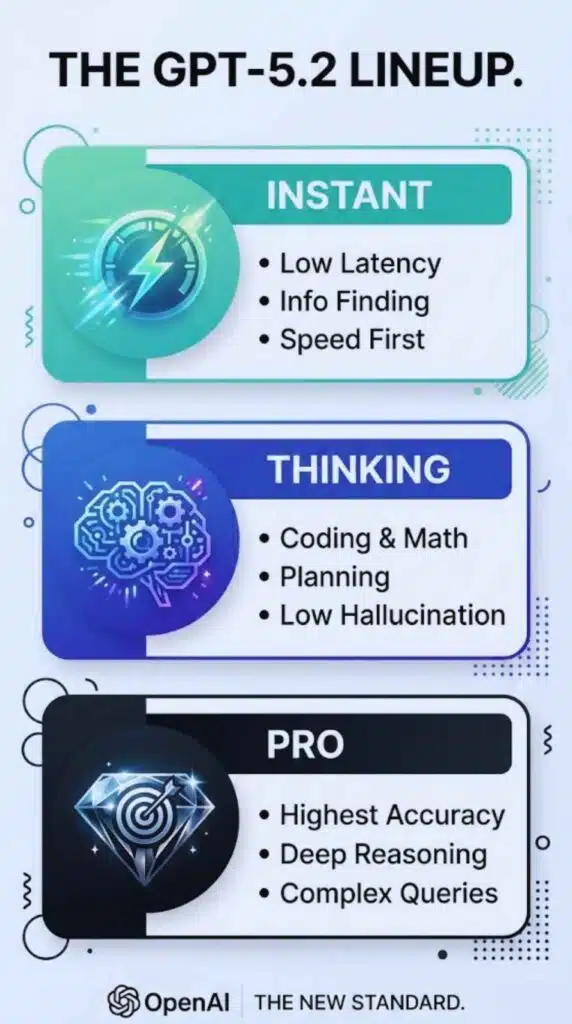
OpenAI and multiple outlets describe GPT-5.2 as a series rather than a single model. WIRED summarizes the lineup as:
- Instant for speed and info-finding.
- Thinking for deeper reasoning (coding, math, planning).
- Pro for highest accuracy on difficult questions.
The Verge reports OpenAI is emphasizing improvements in long-context understanding, tool use, and professional outputs—especially spreadsheets and presentations—along with a focus on lower hallucination rates for the Thinking model.
For developers: GPT-5.2 becomes “latest” in the OpenAI API
On the developer side, OpenAI’s API documentation positions GPT-5.2 as its best general-purpose model and notes improvements over GPT-5.1 in areas like instruction following, accuracy/token efficiency, vision, code generation (including front-end UI), tool calling, context management, and spreadsheet creation.
OpenAI’s “Using GPT-5.2” guide also specifies the API model names and roles:
- gpt-5.2 (main model).
- gpt-5.2-pro (more compute, harder thinking).
- gpt-5.2-chat-latest (the model powering ChatGPT).
New knobs OpenAI highlights for builders
OpenAI says GPT-5.2 expands developer controls with:
- A new xhigh reasoning effort level.
- Concise reasoning summaries.
- New context management via compaction (to better manage long-running tasks).
It also notes that GPT-5.2 defaults to low-latency behavior (with reasoning.effort: none as the default), while still allowing developers to dial up reasoning when needed.
What OpenAI says is “new” in GPT-5.2 (API perspective)
| Area | What’s new in GPT-5.2 | Why it matters |
| Reasoning controls | Adds xhigh + summaries | Lets apps trade latency vs. depth more precisely |
| Long-context workflows | Compaction for context management | Helps agents stay on track across long jobs |
| Code generation | Improved, including front-end UI | Targets the “AI developer” use case directly |
| Tools + agents | Better tool calling + context handling | Improves reliability in multi-step, tool-using flows |
The “code red” backdrop: Google rivalry becomes explicit
Reuters reports that Altman’s internal “code red” paused non-core work and shifted teams toward accelerating GPT-5.2 in response to Google’s Gemini 3 pressure. Reuters also quotes Altman saying Gemini 3 had “less of an impact” on OpenAI’s metrics than feared.
WIRED adds that OpenAI is dealing with stronger competition than in the early ChatGPT era, and reports that the company has pulled focus from some side projects to prioritize core model and product improvements.
This matters because “code red” signals a leadership decision: win on everyday utility, not just benchmark headlines. GPT-5.2’s launch messaging repeatedly returns to the same theme—making ChatGPT a better tool for work.
Claims about performance: what OpenAI (and reporting) says improved
Several outlets cite OpenAI’s internal evaluation results for professional work.
- WIRED reports GPT-5.2 Thinking scored the highest yet on OpenAI’s GDPval benchmark (across 44 occupations), beating human professionals in 70%+ of tasks and finishing tasks about 11x faster.
- Business Insider reports OpenAI said GDPval outputs were produced at >11x the speed and <1% of the cost of expert professionals, and that GPT-5.2 improved performance on internal junior investment-banking spreadsheet modeling tasks versus GPT-5.1.
OpenAI also frames GPT-5.2 as less error-prone in practice. WIRED reports OpenAI claimed the Thinking model hallucinated 38% less than GPT-5.1 on factuality benchmarks.
Editorial note: GDPval and other internal benchmarks are OpenAI-created measures, not independent industry standards. The most useful read is how the model behaves on your own workflows and datasets.
Safety and policy: age prediction and “adult mode” timeline
Beyond performance, OpenAI is also tying the GPT-5.2 cycle to policy changes. WIRED reports OpenAI is rolling out an age-prediction system in some countries to apply additional protections for users under 18, and that it plans an “adult mode” in Q1 2026.
The Verge similarly reports OpenAI leadership is aiming to get age prediction right before shipping adult-mode features.
Another business headline riding alongside the model launch: Disney
Reuters reports Disney is investing $1 billion in OpenAI and will allow the startup to use characters from major Disney franchises in its Sora video generator—news that broke the same day as the GPT-5.2 launch.
While the Disney deal isn’t the GPT-5.2 product story, it reinforces the commercial direction: bigger partnerships, more enterprise usage, and more pressure to show real productivity gains.
Timeline: how GPT-5.2 landed (so far)
| Date | What happened | Source |
| Early Dec 2025 | Reported internal “code red” to refocus resources | Reuters |
| Dec 11, 2025 | GPT-5.2 launch reported; rollout begins | Reuters |
| Dec 12, 2025 | OpenAI updates ChatGPT guidance and limits for GPT-5.2 | OpenAI Help Center |
Final Thoughts: What to watch next
GPT-5.2 is OpenAI’s attempt to turn “AI model progress” into workplace outcomes—better spreadsheets, better decks, better code, and fewer reliability failures in long, tool-using projects.
Next, watch three things:
- Whether developer adoption of gpt-5.2 and gpt-5.2-pro accelerates agent-style apps (tools + long context), as OpenAI is clearly optimizing for that.
- Whether real-world trust improves—OpenAI is making explicit claims about lower hallucinations and better professional performance, which users will quickly test.
- How OpenAI balances capability with safety as age prediction and “adult mode” move closer to launch.