Artificial intelligence has moved from specialized computer science labs straight into everyday business meetings, news headlines, and casual conversations. However, as language moves faster than technical understanding, basic concepts often get mixed up. Tech companies, marketers, and the general public frequently toss around complex buzzwords interchangeably, blurring important technical distinctions.
Using misused ai terms incorrectly leads to false expectations, poor software purchasing choices, and misplaced concerns about what modern automation can actually do. Understanding the precise definitions behind common tech jargon helps teams evaluate software, discuss security risks, and navigate modern digital tools with confidence.
Here are 11 commonly confused artificial intelligence concepts and their true technical meanings.
11 Frequently Misused AI Terms Explained
1. AI vs. Machine Learning
How it is misused: Treating artificial intelligence and machine learning as two completely different competing technologies, or using “AI” to describe simple automated rules.
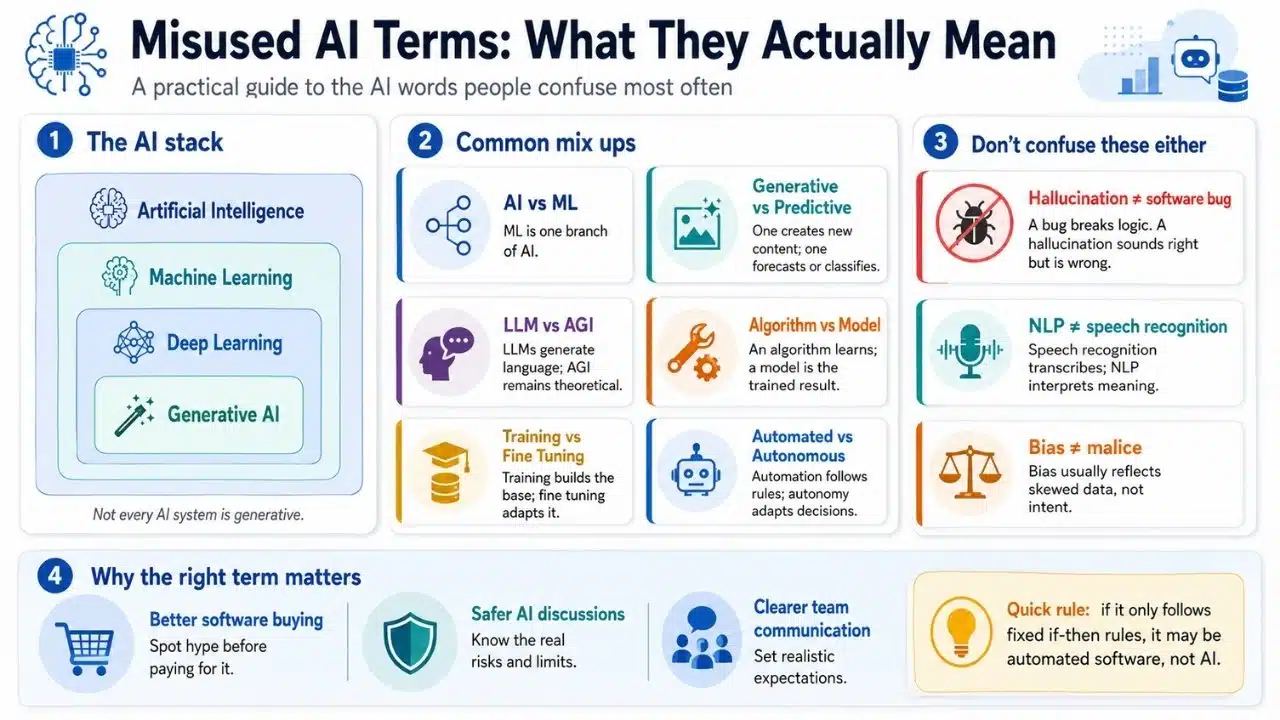
What it actually means: Artificial Intelligence (AI) is the broad umbrella concept of building machines capable of performing tasks that typically require human reasoning, perception, or decision-making. Machine Learning (ML) is a specific subset of AI. Instead of explicitly programming step-by-step rules, ML algorithms analyze large datasets to identify patterns and make predictions autonomously. All machine learning is AI, but not all AI relies on machine learning.
2. Machine Learning vs. Deep Learning
How it is misused: Assuming deep learning is just a marketing synonym for regular machine learning.
What it actually means: Deep learning is a specialized evolution of machine learning powered by artificial neural networks with many processing layers (hence “deep”). Traditional machine learning often requires human engineers to manually structure features from raw input data. Deep learning algorithms process unstructured data, such as images, raw audio, or long video files, automatically discovering relevant features without manual human feature engineering.
3. Generative AI vs. Predictive AI
How it is misused: Lumping all modern algorithms under “Generative AI” simply because they interact with digital content.
What it actually means: Predictive AI analyzes historical data to forecast likely outcomes, classify trends, or calculate risk scores, such as detecting fraudulent credit card transactions or predicting inventory demands. Generative AI creates entirely new original content, including text, images, voice audio, or software code, based on patterns learned during training. Predictive models evaluate existing information, whereas generative models synthesize new data outputs.
4. Large Language Models (LLMs) vs. Artificial General Intelligence (AGI)
How it is misused: Referring to current conversational chat models as “sentient” or treating an LLM as an all-knowing artificial mind.
What it actually means: An LLM is a complex statistical system trained to calculate probability distributions over sequence tokens, predicting the most statistically likely next word in a context window. Artificial General Intelligence (AGI) remains a theoretical concept describing an artificial entity capable of human-level reasoning, abstract problem-solving, and cross-domain learning across any cognitive task. Current LLMs possess no awareness, intent, or generalized comprehension.
5. Algorithm vs. AI Model
How it is misused: Calling every line of software code or automated database rule an “AI model.”
What it actually means: An algorithm is a fixed, step-by-step mathematical set of instructions used to perform a specific calculation or solve a problem, similar to a cooking recipe. An AI model is the trained output generated after running an algorithm through a massive training dataset. The algorithm is the method used to learn, while the model is the resulting framework containing weight parameters used to make predictions on new data.
6. Training vs. Fine-Tuning
How it is misused: Claiming that entering custom text prompts or uploading a single PDF into a web interface “trains a new model.”
What it actually means: Base model training involves processing vast datasets across thousands of specialized processors over weeks or months, costing millions of dollars in compute infrastructure. Fine-tuning takes a pre-trained base model and runs additional supervised training on a smaller, curated dataset to optimize performance for specific niche domains, such as medical transcription or legal documentation. Providing context within a prompt window is called context learning, not training.
7. Hallucination vs. Software Error
How it is misused: Describing standard software bugs, broken web links, or calculation typos in basic applications as “AI hallucinations.”
What it actually means: In software engineering, a bug occurs when code fails to execute its intended program logic. An AI hallucination refers specifically to generative models outputting confident, grammatically correct statements that are factually inaccurate, unsupported by source data, or entirely fabricated. Hallucinations occur because generative models generate responses based on token probability patterns rather than querying a verified truth database.
8. Prompt Engineering vs. Software Programming
How it is misused: Elevating basic conversational typing in a web chatbot to “software engineering” or “coding.”
What it actually means: Software programming involves writing structured, deterministic instructions in code languages like Python, C++, or Rust to execute explicit hardware commands. Prompt engineering is the practice of crafting natural language inputs, contextual guidelines, and system formatting constraints to guide probability outputs from generative AI systems. While useful, prompting relies on natural language communication rather than deterministic code syntax.
9. Autonomous vs. Automated
How it is misused: Labeling basic automated workflows (like scheduled auto-responder emails) as “autonomous systems.”
What it actually means: Automated systems strictly execute pre-defined, static rules without deviation. If condition A occurs, system B triggers automatically. Autonomous systems possess operational agency; they evaluate environmental variables, process unexpected inputs, adapt strategy, and execute multi-step decisions independently without constant human intervention, such as self-driving navigation frameworks.
10. Natural Language Processing (NLP) vs. Speech Recognition
How it is misused: Using speech recognition and natural language processing as identical terms when discussing voice assistants.
What it actually means: Speech recognition (often called Automatic Speech Recognition or ASR) converts spoken acoustic sound waves into written text strings. Natural Language Processing (NLP) takes that written text and analyzes its underlying grammar, intent, sentiment, and semantic meaning. Speech recognition transcribes what you said, while NLP interprets what you meant.
11. Data Bias vs. Algorithmic Malice
How it is misused: Assuming that an AI system producing biased or discriminatory outputs is acting out of deliberate hostility or conscious prejudice.
What it actually means: AI systems contain no conscious intent or moral alignment. System bias occurs when historical human prejudices, incomplete sampling, or skewed representation exist within the underlying training data. The algorithm mathematically amplifies the statistical patterns present in its source input. Addressing bias requires auditing data collection practices and training parameters rather than attributing human emotions to software tools.
Why Precise AI Terminology Matters for Organizations
Misinterpreting tech concepts leads to costly operational decisions. When leadership teams conflate basic automation with machine learning, they risk purchasing overpriced software that offers little more than standard conditional scripts.
Clear language establishes realistic project scopes, sets appropriate security guidelines, and ensures realistic software expectations. Understanding these key distinctions prevents organizations from falling for exaggerated marketing claims while protecting systems against real operational vulnerabilities.
AI Terminology Distinction Matrix
Use this quick reference guide to understand key functional differences across core tech terms:
| Term Category | Primary Mechanism | Operational Objective |
| Machine Learning | Pattern identification via data processing | Predicts outcomes or classifies information without manual rules. |
| Generative AI | Deep probabilistic content synthesis | Creates new original text, media, or code from prompt inputs. |
| Autonomous Systems | Dynamic environmental decision-making | Adapts actions independently without strict rule limitations. |
| Fine-Tuning | Targeted retraining on curated data | Tailors pre-trained base models to specific domain tasks. |
Final Thoughts on Misused AI Terms
As artificial intelligence continues integrating into standard business operations, using precise language becomes essential for clear communication. Moving beyond marketing buzzwords lets you evaluate software capability accurately, cut through tech hype, and deploy digital tools effectively. Clear understanding leads to better technical decisions, grounded expectations, and safer deployment strategies.
Frequently Asked Questions (FAQs) About Misused AI Terms
Why are people using so many misused AI terms incorrectly today?
Rapid commercial adoption has outpaced public technical literacy. Technology vendors and marketing teams often use broad terms like “AI” or “Autonomous” as sales buzzwords to make basic software automation sound advanced, leading to widespread misapplication across industries.
What is the difference between supervised and unsupervised machine learning?
Supervised machine learning trains algorithms using labeled data where correct outputs are already identified, like teaching a model to spot spam using marked email datasets. Unsupervised learning gives the algorithm unlabeled data, forcing it to identify hidden patterns, clusters, and structures independently without human labels.
Can a software application be automated without using artificial intelligence?
Yes. The vast majority of business software runs on deterministic rule-based automation. If a system follows explicit “if-then” logic written by a programmer without learning from data patterns or processing probabilistic models, it is automated software, not artificial intelligence.