A calendar invitation titled “Launch discussion” tells attendees almost nothing. Are they reviewing progress, solving a delay, or approving a date? Good meeting agenda templates define the purpose, preparation, decisions, and follow-up before the call begins.
This is a toolkit, not a ranking. Choose the format that matches the conversation, and treat every timing as a starting point.
Before Using Meeting Agenda Templates
Before copying a template, label each substantial agenda item inform, discuss, or decide. “Discuss the launch” has no clear finish line. “Decide whether to delay the launch by one week” tells everyone what the conversation must produce.
These meeting agenda templates also work better when pre-reading is linked beside the relevant item. Participants should not have to hunt for documents after the meeting starts. End with a task, owner, and deadline; “the team will follow up” is not an action record.
Not every update deserves a meeting. If people only need to receive information and no discussion is required, an email, recorded update, or shared project page may be enough.
8 Meeting Agenda Templates
These meeting agenda templates help teams prepare focused discussions, clarify decisions, assign responsibilities, manage limited time, and leave every meeting with practical next steps instead of unresolved questions or confusion.
1. Weekly Team Meeting Agenda
Among these meeting agenda templates, this is the best default for most managers—and the easiest to overload. A weekly meeting should uncover priority changes, blockers, and cross-team dependencies. It should not become a spoken version of a dashboard everyone has already read.
Sample length: 30–40 minutes
- This week’s intended outcome — 2 minutes
- Important changes or quick wins — 5 minutes
- Priorities and dependencies — 10 minutes
- One or two issues requiring discussion — 15 minutes
- Decisions, owners, and deadlines — 5 minutes
- Parking-lot review, if needed — 3 minutes
Collect routine status updates beforehand. Otherwise, six unstructured five-minute reports can consume half an hour before collaborative work begins.
2. Project Kickoff Meeting Agenda
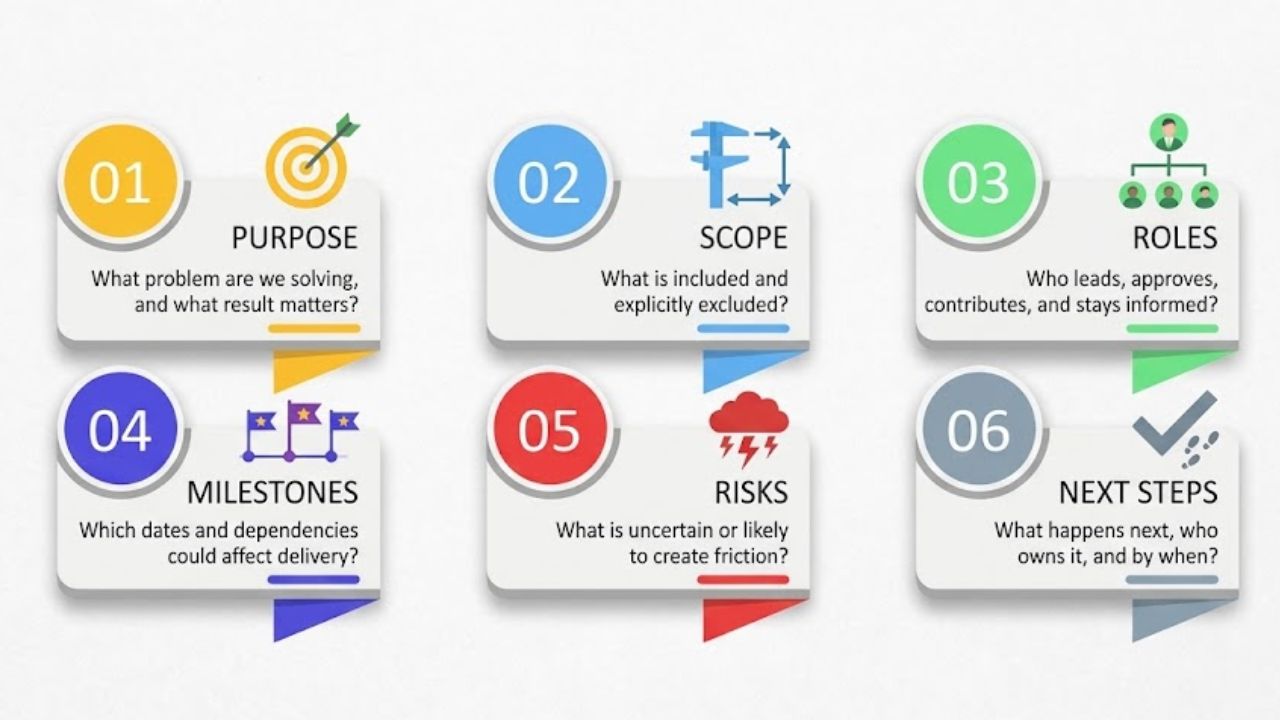
A kickoff should establish a shared understanding of the work, not read a project plan aloud. Send a short brief beforehand, then settle questions that need the team in the room.
- Purpose: What problem are we solving, and what result matters?
- Scope: What is included and explicitly excluded?
- Roles: Who leads, approves, contributes, and stays informed?
- Milestones: Which dates and dependencies could affect delivery?
- Risks: What is uncertain or likely to create friction?
- Next steps: What happens next, who owns it, and by when?
Forty-five to 60 minutes may suit a modest project. If nobody can say who approves scope changes, the kickoff is not finished. A complicated launch may need separate technical or risk sessions rather than one exhausting call.
3. One-on-One Meeting Agenda
The employee should have a real hand in shaping this agenda. When the manager controls every topic and fills the time with task updates, workload concerns, feedback, and development usually disappear.
Use a shared, appropriately private document with four prompts:
- What needs attention today?
- What progress or difficulty should we discuss?
- What feedback, support, or decision is needed?
- What will each person do before the next meeting?
A 25- or 30-minute slot can suit a regular check-in. Sensitive or complicated subjects need enough time and should not be introduced in the final few minutes. Follow the organization’s formal process for performance or disciplinary matters rather than treating this template as a substitute.
4. Decision-Making Meeting Agenda
Decision-focused meeting agenda templates fail when nobody knows who has the final say. Put the decision in the invitation title—“Choose a supplier for the regional launch” is clearer than “Supplier discussion”—and confirm that the decision-maker can attend. If not, reschedule or label the session as input gathering.
Beforehand, share the options, constraints, evaluation criteria, relevant evidence, and any recommendation. During the meeting:
- Restate the decision and deadline — 3 minutes
- Confirm the criteria and non-negotiable limits — 5 minutes
- Compare material differences between options — 15 minutes
- Hear final concerns — 5 minutes
- Record the decision and reasoning — 7 minutes
If evidence is missing, do not disguise a delay as a decision. Record what is needed, who will obtain it, and when the decision will be made.
5. Brainstorming Meeting Agenda
Brainstorming stalls when the question is too broad or evaluation starts before people have produced enough ideas. Define the problem and constraints first. Then separate generation from selection.
For a 45-minute session, use five minutes to frame the question, eight minutes for independent idea writing, and about 12 minutes to share and group similar suggestions. Spend the remaining time comparing the strongest options against agreed criteria.
Finish with a shortlist, a follow-up owner, and a review or testing date. If senior voices dominate open discussion, collecting ideas silently at the start can give others room to contribute before the group begins evaluating them.
6. Project Status and Risk Review Agenda
This meeting earns its place only when it deals with exceptions. Completed tasks and unchanged milestones belong in the written report. Live time should focus on slippage, emerging risks, resource conflicts, and decisions that affect delivery.
Sample 30-minute agenda:
- Material changes since the previous review — 5 minutes
- Milestones at risk and supporting evidence — 8 minutes
- New or worsening risks — 7 minutes
- Dependencies and decisions needed — 7 minutes
- Actions and escalation points — 3 minutes
Do not spend the session debating whether a status should be red or amber. The useful question is what changed, what response is proposed, and who can authorize it.
7. Retrospective Meeting Agenda
A retrospective should help a team improve the next work cycle, not provide a stage for blame. The format can follow a sprint, campaign, event, project phase, or major incident.
Simple prompts such as “What went well?” and “What should change?” may be enough. Teams that need more structure can use Start, Stop, Continue or the 4Ls: Loved, Loathed, Learned, and Longed for.
Begin with quiet reflection, group related points, and identify the themes that could meaningfully affect future work. Select only one or two changes the team can realistically test, then assign an owner and review date. An hour of complaints without follow-through will quickly damage trust in the process.
8. Client or Stakeholder Meeting Agenda
Client meeting agenda templates often lose direction because progress, feedback, approvals, and new requests merge into one conversation. Keep them separate.
Start with the required outcome and any approvals needed. Review progress against the agreed scope, then address risks or questions requiring stakeholder input. Record new requests for assessment; agreeing to them casually is how scope expands without a matching change in time or budget.
Close by documenting:
- Decisions and approvals
- Missing information and its owner
- Agreed deliverables and dates
- Change requests needing an estimate or review
- The purpose of the next meeting
Send complex material early enough for proper review. Asking a stakeholder to approve a proposal they are seeing for the first time invites delay or a poorly informed decision.
Final Thoughts
The strongest meeting agenda templates create a visible line from purpose to preparation, discussion, decision, and follow-through. Pick one recurring meeting this week, remove sections that add no value, and replace vague topics with outcomes the group can actually complete. If the required decisions are recorded and everyone knows what happens next, ending early is a success.
Frequently Asked Questions (FAQs)
There is no useful universal deadline. Share it early enough for participants to read the material, complete any preparation, and flag missing topics. A routine check-in may need little notice, while a technical review or high-value decision may require several working days.
Who should own the meeting agenda?
The organizer or chair should ensure the agenda is ready, but ownership of topics can be shared. Participants should be able to suggest items, and every discussion or action should have a named owner when responsibility matters.
Should meeting agenda templates include a parking lot?
Use one when relevant ideas regularly fall outside the meeting’s immediate purpose. Review it before closing and decide whether each item needs another meeting, an asynchronous follow-up, or no further action. Otherwise, it becomes a list that nobody revisits.