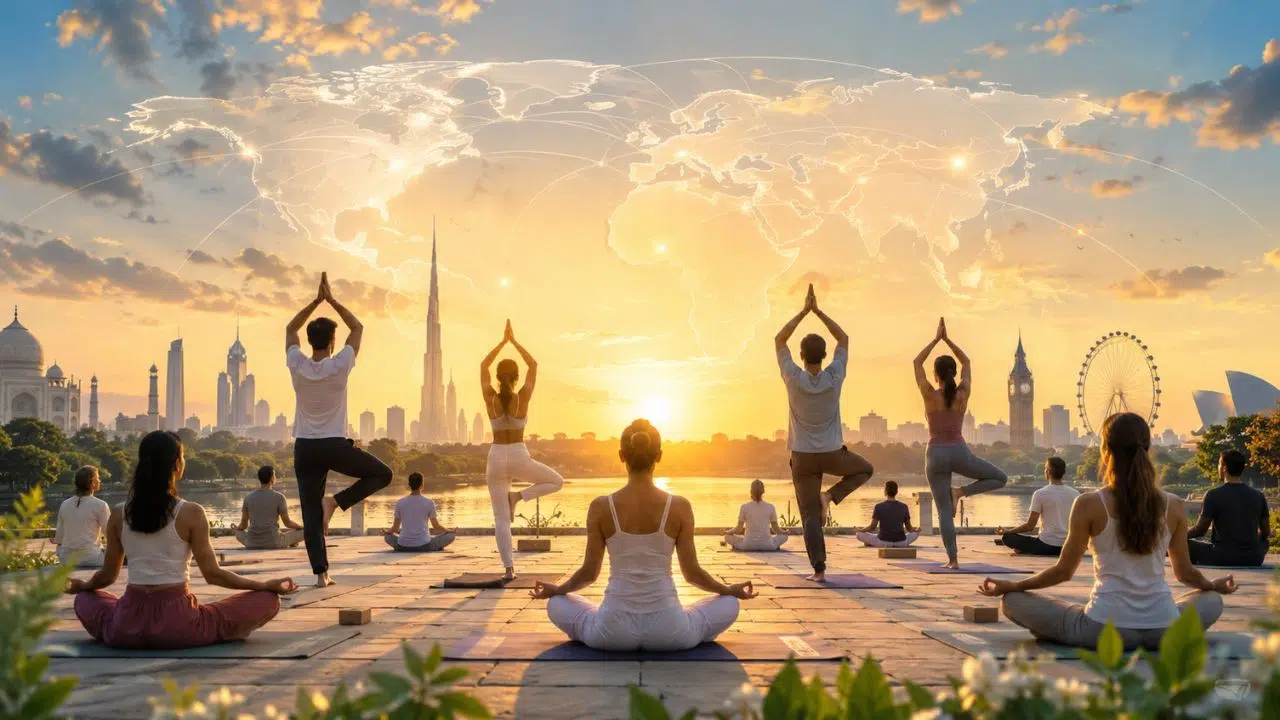
Every 21 June, something quietly extraordinary happens. Before most cities wake up, people are already on mats in parks, on beaches, in school courtyards, and on rooftops. Some are seasoned practitioners moving through sequences they’ve done a thousand times. Most are beginners who just showed up because the day felt like a good reason to try.
This is International Yoga Day 2026, and it happens in more than 190 countries simultaneously.
That scale is hard to picture. But what’s even harder to picture is how fast it all came together and why June 21, specifically, was the date the world agreed on. The answer involves a UN speech, an ancient myth, and the longest day of the year.
What Is International Yoga Day and Who Started It?
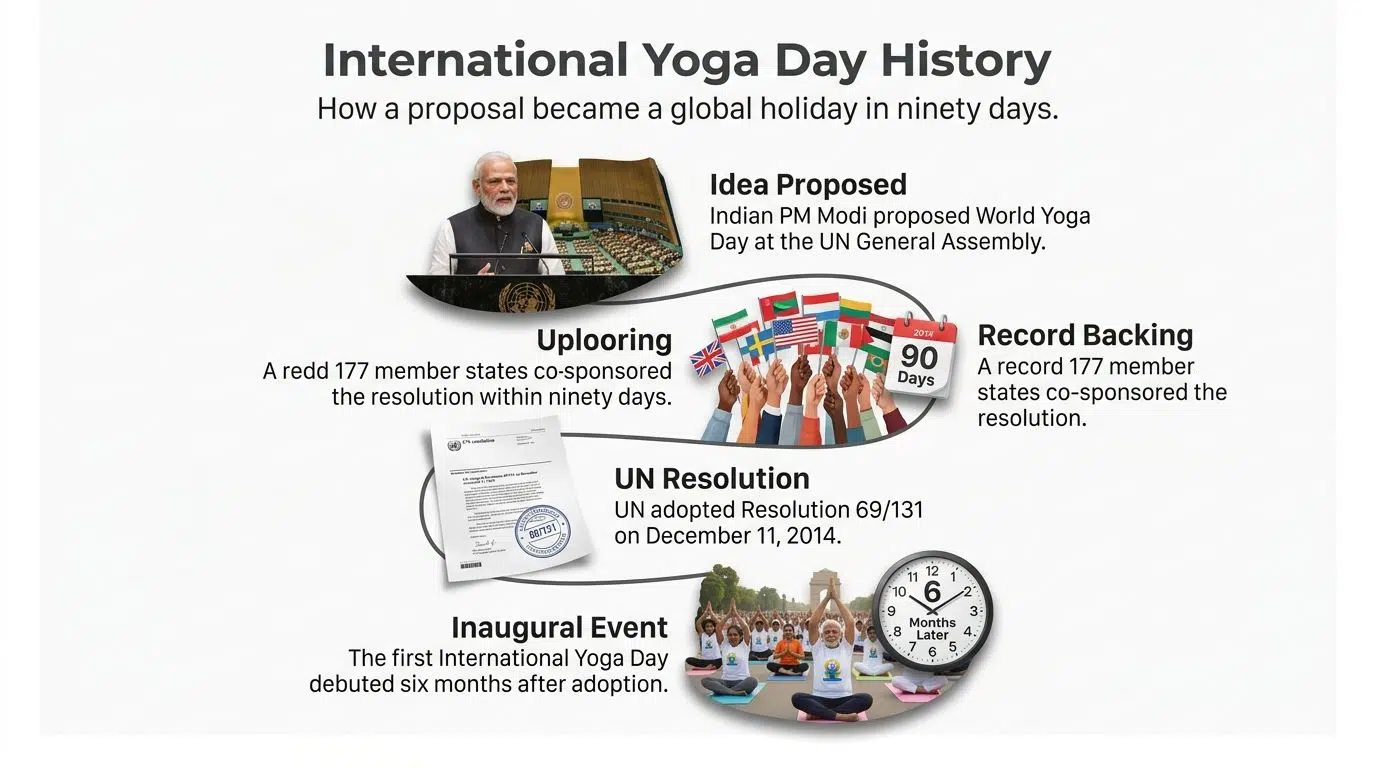
The formal name is the International Day of Yoga, declared by the United Nations General Assembly through Resolution 69/131, adopted on 11 December 2014. But the story starts three months earlier.
From a Speech to a Global Holiday in 90 Days
On 27 September 2014, Indian Prime Minister Narendra Modi stood before the UN General Assembly and made a proposal. He described yoga as “an invaluable gift of India’s ancient tradition” and suggested the world dedicate a single day to it. The idea landed hard. Within 90 days, a record for any UN resolution of its type, 177 member states co-sponsored the resolution. That’s not a narrow majority. That’s near-unanimous.
India’s Ambassador Asoke Kumar Mukerji formally introduced the resolution at the UN. Six months after its adoption, the first International Yoga Day happened. And it didn’t ease in quietly.
The First Yoga Day Was Already Record-Breaking
On 21 June 2015, Prime Minister Modi led 35,985 participants through 21 yoga asanas (postures) for 35 minutes on Rajpath, New Delhi. Dignitaries from 84 nations participated in a single event. Two Guinness World Records were broken that day: the largest yoga class at a single venue and the most nationalities practicing together at once.
That was Day One.
Since then, the numbers have only grown. Today, yoga is practiced by an estimated 300 million people across more than 190 countries. In the United States alone, roughly 36 million adults practice regularly. UNESCO added yoga to its Representative List of Intangible Cultural Heritage of Humanity in 2016, cementing its status as a living tradition rather than just a fitness trend.
Why June 21? The Summer Solstice Is Not a Coincidence
The date wasn’t chosen at random. June 21 is the summer solstice, the longest day of the year in the Northern Hemisphere, when the Earth receives its maximum sunlight. Many cultures around the world mark it as a moment of renewal, transition, and significance.
In yogic tradition, the connection goes deeper. It’s widely believed that on the summer solstice, Adiyogi: Lord Shiva, considered the first yogi, turned south and began transmitting the knowledge of yoga to the seven sages, the Saptarishis. That moment is regarded as the origin of yoga as a systematic practice rather than a personal pursuit.
So June 21 is simultaneously the astronomical peak of the solar year and the symbolic birth of yoga as a teachable science. Both ideas point to the same thing: light, transformation, and the beginning of something.
That’s a hard date to argue with.
2026 Theme: Yoga for Healthy Aging — What It Actually Means
Every year, International Yoga Day carries an official theme. The 2026 theme is “Yoga for Healthy Aging,” announced by India’s Ministry of Ayush and formally launched at the Yoga Mahotsav 25-Day Countdown held at the Khajuraho group of monuments.
The main IDY 2026 celebration will be held in Kolkata, West Bengal, organized in partnership with the Morarji Desai National Institute of Yoga (MDNIY).
Who Does This Theme Actually Speak To?
On the surface, the framing sounds like it’s aimed at seniors. But the message is broader than that. Global life expectancy is rising, and so are the chronic conditions that come with longer lives: joint problems, cognitive decline, metabolic disorders, and mental health challenges. The theme is a reminder that what you do with your body in your 30s and 40s shapes what your 60s and 70s look like.
Yoga’s case for healthy aging is grounded in research, not just tradition. The World Health Organization’s clinical trial registry currently contains nearly 2,919 yoga-related studies. The conditions being studied, obesity, diabetes, hypertension, anxiety, and depression, are the same conditions that define how well most people age. Leading institutions contributing to this research include AIIMS (India) and Harvard Medical School, which says something about where the scientific conversation has moved.
What Yoga Actually Does to Your Body
Yoga has been around for over 5,000 years. Science has only been paying serious attention for a few decades. The research is still building, but what exists is consistent enough to take seriously.
Stress and Anxiety
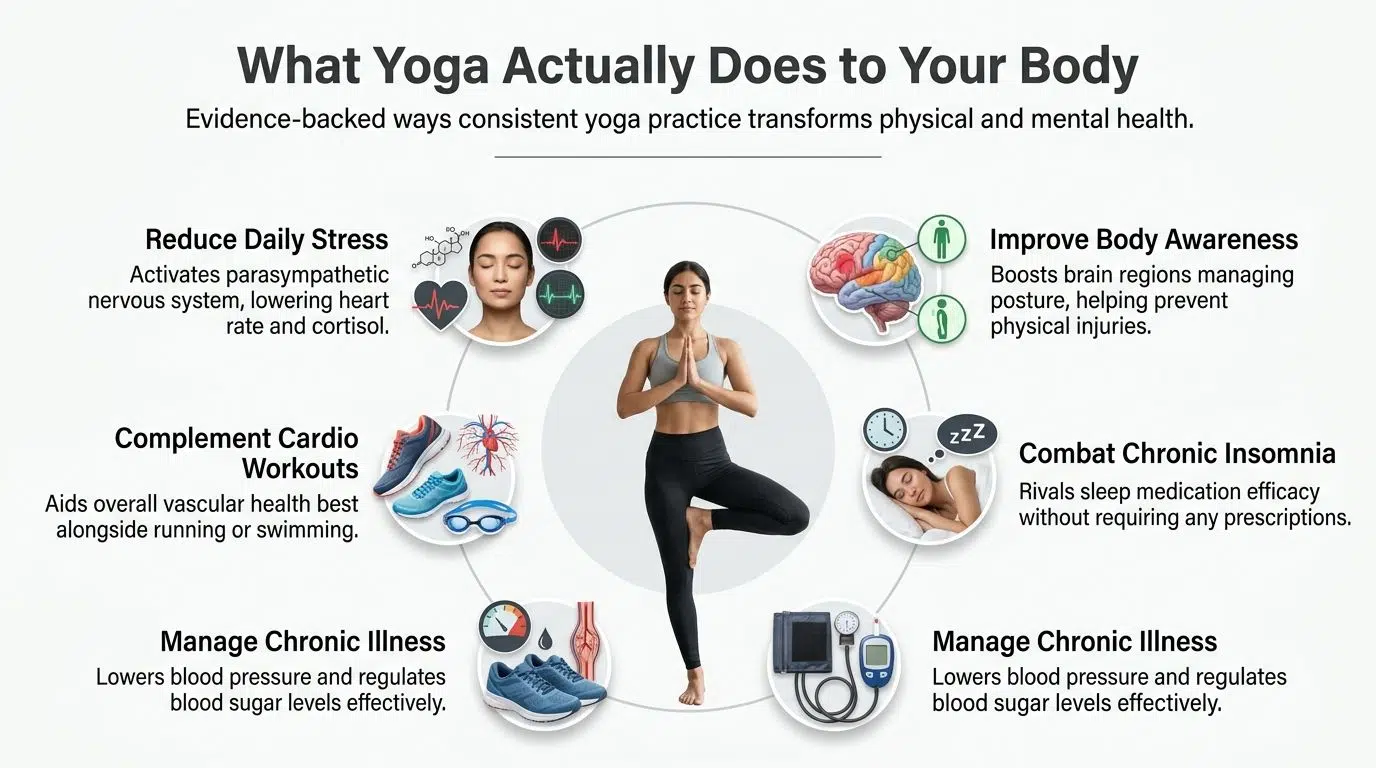
A systematic review of yoga for stress management — drawing from 1,025 publications across Scopus, PubMed, and Web of Science — found steady growth in evidence supporting yoga’s role in reducing stress. The mechanism isn’t mysterious: controlled breathing and focused movement activate the parasympathetic nervous system, which is the biological opposite of the stress response. Your heart rate drops. Cortisol falls. The body stops treating a work deadline like a predator attack.
Flexibility, Posture, and Body Awareness
A 2020 review of 34 research studies found that yoga improves functioning in the brain regions responsible for posture and interoception — the ability to recognize what’s happening inside your body. Better body awareness means you notice discomfort before it becomes injury, and you move more efficiently because you’re actually paying attention to how you move.
Sleep
A 2025 large-scale analysis found that yoga (alongside Tai Chi, walking, and jogging) rivals medication as a treatment for insomnia. For a practice you can do in your living room without a prescription, that’s worth knowing.
Chronic Disease Management
The WHO clinical trial data points consistently at conditions like Type 2 diabetes and hypertension. Studies show yoga can help regulate blood sugar, support insulin sensitivity, and lower blood pressure over time, particularly when practiced consistently alongside other lifestyle changes.
One honest caveat: a 2025 study found that yoga provides some cardiovascular benefits but isn’t as effective as structured aerobic exercise for improving vascular function. Yoga doesn’t replace running or swimming if heart health is your primary goal. It complements them. That distinction matters if you’re making decisions about your routine.
How 190+ Countries Celebrate — and How You Can Too
The scale of International Yoga Day 2026 is genuinely global. Mass outdoor sessions run in New Delhi, Rishikesh, London, New York, Nairobi, Jakarta, and hundreds of cities in between. Online platforms stream live sessions. Schools run programs. Community centers open their doors.
You don’t need to attend a formal event to participate. A 20-minute session at home counts. So does rolling out a mat in your nearest park. The social media community around #InternationalYogaDay and #YogaDay2026 is active and supportive on this day; sharing your practice, however small, connects you to something happening simultaneously across time zones.
If you’re thinking of starting and want the right gear, you don’t need much. A non-slip mat, maybe a block for support, possibly a resistance band. Happinessfit’s yoga equipment collection has beginner-friendly options if you want a straightforward starting point.
Frequently Asked Questions (FAQs) on International Yoga Day
When did International Yoga Day start?
International Yoga Day was first celebrated on 21 June 2015, following the UN General Assembly’s adoption of Resolution 69/131 in December 2014.
Why is June 21 chosen for Yoga Day?
June 21 is the summer solstice — the longest day of the year in the Northern Hemisphere. In yogic tradition, it’s also believed to be the day Adiyogi (Lord Shiva) first transmitted the knowledge of yoga to the seven sages, making it deeply significant both astronomically and spiritually.
What is the theme for International Yoga Day 2026?
The official theme is “Yoga for Healthy Ageing,” announced by India’s Ministry of Ayush. It focuses on yoga’s role in maintaining physical, mental, and emotional resilience as populations around the world age.
How many people celebrate International Yoga Day worldwide?
More than 190 countries participate, with an estimated 300 million people practicing yoga globally. The 2015 inaugural event alone drew 35,985 participants in a single New Delhi venue, setting a Guinness World Record.
Is yoga suitable for absolute beginners?
Yes — and International Yoga Day is specifically designed to welcome first-timers. Many styles, like Hatha and Yin, are gentle and accessible regardless of age or fitness level. The 2026 theme’s focus on healthy ageing reinforces that yoga is built for all bodies, not just flexible ones.
Final Words
193 countries disagreed on plenty in 2014. They agreed on this.
That’s not a small thing. International Yoga Day isn’t just a wellness calendar entry — it’s a rare moment of coordinated global intention. On 21 June each year, millions of people do something simple, together, for no commercial reason: they breathe, move, and pay attention to their bodies.
Whether you’ve practiced for years or you’re curious enough to try a 15-minute session today, that’s the invitation. The world already showed up.