

For the last five years, nations raced to open their borders to remote workers, viewing them as a panacea for tourism deficits post pandemic. However, as we settle into 2026, the narrative has flipped. Governments are now grappling with the unintended consequences, housing crises, tax leakage, and infrastructure strain, forcing a pivot from “open door” policies to “strategic talent acquisition.” This analysis explores why 2026 marks the death of the “Digital Nomad” as a buzzword and the birth of the “Global Resident” as a legal and fiscal reality. A global mobility visa guide has become essential for understanding how countries are redesigning residency, taxation, and work eligibility frameworks for this new class of workers.
Key Takeaways
- The “Wild West” is Over: 2026 sees the end of grey-zone remote work. New data-sharing agreements between nations mean digital nomads can no longer easily evade tax residency.
- The Eastward Pivot: As Western Europe (Spain, Portugal) tightens tax loopholes and battles gentrification, East Asia (Japan, South Korea) has emerged as the new frontier for high-value mobile talent.
- Corporate Crackdown: “Hush trips” are being eradicated by AI-driven compliance tools. Companies now require “Employers of Record” (EORs) to sanction international work, shifting liability from the employee to the entity.
- Housing as a Policy Driver: Visa approvals in hotspots like Lisbon and Mexico City are increasingly tied to income thresholds that protect local housing markets, pushing nomads to “secondary cities.”
The Fiscal Reality: From “Ghost Residents” to Taxpayers

The most significant shift in 2026 is the closing of the tax gap. Between 2020 and 2024, “digital nomads” often lived in a grey zone—neither tax residents of their home country (having left) nor their host country (staying under 183 days).
In 2026, the OECD’s widespread adoption of the Crypto-Asset Reporting Framework (CARF) and stricter Common Reporting Standards (CRS) has made financial invisibility impossible. Countries like Spain and Portugal have retooled their visas not just to attract bodies, but to attract taxable revenue. The “Nomad Visa” is now effectively a “Pre-Residency Tax Track.”
Comparative Analysis: The Cost of Compliance
The following table highlights the financial reality for a remote worker in 2026 compared to the unregulated landscape of 2021.
The “Compliance Premium” – Annual Costs for Global Mobility (2021 vs. 2026)
| Cost Category | The “Wild West” Era (2021) | The “Compliance” Era (2026) | Why the Change? |
| Visa Fees | $200 – $800 (One-time) | $2,500+ (Legal & Processing) | Mandatory legal vetting and criminal background checks have become standard. |
| Taxation | Often $0 (evaded/ignored) | 15% – 24% (Host Country Rates) | Automatic Exchange of Information (AEOI) now flags income to host nations. |
| Insurance | Basic Travel Insurance ($50/mo) | $300+/mo (Local Social Security) | Visas now require full enrollment in national healthcare schemes (e.g., Spain’s Seguridad Social). |
| Employer Cost | $0 | $500/mo (EOR/Admin fees) | Companies must use “Employers of Record” to avoid permanent establishment risk. |
| Total “Overhead” | ~$1,000 / year | ~$20,000 – $30,000 / year | Mobility is now a luxury good. |
The Geopolitical Pivot: Asia Rising, Europe Stalling
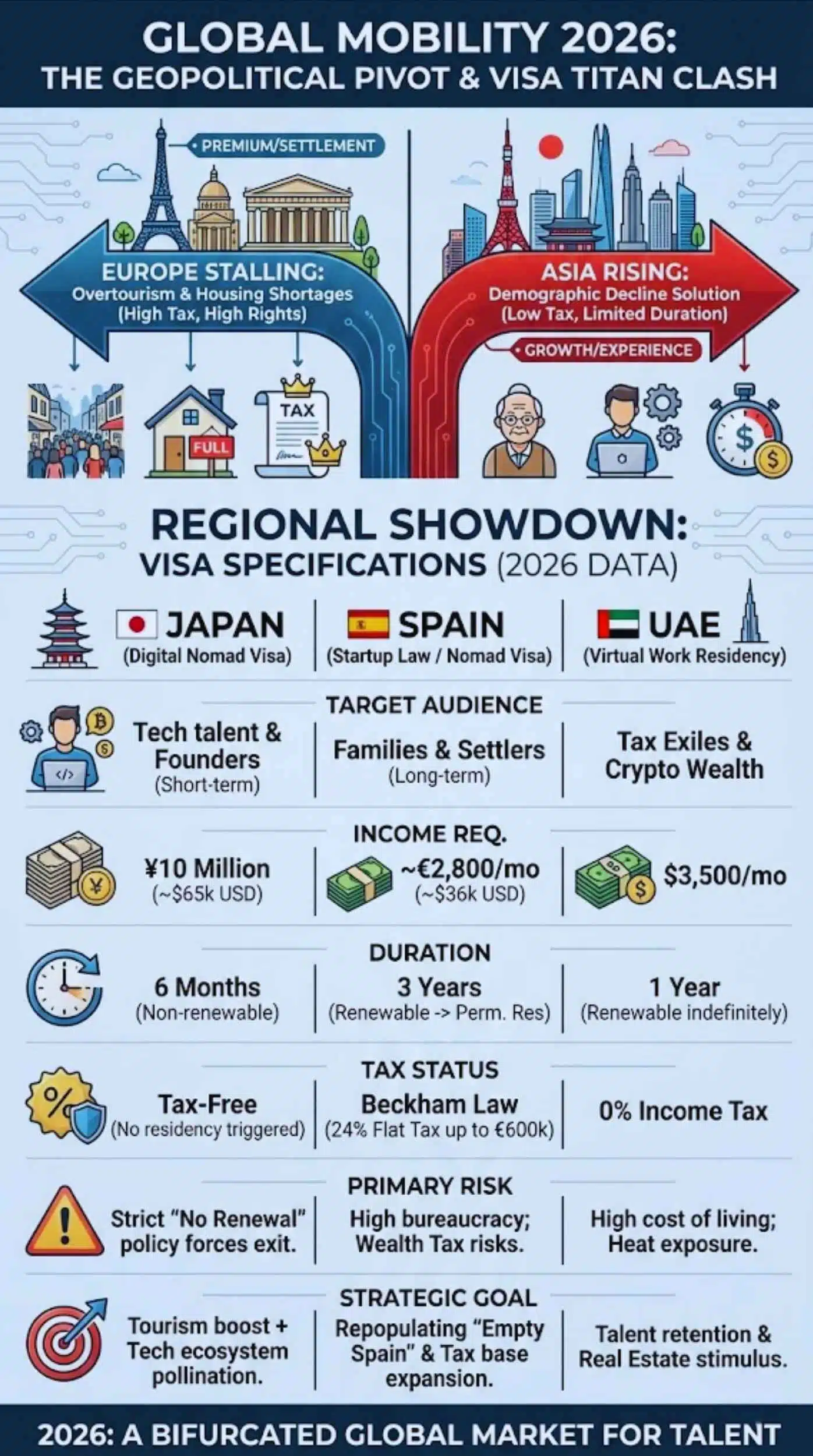
While Europe battles overtourism and housing shortages, East Asia has aggressively entered the market to solve a different problem: demographic decline. Japan and South Korea, facing aging populations, have launched visa products in 2025-2026 designed to import youth and innovation without the long-term political commitment of permanent immigration.
This has created a “bifurcated market.” Europe is the “Premium/Settlement” market (high tax, high rights), while Asia is the “Growth/Experience” market (low tax, limited duration).
Regional Showdown: Visa Specifications (2026 Data)
The table below contrasts the top three destinations defining the 2026 landscape. Note the stark difference in income requirements and path to residency.
2026 Visa Titan Clash – Japan vs. Spain vs. UAE
| Feature | Japan (Digital Nomad Visa) | Spain (Startup Law / Nomad Visa) | UAE (Virtual Work Residency) |
| Target Audience | Tech talent & Founders (Short-term) | Families & Settlers (Long-term) | Tax Exiles & Crypto Wealth |
| Income Req. | ¥10 Million (~$65k USD) | ~€2,800/mo (~$36k USD) | $3,500/mo |
| Duration | 6 Months (Non-renewable) | 3 Years (Renewable -> Perm. Res) | 1 Year (Renewable indefinitely) |
| Tax Status | Tax-Free (No residency triggered) | Beckham Law (24% Flat Tax up to €600k) | 0% Income Tax |
| Primary Risk | strict “No Renewal” policy forces exit. | High bureaucracy; Wealth Tax risks. | High cost of living; Heat exposure. |
| Strategic Goal | Tourism boost + Tech ecosystem pollination. | Repopulating “Empty Spain” & Tax base expansion. | Talent retention & Real Estate stimulus. |
The Corporate Shield: The Rise of the “Employer of Record”
In 2022, companies often turned a blind eye to employees working from “holiday homes.” In 2026, corporate liability laws have caught up. If an employee works from a foreign country for more than a few months, they risk creating a “Permanent Establishment” (PE) for their employer, triggering corporate tax liabilities in that country.
This risk has birthed a booming industry: the Employer of Record (EOR). Companies like Deel, Remote, and Rippling have moved from niche startups to essential infrastructure for the Fortune 500. In 2026, you cannot just “go”; you must be “deployed.”
Expert Insight: “The ‘Hush Trip’ is dead. AI-driven compliance tools now track IP logins and tax data. If you are logging in from Bali for 90 days, HR knows, and legal is shutting it down unless you are on an EOR contract.” — Director of Global Mobility, Tech Multinational (San Francisco).
The Social License: Housing, Gentrification, and “Zoning Visas”

The most visceral friction point in 2026 is the housing market. In cities like Lisbon, Mexico City, and Málaga, the influx of high-earning remote workers earning dollars or euros created a two-tiered rental market, effectively pricing out locals.
In response, 2026 has seen the rise of “Zoning Visas” or “Decentralized Mobility.” Governments are incentivizing nomads to settle in rural or depopulated regions (like Spain’s España Vacia or Japan’s rural prefectures) rather than overcrowded capitals.
Winners & Losers of 2026 Policy Shifts
| Winners (Attracting Talent) | Why? | Losers (Repelling Talent) | Why? |
| Japan | Weak Yen (affordability) + Safety + “Cool Factor.” High income bar keeps quality high. | Portugal (Lisbon) | End of generous NHR tax breaks; housing protests; high saturation. |
| Rural Spain | Fast-track visa processing for those settling in non-urban zones. | Mexico (CDMX) | Stricter enforcement on tourist visa overstays; rising hostility in gentrified zones. |
| Estonia | “Zero-Friction” bureaucracy. Digital ID allows 24-hour business setup. | United Kingdom | High cost of living; lack of specific “Nomad” product; Brexit friction continues. |
| South Korea | “Workcation” visa integrates K-Culture fans with tech infrastructure. | Thailand | Confusing new tax rules on foreign income (effective 2024/25) deterred many. |
Future Outlook: What Happens in 2027?
As we look beyond 2026, three major trends will define the next phase of global mobility. The “Post-Digital Nomad” world will be less about freedom and more about strategic citizenship.
- Visa-as-a-Service (VaaS): Governments will begin outsourcing their entire nomad visa processing to private tech giants. We expect to see “Apply with LinkedIn” buttons for visas, where AI verifies income and criminal records instantly, bypassing slow consulates.
- The “Climate Nomad”: As climate change impacts livability in the Global South and parts of the US sunbelt, we will see the rise of “Climate Resilience Visas.” Nations with temperate climates and water security (Scandinavia, Canada, New Zealand) will offer premium permits specifically to high-value migrants fleeing heat zones.
- Crypto-Citizenship Integration: With the maturation of crypto regulations (MiCA in Europe), we predict a major economy will accept stablecoin proof-of-funds for visa solvency by 2027, integrating blockchain identity (Self-Sovereign Identity) to replace physical passport stamps.
Final Thoughts
The “Post-Digital Nomad Era” of 2026 is less about the freedom to roam and more about the privilege to settle. The romantic vagabond has been replaced by the “compliant global citizen.” For the individual, this means higher costs and more paperwork, but also greater legal certainty and social integration. For nations, it is a high-stakes game of attracting the world’s best minds while protecting their own citizens from the economic shockwaves of a borderless workforce.