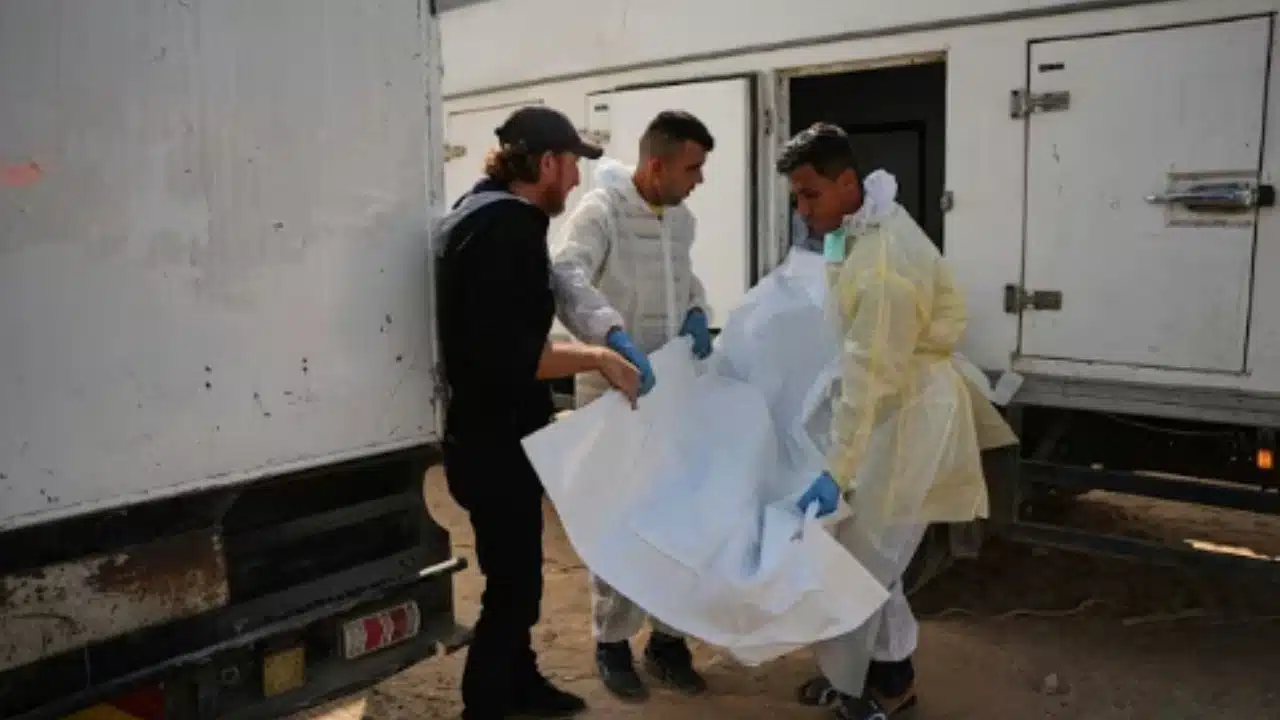
The humanitarian crisis in Gaza deepened over the weekend as officials confirmed that the death toll from the ongoing conflict has risen to more than 69,000, despite a ceasefire that was meant to halt hostilities. Gaza’s Ministry of Health said the total number of fatalities since the outbreak of the war on October 7, 2023, now stands at 69,169, after additional bodies were identified and more victims were recovered from the ruins of destroyed buildings. The figure, already staggering, continues to climb as rescue workers uncover remains from beneath collapsed homes, hospitals, and infrastructure flattened by months of bombardment.
The latest incidents came on Saturday when Israeli forces killed at least three Palestinians in separate attacks across the territory. Medical sources confirmed that a Palestinian man was shot and killed in the Bureij refugee camp in central Gaza, an area that has faced repeated air raids and artillery fire since the beginning of the war. Two others were killed after allegedly crossing the “yellow line,” a military-designated boundary in the north and south of Gaza. These deaths have reignited questions about the integrity of the U.S.-brokered ceasefire that came into effect on October 10, intended to pause active military operations and enable humanitarian relief.
Health authorities in Gaza reported that since the start of the ceasefire, more than 240 Palestinians have been killed, revealing that violence has not truly subsided. Each day brings new civilian casualties—men, women, and children caught between air raids, ground incursions, and unexploded ordnance left behind. One particularly tragic case involved a Palestinian child who died when an explosive device left by Israeli troops detonated in Khan Younis, a southern city still reeling from months of intense combat. Doctors at Nasser Hospital said the child succumbed to injuries caused by fragments from the blast.
Beyond the Gaza Strip, violence has also persisted in the occupied West Bank, where the Israeli military continues to conduct raids. Health officials said that Abdel Rahman Darawsha, a young Palestinian man, was fatally shot during an Israeli operation in the Al Far’a refugee camp, near the city of Tubas. He was taken to a nearby hospital but later died of his wounds. These parallel attacks highlight the broader regional instability, where even areas not directly under bombardment face increasing militarization and deadly crackdowns.
Amid the ongoing tension, Hamas announced on Saturday that it had recovered the body of Israeli officer Hadar Goldin, who was captured and reported killed during Israel’s 2014 offensive in Gaza. The remains were retrieved from a tunnel near Rafah, a city under Israeli control for more than a year. Goldin’s case has long been a point of contention in Israeli society, symbolizing the unresolved trauma of previous wars. His remains, according to Hamas, were found alongside the bodies of six Palestinian fighters who died in the same location.
Witnesses in central Gaza reported heavy military presence around the Rafah area as Hamas’s al-Qassam Brigades claimed responsibility for the recovery. Observers noted that the tunnel where the body was discovered had been inspected multiple times by Israeli forces, raising questions about how it went unnoticed. Hamas’s statement added a layer of controversy, suggesting that some of its members who were guarding Goldin’s body may have been killed in Israeli raids, sparking debate about whether their deaths were collateral damage or part of deliberate targeting operations.
The development has triggered emotional responses across both societies. For many Palestinians, the recovery of the bodies symbolizes resistance and sacrifice, while for Israelis, it reopens wounds of earlier conflicts and reinforces demands for accountability and repatriation of soldiers’ remains. The issue of captives and missing persons remains one of the most sensitive topics in ceasefire negotiations, with five captives still listed as missing under the terms of the truce. The situation underscores how, even amid ceasefire talks, humanitarian and emotional dimensions of war continue to shape both military and political calculations.
As the violence and uncertainty persist, international organizations are increasingly sounding alarms about Gaza’s collapsing health system. The World Health Organization (WHO) renewed calls for reopening the Rafah crossing between Gaza and Egypt, which has been closed intermittently due to security and political concerns. The crossing is crucial for medical evacuations and the entry of essential supplies. According to the WHO, about 4,000 Palestinian patients have been evacuated for treatment in Egypt and other countries, while an estimated 16,500 people remain on waiting lists for urgent medical attention. The closure of Rafah has left many of them trapped without access to life-saving care.
WHO officials described the Rafah crossing as “a lifeline for the sick and wounded,” emphasizing that its continued closure threatens thousands of lives. Hospitals across Gaza remain overwhelmed, operating with limited electricity, dwindling supplies, and minimal staff. Many medical workers have been killed or displaced, and surviving staff members are forced to treat patients under dire conditions. The destruction of healthcare facilities has left entire regions without functioning hospitals, forcing civilians to rely on makeshift clinics and humanitarian field units.
Meanwhile, aid agencies warn of worsening living conditions. Water shortages, sanitation failures, and disease outbreaks are spreading rapidly across overcrowded shelters. Children are especially vulnerable, suffering from malnutrition, dehydration, and psychological trauma after months of bombardment and displacement. The humanitarian crisis is further compounded by restrictions on aid entry, which continue despite international pressure.
West Bank Unrest and Settler Violence Escalate
While Gaza continues to face relentless tragedy, the occupied West Bank has seen a parallel escalation in violence driven by Israeli military raids and settler attacks. These incidents have intensified in recent weeks, particularly during the olive harvest season—an event deeply tied to Palestinian culture, economy, and identity.
On Saturday, a group of Israeli settlers, reportedly masked and armed with clubs and stones, launched an assault on Palestinian villagers and activists harvesting olives in the town of Beita, south of Nablus. Eyewitnesses said the settlers descended from nearby hills and began throwing large rocks at farmers, volunteers, and journalists documenting the harvest. Among those injured were at least five journalists, including a photojournalist whose cheekbone and jaw were fractured. A 70-year-old activist was also severely beaten and required urgent medical care.
Israeli activist Jonathan Pollak, who was present during the attack, described the assault as sudden and coordinated. He said that dozens of masked settlers attacked the group without provocation, shouting threats and hurling stones while soldiers nearby did not intervene. Pollak added that the attack lasted several minutes before the victims managed to flee, leaving behind damaged equipment and uprooted olive trees.
The Palestinian Journalists Syndicate later issued a statement condemning the assault as a “war crime aimed at silencing the press.” Media advocacy groups have echoed the call for accountability, noting that journalists have become frequent targets of violence in both Gaza and the West Bank. The Reuters news agency confirmed that two of its staff members—a journalist and a security adviser—were among those injured in the incident.
Reports from local human rights organizations indicate that settler attacks have become a daily occurrence across multiple regions. The United Nations Office for the Coordination of Humanitarian Affairs (OCHA) has documented more than 126 attacks since September, affecting over 70 towns and villages. More than 4,000 olive trees and saplings have been vandalized or uprooted—acts widely seen as attempts to destroy a key symbol of Palestinian livelihood and resilience.
In addition to settler violence, Israeli military operations continue to intensify in the West Bank. On Saturday, soldiers raided the village of Raba, southeast of Jenin, and clashed with residents. Troops reportedly arrested a 13-year-old boy in the nearby town of Yabad after beating him in the street. Another young man was detained in al-Mazraa ash-Sharqiya, near Ramallah, while in ar-Ram, north of East Jerusalem, a Palestinian man was shot in the leg near Israel’s separation wall. Dozens of others suffered from tear gas inhalation after Israeli forces fired gas canisters at worshippers during evening prayers at the Izz al-Din al-Qassam Mosque in Salem, east of Nablus.
These recurring attacks have fueled widespread anger and fear among Palestinians, who accuse Israeli authorities of condoning settler violence and using military raids to expand illegal settlements. The Israeli government, led by right-wing parties, faces international criticism for its failure to curb such incidents. Many observers see the violence as part of a broader campaign to pressure Palestinians to abandon their lands in favor of expanding settlements.
Despite repeated condemnations from the United Nations, European Union, and human rights organizations, settler attacks have not decreased. The situation is pushing many rural Palestinian families into deeper poverty, forcing them to abandon traditional farming as their lands become too dangerous to work.
The situation across both Gaza and the West Bank reveals a grim reality: the ceasefire has done little to ease suffering or build stability. While large-scale bombing has slowed, civilians continue to die, livelihoods continue to erode, and the humanitarian catastrophe deepens daily.
Mounting Humanitarian Pressure and a Fragile Future
The Gaza Strip today stands on the brink of complete collapse. Entire neighborhoods lie in ruins, and displaced families live in makeshift shelters, schools, and tent camps with limited access to food and clean water. International aid agencies warn that without immediate, unrestricted access to humanitarian corridors, tens of thousands more could die—not only from violence but from starvation and preventable diseases.
Local health workers continue to dig through debris in search of missing persons, many of whom are presumed buried beneath collapsed structures. Recovery efforts are slow and dangerous due to the presence of unexploded ordnance and a shortage of heavy machinery. Volunteers, often untrained civilians, work with minimal protective gear, exposing themselves to immense risks.
Psychological trauma has become another silent casualty of the war. Thousands of children in Gaza and the West Bank are showing symptoms of severe stress, anxiety, and post-traumatic disorder. Aid organizations report that entire generations are growing up in environments marked by destruction and loss, with limited access to education or mental health support.
The World Health Organization, UNICEF, and other global agencies have urged both Israel and Hamas to fully implement the ceasefire and allow humanitarian access without obstruction. Yet, political deadlock, mistrust, and security concerns continue to paralyze relief efforts.
In both territories, the cycle of violence, displacement, and destruction shows no sign of ending. With more than 69,000 dead, tens of thousands wounded, and countless others missing, Gaza’s population faces an uncertain and perilous future. Even as talks of peace persist, the reality on the ground remains one of devastation and endurance—where each ceasefire is fragile, every day is a struggle for survival, and the scars of war deepen far beyond the battlefield.
The Information is Collected from The Times of India and Politico.